
On this page
Start here
Quick answer
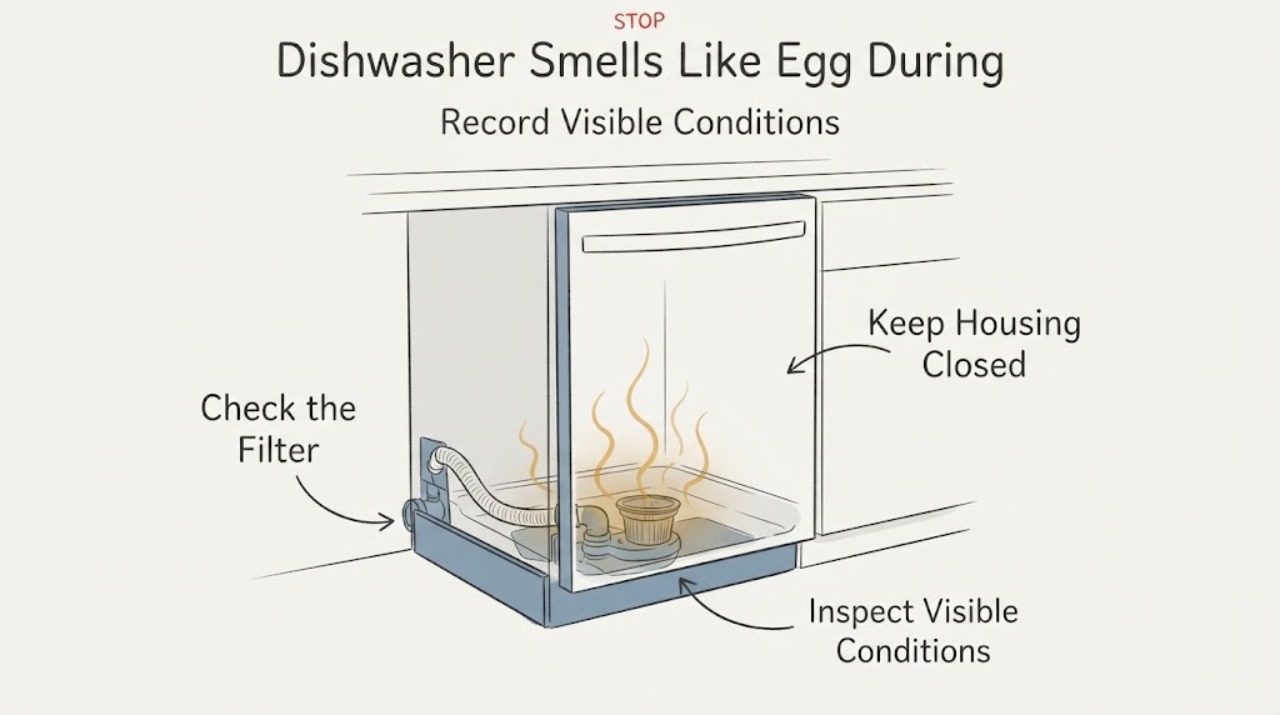
Do not assume an egg or sulfur smell from a Sharp QW-NS14149EX means a failed pump, heater, or other part. The opened Sharp documentation uses QW-NS14I49EX-EN/EU model lettering, so confirm the rating-label suffix before applying model-specific instructions. After the dishwasher has stopped and cooled, record whether the smell is strongest in the tub, below the sink, at another tap, or in the room; check for standing water and visible food on the accessible filter and tub; and inspect only the visible drain-hose routing without disconnecting plumbing. Sharp supports cleaning accessible filters and spray arms, but does not support opening a running door or adding improvised chemicals. A burnt or chemical odour, heat, smoke, sparking, a hot plug, repeated electrical trips, or a room-wide gas-like smell is a stop condition. If the smell follows household water or appears away from the sink, treat it as a plumbing, water-supply, sewage, or possible gas issue rather than a dishwasher-part diagnosis.
Before you begin
Safety first
- Do not open the door during a running cycle, deliberately sniff in a sealed or poorly ventilated space, mix cleaners, add chemical dissolving agents, disconnect the drain hose, remove the drain pump, open the cabinet, bypass safety devices, or perform live electrical tests. Do not order a pump, heater, valve, hose, or control part solely from an egg-like smell.
Work through in order
Diagnostic checks
Use only checks that match the exact appliance or system and its official guide.
-
Check 1
If the dishwasher is operating, use its normal control to stop it only when safe and do not open the door against the running cycle. After it stops and cools, confirm the complete rating-label model and record when the smell begins, whether it is food-like, stagnant/sewer-like, burnt, chemical, or gas-like, and where it is strongest.
Expected result: The odour is confined to the tub, is strongest below the sink or at a drain, affects another tap or the room, or occurs with heat, smoke, sparking, or electrical interruption.
Next step: Continue only with cool, accessible checks when no hazard is present. Stop for gas-like room odour, fumes, smoke, sparking, heat, or a hot/damaged plug and obtain appropriate local emergency or qualified help.
Stop if: Do not open the door during operation, deliberately sniff in a closed space, or continue when the smell causes irritation, dizziness, headache, breathing difficulty, or other symptoms.
Why this matters
Why: Location and hazard signs change the first branch. A tub-only pattern can be inspected accessibly; a drain, water, gas, or electrical pattern must not be reduced to a dishwasher part.
-
Check 2
With the dishwasher unplugged from a dry, safe position and the water cool, inspect only the visible tub floor, filter assembly, door seal, and spray-arm openings. Remove visible food residue from accessible surfaces and clean the filters and spray arms with water as the Sharp manual directs; refit the filters correctly. Do not reach into a pump or use a tool to probe a hidden passage.
Expected result: Food residue or debris is visible on the filter, spray arms, or tub, or those areas are clean while the smell and standing water remain.
Next step: Complete one accessible clean and allow the machine to dry. If water remains, the smell persists, or debris is behind the filter area, stop repeated runs and arrange qualified service rather than selecting a part by smell.
Stop if: Stop for broken glass, sharp objects, hot water, a damaged seal, or wetness near electrical parts. Do not mix cleaners or add chemical dissolving agents.
Why this matters
Why: Visible residue supports one documented cleaning, but does not prove a pump or heater fault. Persistent odour or water above the filter makes incomplete draining or a hidden source more likely.
-
Check 3
Check the visible drain-hose route from outside the cabinet without disconnecting, pulling, or opening plumbing. Look for a kink, crushing, an unusual low loop, or a connection below the sink where the smell is strongest. Note whether the sink or drain smells independently, backs up, or whether water remains above the dishwasher filter after a completed cycle.
Expected result: The smell is strongest at the sink/drain, the sink backs up or smells independently, the hose is visibly kinked or poorly routed, or standing water remains.
Next step: Keep the dishwasher out of repeated testing and have the drain connection and appliance discharge path checked by qualified appliance or plumbing service. Do not disconnect the hose, pour chemicals into it, or remove the pump.
Stop if: Stop for a leak, water near electrical parts, a swollen or damaged hose, sewage exposure, or any need to work inside the cabinet.
Why this matters
Why: This makes incomplete discharge, backflow, or household drain routing more plausible than a confirmed dishwasher pump or heater failure. One successful drain does not rule out a slow or intermittent restriction.
-
Check 4
Without tasting water or repeatedly running the dishwasher, compare the odour scope at normal household fixtures in a ventilated area. Note whether the same rotten, stagnant, or sulfur-like smell is present at more than one tap or remains when the water is away from the sink. Do not close yourself into a room to smell-test the appliance or drain.
Expected result: The smell follows water at several fixtures or remains away from the sink, or it is isolated to the dishwasher tub and disappears from other household water and room air.
Next step: For a household-water pattern, contact the water supplier or a qualified plumber. For a sink/drain pattern, arrange plumbing attention. For an isolated tub pattern, finish only the Sharp-supported cleaning path and escalate if it returns.
Stop if: Do not drink water that is unpalatable, use hot tap water for drinking, or improvise a chemical treatment for the dishwasher or plumbing.
Why this matters
Why: DWI guidance says an odour at multiple fixtures or away from the sink can point to household plumbing or water supply, while one that disappears away from the sink points more toward the sink or drain. An isolated tub pattern keeps accessible residue or discharge in scope but does not identify a part.
-
Check 5
Treat a burnt, acrid, solvent-like, or chemical smell, a hot cabinet or plug, smoke, sparking, repeated breaker or RCD trips, or a smell that seems to be gas in the room as a stop condition. If gas is possible, leave the area, avoid switches and flames, and contact the local gas emergency service from a safe location.
Expected result: The smell is ordinary food or stagnant residue with no heat or electrical sign, or it is accompanied by a hazardous sign or remains in the room independently of the dishwasher.
Next step: For any hazard, stop using the dishwasher and keep people away until the appropriate qualified service, utility, or emergency responder has assessed it. Do not restore power to see whether the smell returns.
Stop if: Do not operate electrical switches in a suspected gas leak, use flames or smoke, open the appliance cabinet, or perform live electrical measurements.
Why this matters
Why: A normal residue pattern can remain in the cleaning/drain branch. A room-wide rotten-egg or gas-like odour is not safely attributable to this dishwasher; HSE and GOV.UK guidance treat suspected gas as an immediate safety event.
-
Check 6
If the smell clears after accessible filter/tub cleaning and a complete drain, document the detergent type, load containing egg or other protein residue, cycle, and whether water remained. If it returns on the next normal use, capture the timing and whether dishes, drain water, the sink, or the room carry the smell instead of escalating to stronger cleaners or a guessed replacement.
Expected result: The odour clears and the dishwasher drains normally, or it returns despite clean accessible surfaces, normal-looking hose routing, and no household-water or electrical hazard.
Next step: Monitor one normal cycle only when no safety sign is present. For recurrence, stop repeated experiments and give qualified service the exact model suffix, cycle timing, water level, filter result, hose observations, and whether the smell occurs elsewhere.
Stop if: Do not keep running hot cycles, alternate or combine cleaners, or replace a pump, heater, valve, or hose solely because the odour resembles eggs.
Why this matters
Why: A one-time clear result is more consistent with accessible residue or a temporary drain/storage condition. Recurrence with a normal visible path means the source remains unverified and may require internal appliance or installation diagnosis.
Use your observations
Decision map
Find the observation that best matches what you see, then follow the next safe action.
-
PATH 01Next step
What you see
Visible food residue is present on the accessible filter, spray arms, tub, or seal; there is no standing water, heat, smoke, or electrical damage; and the smell clears after the Sharp-supported cleaning and a complete drain.
Do this next
Allow the interior to dry, refit the filter correctly, and monitor one normal use. Stop if the smell returns rather than escalating chemicals or ordering a part.
Why this path and its safety boundary
Why it matters: The evidence supports an accessible residue or temporary condition, not an automatically failed part.
-
PATH 02Next step
What you see
Standing water remains above the filter, the sink backs up, the sink or drain smells independently, or the visible drain route is kinked or abnormal.
Do this next
Stop repeated cycles and arrange qualified appliance or plumbing service. Keep power or water isolated when a leak or electrical exposure is present; do not disconnect plumbing or remove a pump.
Why this path and its safety boundary
Why it matters: The pattern makes incomplete discharge, backflow, or household drain routing more likely than a confirmed dishwasher pump or heater failure.
-
PATH 03Next step
What you see
The same rotten, stagnant, or sulfur-like odour affects more than one tap or remains away from the sink, or it is present in the room independently of the dishwasher.
Do this next
Do not attribute the smell to a dishwasher part. Contact the water supplier or qualified plumber for a water/plumbing pattern; if gas is possible, leave the area and contact the local gas emergency service without operating switches or flames.
Why this path and its safety boundary
Why it matters: The evidence points outside the dishwasher to household plumbing, water supply, sewage/drain environment, or a possible gas or hazardous-vapour event.
-
PATH 04Next step
What you see
The smell is burnt, chemical, or acrid, or the dishwasher, cabinet, plug, or outlet becomes hot, smokes, sparks, trips protection, leaks, or shows damaged wiring.
Do this next
Stop use, keep clear, isolate power or water only if it can be done safely, and obtain qualified appliance or electrical service. Do not restore power for another test.
Why this path and its safety boundary
Why it matters: This is an immediate electrical, fire, chemical, or water-safety boundary rather than an ordinary dishwasher-odour diagnosis.
-
PATH 05Next step
What you see
The accessible filter, tub, seal, and visible hose route look normal, the odour recurs during washing, and no household-water or immediate electrical/gas hazard explains it.
Do this next
Stop repeated experiments and request qualified Sharp or appliance service using the exact rating-label suffix, cycle stage, water level, filter result, hose observations, and photos. Ask for diagnosis before naming a pump, heater, valve, hose, or control component.
Why this path and its safety boundary
Why it matters: The source remains unverified; internal circulation, heating, discharge, installation, or material conditions cannot be separated safely from outside, and the odour does not identify a replaceable part.
Helpful context
Understand the symptom
A smell that appears during washing can be released when hot water moves residue, but timing alone does not identify a failed part. Do not open the door against a running cycle. Once the machine has stopped and cooled, locate the smell without deliberately sniffing a sealed or poorly ventilated space: compare the tub, the sink/drain area, other taps, and the surrounding room. Standing water, a dirty filter, drain backflow, a household-water odour, and a burnt electrical smell require different next steps.
The opened Sharp English manual is labeled QW-NS14I49EX-EN and the Sharp product sheet uses QW-NS14I49EX-EU; the task identity is the unseparated QW-NS14149EX form. Confirm the full market suffix on the rating label. Do not mix cleaners, pour chemicals into the tub or drain, disconnect the drain hose, remove a pump, or keep running cycles to make the smell easier to identify.
When checks do not resolve it
Need a professional?
Use Sharp-authorized or qualified appliance service for a recurring tub-only odour with no accessible cause, persistent standing water, leakage, abnormal heating, or any condition needing internal access. Use qualified plumbing or water-supply help when the smell follows the sink, other taps, or household water. Use local gas emergency guidance immediately if gas or hazardous vapour is possible.
Safety scope: Do not open the door during a running cycle, deliberately sniff in a sealed or poorly ventilated space, mix cleaners, add chemical dissolving agents, disconnect the drain hose, remove the drain pump, open the cabinet, bypass safety devices, or perform live electrical tests. Do not order a pump, heater, valve, hose, or control part solely from an egg-like smell.
Have this ready
- Provide the full rating-label model and market suffix, cycle and time when the smell starts, exact odour description, water level after the cycle, filter and visible tub condition, visible hose routing, sink/other-tap comparison, detergent/load details, and photos of any leak or damage.
Common questions
FAQ
Does a rotten-egg smell during a Sharp QW-NS14149EX cycle mean the pump is bad?
No. It may arise from accessible food residue, standing water, drain backflow, household water or plumbing, or a hazard outside the dishwasher. Check the location and water state safely, then use the Sharp filter and spray-arm guidance. Consider a pump or other part only after a qualified diagnosis for the complete model and suffix.
Can I open the door while the egg smell is happening?
Do not open the door against a running cycle just to investigate; Sharp warns that hot water may spill and that the door safety system stops operation when opened. Stop the cycle using normal controls when safe, wait for cooling, and then make only accessible checks.
How can I tell whether the smell is from the sink or dishwasher drain?
After the appliance is stopped and cool, note whether the smell is strongest below the sink, whether the sink smells or backs up independently, and whether water remains above the dishwasher filter. DWI guidance says a stagnant or rotten smell that disappears away from the sink points more toward the sink or drains, while an odour that remains away from the sink can indicate household plumbing or water-supply involvement. Do not disconnect the hose or pour chemicals into it.
Could hot water itself be causing a sulfur smell?
The odour may be associated with household water or plumbing rather than a dishwasher component, but dishwasher timing does not prove that. Compare the odour at other fixtures without tasting water or repeatedly running the dishwasher. If other taps are affected or the smell remains away from the sink, contact the water supplier or a qualified plumber.
When is an egg smell an emergency?
Treat a room-wide gas-like smell, smoke, sparking, a hot plug or cabinet, repeated electrical trips, chemical fumes, leaks, or breathing difficulty, dizziness, or headache as a stop condition. Leave the area if gas or hazardous vapour is possible, avoid flames and electrical switches, and contact the appropriate local emergency or utility service from a safe location. Do not keep sniffing or restore power to test the dishwasher.
Read the exact guide
Official sources
- Methane: general informationUK Health Security Agency / GOV.UK · Opened GOV.UK guidance used only when a rotten-egg smell may be gas in the room; it is not used to assert that this electric dishwasher produces gas or that the assigned odour is a gas leak.
- SLIM vestavná myčka Sharp QW NS14I49EXSharp Home CZ · Opened Sharp Home CZ product page identifying the QW NS14I49EX slim built-in dishwasher and its market distribution. Used to keep suffix and market boundaries explicit, not to infer a component fault.
- Gas safety - Home ownersHealth and Safety Executive · Opened HSE page used only for suspected-gas escalation and qualified service, not to attribute any dishwasher odour to gas.
- QW-NS14I49EX-EN Dishwasher User ManualSharp Home Appliances · Opened official English manual labeled QW-NS14I49EX-EN. It is used for the assigned unseparated QW-NS14149EX identity only with an explicit suffix/market confirmation boundary, not generalized to other Sharp models.
- Taste and Odour in Drinking WaterDrinking Water Inspectorate · Opened UK consumer guidance used only for cross-system observation of sink/drain, household-plumbing, and water-supply odour; it is not a Sharp appliance diagnosis or universal market-specific water conclusion.
Community feedback
Share a repair observation
Share a plain-text repair observation. Accepted observations are published automatically; this page may take a moment to update.