
On this page
Start here
Quick answer
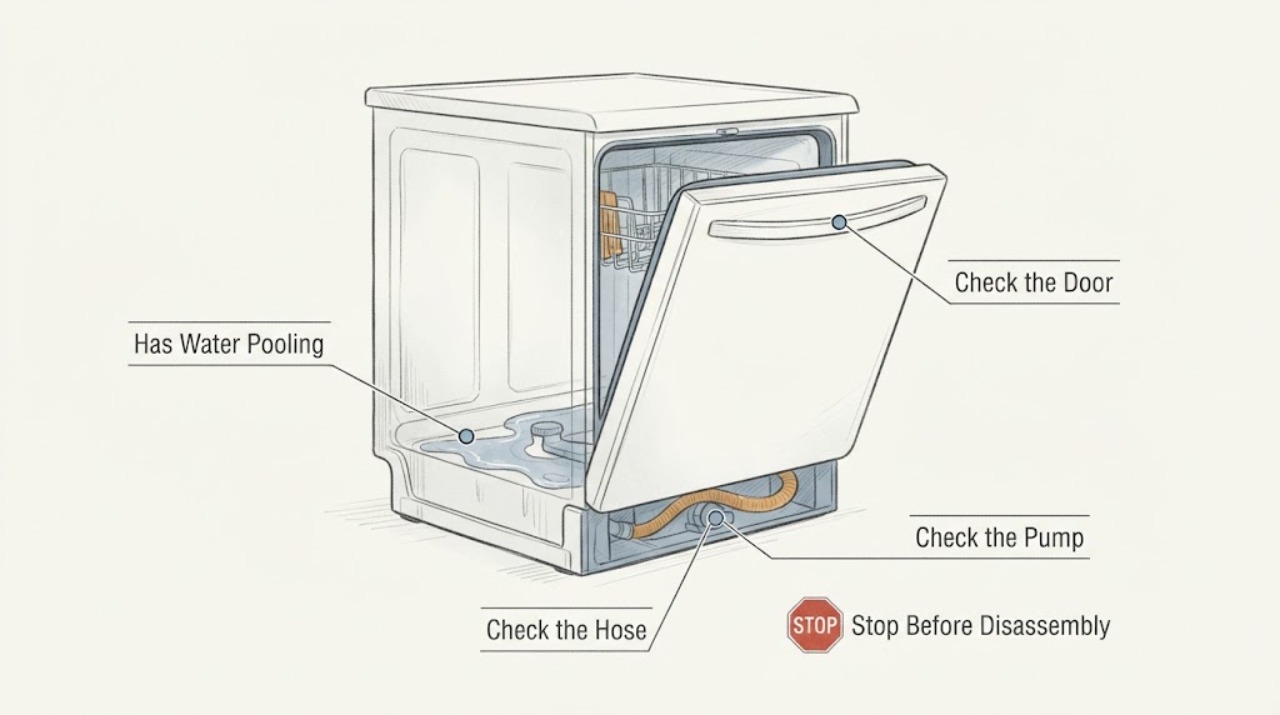
The supplied Sharp dishwashers thread is primarily a buying question, but a commenter in that exact thread does report several inches of water pooling in a Sharp dishwasher. For the SDW6888JS, Sharp's operation manual says water can remain when a previous cycle was interrupted; for a completed cycle that does not drain, it directs attention to a clogged drain, the sink air gap or disposer, and a kinked or incorrectly connected drain hose. If the appliance is overflowing or water is in the base pan, turn off the main water supply and do not restart it until the water is removed and the cause is checked. These checks do not prove a failed pump; recurring pooling after the external drain path is clear needs Sharp or qualified service.
Work through in order
Diagnostic checks
Use only checks that match the exact appliance or system and its official guide.
-
Check 1
Confirm whether the cycle actually finished and locate the water. Look in the tub, under the door, and around the toe-kick area without removing panels; note whether the water is a shallow amount in the tub, several inches, or an active overflow/leak.
Expected result: The cycle was interrupted or canceled, water is only in the tub, or water is in the base area or actively overflowing.
Next step: If there is an overflow, turn off the main water supply as the manual directs and do not restart the dishwasher. If water is near electrical connections or the source is unclear, leave power off and arrange service.
Why this matters
Why: Sharp lists an interrupted previous cycle as a reason water may remain. Water in the base pan or an overflow is a separate safety condition and is not evidence by itself that the pump failed.
-
Check 2
With the dishwasher stopped, inspect the sink-side air gap if the installation has one and confirm that the disposer or sink drain connection is open and not blocked. Do not reach into the dishwasher pump or remove the built-in unit from the cabinet.
Expected result: The air gap is obstructed, the disposer connection is blocked or still has an installation plug, or the sink-side drain path is clear.
Next step: Clear only the accessible air-gap or sink-side obstruction using the model manual. If the connection is not identifiable or water remains afterward, stop and request service.
Why this matters
Why: Sharp lists a clogged drain, an air gap, or a connected disposer as checks when the dishwasher does not drain properly. A clear sink-side path shifts attention to the drain hose and service; it does not identify a pump defect.
-
Check 3
Inspect the visible drain hose route under the sink for a kink, compression, loose connection, or missing high loop/air-gap arrangement. Compare it with the SDW6888JS installation manual; do not pull the dishwasher out or disconnect a water or electrical line as a home test.
Expected result: The drain hose is kinked, crushed, loose, or routed without the required high loop/air gap, or the route appears intact.
Next step: Have an installer or qualified technician correct a concealed, loose, or incorrectly routed connection. Do not improvise a drain path or run repeated cycles to force the water out.
Why this matters
Why: Sharp identifies a kinked or improperly connected drain hose as a cause of improper draining and specifies an air gap or high drain loop to prevent backflow. An intact visible route does not rule in a failed pump.
-
Check 4
If the water is not an active overflow and the manual's external drain checks are clear, record whether pooling returns after a fully completed cycle and whether the dishwasher also leaks at the door or drain connection. Keep the model number and any prior service or part replacement record.
Expected result: Pooling returns after a completed cycle, the dishwasher leaks, or the tub drains normally after the external correction.
Next step: If pooling or leaking returns, stop using the dishwasher and request Sharp or qualified appliance service with the exact model and the prior repair history. Do not open the pump, bypass safety controls, or order a part from the Reddit comment.
Why this matters
Why: Recurring pooling after the accessible path is clear is a service diagnosis, not a confirmed pump failure. A leak needs attention to leveling and connections; clearing after a hose/air-gap correction points to installation or plumbing.
Use your observations
Decision map
Find the observation that best matches what you see, then follow the next safe action.
-
PATH 01Next step
What you see
Water appeared after a cycle was canceled or interrupted, with no overflow and no continuing leak.
Do this next
Use the exact manual's cancel/drain behavior once the appliance is safe. If water remains after a completed cycle, follow the drain-path checks rather than assuming the pump failed.
Why this path and its safety boundary
Why it matters: Sharp lists an unfinished or interrupted previous cycle as a reason water may remain in the dishwasher.
-
PATH 02Next step
What you see
A completed cycle leaves several inches of water, and the air gap, disposer connection, and visible drain hose are obstructed or kinked.
Do this next
Correct the accessible obstruction or have the drain connection repaired, then request service if the water returns. Do not pull out the dishwasher to inspect internal parts.
Why this path and its safety boundary
Why it matters: The manual-supported external drain path is a stronger first suspect than an unverified pump diagnosis.
-
PATH 03Next step
What you see
Water is in the base pan, actively overflowing, or leaking around the door or drain connection.
Do this next
Turn off the main water supply, keep the dishwasher off, and have qualified service inspect it. Remove base-pan water only by the model's safe service procedure; do not restart it while the cause is unknown.
Why this path and its safety boundary
Why it matters: This is an active leak/overflow condition, not a normal residual-water observation.
-
PATH 04Next step
What you see
The external drain path is clear but pooling recurs after completed cycles, including after the type of repair described by the thread commenter.
Do this next
Stop using the dishwasher and provide service the exact model, dates, water location, and prior work. Do not infer a pump or order a replacement part from the anecdotal thread.
Why this path and its safety boundary
Why it matters: The symptom needs model-specific service diagnosis. The thread does not establish which part failed or that the same repair applies to every SDW6888JS.
Helpful context
Understand the symptom
The thread supports a symptom, not a pump diagnosis
The original Reddit title asks whether Sharp dishwashers are worth buying. A commenter in that same thread describes 2–3 inches of water pooling after cycles and recurrence after a part was replaced. That is useful symptom context, but it is not a controlled diagnosis of the SDW6888JS drain pump or proof that every unit has the same fault.
Start with the external drain path
Sharp's model-specific manual separates water remaining after an interrupted cycle from a dishwasher that does not drain properly. It lists the air gap or disposer, drain-hose connection and kinks, and leveling/leak checks before service. Keep the checks at the user-accessible plumbing and controls; do not remove the dishwasher or open the pump housing.
When checks do not resolve it
Need a professional?
Request Sharp or qualified appliance service if water remains after a completed cycle with the accessible drain path clear, if the dishwasher overflows or leaks, if water is in the base pan, or if the unit requires removal from the cabinet or internal pump work. Provide the exact SDW6888JS model and prior repair details.
Common questions
FAQ
Does water in the bottom of the Sharp SDW6888JS prove the drain pump is bad?
No. Sharp's manual first lists an interrupted cycle, a clogged drain, an air gap or disposer connection, and a kinked drain hose. Recurring pooling after those external checks needs service diagnosis; the Reddit comment is an anecdote, not a pump test.
Is the Sharp dishwashers Reddit post itself a water-pooling report?
The title and original post are primarily a buying and service/parts question. A commenter in that same exact thread does report 2–3 inches of water pooling and recurrence after a repair, which supports the symptom context but not a universal defect or exact part diagnosis.
What should I do if water is in the base pan or the dishwasher is overflowing?
Turn off the main water supply and keep the dishwasher off. Sharp warns that base-pan water from an overfill or small leak should be removed before restarting; have the cause checked by qualified service rather than pulling the machine out or opening internal parts.
Read the exact guide
Official sources
- 24 in. Slide-In Smart 42 dB Dishwasher (SDW6888JS) (Out of Stock)Sharp Electronics Corporation · Sharp SDW6888JS product identity and manufacturer product page
- Dishwasher: Model SDW6888JS - Operation ManualSharp Electronics Corporation · Sharp SDW6888JS operation, care, troubleshooting, water remaining, drain problems, leaks, noise, and overflow safety
- Sharp dishwashers?Reddit / r/Appliances
- Dishwasher: SDW6888JS - Installation ManualSharp Electronics Corporation · Sharp SDW6888JS drain hose routing, high loop/air gap, installation safety, and leak checks
Community feedback
Share a repair observation
Share a plain-text repair observation. Accepted observations are published automatically; this page may take a moment to update.