
On this page
Start here
Quick answer
For the built-in Siemens KI24LA50/05, do not diagnose a failed thermostat or compressor from one warm reading. This model family is documented with electronic temperature control, static cooling without an interior fan, and climate class SN-ST; during a heat wave, first measure the food compartment with an appliance thermometer, record the room temperature and door activity, and check the setpoint, door seal, cabinet ventilation, and loading. Siemens generally recommends about 4°C for the refrigerator, but use the exact /05 manual for the available setting range. If the measured food temperature stays above the safe limit with the door closed overnight, or if there is frost, water, burning odor, damaged wiring, or an unusual mechanical sound, protect the food and arrange qualified service rather than replacing a part by guesswork.
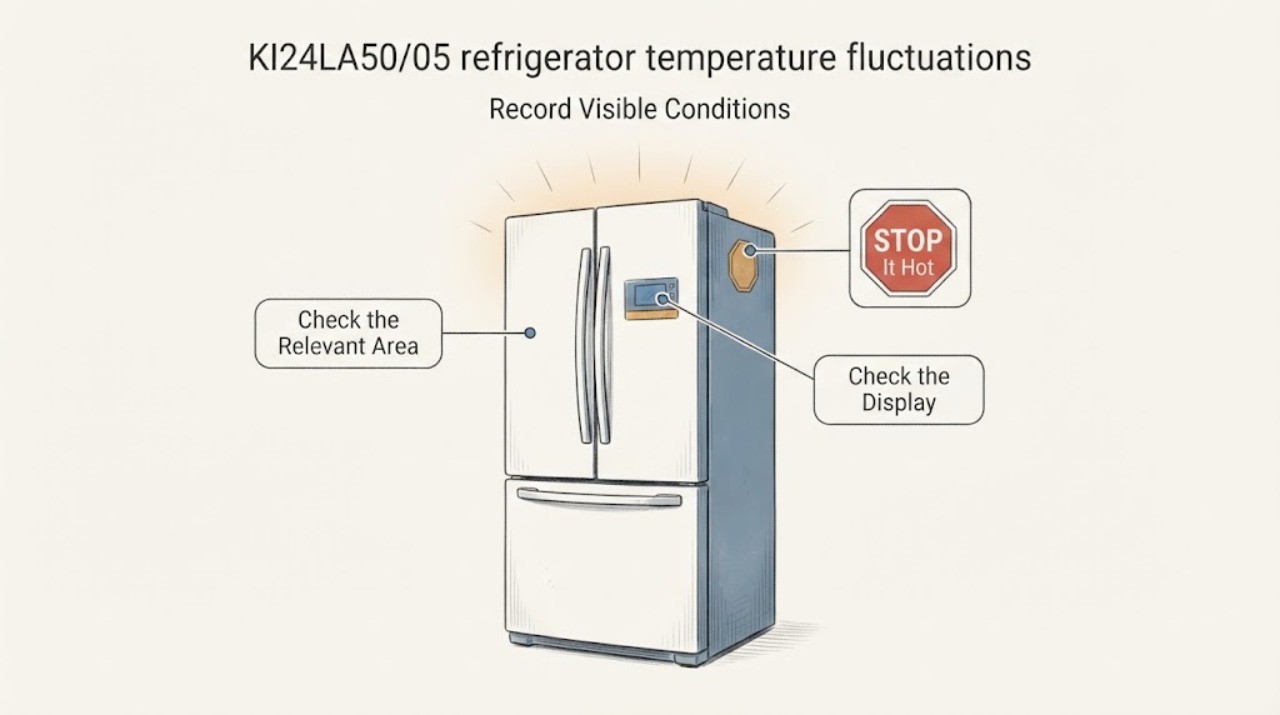
Work through in order
Diagnostic checks
Use only checks that match the exact appliance or system and its official guide.
-
Check 1
Protect the food first. Check the refrigerator and floor from a dry, safe position for standing water, burning odor, smoke, damaged cord or wiring, repeated electrical trips, or an unusual mechanical sound. If the food compartment is clearly warm, move perishable food to a working refrigerator or suitable cooler while you record the symptom; do not taste food to decide whether it is safe.
Expected result: There is no immediate hazard and the food can be kept cold elsewhere, or there is water near electrical parts, smoke, a burning odor, exposed damage, repeated tripping, or food that has been warm for an uncertain period.
Next step: For any electrical, fire, leak, or dangerous mechanical sign, keep the refrigerator off and arrange qualified appliance or electrical service; follow local food-safety guidance for affected food. Otherwise continue with the thermometer check.
Stop if: Do not restore power to a wet or damaged appliance, keep resetting a tripping circuit, or continue operation with smoke, burning odor, exposed wiring, or a dangerous sound.
Why this matters
Why: A hazard or uncertain food exposure is a stop-use and food-safety decision, not a temperature-setting exercise. A safe, dry appliance with the food protected can proceed to measurement without assuming an internal part has failed.
-
Check 2
Measure the food compartment instead of relying on a short display change. Put a calibrated appliance thermometer in a glass of water on the middle shelf, away from the wall and door. Keep the door closed and wait 5–8 hours or overnight; record the reading, room temperature, setpoint, and whether the reading was taken before or after heavy door use. Repeat at a comparable time after any permitted adjustment.
Expected result: The water-backed thermometer stays near the target, rises only after door openings or a hot load, or remains warm with the door closed for the full observation period.
Next step: Keep the measurement log and continue to the setting, door, and environment checks. If the measured food temperature remains above the safe storage limit, protect the food and arrange service.
Why this matters
Why: A water-backed, time-stable reading is more useful than a brief air reading. A door/load-linked rise points toward heat entering during use; a persistent warm result establishes a real cooling problem but still does not identify a thermostat, sensor, or compressor.
-
Check 3
Verify the temperature setting against the exact KI24LA50/05 manual and confirm the control has not been left at an unfamiliar low-cooling, holiday, or demonstration setting. Siemens generally recommends about 4°C for the refrigerator, but do not assume a control range or hidden mode that is not documented for this model. Make at most one small, manual-approved adjustment, then close the door and allow a full stabilization period before measuring again.
Expected result: The setpoint is outside the manual guidance, the control state is unclear, or the setpoint is appropriate and the thermometer still reads warm after stabilization.
Next step: Monitor a corrected setting with the same thermometer method. If the setting is correct and the measured temperature remains out of range, stop changing settings and prepare a model-specific service request.
Why this matters
Why: A documented setting correction can explain a fluctuation without proving a component fault. A correct setting followed by a persistent warm measurement makes an internal control or refrigeration issue possible, but the reading alone cannot select a part.
-
Check 4
Check the external summer conditions without moving the built-in appliance or removing panels. Note the room temperature and whether the cabinet is next to an oven, radiator, or direct sun. Look for blocked or dusty accessible ventilation openings and confirm that food is not pressed against the rear wall or packed so tightly that cold air cannot circulate. Inspect the visible door gasket for a tear, gap, or item preventing closure, and close the door normally.
Expected result: The room is unusually hot, the cabinet ventilation is obstructed, a heat source is nearby, the gasket has a visible gap, or the compartment is overloaded; alternatively, these conditions are normal and the temperature still drifts.
Next step: Reduce heat exposure and door openings, restore only accessible airflow, allow the appliance to stabilize, and repeat the thermometer log. If the room is beyond the nameplate class, built-in ventilation cannot be corrected, or the symptom persists under normal conditions, involve the installer or qualified service.
Stop if: Do not pull the built-in refrigerator, remove covers, scrape frost with a sharp tool, or access the refrigeration or electrical system.
Why this matters
Why: Siemens says climate class defines the ambient range for which operation is guaranteed, and its KI24LA50 family specification lists SN-ST; Siemens also emphasizes ventilation, minimizing door openings, cleaning accessible condenser areas, and keeping hot food out until cooled. A summer condition outside the stated range or a correctable installation/load issue can produce heat-related swings without proving an internal failure.
-
Check 5
Use the pattern of the readings to separate a heat-wave trigger from a persistent fault. Compare a low-door-use period with a period of normal use, and note whether the freezer compartment also changes. Do not interpret compressor run time, a click, or a single warm shelf as a part diagnosis, especially on this static-cooling design.
Expected result: Only the refrigerator warms after frequent opening or hot loading, both compartments remain warm despite a stable room, or the refrigerator compartment is warm while the freezer remains comparatively cold.
Next step: Keep the dated readings, room temperature, setpoint, door activity, and frost/noise notes. If the symptom remains after an overnight stable test, stop experimenting and request qualified Siemens service.
Why this matters
Why: A usage-linked pattern supports heat entering through doors or load. A persistent two-compartment change or a stable-condition failure is more concerning for a model-specific cooling/control problem; a difference between compartments is useful service evidence but does not name a component.
Use your observations
Decision map
Find the observation that best matches what you see, then follow the next safe action.
-
PATH 01Next step
What you see
The water-backed thermometer is within the target after a closed-door overnight period, and the warm readings occur after frequent openings, hot food, or a hot room.
Do this next
Reduce door openings, cool hot food before storage, keep loading from blocking the cold zones, and continue logging during the heat wave. Seek service if the stable baseline later drifts out of range.
Why this path and its safety boundary
Why it matters: The fluctuation is more consistent with heat entering during use or summer ambient stress than with a confirmed component failure.
-
PATH 02Next step
What you see
The room is outside the appliance's nameplate climate class, cabinet ventilation is blocked, or a nearby heat source is warming the built-in enclosure.
Do this next
Correct only accessible environmental or installation conditions and let the refrigerator stabilize. If the room or built-in ventilation cannot meet the documented conditions, involve the installer or qualified service rather than adjusting internal parts.
Why this path and its safety boundary
Why it matters: The operating environment is not a valid basis for condemning the cooling system; Siemens documents SN-ST for the KI24LA50 family and treats climate class as an ambient operating range.
-
PATH 03Next step
What you see
The setpoint is manual-approved, the room and ventilation are normal, doors are closed, and the thermometer remains warm through an overnight test.
Do this next
Protect perishable food, leave the appliance in a safe state, and give qualified Siemens service the exact KI24LA50/05 identity and the full measurement log. Do not keep changing settings or order a part from the symptom alone.
Why this path and its safety boundary
Why it matters: This is a repeatable temperature-control or cooling symptom that needs model-specific diagnosis; it is not enough evidence to name a thermostat, sensor, fan, or compressor.
-
PATH 04Next step
What you see
There is frost buildup, standing water, burning odor, smoke, exposed wiring, repeated electrical tripping, or a dangerous mechanical noise.
Do this next
Keep the refrigerator off, keep people away from the hazard, protect the food, and arrange qualified appliance/electrical service; use emergency help for an active fire or immediate danger.
Why this path and its safety boundary
Why it matters: The symptom has crossed the safety boundary and should not be handled as a summer calibration problem.
Helpful context
Understand the symptom
The identity is important before interpreting a summer symptom. Siemens' exact support page identifies KI24LA50/05 as a built-in fridge with freezer section, while the family specification describes electronic temperature control, static cooling with no interior fan, and SN-ST climate class. The public documents do not establish a part-level cause for temperature swings on this exact /05 appliance, so this guide uses measurements and external conditions to decide whether the fluctuation follows heat and usage or needs service.
A built-in static refrigerator can have different cold zones, and a thermometer placed against a wall or in the door can exaggerate a short-lived swing. Compare repeatable measurements rather than a display snapshot. Never use food tasting as a safety test; if perishable food has been too warm or the duration is uncertain, follow local food-safety guidance.
When checks do not resolve it
Need a professional?
Call when the measured temperature stays warm after a stable overnight test under normal ambient and ventilation conditions, when an environmental correction cannot be made, or immediately for water near electrical parts, smoke, burning odor, exposed damage, repeated trips, or dangerous mechanical noise.
Common questions
FAQ
Can one warm reading prove the Siemens KI24LA50/05 thermostat or compressor is bad?
No. Use a water-backed appliance thermometer on the middle shelf and allow a closed-door stabilization period. Record the room temperature, setpoint, door activity, and both compartment readings before requesting model-specific service.
Should I turn the setting colder whenever a summer heat wave starts?
Measure first and use only the range documented for the exact /05 manual. Siemens generally recommends about 4°C for the refrigerator; correct ventilation, reduce door openings, and cool hot food before assuming a colder setting is the repair.
What should I do if the food has been warm while the temperature fluctuates?
Move perishable food to a working refrigerator or suitable cooler and follow local food-safety guidance when the measured temperature or exposure time is uncertain. Do not taste-test food to decide whether it is safe.
Read the exact guide
Official sources
- Bien choisir son réfrigérateur-congélateur | SiemensSiemens Home Appliances · General Siemens guidance, used for environmental decisions rather than as a replacement for the KI24LA50/05 manual.
- Good to know | Siemens Home AppliancesSiemens Home Appliances · General Siemens guidance only; exact KI24LA50/05 control range and modes must come from its model-specific manual.
- Integrerad kylskåp med frysfack, 122.5 cm: KI24LA50 | Siemens specificationSiemens Home Appliances · The opened Siemens/BSH specification identifies a 1-compressor built-in KI24LA50 with electronic temperature control, no interior fan, 220–240 V/50 Hz, and SN-ST climate class; regional details must be confirmed for the exact /05 appliance.
- How to store BBQ food in the fridge | SiemensSiemens Home Appliances · General Siemens food-safety guidance used to support cold-storage decisions; local food-safety rules govern discard decisions.
- KI24LA50 built-in fridge-freezer | SiemensSiemens Home Appliances · The opened Germany product page identifies KI24LA50 as a built-in refrigerator with freezer compartment and provides product documents; it does not substitute for the exact /05 manual.
- KI24LA50/05 built-in fridge with freezer section | Siemens supportSiemens Home Appliances · The opened Siemens Ireland support page identifies the exact /05 appliance and links its model-specific documents and service resources.
Community feedback
Share a repair observation
Share a plain-text repair observation. Accepted observations are published automatically; this page may take a moment to update.