
On this page
Start here
Quick answer
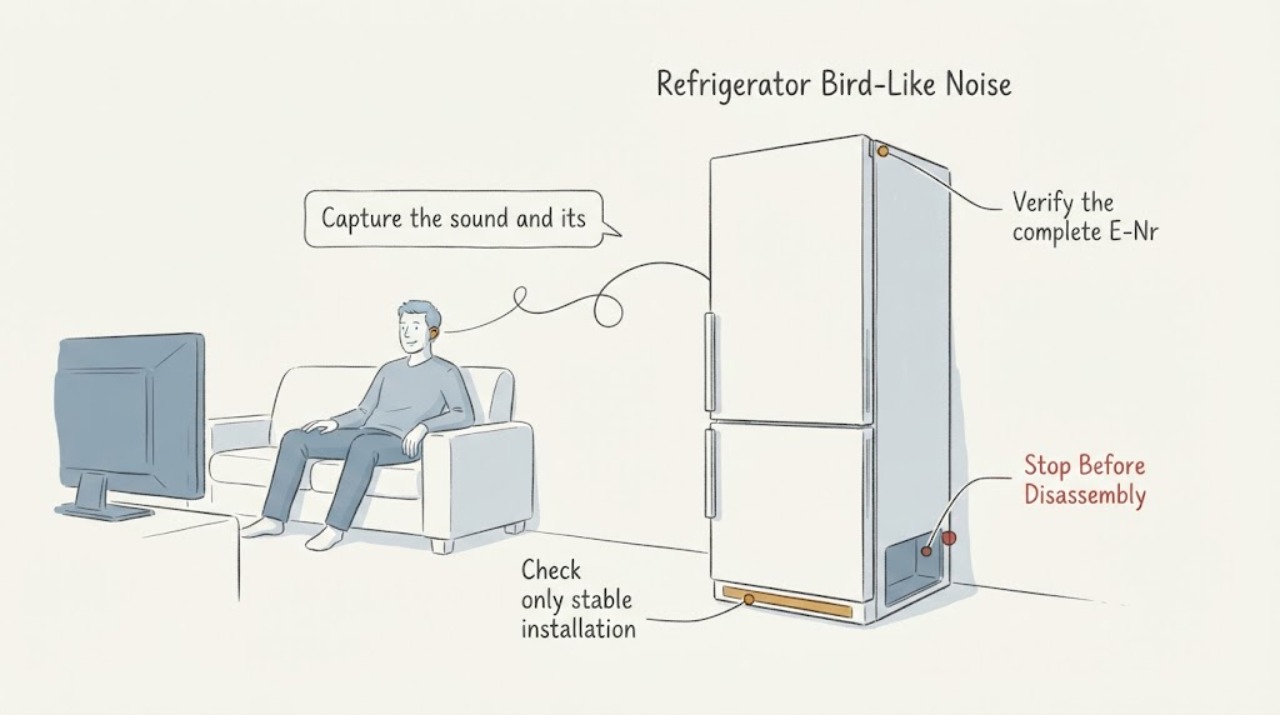
The Siemens KG39EAICA product page identifies this as a 38 dB iQ500 fridge-freezer, but that rating does not prove that a sharp bird-like chirp every few seconds is acceptable or that R600a alone explains it. First document whether the sound is tied to compressor/fan operation, a door movement, vibration, or a particular location; with the appliance safely in place, check only for leveling, clearance, and loose containers. Do not remove covers, touch refrigerant tubing, or attempt a compressor or fan repair. If the noise is new, escalating, accompanied by temperature change, scraping, burning smell, damaged tubing, or a fault indication, stop treating it as a normal sound and use Siemens service with the exact E-Nr and a recording.
Work through in order
Diagnostic checks
Use only checks that match the exact appliance or system and its official guide.
-
Check 1
Capture the sound and its timing from the room where it is normally heard.
Expected result: Record whether the chirp repeats at a regular interval, whether the brief harsh sound follows it, and whether either event begins after a door closes or when cooling starts.
Next step: Keep the recording with the complete E-Nr and provide both to Siemens service; do not use a guessed component diagnosis to order parts.
Why this matters
Why: A repeatable pattern is useful evidence for service, but it cannot identify R600a, a fan, a compressor, a valve, or a refrigerant leak by itself.
-
Check 2
Check only stable installation and removable-item contact while the appliance remains assembled.
Expected result: Note whether the cabinet is touching a wall or cabinet and whether bottles, shelves, or containers vibrate when the sound occurs.
Next step: Remove only the clearly loose removable item or correct an obvious safe contact. Do not move a loaded appliance, pull on the door, or remove panels; if the sound remains, use the model-specific support path.
Why this matters
Why: A sound that changes when a removable item is moved or when contact is relieved may be resonance or vibration; it does not prove an internal part is good or bad.
-
Check 3
Verify the complete Siemens E-Nr and compare the product identity before applying any normal-noise explanation.
Expected result: Read the rating label and record KG39EAICA plus any slash suffix, then compare it with the official Siemens product/support page.
Next step: Use the exact E-Nr with Siemens support and attach the recording. Do not transfer a noise explanation or procedure from a different model.
Why this matters
Why: The base model and regional or production suffix can have different documents and support routing; an unrelated KG39 or generic refrigerator page is not exact-model evidence.
-
Check 4
Screen for safety and performance changes before deciding that the noise is merely annoying.
Expected result: Check from outside the appliance whether cooling remains normal and whether there is scraping, burning smell, visible tubing damage, damaged power cord, or a fault indication.
Next step: If tubing is damaged, smoke or burning smell is present, or cooling is failing, stop using the appliance, avoid ignition sources, ventilate if safe, and contact service. Do not open the refrigeration circuit or test energized components.
Why this matters
Why: A new noise combined with a temperature or visible safety change needs service assessment; the sound alone cannot distinguish normal refrigerant flow from an appliance fault.
Use your observations
Decision map
Find the observation that best matches what you see, then follow the next safe action.
-
PATH 01Next step
What you see
The chirp and brief harsh sound occur with stable cooling, no visible damage, and no change when loose items or obvious cabinet contact are corrected.
Do this next
Send the recording, timing, placement, and exact E-Nr to Siemens support for a model-specific noise assessment; do not declare the sound normal solely because it is intermittent.
Why this path and its safety boundary
Why it matters: The product page's noise rating does not settle the issue, but the symptom is not accompanied by the high-risk indicators that require immediate shutdown.
-
PATH 02Next step
What you see
The sound changes when a bottle, shelf, cabinet contact, or other removable item is addressed.
Do this next
Leave the item or safe contact condition corrected and monitor briefly. If the sharp sound continues, returns, or becomes louder, provide the recording and exact E-Nr to service.
Why this path and its safety boundary
Why it matters: That result supports a resonance or contact explanation for that episode, but it does not prove the refrigerator has no internal noise issue.
-
PATH 03Next step
What you see
The noise is accompanied by loss of cooling, scraping, burning smell, visible oil or refrigerant-tube damage, damaged wiring, or a fault indication.
Do this next
Stop using the appliance. If refrigeration tubing is damaged, keep ignition sources away, ventilate if safe, and contact Siemens or qualified service; do not puncture, bend, or repair the circuit.
Why this path and its safety boundary
Why it matters: The combination is outside a simple normal-noise observation and may involve a mechanical, electrical, or refrigeration safety issue.
-
PATH 04Next step
What you see
The rating label does not confirm KG39EAICA or the model has a different suffix than the support record.
Do this next
Pause model-specific troubleshooting and use the complete E-Nr with Siemens support. Do not use this page's model claims until the identity is corrected.
Why this path and its safety boundary
Why it matters: The assigned model identity is unresolved for a model-specific acoustic conclusion.
Helpful context
Understand the symptom
The exact post describes a Siemens KG39EAICA bought the previous week, a bird-like chirp at roughly 5–10-second intervals, and a separate harsh sound lasting about half a second roughly once a minute while the owner is sitting several metres away watching television. The post also reports that Siemens attributed the sound to R600a. That is the user's reported explanation, not a model-specific acoustic diagnosis. Start with the timing and location of the sound rather than trying to identify a compressor, fan, valve, or refrigerant circuit by ear.
Separate the noise rating from the noise pattern
Siemens lists KG39EAICA at 38 dB(A), but a rating does not describe whether a short, high-pitched event repeats every few seconds or whether a brief harsh sound occurs during a cooling cycle. Record the sound from the normal listening position and note whether it starts after a door closes, when the compressor starts, during defrost, or without an obvious event. The recording helps service compare the symptom with the exact E-Nr; it does not prove the cause.
Check the installation and removable items without opening the fridge
Without removing covers or reaching behind moving or powered parts, note whether the cabinet is stable, whether it touches a wall or adjacent cabinet, and whether bottles, shelves, or other removable items are vibrating. If the sound changes when a loose item is moved or when the door is gently closed, that points to a resonance or contact condition rather than identifying an internal component. Do not push the cabinet into a new position while it is loaded or pull it by the door.
Use the exact E-Nr and Siemens noise support path
Confirm the complete E-Nr on the rating label, including any slash suffix, because Siemens support pages distinguish variants such as KG39EAICA/17. The opened Siemens support page offers noise categories for clicking/rattling/cracking, droning, and a general noise problem. Give service the E-Nr, purchase date, room placement, sound recording, repeat interval, and whether cooling and temperatures remain normal. Do not substitute a different KG39 model's manual or a different Siemens sound explanation.
Know when a normal-noise explanation is no longer enough
Keep the appliance under observation only when it is cooling normally and there is no visible damage or safety symptom. Stop using it and seek service if the sound is accompanied by loss of cooling, repeated clicking without a cooling cycle, scraping, a burning smell, visible oil or tubing damage, a damaged power cord, or a fault indication. Do not puncture panels, bend refrigerant tubing, remove the rear cover, or test a fan or compressor with the appliance energized.
When checks do not resolve it
Need a professional?
Use Siemens or qualified refrigerator service when the noise remains after safe external checks, is new or worsening, or the exact E-Nr is needed to select the correct documentation., Stop using the appliance and seek service promptly for loss of cooling, scraping, burning smell, visible tubing damage, damaged wiring, or a fault indication. Do not open the refrigeration circuit or perform energized component tests.
Common questions
FAQ
Are bird-like chirps automatically normal on the Siemens KG39EAICA?
No conclusion can be made from the sound label alone. Siemens lists the KG39EAICA at 38 dB(A), but that rating does not define a repeated chirp or brief harsh sound. Record the pattern and use the exact E-Nr with Siemens support.
Does hearing the sound prove that R600a is escaping?
No. The exact post reports that explanation, but sound cannot confirm a refrigerant leak or identify a refrigerant-circuit component. If tubing is visibly damaged or cooling changes, stop using the appliance and contact service.
Can I remove the rear cover to find the source?
Do not remove covers or test the compressor, fan, valve, or refrigerant circuit while energized. Use a recording, safe external observations, the complete E-Nr, and Siemens or qualified service instead.
Read the exact guide
Official sources
- Siemens service, user manuals, spare parts, accessories for KG39EAICA/17Siemens Home Appliances / BSH · Opened official Siemens support page for a KG39EAICA suffix variant. Used to show the need for the complete E-Nr and the available noise categories; it is not used to claim that /17 is the assigned unit.
- Siemens claims these refrigerator bird noises are normal. This can't be true?Reddit r/Appliances · Opened exact post. It verifies the assigned case identity and symptoms but does not independently verify the sound cause, normality, or repair outcome.
- KG39EAICA iQ500 freestanding fridge-freezer with freezer at bottomSiemens Hausgeräte · Opened exact Siemens product page. Confirms KG39EAICA and the 38 dB(A) noise value; it does not define the reported chirp or prove the cause.
- Instructions for Use — Siemens refrigeratorBSH Home Appliances / Siemens · Opened official Siemens manual portal. Used only for the general R600a safety boundary and the fact that Siemens manuals distinguish operating/noise guidance; it is not presented as the exact KG39EAICA manual or as proof of the sound's cause.
Community feedback
Share a repair observation
Share a plain-text repair observation. Accepted observations are published automatically; this page may take a moment to update.