
On this page
Start here
Quick answer
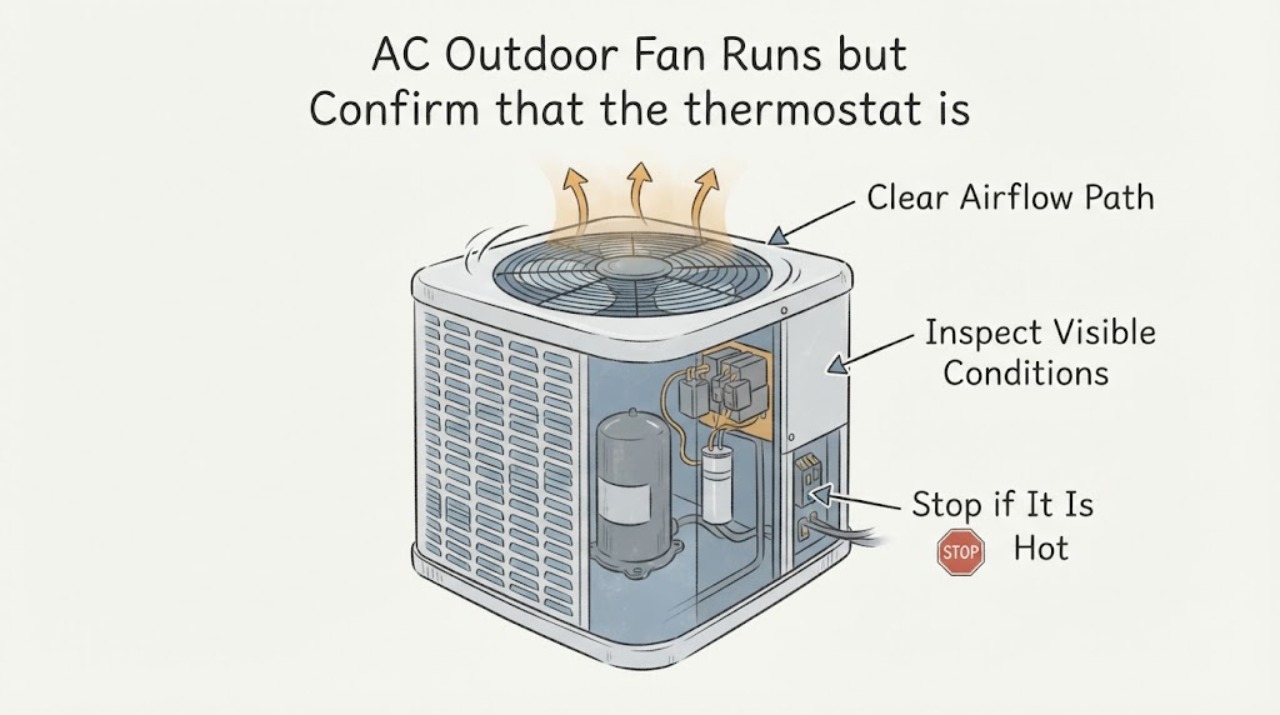
An outdoor fan that runs while the compressor is silent and the house receives warm air is a symptom, not proof of one failed part. From a safe distance, confirm the thermostat is calling for cooling, note whether the outdoor fan is actually running, and listen for silence, a click, or a hum; also check only the accessible indoor filter and visible exterior for damage, odor, oil, or ice. Do not remove the outdoor access panel, touch wiring, bridge a contactor, spin the fan with a tool, measure voltage, or test or discharge a capacitor. Carrier warns that capacitors can retain high-voltage charge even after power is off, and its troubleshooting guidance says compressor, capacitor, and other outdoor-unit electrical faults generally need a professional. Turn the cooling call off if the compressor remains silent, document the sound and visible symptoms, and have a qualified HVAC technician inspect the capacitor, contactor, compressor circuit, and refrigerant system using the model's service procedure.
Work through in order
Diagnostic checks
Use only checks that match the exact appliance or system and its official guide.
-
Confirm that the thermostat is requesting cooling
At the indoor thermostat, verify that the mode is Cool, the setpoint is below the room temperature, and there is an active call for cooling. Do not remove the thermostat cover or alter wiring.
Expected result: The thermostat is clearly calling for cooling and the indoor air remains warm; or the mode, setpoint, schedule, or display does not request cooling.
Next step: If there is no cooling call, correct only the user-accessible setting and observe whether the system starts normally. If a valid call exists, continue to the exterior observation without opening the unit.
Stop if: Stop and request service for a damaged thermostat, exposed wiring, burning odor, smoke, or any need to access electrical terminals.
Why this matters
Why: A missing cooling call can make the outdoor-unit symptom appear misleading. A valid cooling call with warm air makes the outdoor fan/compressor observation meaningful, but still does not identify a failed component.
-
Observe the outdoor fan and compressor from a distance
With a confirmed cooling call, stand clear of the outdoor unit and observe through the grille without touching it, removing a panel, inserting a tool, or trying to start the fan. Note whether the fan turns, whether the compressor produces its normal operating sound, and whether the indoor supply air stays warm.
Expected result: The fan runs while the compressor is silent and the indoor air is warm; the compressor hums or clicks but does not settle into operation; or neither outdoor load runs.
Next step: Turn off the cooling call if the compressor remains silent and record the sound pattern. Give the technician the observation rather than selecting a capacitor or contactor from it.
Stop if: Stop immediately for smoke, a burning smell, arcing, a damaged fan blade, exposed wiring, or any urge to touch the grille or cabinet while the unit is energized.
Why this matters
Why: Fan-running/compressor-silent is the assigned symptom and can involve the compressor circuit, capacitor, contactor, controls, or compressor itself. A hum or click is useful information for a technician but is not a safe home diagnosis. If neither load runs, power, controls, or another system condition may be involved.
-
Check only accessible indoor airflow clues
With the cooling call off, inspect the user-accessible indoor air filter and supply registers without opening the air handler. Replace or clean the filter only as the equipment manual permits, and note any ice visible from a safe exterior view; do not scrape ice or access the evaporator coil.
Expected result: The filter is heavily loaded or registers are obstructed; the filter is clean but ice is visible; or airflow is normal with no visible ice.
Next step: If the filter is user-serviceable and dirty, correct that low-risk maintenance and leave cooling off while documenting whether ice is present. If ice, weak airflow, or warm air persists, arrange HVAC service rather than opening the system.
Stop if: Do not remove panels, handle refrigerant lines, scrape ice, or continue operating with visible ice, water, smoke, or electrical damage.
Why this matters
Why: Restricted airflow can contribute to coil icing and warm or inadequate cooling, while a clean filter and normal airflow make the outdoor compressor circuit observation more important. Ice does not prove a capacitor or contactor failure and needs professional diagnosis.
-
Record exterior warning signs without cabinet access
With the system off, look from outside the cabinet for a damaged fan blade, burnt area, oil residue, ice on accessible tubing, or signs of impact. Do not remove the service panel or touch the capacitor, contactor, terminals, refrigerant lines, or fan motor.
Expected result: The cabinet has no visible damage or odor; or there is smoke, a burnt mark, oil residue, ice, a damaged blade, or another abnormal exterior sign.
Next step: Photograph or describe the sign from a safe position, leave the system off, and request qualified service. If no sign is visible, continue to the service handoff rather than opening the cabinet.
Stop if: Stop for smoke, gas or burning odor, active arcing, leaking oil or refrigerant, water near electrical equipment, or any exposed conductor.
Why this matters
Why: Exterior clues can help a technician prioritize electrical, mechanical, refrigerant, or airflow inspection, but none identifies a particular component safely. Carrier notes that refrigerant and electrical issues should not be troubleshot by the homeowner.
-
Hand off capacitor and contactor checks to a qualified technician
Keep the cooling call off and arrange a qualified HVAC inspection. Tell the technician that the outdoor fan runs, the compressor is silent, the air is warm, and describe any hum, click, ice, odor, breaker event, or visible damage. Leave capacitor, contactor, compressor, and refrigerant testing to the technician's model-specific safety procedure.
Expected result: The technician confirms a capacitor, contactor, compressor, control, airflow, or refrigerant fault; or the system passes those checks and the symptom is intermittent.
Next step: Use only a replacement part confirmed for the exact model after the technician identifies the failed component. If no fault is reproduced, provide the timeline, thermostat behavior, and sound recording or notes for a follow-up diagnosis.
Stop if: Do not resume DIY testing, bypass a contactor, bridge controls, measure live voltage, discharge a capacitor, or open the outdoor cabinet.
Why this matters
Why: The observed symptom narrows the service call but cannot distinguish among the listed causes without controlled electrical and HVAC testing. An intermittent result makes the recorded timing and sound pattern especially important.
Use your observations
Decision map
Find the observation that best matches what you see, then follow the next safe action.
-
PATH 01Next step
What you see
A valid cooling call is present, the outdoor fan runs, the compressor remains silent, and supply air is warm.
Do this next
Leave the cooling call off and request qualified HVAC service for a de-energized, model-specific inspection of the compressor circuit.
Why this path and its safety boundary
Why it matters: This is the assigned compressor-not-starting symptom. Trane's service table lists capacitor, contactor, wiring, compressor, and related checks; the observation does not select one part.
-
PATH 02Next step
What you see
The outdoor fan runs and the compressor emits a hum or repeated click but does not begin normal operation; the home remains warm.
Do this next
Do not try to spin the fan or open the cabinet. Turn the cooling call off, record the timing and sound, and arrange qualified service.
Why this path and its safety boundary
Why it matters: A start or run problem is possible, but sound alone cannot distinguish a capacitor, contactor, compressor, control, or protection response.
-
PATH 03Next step
What you see
The filter is heavily loaded, airflow is weak, or ice is visible while the compressor symptom is being observed.
Do this next
Leave cooling off, address only a user-serviceable filter if the manual permits, do not scrape ice, and arrange HVAC service if the warm-air or ice symptom persists.
Why this path and its safety boundary
Why it matters: Airflow restriction or a frozen coil may be contributing to warm air, and Carrier says frozen-coil, refrigerant, and electrical diagnosis requires professional handling; this pattern does not prove a capacitor or contactor failure.
-
PATH 04Next step
What you see
The thermostat is not actually calling for cooling, or the fan is set to run independently of cooling, so the outdoor observation cannot be reproduced under a cooling call.
Do this next
Correct only the accessible mode, setpoint, or fan setting and observe once. If the system still fails under a valid cooling call, stop and request service.
Why this path and its safety boundary
Why it matters: The apparent mismatch may be a control or thermostat-setting condition rather than a confirmed compressor, capacitor, or contactor fault.
Helpful context
Understand the symptom
What the symptom does and does not prove
The outdoor condenser fan and compressor are separate loads in a typical split-system outdoor unit. A fan that runs does not prove that the compressor has started, and a silent compressor does not by itself identify a capacitor, contactor, compressor, control, or refrigerant problem. Trane's service table treats this symptom as a diagnostic condition with several electrical checks, while Carrier directs homeowners away from refrigerant and electrical troubleshooting.
Safe observations only
Keep observations outside the cabinet. Confirm the thermostat is in cooling mode and set below the room temperature, note whether the outdoor fan runs, and listen for the compressor without touching the grille or wiring. Look only for exterior damage, smoke, oil residue, ice, or an obvious burning smell. A high-voltage capacitor may remain charged after power is removed, so the outdoor panel and contactor are technician-only access points.
What to tell the HVAC technician
Record the model and serial information, thermostat setting, indoor filter condition, time the fan starts, whether the compressor is silent, clicking, or humming, and whether the supply air stays warm. Ask the technician to inspect the run or start capacitor, contactor, compressor circuit, controls, airflow, and refrigerant system under the equipment's service procedure. Do not order a capacitor or contactor by appearance or symptom alone.
Only after diagnosis
Potential parts
- run or start capacitor
Consider this category only after a qualified technician confirms a capacitor failure during the fan-running/compressor-silent diagnosis; the sound pattern alone is not enough.
Confirm the complete outdoor-unit model and the manufacturer's electrical rating and fit information. Do not select or handle a capacitor based on appearance. - compressor contactor
Consider this category only after a qualified technician confirms that the contactor or its control circuit is the failed cause of the compressor-not-starting symptom.
Confirm the complete outdoor-unit model and the manufacturer's electrical and mechanical fit information; contactor inspection and replacement are not homeowner procedures.
When checks do not resolve it
Need a professional?
Arrange qualified HVAC service when the outdoor fan runs but the compressor remains silent and the air is warm, especially if the symptom repeats after a valid thermostat cooling call. Tell the technician the model, timing, sound pattern, filter and airflow observations, and any ice, oil, odor, breaker, or visible damage. Ask for a model-specific, de-energized inspection of the run or start capacitor, contactor and control circuit, compressor, airflow, and refrigerant system. Keep the cooling call off and do not open the outdoor cabinet.
Common questions
FAQ
Does a running outdoor fan prove the AC compressor is good?
No. The fan and compressor are separate loads. A fan that runs while the compressor is silent and the air is warm is a service symptom that can involve the compressor circuit, capacitor, contactor, controls, compressor, airflow, or refrigerant system.
Can I test or discharge the AC capacitor myself?
No. Carrier warns that capacitors can retain a high-voltage charge even after power is off and says trained HVAC technicians should handle them. Do not remove the outdoor panel or use a meter on the capacitor.
What should I tell the HVAC technician?
Provide the exact model, thermostat setting, when the outdoor fan starts, whether the compressor is silent, humming, or clicking, whether the supply air stays warm, and any filter, airflow, ice, odor, breaker, or exterior-damage observations.
Should I keep running the AC when the compressor is silent?
Turn the cooling call off and arrange service. Repeatedly commanding an outdoor unit that is not completing its cooling sequence can worsen an unresolved electrical or compressor problem, and the needed checks are not safe homeowner tests.
Read the exact guide
Official sources
- 15.2 TroubleshootingTrane · A service-document reference for trained personnel only. Its troubleshooting matrix explicitly separates "Compressor Will Not Start But O.D. Fan Runs" and lists high-voltage wiring, run/start capacitors, contactor contacts and coil, compressor, and related controls as service checks; it does not authorize homeowner electrical testing.
- Troubleshoot an Air Conditioner | AC TroubleshootingCarrier · Supports non-invasive thermostat, filter, visible-ice, and outdoor-unit observations plus professional escalation for electrical, refrigerant, frozen-coil, compressor, and run-capacitor issues.
- AC Fan Not Spinning? Here’s Why and How to Fix ItCarrier · Supports the safe interpretation of an abnormal outdoor-unit sound or load pattern and the boundary against homeowner capacitor handling; it is not a model-specific diagnosis for every Carrier or non-Carrier system.
Community feedback
Share a repair observation
Share a plain-text repair observation. Accepted observations are published automatically; this page may take a moment to update.