
On this page
Start here
Quick answer
A brief cloud of steam from a heat pump's outdoor unit can be normal defrost vapor: the system temporarily reverses refrigerant flow to warm the outdoor coil and melt frost. During that interval, the outdoor fan may stop, a swishing sound may occur, and AUX heat may appear on the thermostat; these details vary by system. Watch from a safe distance for the unit to return to heating after the frost is cleared. If defrost runs constantly, lasts longer and longer, leaves heavy ice covering the coil, or the system does not recover heat, stop troubleshooting and arrange HVAC service.
Before you begin
Safety first
- Observe only from a safe distance. Do not touch the coil, fan, refrigerant lines, reversing valve, or wiring; do not chip ice, pour hot water over the unit, remove panels, bypass controls, or test energized circuits. Turn the system off from a safe location when a hazard is present.
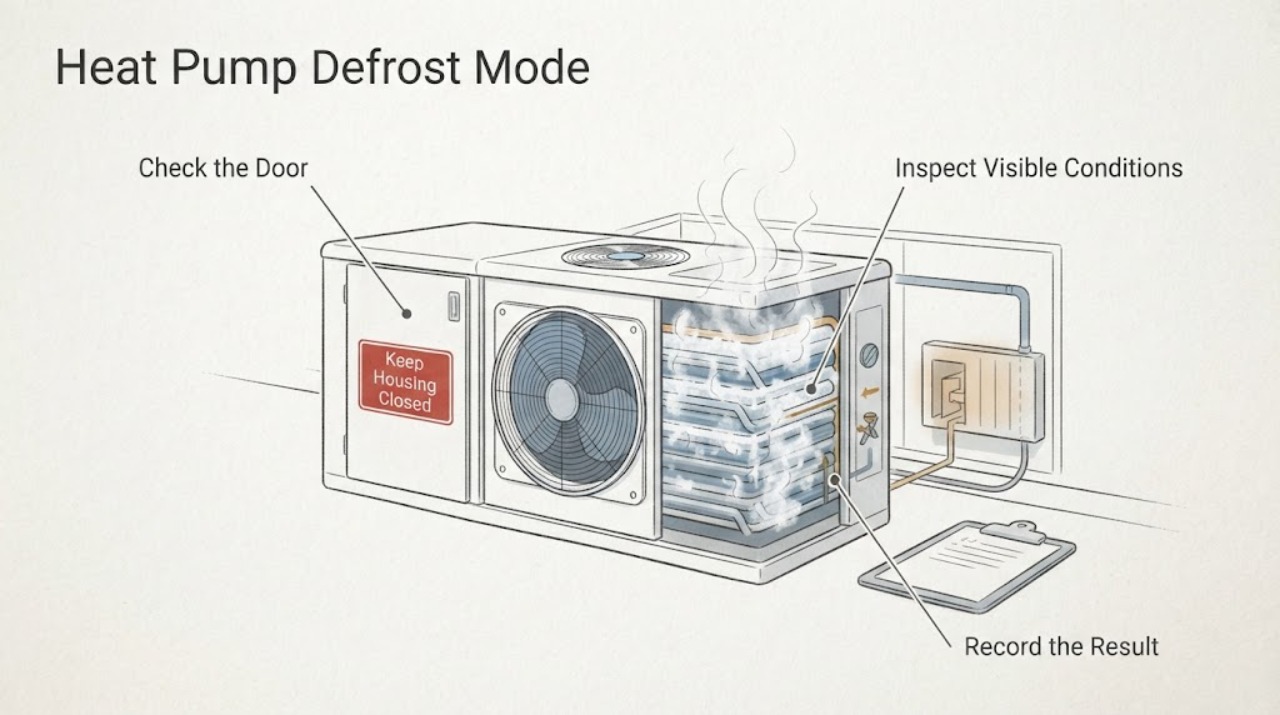
Work through in order
Diagnostic checks
Use only checks that match the exact appliance or system and its official guide.
-
Check 1
Note the conditions when the event begins: the thermostat is calling for heat, the outdoor coil has frost, a cloud rises from the unit, the outdoor fan changes state, or the indoor air briefly changes temperature.
Expected result: Frost plus a short steam cloud during a heating call is a recognizable defrost pattern. Steam without frost, water spraying from a damaged component, smoke, or an odor of burning insulation is not enough to label normal defrost.
Next step: Stay outside the unit and continue with the safe transition observation. If there is smoke, a burning odor, a refrigerant-like release, or an electrical hazard, shut the system off from a safe location and call for service.
Why this matters
Why: Defrost is initiated to remove frost from the outdoor coil; the outdoor coil can be colder than ambient air and collect freezing condensation.
-
Check 2
Watch the outdoor unit from a distance during the defrost transition; do not open the cabinet. Listen for a brief change in sound and observe whether the outdoor fan stops while the system remains powered.
Expected result: A brief swooshing sound and a stopped outdoor fan can occur while refrigerant flow is being reversed. A fan that does not run outside the defrost interval is a different pattern from a fan that pauses only during defrost.
Next step: Do not condemn the fan or reversing valve from the pause alone. Wait for the transition to finish and record whether the fan returns and heating resumes.
Why this matters
Why: The reversing valve temporarily puts the heat pump into a cooling-like refrigeration direction to heat the outdoor coil, and the fan may be stopped to support defrost operation.
-
Check 3
Observe the thermostat and indoor comfort during the event without repeatedly changing modes. Record whether AUX or auxiliary heat appears and whether the supply air is briefly cooler or remains warm.
Expected result: AUX heat can appear when installed, and a system without backup heat may deliver briefly cool air during defrost. Either can be an expected design behavior if the system promptly returns to heating.
Next step: Leave the thermostat at the requested heating setting and assess recovery after the defrost transition. Do not force emergency heat or alter wiring to hide a recurring fault.
Why this matters
Why: Auxiliary heat may maintain indoor comfort while the heat pump uses the indoor side of the cycle differently to warm the outdoor coil; not every installation has backup heat.
-
Check 4
Time several events only to compare their trend, and note whether the outdoor coil clears and the system returns to normal heating. Do not treat one universal minute limit as a diagnosis because defrost controls differ.
Expected result: A short event that ends after frost is cleared is more consistent with normal operation. Events that become longer, occur nearly continuously, or leave frost and ice accumulating show an abnormal trend.
Next step: If the trend is increasingly long or the coil stays iced, stop using the sequence as a self-test and schedule HVAC service. Keep the recorded times and outdoor conditions for the technician.
Why this matters
Why: Trane describes its demand-defrost cycles as usually 3–5 minutes, while also noting that other systems may use timed defrost; the actionable signal is failure to clear and recover, not a single stopwatch value.
-
Check 5
From outside the unit, visually check for heavy ice covering the outdoor coil, blocked clearance, or a fan that remains stopped after the defrost event. Do not remove panels, chip ice, or reach through the grille.
Expected result: A coil that clears and an outdoor fan that resumes after defrost support normal recovery. Ice that continues to cover the coil, a fan that stays stopped, or repeated loss of heating after defrost points beyond a normal transition.
Next step: Keep the unit clear of new obstructions without entering it, and call a qualified HVAC technician for persistent ice, no recovery, or a non-running fan outside defrost.
Why this matters
Why: Frost growth can restrict airflow and degrade heat-pump performance; persistent ice or failure to recover cannot identify a specific internal component from a visual check alone.
-
Check 6
After the event has ended, verify the heat pump is again delivering the expected heating and that the outdoor fan behavior has returned to the system's normal heating pattern. Compare the result with the exact equipment manual if available.
Expected result: Normal heating recovery after a brief defrost supports an expected cycle. Failure to return to heat, repeated changeover into cooling, constant defrost indication, or a fan that never recovers is not a normal completed cycle.
Next step: Stop relying on repeated mode changes or resets. Turn the system off if it is unsafe or cannot maintain heat, and arrange qualified HVAC service with the recorded sequence and equipment identification.
Why this matters
Why: The defrost process should end after frost is cleared and the heat pump should reenter heating; persistent or worsening defrost symptoms are a service signal.
Use your observations
Decision map
Find the observation that best matches what you see, then follow the next safe action.
-
PATH 01Next step
What you see
Do this next
Leave the system alone and monitor the trend. Do not replace a fan or reversing valve based only on steam or a temporary fan pause.
Why this path and its safety boundary
Why it matters: This pattern is consistent with a normal reverse-cycle defrost. Steam is melted frost evaporating, and the fan pause can be part of the sequence.
-
PATH 02Next step
What you see
Do this next
Do not change wiring or force a different mode. Check the exact system manual for its auxiliary-heat behavior and call service only if the system fails to recover or the pattern worsens.
Why this path and its safety boundary
Why it matters: Auxiliary heat may be supporting comfort during defrost; a system without backup heat may briefly feel cool. Recovery is the important decision point.
-
PATH 03Next step
What you see
Do this next
Stop self-diagnosis at the visual observation and schedule qualified HVAC service. Provide the event trend, outdoor conditions, thermostat state, fan behavior, and whether the coil clears.
Why this path and its safety boundary
Why it matters: This is not explained by a single normal steam event. Persistent frost can restrict airflow, and the unresolved cause may involve controls, sensors, refrigerant flow, airflow, or another system-specific fault.
-
PATH 04Next step
What you see
Do this next
Turn the system off from a safe location, keep clear of the outdoor unit, and call qualified HVAC service. Do not open the electrical compartment or attempt to free the fan.
Why this path and its safety boundary
Why it matters: The fan pause is no longer confined to a documented defrost transition, or there is a safety symptom that cannot be separated from an electrical or mechanical fault by observation alone.
Helpful context
Understand the symptom
Why steam and a stopped outdoor fan can be normal
In heating mode, moisture can freeze on the outdoor coil. Defrost removes that frost by temporarily reversing the refrigeration cycle so the outdoor coil becomes warm. Meltwater can evaporate as a visible cloud, and the outdoor fan may be stopped during the changeover. A short, self-ending event is therefore not by itself evidence of a failed reversing valve or fan motor.
What varies by heat-pump design
Demand-defrost and timed-defrost controls do not use the same trigger or duration, and not every system has the same auxiliary-heat arrangement. Use the behavior described here to decide whether the event resolves normally, then use the exact equipment manual for any model-specific indicator or sequence.
Observe without entering the equipment
Keep clear of the outdoor unit and its electrical compartment. Do not touch the coil, fan, refrigerant piping, or reversing-valve wiring; do not chip ice, pour hot water over the unit, bypass controls, or test energized circuits.
When checks do not resolve it
Need a professional?
Arrange qualified HVAC service when defrost is constant or increasingly prolonged, ice continues to cover the outdoor coil, the system does not return to heating, the outdoor fan remains stopped outside defrost, or any smoke, burning odor, severe noise, or electrical hazard occurs.
Safety scope: Observe only from a safe distance. Do not touch the coil, fan, refrigerant lines, reversing valve, or wiring; do not chip ice, pour hot water over the unit, remove panels, bypass controls, or test energized circuits. Turn the system off from a safe location when a hazard is present.
Have this ready
- Provide the equipment brand and model, whether the thermostat called for heat, outdoor temperature and moisture conditions, the steam and fan pattern, approximate event trend, AUX indication, whether the coil cleared, and whether heating recovered.
Common questions
FAQ
Is steam from a heat pump during defrost normal?
A brief cloud can be normal: defrost warms the outdoor coil, and melting frost can evaporate as steam. It is reassuring only when the event ends and the system returns to heating; persistent ice or worsening defrost needs service.
Should the outdoor fan stop during defrost?
It may. Trane describes the outdoor fan stopping during its defrost sequence while refrigerant flow reverses. Compare the fan's behavior during and after defrost with the exact equipment manual; a fan that never resumes is a service symptom.
What does the reversing valve do in defrost mode?
The valve temporarily reverses refrigerant flow so the outdoor coil receives heat and frost can melt. That is why the system can sound different and briefly behave unlike ordinary heating.
How long should a heat-pump defrost cycle last?
There is no universal duration: demand and timed controls differ. Trane says its demand-defrost cycles are usually 3–5 minutes, but a trend of longer events, persistent ice, or failure to return to heat is more important than a single stopwatch reading.
Read the exact guide
Official sources
- BTO Peer Review: Quantifying and reducing defrost energy useU.S. Department of Energy, Office of Energy Efficiency and Renewable Energy · DOE/NREL technical presentation describing frost formation and reverse-cycle defrost in heat pumps.
- What Is the Heat Pump Defrost Cycle?Trane · Trane manufacturer explanation of air-source heat-pump defrost behavior, steam vapor, reversing valve, outdoor fan, auxiliary heat, and service symptoms.
Community feedback
Share a repair observation
Share a plain-text repair observation. Accepted observations are published automatically; this page may take a moment to update.