
On this page
Start here
Quick answer
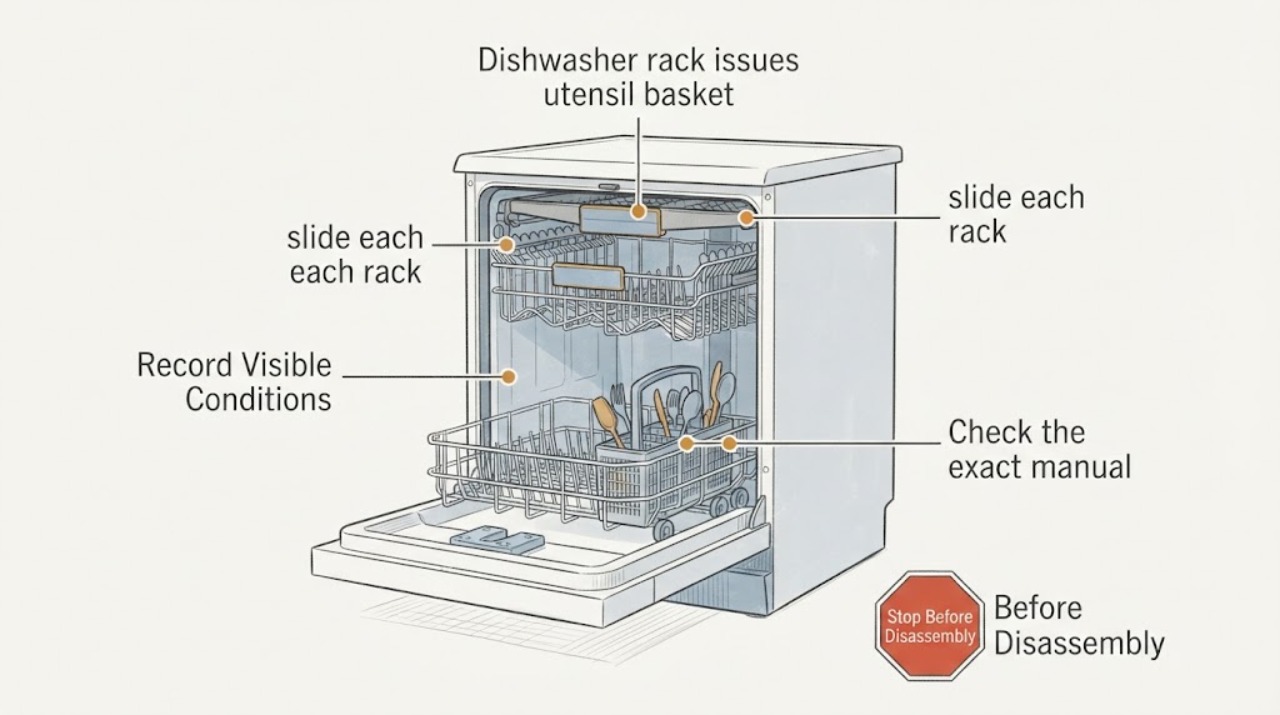
A third-party rack or utensil basket is not automatically compatible with a Monogram dishwasher. GE Appliances says the full-extension third rack uses rails attached to the dishwasher, so it cannot be added to models without that feature; some Monogram models use a two-piece third rack, and silverware-basket designs vary by model. Find the exact model number and compare rails, basket position, door clearance, and spray-arm clearance with its owner's manual before buying or installing anything. If a rack sticks, rolls by itself, is damaged, or leaves cutlery blocking the spray arm, correct only the accessible loading or fitting issue. Persistent binding or an unverified third-party fit needs model-specific service or parts guidance.
Work through in order
Diagnostic checks
Use only checks that match the exact appliance or system and its official guide.
-
Check 1
Record the exact Monogram dishwasher model number and classify the issue as a missing third rack, a rack that will not slide, a utensil basket that will not seat, a basket that blocks the door or spray arm, or a rack that rolls by itself.
Expected result: The model number is available and the issue is a fit, sliding, loading, or movement problem, or the model number cannot be found.
Next step: Use the model number to open the owner's manual and parts view before ordering or modifying a rack. If the model cannot be identified, request Monogram support guidance before purchase.
Why this matters
Why: Rack and basket designs vary across models, so the model number determines whether a third-rack feature, two-piece tray, or particular basket position applies. Appearance is not a compatibility test.
-
Check 2
Check the exact manual and model support page for a third-rack feature and compare the proposed rack's rail attachment, width, stop position, height, and tray arrangement; do not force a rack into rails that were not built for it.
Expected result: The model has factory-attached third-rack rails, has no third-rack feature, or the proposed rack has different rails, stops, or frame geometry.
Next step: Use only a rack identified for the exact model and feature configuration. If the model lacks the feature, do not drill, glue, or adapt rails; use the supported basket or rack arrangement.
Why this matters
Why: GE Appliances states that attached rails prevent adding a third rack to models without the feature. Different rail or frame geometry can cause binding, door interference, or spray-arm obstruction.
-
Check 3
With the dishwasher stopped and the rack unloaded, slide each rack from the center and inspect accessible wheels, slides, stops, and the tub opening for mineral or detergent residue, a displaced roller, or an object that catches the frame.
Expected result: The rack sticks or squeaks, residue is visible, a wheel or slide is displaced, or the rack moves smoothly when centered.
Next step: Clean only accessible residue using the model manual's permitted method and pull the rack from the center. Do not bend rails, remove the slide assembly, or force a damaged rack; arrange service if binding remains.
Why this matters
Why: GE Appliances identifies hard-water mineral or detergent-residue buildup as common causes of sticking and says pulling an upper rack from the side can bind the slide mechanism. A damaged slide needs model-specific repair guidance.
-
Check 4
Load the utensil basket or third rack exactly as the model manual shows: distribute cutlery instead of nesting it, keep slender items from extending through the basket, and keep tall utensils away from the detergent cup and spray-arm path.
Expected result: Cutlery is nested, a handle or utensil protrudes below the basket or in front of the detergent cup, the basket is in an unsupported location, or loading is clear.
Next step: Rearrange only the accessible load and place the basket where the exact manual permits. If it cannot seat without interfering with the door or wash arm, stop using it and verify the model-specific basket.
Why this matters
Why: GE Appliances says mixed, even silverware loading improves washing, warns that protruding slender items can stop the wash arm, and says tall cutlery can prevent the detergent cup from opening. Basket placement is model-dependent.
-
Check 5
With power off, rotate the accessible spray arms by hand and push the loaded racks fully in to confirm the rack, basket, and utensils do not obstruct rotation, the door, or the detergent cup; do not reach into a powered dishwasher.
Expected result: A rack or utensil blocks an arm, the arm completes a free revolution, the door cannot close, or the rack catches before its normal stop.
Next step: Remove the visible obstruction and retest the unloaded rack once. If the arm still cannot rotate or the rack will not reach its normal position, arrange model-specific service rather than trimming or modifying it.
Why this matters
Why: GE Appliances links blocked spray-arm rotation with large utensils and items hanging below a rack, and says a free arm is needed for even water distribution. A rack that catches without a load obstruction points toward fit, slides, leveling, or damage.
-
Check 6
If a rack rolls inward or outward with the door open, observe whether the door lies flat and whether the dishwasher is visibly level from a safe standing position; do not adjust springs, leveling legs, or an installed unit unless the manual authorizes it.
Expected result: The door does not lie flat, the racks roll on their own, the unit appears out of level, or the rack issue occurs only with a load.
Next step: Remove the load and stop using the affected rack if it can fall or pinch. Have the installer or qualified service inspect leveling, door springs, slides, and rack fit.
Why this matters
Why: GE Appliances attributes self-rolling racks to door position or an unlevel dishwasher and directs owners to installation instructions or the installer for adjustment.
Use your observations
Decision map
Find the observation that best matches what you see, then follow the next safe action.
-
PATH 01Next step
What you see
The exact Monogram model has factory-attached third-rack rails and the proposed rack matches the model's rail and tray configuration.
Do this next
Install or refit only as the exact model instructions show, then check door and spray-arm clearance with the rack unloaded.
Why this path and its safety boundary
Why it matters: The feature and attachment are compatible in principle, but loading and the owner's manual still control safe placement.
-
PATH 02Next step
What you see
The model has no third-rack feature, or the proposed rack has different rails, stops, height, or frame geometry.
Do this next
Do not adapt or force the rack. Use the model-supported rack or utensil-basket arrangement and verify any replacement through the manual or official parts support.
Why this path and its safety boundary
Why it matters: GE Appliances says a third rack cannot be added to models without the attached rail feature; visual similarity does not establish fit.
-
PATH 03Next step
What you see
The rack binds or squeaks when empty, with residue, a displaced roller, or side pulling, but there is no visible damage or safety hazard.
Do this next
Clean only accessible residue as the manual allows and pull the rack from the center. If it still binds, arrange service for rails or rollers.
Why this path and its safety boundary
Why it matters: Mineral or detergent buildup and pulling a rack from the side can bind the slide mechanism according to GE Appliances.
-
PATH 04Next step
What you see
The rack or utensil basket fits only when a utensil protrudes into the spray-arm path, blocks the detergent cup, prevents the door from closing, or leaves the rack short of its stop.
Do this next
Unload and rearrange the items, then verify basket location and rack geometry against the exact manual. Do not run with blocked wash arms or an unlatched door.
Why this path and its safety boundary
Why it matters: This is a loading or compatibility conflict, not evidence that trimming, bending, or modifying the rack will make it safe.
-
PATH 05Next step
What you see
The rack rolls by itself, the door does not lie flat, the dishwasher is visibly unlevel, or the rack or slide is cracked or unstable.
Do this next
Keep the rack unloaded and arrange the installer or qualified service to inspect the door, leveling, slides, and rack. Do not reposition the dishwasher.
Why this path and its safety boundary
Why it matters: GE Appliances associates self-rolling racks with door position or leveling; visible damage or instability needs installation or service inspection.
-
PATH 06Next step
What you see
The rack or basket has sharp broken wire, the door cannot latch, water leaks, an electrical smell or exposed wiring is present, or internal panels must be removed.
Do this next
Stop using the dishwasher and arrange qualified appliance service. Do not tape a structural break, bypass the latch, or operate with an enclosure or safety component missing.
Why this path and its safety boundary
Why it matters: An injury, water, or electrical hazard overrides rack fitting and loading checks.
Helpful context
Understand the symptom
Compatibility depends on the dishwasher's rails
A rack that looks the right size can still be wrong for the dishwasher's rails, stops, height, or spray-arm clearance. GE Appliances says the full-extension third rack is found on some Monogram models and cannot be added to models without the feature because the rails are attached to the dishwasher. Some Monogram models use a two-piece tray with defined positions.
Utensil baskets are model-specific too
GE Appliances says silverware-basket designs vary by model. Its loading guidance warns that tall cutlery can block the detergent cup and slender items extending through the basket can prevent a wash arm from rotating. Confirm placement in the owner's manual before treating a basket problem as a mechanical failure.
Only after diagnosis
Potential parts
- model-specific Monogram third rack or utensil-basket assembly
Consider only when the exact model manual or official parts lookup confirms the feature and the installed rack or basket is damaged, missing, or mismatched.
Confirm exact model, rail attachment, tray configuration, basket position, and spray-arm and door clearance. Do not infer fit from dimensions or a similar-looking listing.
When checks do not resolve it
Need a professional?
Arrange Monogram or qualified dishwasher service when a rack still binds after accessible residue and loading checks, a third-party rack does not match the exact model's rails or feature configuration, a utensil basket cannot seat without blocking the door or spray arm, the rack rolls by itself, or any rail, roller, wire, door, leak, or electrical problem is present. Provide the exact model number, rack position, photos of rails and basket, load condition, and clearance findings. Do not drill, bend, glue, or force a rack into the dishwasher.
Common questions
FAQ
Can I add a third-party third rack to a Monogram dishwasher?
Only when the exact model already supports the feature and its rail and tray configuration match. GE Appliances says the rails are attached to the dishwasher, so a third rack cannot be added to models without that feature. Verify the model manual before purchase or installation.
Why does my Monogram dishwasher rack stick?
GE Appliances identifies hard-water mineral or detergent-residue buildup as common causes and says pulling an upper rack from the side can bind the slide mechanism. Clean only accessible residue as the manual allows and pull from the center; persistent binding needs service.
Where should the utensil basket go?
Basket design and placement vary by model. GE Appliances says the silverware basket is generally in the lower rack unless the owner's manual says otherwise; tall cutlery must not block the detergent cup and slender items must not stop the spray arm.
Should I trim or modify a third-party rack so it fits?
No. A mismatch in rails, stops, height, or frame geometry can create door, spray-arm, or stability problems. Verify the exact model's supported rack or basket through the owner's manual and official parts support, or ask a qualified technician.
Read the exact guide
Official sources
- Parts & Accessories for ZDT985SPNSSGE Appliances · Example Monogram dishwasher Owner Center and model-specific parts lookup workflow
- Dishwasher - Racks Roll In or Out On Their OwnGE Appliances · GE and Monogram dishwasher self-rolling rack, door position, and leveling guidance
- Dishwasher - Racks Squeaking or StickingGE Appliances · GE and Monogram dishwasher rack sticking, residue, and center-pull guidance
- Dishwasher - Lower Spray Arm Not SpinningGE Appliances · GE and Monogram dishwasher spray-arm rotation and rack or utensil obstruction checks
- Dishwasher - Proper Silverware LoadingGE Appliances · GE and Monogram dishwasher silverware loading, spray-arm and detergent-cup clearance
- Dishwasher - 3 Piece Silverware / Utensil BasketsGE Appliances · GE and Monogram dishwasher silverware and utensil-basket model variation and placement
- Dishwasher - Full-Extension 3rd RackGE Appliances · GE and Monogram dishwasher third-rack feature availability, attached rails, two-piece Monogram trays, and model-manual requirement
Community feedback
Share a repair observation
Share a plain-text repair observation. Accepted observations are published automatically; this page may take a moment to update.