
On this page
Start here
Quick answer
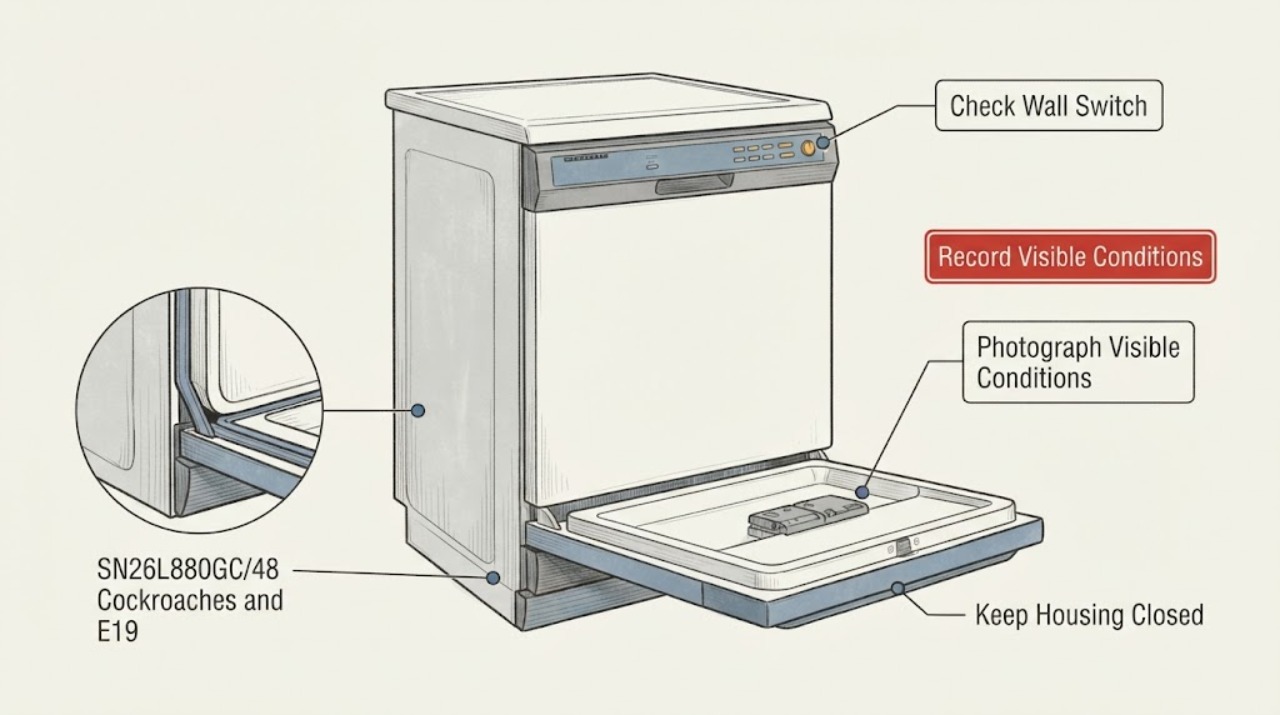
Do not run a Siemens SN26L880GC/48 dishwasher to flush out cockroaches or to see whether E19 clears. The exact Siemens service page identifies this E-number as an iQ500 free-standing dishwasher and lists E19 among its supported error displays. Siemens' official E19 guidance says the code indicates a dispenser or internal-valve problem and recommends closing the water tap and switching off the appliance rather than trying to resolve it at home. Siemens pages from different markets use slightly different wording, so the local manual remains the authority for this /48 variant. From a dry, safe position, close the water tap and isolate power only if the plug, outlet, cord, and floor are safe to reach; keep dishes, detergent, and food-contact items away from visible contamination. Arrange Siemens appliance service and a licensed pest-control assessment separately. Do not spray insecticide into the dishwasher, dispenser, vents, wiring, or cavity, do not use a fogger under the counter, and do not open panels or guess a dispenser or valve replacement.
Work through in order
Diagnostic checks
Use only checks that match the exact appliance or system and its official guide.
-
Check 1
From a dry, uncontaminated position, stop the dishwasher with its normal control, close the water tap, and switch off the appliance. Disconnect the plug only if the outlet, plug, cord, floor, and hands are dry and safely reachable; otherwise isolate the circuit through a qualified person. Do not start another program.
Expected result: E19 remains displayed, the appliance is silent, water is present in or under the unit, the tap cannot be reached safely, or there is moisture near the electrical connection.
Next step: Keep the water tap closed and the appliance isolated. Use Siemens service for the dishwasher and an electrician or plumber when the electrical or water isolation itself is unsafe.
Stop if: Do not reach through water, pull the dishwasher from the cabinet, remove panels, or restore power to see whether E19 returns.
Why this matters
Why: Siemens treats E19 as a dispenser or internal-valve fault that should not be repaired at home, and water or electrical exposure raises the immediate safety priority. A code remaining after switch-off does not identify whether the dispenser, valve, wiring, or control is at fault.
-
Check 2
Without opening the cabinet or spraying anything, photograph the display and record the complete E-number exactly as printed, the local market, when E19 first appeared, whether the dispenser lid opened normally, whether detergent was wet or undissolved, and whether any water leaked. Photograph only from a clean, safe position.
Expected result: The label clearly reads SN26L880GC/48, the suffix differs or is unreadable, E19 appears repeatedly, or the code is actually another E/F code.
Next step: Give the exact label, display photo, manual language/market, and symptom timeline to Siemens service. Do not select a dispenser, valve, or control from a family-level parts list.
Why this matters
Why: The exact model page confirms that /48 is a real Siemens dishwasher variant and lists E19, but code wording and controls can be market-specific. A different suffix or code makes cross-model instructions unreliable.
-
Check 3
Make an exterior-only pest record from a clean area: note live or dead cockroaches, droppings, egg cases, odor, activity around the door seal or floor, and whether contamination is also present under the sink, behind cabinets, or around other appliances. Do not open the door to inspect hidden areas if doing so spreads contamination or exposes standing water.
Expected result: Activity is limited to the surrounding floor, signs are visible at the door or dispenser opening, roaches emerge from under the counter, or the extent cannot be safely determined.
Next step: Keep the dishwasher isolated, remove exposed food and dishes from the area without spreading debris, and arrange a pest-control inspection. Tell the appliance technician about the infestation before any access or transport is planned.
Why this matters
Why: An exterior sighting does not establish that the dishwasher's internal water path or electronics are contaminated. EPA notes that food, water, and shelter sustain pests, while droppings or body parts can trigger allergic reactions; a hidden or widespread infestation needs a coordinated assessment.
-
Check 4
Do not apply insecticide, boric-acid dust, gel, bleach, or a fogger to the dishwasher, dispenser, vents, door seal, wiring, or cavity. If pest treatment is considered, keep all food, dishes, utensils, children, and pets away and have the pest professional specify the labeled treatment area and re-entry/cleaning instructions.
Expected result: A spray or fogger has already been used near the appliance, pesticide contacted dishes or food-contact surfaces, or no pesticide has been used.
Next step: If pesticide contacted food, dishes, or the appliance interior, stop using those items and contact the product label's poison-control or health guidance and the pest professional. Do not run the dishwasher to rinse chemicals into the drain; have Siemens and pest professionals determine safe decontamination.
Stop if: Do not mix chemicals, spray into openings, use an unlabelled product, or use a total-release fogger under the counter.
Why this matters
Why: EPA warns that foggers can create flammable vapors, should not be used in cabinets or under counters, and must be kept away from electrical ignition sources. North Carolina guidance says pesticides must follow their labels and must not be applied where food is prepared or where children or pets can contact them.
-
Check 5
Separate the food-contact decision from the E19 repair: remove clean dishes and detergent packages from the contaminated area only if they can be handled without contact with droppings, dead insects, or pesticide. Bag or isolate visibly contaminated disposable material, and do not place questionable items back into the dishwasher.
Expected result: Dishes or detergent contacted insects, droppings, pesticide, or unknown residue; the interior appears clean but the surrounding cavity is affected; or contamination is unknown.
Next step: Keep questionable food-contact items out of use until cleaned or discarded according to health guidance. Tell both professionals what was exposed and preserve photos and product labels; do not improvise a chemical wash.
Why this matters
Why: A dishwasher cycle is not a validated pest or pesticide-decontamination procedure. Food-contact safety and chemical exposure require the product label, local health advice, or a qualified professional; the E19 code remains an appliance-service issue.
-
Check 6
Request a written Siemens service assessment that addresses E19, the dispenser/internal-valve path, water isolation, and whether the appliance can be safely accessed or transported after pest treatment. Ask the pest professional for a written treatment scope that excludes the dishwasher interior unless the product label and manufacturer guidance permit it.
Expected result: The technician confirms E19, finds a dispenser or internal-valve fault, sees pest contamination, or cannot safely access the unit because it is built in or wet.
Next step: Provide the exact E-number, model label, code photos, water/electrical status, pest photos, treatment products, and dates. Let qualified professionals decide whether repair, decontamination, or replacement is safe and economical.
Why this matters
Why: E19 narrows the service conversation but does not identify a compatible part or prove a pest-related failure. Appliance access and pest treatment can affect each other, so an undocumented spray, removal, or replacement may create new contamination, electrical, water, or warranty risk.
Use your observations
Decision map
Find the observation that best matches what you see, then follow the next safe action.
-
PATH 01Next step
What you see
SN26L880GC/48 is confirmed, E19 returns, and the water tap can be safely closed with no immediate electrical hazard.
Do this next
Leave the dishwasher off and water-isolated and book Siemens service. Disclose the infestation before the technician opens or transports the appliance.
Why this path and its safety boundary
Why it matters: The Siemens code is consistent with a dispenser or internal-valve service issue, but the code alone does not identify the failed part or establish that cockroaches caused it.
-
PATH 02Next step
What you see
Live cockroaches, droppings, egg cases, or pesticide residue are visible in or around the dishwasher cavity, or activity is present under the counter.
Do this next
Keep the appliance isolated and arrange licensed pest-control assessment plus Siemens service. Do not spray, fog, dismantle, or move the dishwasher yourself.
Why this path and its safety boundary
Why it matters: Pest exposure is an independent sanitation and chemical-safety problem; it cannot be resolved by running the dishwasher and does not establish an internal dispenser failure.
-
PATH 03Next step
What you see
Cockroaches are seen only on the surrounding floor, there is no visible pesticide or food-contact contamination, and E19 is absent or does not recur after safe isolation.
Do this next
Keep the area dry and food-free, obtain pest-control advice, and use the exact local Siemens manual for any later code. Arrange appliance service if E19 returns or water/electrical symptoms appear.
Why this path and its safety boundary
Why it matters: The exterior pest problem is not evidence of a dispenser or internal-valve fault. A previous E19 still needs to be reported if it returns, but a clean exterior observation does not justify opening the machine.
-
PATH 04Next step
What you see
The suffix, market, or displayed code cannot be matched to SN26L880GC/48, or water/electrical isolation cannot be performed safely.
Do this next
Do not guess from another Siemens or Bosch model. Keep people away from the wet or treated area and contact Siemens, a qualified electrician/plumber, and pest-control professionals as applicable.
Why this path and its safety boundary
Why it matters: Model-specific E19 interpretation and any user procedure are unresolved, and the hazard exceeds safe observation-only troubleshooting.
Helpful context
Understand the symptom
This is two linked but different service problems: a reported cockroach infestation around or inside a dishwasher, and E19. The Siemens E19 code narrows attention to the dispenser or an internal valve, but it does not prove that cockroaches caused the fault or identify a replacement part. Because the appliance combines water, mains electricity, detergent, heat, and a food-contact environment, isolate it and coordinate appliance and pest professionals instead of running a cleaning cycle.
The exact Siemens page for SN26L880GC/48 identifies an iQ500 free-standing dishwasher and exposes E19 as a selectable error category, but the opened E19 wording is market-specific. Use the manual for the appliance's actual region and language. Do not transfer a different /01, /35, /44, or other suffix's valve, dispenser, diagnostic, or disassembly procedure to /48.
Only after diagnosis
Potential parts
- dishwasher dispenser assembly
Consider only if Siemens service confirms that the E19 fault is in the dispenser path after identifying the exact /48 variant and assessing contamination and safe access.
E19 does not prove a dispenser failure, and Siemens' official wording also includes an internal valve. Confirm the full E-number, market, and technician diagnosis before any part decision. - dishwasher internal water valve
Consider only when a qualified Siemens technician confirms the internal-valve branch of E19 and documents that repair is safe after the pest assessment.
Do not access, test, or order an internal valve from E19 alone; water, electrical, chemical, and pest-contamination risks require professional handling.
When checks do not resolve it
Need a professional?
Call Siemens service before further dishwasher use for recurring E19, any dispenser or internal-valve symptom, water under the appliance, a code that returns after isolation, a built-in unit that must be moved, or any uncertainty about safe access. Arrange pest-control service for live cockroaches, droppings, egg cases, repeated activity, or infestation in the cabinet/cavity; disclose the appliance's E19 and isolation state. Escalate immediately for water near an outlet, damaged cord or plug, sparks, smoke, burning odor, a tripped breaker, chemical exposure, breathing symptoms, or uncontrolled leakage. Do not run a cycle to kill or flush insects, spray into the machine, use a fogger under the counter, mix chemicals, open panels, bypass safety devices, probe wiring, or order a dispenser or valve by model family alone.
Common questions
FAQ
Can I run the Siemens SN26L880GC/48 to kill or flush cockroaches?
No. Running the dishwasher can spread contamination, move insects through the home, or circulate an unapproved chemical; it also does not resolve E19. Close the water tap, switch off the appliance, isolate power only from a dry safe position, and arrange pest-control and Siemens service.
Does E19 prove that the cockroaches damaged the dispenser?
No. Siemens describes E19 as a dispenser or internal-valve problem, but the code does not establish the cause or identify a failed part. Cockroach activity is a separate observation; a technician must assess the appliance after safe isolation and coordinate with pest treatment.
Can I spray insecticide inside the dishwasher or under the counter?
Do not spray into the dishwasher, dispenser, vents, wiring, or cavity. EPA warns against foggers in enclosed spaces such as cabinets or under counters and around electrical ignition sources; pesticide use must follow the exact label and food-contact restrictions. Use pest-control professionals for the infestation assessment.
Read the exact guide
Official sources
- Siemens dishwasher error E19Siemens Home Appliances Germany · Opened official Siemens regional E19 page; the page's exact wording is Germany-specific, so the local manual for SN26L880GC/48 controls regional code interpretation.
- Do you really need to use a pesticide?U.S. Environmental Protection Agency · Government household pest guidance used for sanitation and prevention around a dishwasher; it is not an appliance repair or decontamination protocol.
- Safety Precautions for Total Release FoggersU.S. Environmental Protection Agency · Government pesticide-safety guidance used to prohibit fogging under or inside a dishwasher area; it is not permission to use a fogger in this scenario.
- Model SN26L880GC/48: User manuals, spare parts, accessoriesSiemens Home Appliances · Opened official Siemens Hong Kong service page for the exact /48 E-number; it supports identity and the existence of an E19 category, not the detailed E19 cause or a globally applicable repair procedure.
- Structural Pest Control and Pesticides - Cockroach Control and PreventionNorth Carolina Department of Agriculture and Consumer Services · State-government pest-control guidance used for safe boundaries; local law and the pesticide label govern any treatment, and it does not authorize treatment inside an appliance.
Community feedback
Share a repair observation
Share a plain-text repair observation. Accepted observations are published automatically; this page may take a moment to update.