
On this page
Start here
Quick answer
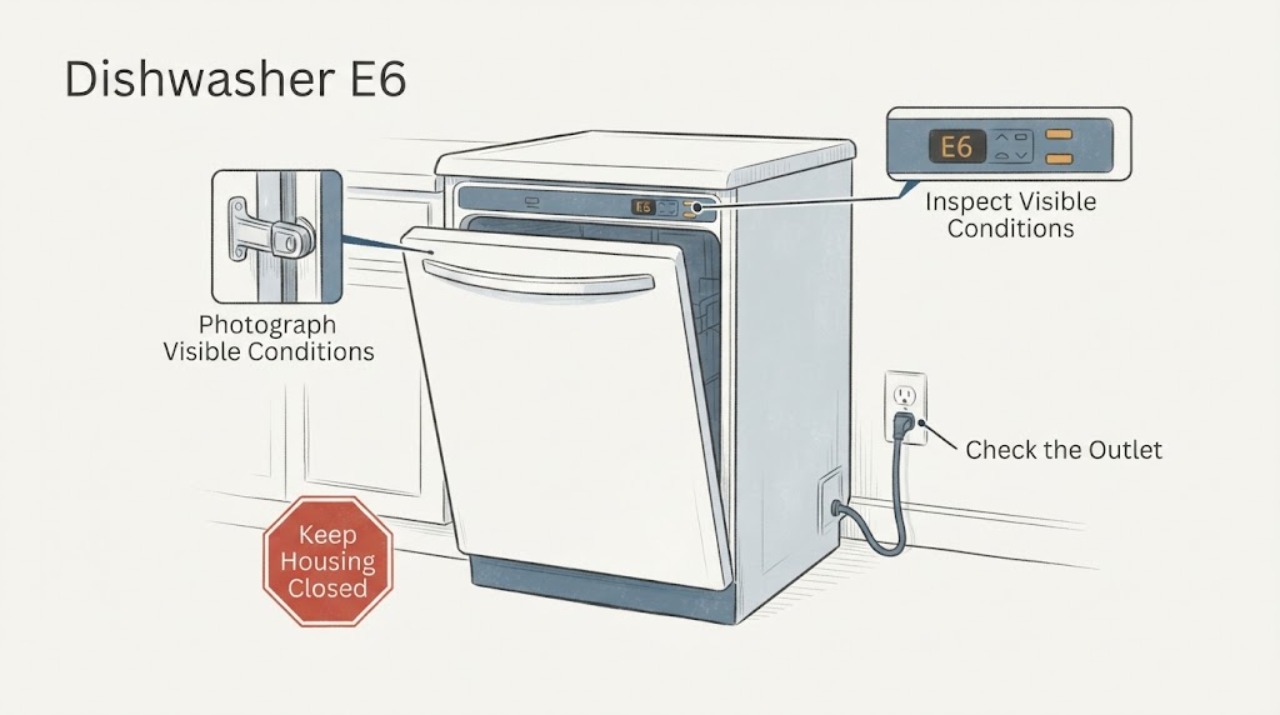
For a Siemens SN25E201EU dishwasher, do not treat an unverified E6, E06, or E:06 display as interchangeable. Siemens' SN25E201EU/01 support page lists E06 among the model's selectable error-code problems, while Siemens' public dishwasher error page labels that entry E06 and tells the user to report it as E6; the same page warns that codes and actions may not apply to every model. Record the exact characters and the complete E-Nr suffix, check only that the door closes without a visible obstruction and that the external power is normal, then use the matching user manual. If the door-sensor/electronics fault returns, or the display format cannot be matched, stop the dishwasher and contact Siemens service. A service manual, hidden key sequence, internal sensor test, control-board diagnosis, or live measurement is not a safe consumer step.
Before you begin
Safety first
- Consumer checks are limited to recording the exact display and complete E-Nr, removing a visibly projecting dish or accessory, confirming normal door closure without force, checking the accessible external power path once, and using only the exact manual's ordinary restart. Do not enter service mode, use hidden button sequences, remove panels or door trim, bypass the door interlock, test internal or live wiring, or select a sensor, lock, or control board from the code.
Work through in order
Diagnostic checks
Use only checks that match the exact appliance or system and its official guide.
-
Check 1
Photograph or write down the complete display exactly as shown, including whether it reads E6, E06, E:06, another code, or only a flashing indicator. Read the rating label for the complete Siemens E-Nr, including the slash suffix, and record the market and when the message appeared.
Expected result: The display and complete E-Nr match a Siemens document, or the characters/suffix remain uncertain.
Next step: Use the exact suffix's public user manual and keep the original display wording in the service request. If the display cannot be identified, do not apply an E6/E06/E:06 procedure by resemblance.
Stop if: Do not open panels or search for a hidden service display to identify the code.
Why this matters
Why: Siemens' SN25E201EU/01 support page proves that this base model has multiple suffix-specific support records and lists E06 as a selectable problem. Siemens' general page separately warns that code meanings and actions may not apply to every dishwasher.
-
Check 2
With the dishwasher off and your hands dry, check only the visible door closing path: remove a dish, rack item, or accessory that visibly projects into the doorway; look for a displaced gasket or obvious debris at the strike area; then close the door normally without forcing it.
Expected result: The door closes and latches normally, a visible item prevents closure, or the door will not close/latch without force.
Next step: Remove only the visible obstruction and follow the exact user manual for one normal cycle if the display has cleared. If the door remains misaligned, will not latch, or the code returns, stop and arrange service.
Stop if: Do not remove door trim, bend the latch, bypass the interlock, or force the door closed.
Why this matters
Why: A visible obstruction can explain a door-related symptom, but a normal-looking door does not prove that an internal door sensor or electronic circuit is healthy. Siemens' public E06 entry directs the user to service rather than an internal sensor test.
-
Check 3
Check the external power path once from a dry, accessible position: confirm the plug is seated, the outlet is not visibly damaged or wet, and the household breaker has not tripped. Use the dishwasher's normal on/off control; do not remove a cover or access electrical points.
Expected result: The dishwasher has normal display power, the outlet or breaker is off, the connection is hot/damaged, or the breaker trips again.
Next step: Restore only an obvious safe external condition once. For a hot/damaged connection, repeated trip, smoke, or burning smell, leave the appliance disconnected and obtain qualified electrical or appliance service.
Stop if: Do not repeatedly reset the breaker, use an extension lead, or access internal fuses, wiring, or terminals.
Why this matters
Why: An external supply interruption can interrupt a programme, but it cannot identify a door sensor or electronics failure. Heat, damage, or a repeated trip is an electrical safety condition.
-
Check 4
If the exact display is matched to the correct public user manual and there is no visible door or electrical hazard, switch the dishwasher off with its normal control and wait a few minutes. Perform at most the single ordinary restart that Siemens documents for the applicable code page, then observe whether the same characters return; do not use a service-mode sequence.
Expected result: The display clears and the dishwasher completes a normal cycle, or the identical code returns immediately or on the next attempt.
Next step: If it clears, keep the recorded code and monitor without repeated resets. If it returns, close the water tap, switch the appliance off, disconnect power only when safe and allowed by the manual, and contact Siemens service with the exact E-Nr and display.
Stop if: Do not repeat power cycling, enter hidden diagnostics, or continue running cycles after a recurring code.
Why this matters
Why: Siemens describes a restart as a consumer step for a technical error, but a cleared message does not prove that the door sensor or electronics fault is repaired. A returning matched code is evidence for professional diagnosis.
-
Check 5
Before requesting service, record the exact E-Nr suffix, market, display characters, cycle stage, door-closing result, power observations, whether water remains, and any odor, heat, smoke, or tripped breaker. Keep the dishwasher out of service if the error persists.
Expected result: The code is recurring, the notation is not in the exact manual, the door cannot latch, water or damage is visible, or the appliance has an electrical warning.
Next step: Give Siemens or a qualified appliance technician the complete identity and observations. Ask for diagnosis against the exact E-Nr rather than ordering a component from the code alone.
Stop if: Do not run the machine with a recurring fault, exposed wiring, water near electrics, smoke, burning odor, or a door that cannot secure.
Why this matters
Why: The public Siemens guidance separates user-visible checks from faults that require service. A recurring E06/E6-type report does not identify a replaceable sensor, lock, or control board from outside.
Use your observations
Decision map
Find the observation that best matches what you see, then follow the next safe action.
-
PATH 01Next step
What you see
The complete E-Nr is confirmed, the display matches the exact public manual, a visible door obstruction is corrected, and the code does not return after the one documented ordinary restart.
Do this next
Monitor the next normal cycle and keep the original code record. If the code returns, stop and contact Siemens with the exact model and display.
Why this path and its safety boundary
Why it matters: The event may have been a transient programme or electronics interruption, but clearing the display does not prove that an internal door sensor or electronic circuit is healthy.
-
PATH 02Next step
What you see
The display is exactly E6 or the Siemens page's E06 entry, but the complete E-Nr suffix or model-specific manual is not confirmed.
Do this next
Treat the notation as unconfirmed, record the label and display, and ask Siemens service to identify the applicable user documentation. Do not use a Bosch or other platform's E06/E:06 instructions.
Why this path and its safety boundary
Why it matters: Siemens' public pages show a notation difference and warn that code actions may not apply to every dishwasher. The code cannot safely be translated into a component diagnosis without the exact suffix.
-
PATH 03Next step
What you see
The door will not latch, the display remains after the safe external checks, or the same matched code returns.
Do this next
Stop using the dishwasher, close the water tap if the manual or local situation calls for it, isolate power only when safe, and arrange qualified Siemens/appliance service.
Why this path and its safety boundary
Why it matters: The visible checks did not resolve the condition; Siemens describes the E06 entry as a door-sensor or electronics fault requiring service, not a user-level internal test.
-
PATH 04Next step
What you see
There is a hot or damaged outlet/cord, repeated breaker operation, smoke, burning odor, water near electrical parts, or exposed wiring.
Do this next
Stop and keep clear; disconnect power only from a safe dry position if possible, and use qualified electrical/appliance service. For active smoke or fire, leave the area and call emergency services.
Why this path and its safety boundary
Why it matters: This is an electrical or water-safety stop condition, regardless of whether the display says E6, E06, E:06, or something else.
Helpful context
Understand the symptom
The useful distinction here is display identity, not a guessed replacement part. Siemens' support workflow for SN25E201EU/01 includes E06 as a selectable dishwasher error, but its general error page presents the same entry under E06 and says to tell service E6. That page also says that code meanings and actions may not apply to every model. Therefore a report of “E6” is not permission to copy an E06, E:06, Bosch, or service-manual procedure onto every SN25E201EU suffix.
Keep the investigation at the consumer level: capture the exact display and E-Nr, check the door and power only from safe accessible positions, and use the model-specific user manual. Do not remove the control panel or door trim, enter service mode, bridge a door interlock, or measure internal wiring. A recurring matched code is a service decision, not a part-ordering decision.
When checks do not resolve it
Need a professional?
Request Siemens or qualified appliance service for a recurring or unmatched E6/E06/E:06 display, a door that will not latch, or any suspected door-sensor/electronics fault. Use qualified electrical help for a damaged or hot supply connection or repeated breaker trips.
Safety scope: Consumer checks are limited to recording the exact display and complete E-Nr, removing a visibly projecting dish or accessory, confirming normal door closure without force, checking the accessible external power path once, and using only the exact manual's ordinary restart. Do not enter service mode, use hidden button sequences, remove panels or door trim, bypass the door interlock, test internal or live wiring, or select a sensor, lock, or control board from the code.
Have this ready
- Provide the complete E-Nr including slash suffix, market, exact display characters, a photo of the rating label if available, cycle stage, door-closing result, power observations, and any water, odor, heat, smoke, or breaker history.
Common questions
FAQ
Does Siemens E6 mean the same thing as E06 or E:06?
Do not assume that. Siemens' public page has an E06 heading and tells the user to report E6, while also warning that code meanings and actions may not apply to every model. Record the exact display and complete SN25E201EU suffix and use the matching manual.
Can I run a service-mode test for the SN25E201EU E6 fault?
No. A service-mode sequence, internal sensor measurement, or control-panel disassembly is outside safe consumer troubleshooting. Limit checks to the visible door, external power, exact display, and one ordinary restart allowed by the exact user manual, then use qualified service if the fault persists.
Can I replace the door sensor or control board because E6 is displayed?
Not from the code alone. Siemens' public E06 entry describes a door-sensor or electronics fault and directs the user to service; it does not identify which internal component has failed. Provide the full E-Nr and exact display to the technician.
What should I do if E6 disappears after switching the dishwasher off?
Keep the recorded display and monitor one normal cycle if the exact user manual permits that ordinary restart. A cleared code is not proof of repair. If it returns, stop, close the water tap if appropriate, isolate power safely, and request service.
Read the exact guide
Official sources
- Siemens dishwasher error codes and what they meanSiemens Home Appliances · General Siemens consumer guidance, not a substitute for the exact SN25E201EU slash-suffix manual; the page explicitly warns that codes and recommended actions may not apply to every dishwasher.
- Siemens online support assistant — SN25E201EU/01Siemens Home Appliances · Exact Siemens support record for the SN25E201EU base model with /01 E-Nr suffix; the page lists E06 under its dishwasher error-code problem category but does not authorize service-mode or internal testing.
Community feedback
Share a repair observation
Share a plain-text repair observation. Accepted observations are published automatically; this page may take a moment to update.