
On this page
Start here
Quick answer
On the Siemens SN65Z802BE, first identify when the hum occurs rather than naming a part. Siemens lists Zeolith and a heat exchanger for this exact model, and its Zeolith description says a fan moves moist air during drying; a quiet, phase-linked hum without a leak, harsh vibration, burning smell, or standing water can therefore be a normal operating sound. A hum that is unusually loud or rough, continues with poor draining, or appears with a leak or electrical warning should end the test and go to Siemens service. Do not open the base, touch a pump or fan, or run repeated cycles just to reproduce the sound.
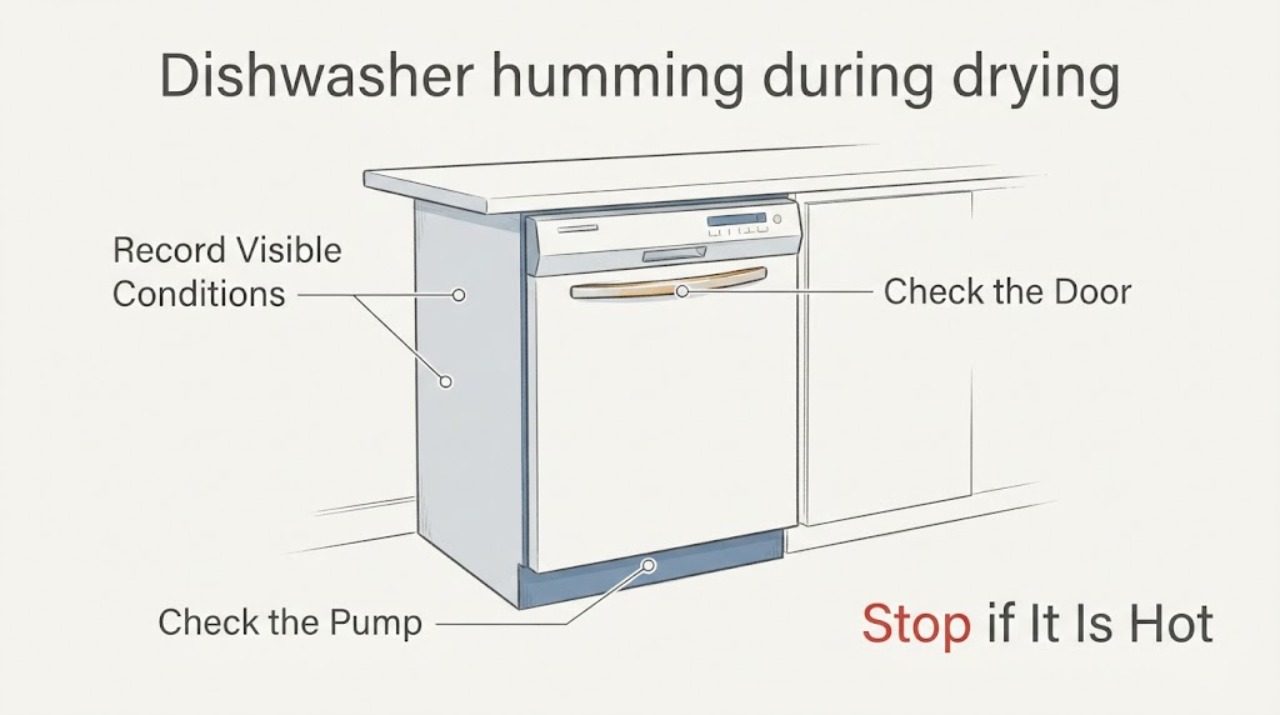
Work through in order
Diagnostic checks
Use only checks that match the exact appliance or system and its official guide.
-
Check 1
Read the rating plate and record the complete E-Nr or model text, then note whether the hum was heard during the drying stage, while water was being discharged, at the end of the programme, or at several stages.
Expected result: The plate confirms SN65Z802BE, an added slash suffix is present, and the sound is tied to one stage or is present throughout the programme.
Next step: Keep the full model and phase description for the Siemens support record. Do not assign a pump, fan, or other component from the word hum alone.
Stop if: Stop if the rating plate cannot be read without moving or dismantling the appliance, or if the sound is accompanied by smoke, a burning smell, or exposed wiring.
Why this matters
Why: The exact model confirms which drying technology is present, while phase timing separates a documented drying-air process from a discharge-related sound or a broader mechanical symptom. A missing suffix or uncertain timing limits what can be concluded.
-
Check 2
After the programme has ended and the dishwasher is safe to approach, inspect the visible floor area, door edge, and cabinet front for water, fresh residue, scorching, or a new gap; note whether the dishes completed drying normally and whether any water remains in the tub.
Expected result: There is no visible leak and no unusual residue, or there is water near the appliance, standing water, scorching, or a persistent wet interior beyond the expected end state.
Next step: If the end state is normal, record it and avoid repeated sound tests. If water, scorching, or abnormal residual water is present, leave the dishwasher off and arrange model-specific service.
Stop if: Stop immediately for active leakage near electrical parts, smoke, a burning or electrical odor, or a hot plug or cord; isolate water or power only when the shutoff or plug is safely accessible.
Why this matters
Why: A quiet hum with a normal end state is less concerning than a hum paired with drainage trouble, leakage, or heat damage. The visible result does not identify an internal pump or fan, but it determines whether continued use is reasonable.
-
Check 3
From outside the machine, classify the sound you already heard as a low steady hum, a rough or grinding hum, a knock or rattle, or a buzz that changes with cabinet vibration. Do not place hands near the running door, spray arms, pump area, or underside.
Expected result: The hum is low and brief, the sound is very loud or rough, the noise is a knock or rattle, or the cabinet vibrates or shifts.
Next step: For a quiet phase-linked sound with no warning signs, document the pattern and use the dishwasher normally without trying to reproduce it. For a loud, rough, repeated, or movement-related sound, stop further testing and request service rather than opening the base or ordering a part.
Stop if: Stop use for harsh grinding, metal-on-metal noise, repeated abnormal vibration, visible cabinet movement, smoke, or any electrical or water warning.
Why this matters
Why: Siemens describes ordinary humming or buzzing during discharge and identifies loading-related knocks or rattles as a separate pattern. A very loud or rough sound is not explained by the normal description, but sound alone still cannot prove which internal component is involved.
-
Check 4
Compare the timing with the SN65Z802BE drying design: Siemens says Zeolith drying uses a fan to direct moist air into a zeolite chamber, where moisture absorption generates heat. Treat this as an explanation for why a drying-stage airflow sound may exist, not as proof that the fan is failing.
Expected result: The hum appears only while drying and the completed load is otherwise normal, or it is accompanied by poor drying, overheating, an error, or a new smell.
Next step: If the drying result and appliance exterior are normal, keep the observation as a baseline and do not dismantle anything. If drying changes or a warning symptom appears, stop use and provide Siemens service with the exact model, programme, phase, and visible symptoms.
Stop if: Do not remove panels, reach toward a fan, bypass a safety device, or continue a cycle after overheating, smoke, burning smell, or electrical damage.
Why this matters
Why: A phase-specific hum with normal results is consistent with an operating drying process. A change in drying performance or a heat, odor, or error symptom means the normal-process explanation is no longer sufficient and the appliance needs model-specific diagnosis.
-
Check 5
Prepare a service handoff without opening the dishwasher: provide the complete model and any suffix, programme and option, point in the cycle, duration and character of the hum, whether it is new or worsening, and the end-state observations.
Expected result: The sound can be described by phase and character, or the model, suffix, and timing remain uncertain.
Next step: Request Siemens service with the recorded details. Ask the technician to assess drainage, drying airflow, mounting, and internal components using the exact E-Nr rather than accepting a part diagnosis based only on the noise label.
Stop if: Stop all user diagnosis when the next check would involve the base, electrical covers, internal pump or fan, live testing, or a water/electrical hazard.
Why this matters
Why: Siemens support and documentation are model-specific, and a phase-based description is more useful than an assumed pump or fan diagnosis. Missing identity or a sound that cannot be safely observed leaves the internal cause unresolved.
Use your observations
Decision map
Find the observation that best matches what you see, then follow the next safe action.
-
PATH 01Next step
What you see
The hum is quiet, occurs only in the documented drying or discharge phase, and there is no leak, harsh vibration, odor, smoke, error, or abnormal end state.
Do this next
Record the phase and continue normal use without repeating cycles to reproduce the sound. Escalate if the sound becomes louder, changes character, or gains a safety or performance symptom.
Why this path and its safety boundary
Why it matters: The pattern is compatible with normal Siemens dishwasher operation, including the SN65Z802BE's Zeolith drying airflow or ordinary water discharge; no component failure has been established.
-
PATH 02Next step
What you see
The hum is very loud, rough, persistent across stages, or paired with standing water, poor drainage, poor drying, an error, or a new leak.
Do this next
Leave the dishwasher off and arrange Siemens service with the exact model, programme, timing, and visible result. Do not remove the base or inspect the pump or fan yourself.
Why this path and its safety boundary
Why it matters: The normal phase-sound explanation is insufficient. An internal drainage, drying, mounting, or control issue is possible, but the sound does not identify the failed part.
-
PATH 03Next step
What you see
The noise comes with cabinet movement, metal-on-metal impact, smoke, burning or electrical odor, a hot cord, or water near electrical parts.
Do this next
Stop using the dishwasher. From a safe, dry position isolate power or water only if the control, plug, or shutoff is safely accessible, then contact qualified appliance service; use emergency help for an immediate fire or electrical danger.
Why this path and its safety boundary
Why it matters: This is a safety stop, not a sound-identification exercise. Continued operation could worsen an electrical, water, or mechanical hazard.
When checks do not resolve it
Need a professional?
A Siemens technician should assess the appliance when the hum is loud, rough, worsening, present with standing water or poor drying, or accompanied by vibration, an error, odor, smoke, or a leak. Supply the complete SN65Z802BE identification and phase-based observation; do not approve a pump or fan replacement from sound alone.
Common questions
FAQ
Does a hum during drying prove the Zeolith fan is failing?
No. Siemens identifies Zeolith drying on the SN65Z802BE and explains that a fan moves moist air during drying. That establishes a plausible operating mechanism, not a part failure. A change in drying, a loud or rough sound, or a safety symptom needs service diagnosis.
Should I remove the filter or pump cover to find the source?
Not for this observation. Siemens has model-specific cleaning guidance, but the safe decision here is based on phase, loudness, visible end state, and safety symptoms. Do not remove the base or reach into the pump or fan; ask service to use the exact E-Nr if an internal inspection is required.
Read the exact guide
Official sources
- SN65Z802BE Volledig integreerbare vaatwasser | SIEMENS BESiemens Home Appliances · Exact base model SN65Z802BE, Siemens Belgium product page
- Geschirrspüler macht Geräusche | Siemens Hausgeräte DESiemens Home Appliances · Siemens dishwasher symptom guidance for normal humming or buzzing, loud noise, rattling, and professional escalation; not a model-specific component diagnosis
- Zeolith® Drying Technology | Siemens Home IESiemens Home Appliances · Siemens dishwasher Zeolith drying mechanism; exact SN65Z802BE product page confirms this model has Zeolith
Community feedback
Share a repair observation
Share a plain-text repair observation. Accepted observations are published automatically; this page may take a moment to update.