
On this page
Start here
Quick answer
There is no Siemens evidence that simply omitting rinse aid doubles a dishwasher's electricity use. Siemens documents rinse aid primarily as a drying aid, while combination tablets may contain rinse-aid and salt-replacement substances but are not automatically equivalent to the dishwasher's separate dispenser settings. First identify the exact E-Nr and market: “Series 700” is a product family, not a complete model, and Siemens requires the rating-plate E-Nr for the correct manual and parts or settings. Then compare the same programme, load, options, water-hardness setting, and meter method. The EU energy-label figure is based on the Eco programme and 100 cycles, so it is not a promise for every cycle. A large difference that remains under matched conditions is an efficiency or measurement question for Siemens service, not a reason to replace a component from the rinse-aid observation alone.
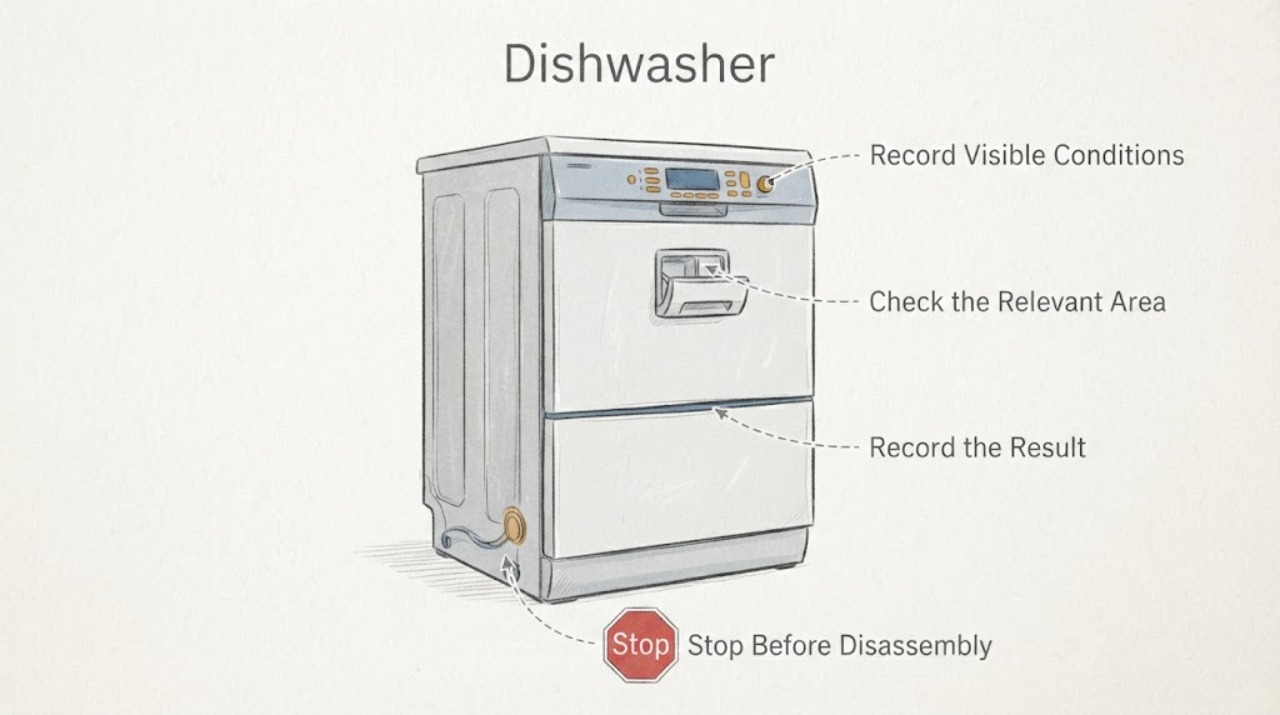
Work through in order
Diagnostic checks
Use only checks that match the exact appliance or system and its official guide.
-
Check 1
Read the dishwasher rating plate and record the complete Siemens E-Nr, including the slash suffix, plus the market or country of purchase; do not treat “Series 700” as the model number.
Expected result: The plate provides a complete E-Nr, or only the Series 700 family name is available.
Next step: Use the exact E-Nr in Siemens documentation lookup before changing rinse-aid, water-softener, or programme settings. If the E-Nr cannot be read, keep the comparison at family-level and do not order parts or assert a fault.
Stop if: If the plate is inaccessible without moving or dismantling the dishwasher, stop at the visible information and ask qualified service to identify it.
Why this matters
Why: Only the exact E-Nr routes to the applicable Siemens manual, programme list, settings, and appliance data; a family name cannot validate a model-specific energy claim.
-
Check 2
Define the energy comparison before drawing a conclusion: use the same programme, load size, water supply condition, detergent or tab, rinse-aid state, water-softener setting, and optional functions, and record actual kWh rather than only cost or a smart-meter percentage.
Expected result: The two readings used different programmes, loads, options, water-hardness settings, tariffs, time windows, or measurement devices, or the conditions were matched.
Next step: Repeat or compare only under the same safe, normal-use conditions and keep a dated log of programme and options. Do not repeatedly run cycles solely to chase a number if the appliance has a leak, fault indication, or unsafe electrical symptom.
Stop if: If the conditions cannot be matched, label the result inconclusive instead of calling it a rinse-aid energy penalty.
Why this matters
Why: Unmatched conditions can easily explain a large apparent difference; matched conditions make the remaining difference worth documenting, but still do not identify a failed component.
-
Check 3
Check the exact manual's selected programme and options, including Eco, auto, quick, intensive, extra-dry, speed, or any connected-app modification; record what was actually active when the high reading occurred.
Expected result: The high-use reading came from a quick or intensive cycle, a sensor-controlled auto cycle, a drying-enhanced or speed option, or the same Eco setup used for the comparison.
Next step: Compare like with like using the exact E-Nr manual and the same options. If an unexpected option keeps returning or a programme behaves abnormally, save the display and request model-specific support rather than changing internal settings.
Stop if: If no option history is available, treat the energy comparison as uncertain.
Why this matters
Why: Siemens explains that programme duration and efficiency vary by programme and load; a speed or drying option can change the operating profile, while an Eco label value is not a universal per-cycle value.
-
Check 4
Verify the detergent format, separate rinse-aid setting, salt status, and local water hardness against the exact manual; do not assume a multi-tab's integrated ingredients are identical to a separately dosed rinse aid or that they override the machine's settings.
Expected result: Separate rinse aid is empty or disabled, a combination tab is being used, water hardness is above the tab's stated range, salt is missing, or the settings match the manual.
Next step: Apply only the exact manual's water-softener and rinse-aid instructions, then assess drying quality and matched kWh separately. Do not add extra detergent, washing-up liquid, vinegar, or unapproved chemicals to compensate.
Stop if: If the dispenser and settings already match the manual, do not change them merely to explain an unverified energy number.
Why this matters
Why: Siemens links rinse aid to drying and says combination tabs have water-hardness limits; these conditions can change drying and residue results, but the official guidance does not quantify a doubled electricity use from missing rinse aid.
-
Check 5
Escalate a persistent, matched-condition difference only with the E-Nr, market, programme and option log, kWh readings, load description, water-hardness setting, detergent and rinse-aid format, cycle duration, and any error or performance symptom; do not open the dishwasher or order a part from the energy claim.
Expected result: The high reading disappears when conditions are matched, remains without any functional symptom, or remains together with abnormal heating, cycle length, drying, leaks, or an error display.
Next step: Use Siemens support or a qualified technician for a persistent, well-documented discrepancy; request diagnosis before any repair. Stop using the dishwasher for a leak near electrical parts, burning odor, smoke, sparks, damaged cord, or recurring protective-device trip.
Stop if: If there is no repeatable discrepancy or appliance symptom, do not create a component fault from the original comparison.
Why this matters
Why: A disappearing difference points to measurement or use conditions. A persistent difference with performance symptoms may justify model-specific efficiency diagnosis, but the energy observation alone cannot name a heater, sensor, pump, or control part.
Use your observations
Decision map
Find the observation that best matches what you see, then follow the next safe action.
-
PATH 01Next step
What you see
The comparison used different programmes, loads, options, or meter/cost calculations.
Do this next
Discard the causal conclusion and repeat only a like-for-like comparison, or report the result as inconclusive.
Why this path and its safety boundary
Why it matters: The apparent doubling is not attributable to rinse aid because the experiment changed more than one variable.
-
PATH 02Next step
What you see
The exact E-Nr is unavailable and only “Series 700” is known.
Do this next
Locate the rating plate or ask Siemens service to identify the appliance before making a model-specific fault or efficiency claim.
Why this path and its safety boundary
Why it matters: Model-specific programme, setting, and energy data cannot be verified; Series 700 is not a unique appliance identity.
-
PATH 03Next step
What you see
Separate rinse aid is absent or disabled, but the only change is poorer drying or more water left on dishes, with no validated kWh increase.
Do this next
Use the exact manual to set rinse aid and water softener for the detergent and local hardness, then judge drying separately from electricity use.
Why this path and its safety boundary
Why it matters: That pattern is consistent with Siemens' documented rinse-aid function and does not prove an energy fault or a failed heater.
-
PATH 04Next step
What you see
A matched, repeatable high kWh reading is accompanied by abnormal heating, an unusually long or incomplete cycle, an error display, a leak, burning odor, smoke, sparks, or a recurring electrical trip.
Do this next
Stop use for the safety symptoms and contact Siemens or a qualified appliance technician with the full E-Nr and measurement log. Do not open panels, enter service mode, or test live components.
Why this path and its safety boundary
Why it matters: The combination warrants model-specific professional diagnosis; rinse-aid absence still does not identify the failed component.
Helpful context
Understand the symptom
What the rinse-aid observation does and does not show
Siemens describes rinse aid as a way to improve drying and reduce water marks. It also says that 3-in-1, 4-in-1, and 5-in-1 tabs can contain detergent, rinse aid, salt-replacement substances, and other additives, with limitations that depend on water hardness. Those statements do not establish a one-to-one electrical-energy penalty when separate rinse aid is absent. Poorer drying, a different tab, a different programme, an enabled option, or a changed water-softener setting can alter the result without proving an appliance fault.
Why “Series 700” is not enough for a model diagnosis
Siemens documentation lookup is driven by the E-Nr on the dishwasher rating plate. The exact suffix and market determine which manual, programme names, options, and energy data apply. Do not use a Series 700 family label to infer a particular sensor, heater behavior, multi-tab function, or energy figure. Record the full E-Nr before changing settings or asking service to interpret the comparison.
Energy-label figures are a controlled reference
Siemens says the dishwasher energy label is based on the Eco programme and reports energy per 100 operating cycles. Its buying guide also notes that Eco runs longer but can be more efficient because the load has more time to soak and less heat is needed, while auto programmes vary with load and soil level. A meter reading from one short, intensive, auto, or option-enhanced cycle cannot be compared directly with the label or with another programme.
When checks do not resolve it
Need a professional?
Request Siemens or qualified service when a complete E-Nr is available but a matched, repeatable energy discrepancy occurs with abnormal heating, cycle timing, incomplete programmes, error displays, leaks, or other performance changes. Stop using the dishwasher for smoke, sparks, burning odor, a damaged or hot cord, active water near electrical parts, or a recurring protective-device trip. Do not open panels, enter service mode, test live parts, or order a component from the rinse-aid observation.
Common questions
FAQ
Does not using separate rinse aid double a Siemens dishwasher's energy consumption?
No such doubling is established by Siemens' public guidance. Siemens describes rinse aid mainly as a drying aid and says combination tablets may contain rinse-aid and salt-replacement substances. Compare the same programme, options, load, settings, and kWh measurement before treating the result as an appliance issue.
Are multi-tabs with integrated rinse aid the same as filling the separate rinse-aid dispenser?
Do not assume they are identical. Siemens says combination tablets contain additional ingredients and have water-hardness limits, while the dishwasher's separate rinse-aid quantity is independently adjustable. Follow the exact E-Nr manual and local water-hardness guidance.
Can I compare my reading with the Siemens energy-label number?
Only with care. Siemens says the dishwasher label is based on the Eco programme and reports energy per 100 cleaning cycles. A reading from another programme, load, option set, or measurement method is not a direct comparison.
What exact model information does Siemens need?
Siemens needs the complete E-Nr from the rating plate, including the slash suffix. “Series 700” is a family label and is not sufficient for model-specific manuals, programmes, settings, or service diagnosis.
Read the exact guide
Official sources
- What is the best dishwasher to buy? | Siemens Home UKSiemens Home Appliances · The official Siemens guide explains that programme time and efficiency vary with Eco, quick, auto, load, and options; it is general UK guidance and does not define the unspecified Series 700 model's exact energy rating.
- Energy Label | Siemens Home AppliancesSiemens Home Appliances · The official Siemens EU energy-label page explains that dishwasher energy-label values use the Eco programme and energy per 100 operating cycles; it is a measurement reference, not a Series 700 product sheet or a diagnosis of the reported comparison.
- Good to know | Siemens Home UKSiemens Home Appliances · The official Siemens page recommends matching rinse-aid and water-softener settings to the detergent type and points users to the exact manual; it supports settings context but does not quantify an energy penalty for missing rinse aid.
- Siemens dishwasher cleaning and care tipsSiemens Home Appliances · The official Siemens page explains rinse-aid and combination-tab functions, water-hardness limits, and drying effects across Siemens dishwashers; it does not state that missing rinse aid doubles electricity consumption or identify a Series 700-specific energy fault.
- User Manuals | Siemens UKSiemens Home Appliances · The official Siemens UK manual page requires the appliance model number (E-Nr) from the rating plate to access documentation; it does not identify a particular Series 700 dishwasher or prove an energy effect from rinse aid.
- Spare Parts for Dishwashers | Siemens UKSiemens Home Appliances · The official Siemens dishwasher parts page says the E-Nr identifies the appliance and is needed to list fitting parts; it is used here to prevent Series 700 from being treated as a unique model and does not diagnose the energy report.
Community feedback
Share a repair observation
Share a plain-text repair observation. Accepted observations are published automatically; this page may take a moment to update.