
On this page
Start here
Quick answer
A Siemens iQ500 water-tap symbol during a cleaning cycle is not enough to identify one part or one E-code because iQ500 is a product series, not a complete E-Nr. Record the exact display, complete E-Nr, market, and the point in the cycle where it appeared. From a dry position, check that the tap is fully open and the visible inlet hose is not kinked; use the exact manual before touching an inlet filter or AquaStop connection. Siemens' official water-tap guidance separates a bent or blocked hose, insufficient water flow, and a blocked inlet filter. An opened Siemens dishwasher manual for another model uses E15 for activated water protection and E18 with water-supply faults, but those meanings cannot be transferred to an unspecified iQ500. If the display is actually E15, water is in the base, the machine leaks, the tap symbol returns after the external checks, or the full E-Nr is unavailable, close the tap, switch the dishwasher off, do not tilt or dismantle it, and arrange Siemens service.
Before you begin
Safety first
- Do not tilt or dismantle the dishwasher, open panels, disconnect a pressurized inlet or AquaStop hose, bypass water protection, probe live parts, or continue cleaning cycles to reproduce the water-tap indication. Close the tap and stop use for E15-like indications, visible water, uncontrolled filling, leaks, or wet electrical areas.
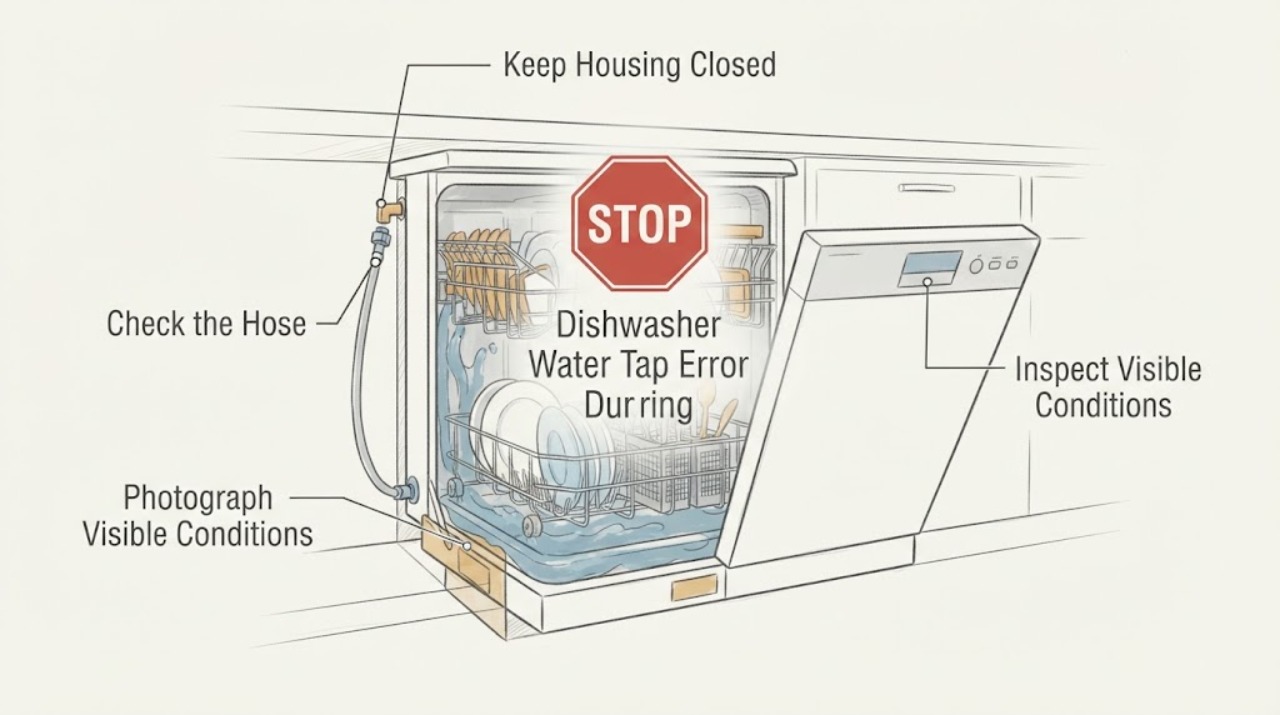
Work through in order
Diagnostic checks
Use only checks that match the exact appliance or system and its official guide.
-
Check 1
Stop the cleaning cycle from a dry position and record the exact display: the water-tap icon, E15, E18, E:xx, a blinking indicator, or a different symbol. Photograph the panel and record the complete E-Nr/model label, country, and the time in the cycle when the indication appeared.
Expected result: Only iQ500 is known, the display is a water-tap symbol, a complete E-code is visible, the code appears late in the cycle, or water is present in or around the appliance.
Next step: Use the full E-Nr to retrieve the matching Siemens manual. If the E-Nr cannot be found, preserve the photo and treat the code as model-uncertain; do not apply a code meaning from another iQ500.
Stop if: Do not clear a suspected E15 or water-protection event by repeatedly restarting, tilting, or opening the appliance.
Why this matters
Why: A series name cannot select the correct code table. A water-tap symbol is a supply-path warning at a general level, while an E15-like display may represent water protection on some Siemens platforms. Late-cycle timing or water in the base raises a different safety branch than a tap that was closed at startup.
-
Check 2
From a dry, safe position, confirm that the dedicated dishwasher tap is fully open and that the visible inlet hose is not kinked, crushed, or trapped behind the cabinet. Do not pull the machine out or disconnect the hose to perform this check.
Expected result: The tap is closed or partly restricted, the hose is kinked or crushed, or the visible supply path looks clear.
Next step: Correct only a plainly visible tap or hose position if it is safe, then use the exact manual for a single supervised retry. If the indication returns, close the tap and arrange service rather than replacing an inlet valve by guess.
Stop if: Do not loosen fittings, move the dishwasher, immerse or bypass an AquaStop device, or operate near a wet outlet.
Why this matters
Why: Siemens identifies a closed or restricted tap and a kinked or blocked supply hose as common water-tap causes. A clear visible path does not prove adequate flow or exclude a blocked filter or internal fault.
-
Check 3
If the installation allows a safe household check without disconnecting the dishwasher, observe whether the nearby tap provides a normal, steady flow. Use the official Siemens flow guidance only as a general check; do not create a hose-disconnection test when the E-Nr is unknown or the area is wet.
Expected result: Flow is visibly weak or intermittent, the tap or aerator is furred or jammed, household water is normal, or the flow cannot be checked safely.
Next step: Ask a plumber or installer to correct a household flow problem. If flow is normal, keep the dishwasher off when the symbol returns and give the technician the exact cycle timing and display photo.
Stop if: Do not disconnect a pressurized inlet hose, test water flow with the dishwasher electrical area wet, or treat one normal faucet check as proof the appliance is healthy.
Why this matters
Why: Siemens' water-tap guidance treats low flow and a jammed or furred tap as separate supply conditions. Normal household flow makes a kink or filter/internal dishwasher path relatively more important but does not prove a valve, flow meter, or control failure.
-
Check 4
Check the exact Siemens manual for whether the inlet filter or supply-connection screen is a user-accessible item on this model. Only if the model manual explicitly permits it, and only with the appliance off, the tap closed, and the area dry, inspect for a visibly blocked filter without forcing the connection.
Expected result: The matching manual permits the filter check and the screen is visibly blocked, the manual does not match or does not permit access, or the filter path is clear but the symbol returns.
Next step: Follow only the matching manual for any permitted external filter care. Otherwise close the tap and arrange Siemens service; do not dismantle the inlet valve or AquaStop assembly.
Stop if: Do not pry a filter, cut or immerse an AquaStop hose, open the door base, or restore water to a damaged connection as a test.
Why this matters
Why: Siemens identifies a blocked inlet filter as a water-tap cause, but access and AquaStop construction vary by model. A mismatch or inaccessible screen means the safe boundary has been reached; a clear screen does not rule out low flow, a metering fault, or water protection.
-
Check 5
Separate the water-tap indicator from an E15-like water-protection event. Without tilting or opening the dishwasher, look for a visible leak, wet flooring, water escaping from the plinth, persistent filling, or a pump that continues to run after the cycle stops.
Expected result: E15 is displayed, water is in or under the base, the machine leaks or keeps filling, the water-tap symbol appears without visible water, or the appliance is dry and the display is uncertain.
Next step: Close the water tap, switch the dishwasher off, and arrange qualified Siemens service. Do not run another cleaning cycle or use the display to decide whether a leak is harmless.
Stop if: Do not tilt the dishwasher to drain a base tray, remove panels, bypass the water-protection system, or touch wet electrical parts.
Why this matters
Why: The comparison Siemens manual uses E15 for activated water protection and E16 for continuous inflow, while E18 or a water-supply indicator covers supply-path causes. Those meanings are not guaranteed for an unspecified iQ500, but visible water or uncontrolled filling requires the same immediate safety response: close the tap and stop use.
-
Check 6
If the tap, visible hose, household flow, and any manual-permitted filter check are normal but the water-tap indication returns during the same cleaning stage, document the exact timing and whether the machine still fills, washes, drains, or heats. Do not infer a flow sensor, circulation pump, or control board from timing alone.
Expected result: The symbol appears only near the end, the first half of the cycle is normal, the machine leaves standing water, or the symbol returns immediately after startup.
Next step: Keep the dishwasher off and request a Siemens diagnosis using the complete E-Nr, display photo, cycle stage, supply observations, and any water-protection signs. Ask the provider to test the applicable water-inlet and metering path before selecting a part.
Stop if: Do not enter an unverified service mode, replace a flow sensor or inlet valve by series name, or keep cycling to make the symbol recur.
Why this matters
Why: A repeated or stage-specific warning after external supply checks is an unresolved model-specific fault. A public iQ500 report with no complete model describes a late-cycle water-tap indication despite normal hose, filter, pressure, leak, and drainage checks, later associated by the user with a flow-sensor repair; this cannot be transferred to every iQ500.
Use your observations
Decision map
Find the observation that best matches what you see, then follow the next safe action.
-
PATH 01Next step
What you see
The water-tap indicator appears at startup and the tap is closed, the visible inlet hose is kinked, or household flow is clearly restricted.
Do this next
Correct only the safe visible tap or hose condition, then use the exact E-Nr manual for one supervised retry. If the indication returns, close the tap and call Siemens service.
Why this path and its safety boundary
Why it matters: A visible supply restriction is the leading supported branch at series level.
-
PATH 02Next step
What you see
The water-tap indicator returns after the tap, hose, flow, and model-permitted inlet-filter checks are normal.
Do this next
Keep the dishwasher off, provide the complete E-Nr and cycle timing, and request Siemens diagnosis. Do not order an inlet valve, flow sensor, or control board from the symbol alone.
Why this path and its safety boundary
Why it matters: An internal inlet, metering, protection, or model-specific control path remains possible; the series name cannot select a component.
-
PATH 03Next step
What you see
The display is E15 or another water-protection indication, water is visible in the base or on the floor, the machine keeps filling, or a leak is suspected.
Do this next
Close the tap, switch off the dishwasher, keep away from wet electrical areas, and arrange qualified service without tilting or dismantling the appliance.
Why this path and its safety boundary
Why it matters: This is a water-protection or flooding branch. An opened Siemens manual example assigns E15 to water protection, but exact applicability still depends on E-Nr.
-
PATH 04Next step
What you see
Only iQ500 is known, the full E-Nr cannot be recovered, or the displayed symbol/code does not match the opened Siemens documentation.
Do this next
Photograph the rating plate and display, obtain the regional manual through Siemens using the full E-Nr, and ask service to identify the code before any internal check.
Why this path and its safety boundary
Why it matters: The model-specific evidence is insufficient for an exact code meaning, button sequence, flow threshold application, or part recommendation.
Helpful context
Understand the symptom
iQ500 identifies a Siemens dishwasher family, not a single platform. Siemens' support pages use the complete E-Nr to expose the applicable troubleshooting and manual content, and the opened iQ500 support example lists many different water and error problems under one exact model page. Until the full E-Nr and market are recorded, use only safe series-level checks and do not borrow a code definition from another iQ500.
Siemens' official water-tap guidance separates a kinked or blocked supply hose, insufficient flow at the tap, and a blocked inlet filter. The same guidance ends with service when those checks do not solve the indication. A comparison Siemens manual uses E15 for water protection and E18 for a water-supply path, but the missing E-Nr prevents treating those labels as confirmed for this dishwasher.
Only after diagnosis
Potential parts
- water-inlet filter, inlet hose, or AquaStop assembly
Consider this class only after the complete E-Nr manual and a qualified inspection confirm a supply-path fault. A water-tap symbol does not establish that the filter, hose, valve, or AquaStop assembly is defective.
Verify the complete E-Nr, market, hose configuration, and documented failure before ordering; do not use a generic iQ500 part or disconnect a pressurized connection as a trial. - flow-meter, water-protection, or control-path component
Consider an internal metering or control component only when the exact model service documentation and diagnostic evidence show that the supply path is adequate and the component fails the applicable test. The unspecified iQ500 community case is not proof of fit or cause.
Do not order a flow sensor, inlet valve, control, or water-protection part from the iQ500 series name, a late-cycle symptom, or a community report alone.
When checks do not resolve it
Need a professional?
Call Siemens service for a recurring water-tap indication, any E15 or water-protection display, a late-cycle warning after supply checks, standing water, leakage, or a missing complete E-Nr. Call a plumber for low household flow, a blocked tap, or a restricted building supply.
Safety scope: Do not tilt or dismantle the dishwasher, open panels, disconnect a pressurized inlet or AquaStop hose, bypass water protection, probe live parts, or continue cleaning cycles to reproduce the water-tap indication. Close the tap and stop use for E15-like indications, visible water, uncontrolled filling, leaks, or wet electrical areas.
Have this ready
- Provide the complete E-Nr and serial label, country, display photo, exact water-tap or E-code characters, cycle stage and elapsed timing, whether filling/washing/draining/heating continued, tap and hose observations, flow result if safely established, filter-check result if manual-permitted, leak or base-water observations, and the manual version.
Common questions
FAQ
What does the water-tap symbol mean on a Siemens iQ500 dishwasher?
At the series level it indicates a water-supply check, but iQ500 is not a complete model. Siemens lists a closed or restricted tap, kinked hose, low flow, and blocked inlet filter as separate possibilities. The full E-Nr is needed before applying a model-specific code or repair step.
Is E15 the same as the water-tap error?
Do not assume that. An opened Siemens dishwasher manual example lists E15 as activated water protection, while E18 or a water-supply indicator covers supply-path causes. Without the complete E-Nr, treat E15 as an escalation signal: close the tap, switch off, and obtain service.
Can I clean the inlet filter myself?
Only if the exact E-Nr manual explicitly permits that access and the appliance is off, the tap is closed, and the area is dry. Do not disconnect an AquaStop or pressurized connection as an experiment; if the manual is unavailable, ask Siemens service.
Why does the symbol appear only near the end of the cleaning cycle?
That timing keeps several model-specific possibilities open after the initial supply check, including metering, water protection, or another stage-dependent path. A community iQ500 report had a similar pattern, but its model was incomplete and its outcome cannot be transferred to every iQ500.
Read the exact guide
Official sources
- Siemens service, user manuals, spare parts and accessories for an iQ500 dishwasherSiemens Home Appliances · Official Siemens support page opened for an example iQ500 dishwasher to establish that documentation and troubleshooting are tied to a complete E-Nr. It is not the user's exact model and is not used to assign its code meanings.
- Water-tap error on a Siemens dishwasherSiemens Home Appliances · Official Siemens guidance opened for the general water-tap indicator. It separates kinked/blocked hose, low water pressure or flow, and inlet-filter blockage, but it does not identify the exact code or E-Nr for this unspecified iQ500.
- Siemens dishwasher water tap errorReddit r/appliancerepair · Community pattern only: the user reports an iQ500 water-tap symbol late in the cycle after external hose, filter, flow, leak, and drainage checks, then reports a flow-sensor replacement worked. The missing E-Nr and community context prevent transferring the diagnosis or part to another iQ500.
- Siemens dishwasher operating instructions and fault tableSiemens Home Appliances / BSH · Official Siemens manual opened as a comparison boundary only. Its fault table lists E15 as activated water protection and E18 or the water-supply indicator with supply-path causes, but the PDF is not evidence that the same mappings apply to the user's incomplete iQ500 identity.
Community feedback
Share a repair observation
Share a plain-text repair observation. Accepted observations are published automatically; this page may take a moment to update.