
On this page
Start here
Quick answer
The exact community post identifies a Siemens KI81RAD30/03 refrigerator owner who has ordered a temperature sensor and wants replacement instructions, but it does not prove that the sensor is defective or that the ordered part fits. Confirm the rating-label model and record actual refrigerator temperature before replacing anything. Siemens guidance for the KI81R.. family uses a 4 °C setting, allows time for the compartment to reach temperature, and directs a five-minute power reset and appliance self-test for relevant symptoms. You may clean the accessible condensation channel and drainage hole only as the manual describes, with the appliance disconnected for cleaning. Do not open panels, splice sensor wiring, or install an unverified sensor; Siemens says repairs should be performed by trained specialists using genuine spare parts.
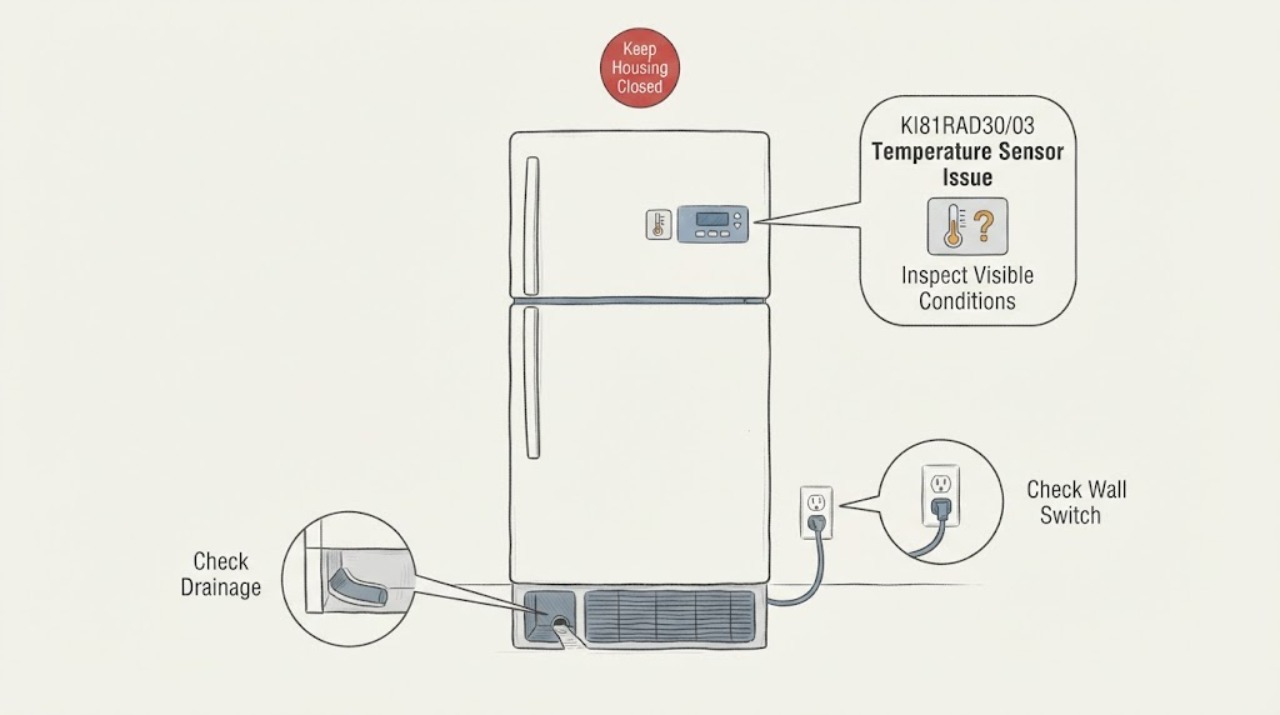
Work through in order
Diagnostic checks
Use only checks that match the exact appliance or system and its official guide.
-
Check 1
Read the appliance rating plate and verify that the full E-Nr. is KI81RAD30/03 before using any manual, service path, or sensor listing. Record the FD number and the observed symptom: too warm, too cold, fluctuating, or an actual display warning.
Expected result: The rating plate matches KI81RAD30/03 and the symptom is recorded, or the suffix/model cannot be confirmed.
Next step: If the model does not match, stop and obtain the manual and parts path for the actual E-Nr. If it matches, keep the record for the remaining checks and any service call.
Why this matters
Why: The Siemens support page is model-specific, while the opened user manual is labelled KI81R..; an unconfirmed suffix is not enough to claim sensor or part compatibility.
-
Check 2
Measure the refrigerator compartment with a reliable thermometer and compare the result with the displayed setting and, if present, the manual's OK sticker. For a newly switched-on or recently adjusted appliance, allow the stated stabilization period before judging the result; do not use a single reading to condemn the sensor.
Expected result: The compartment is near the 4 °C recommended check, remains outside the expected range after stabilization, or the reading changes widely.
Next step: Record time, setting, measured temperature, door openings, and food position. If the deviation persists, continue only with the external checks and service boundary below.
Why this matters
Why: The manual permits a 2–8 °C setting range, recommends +4 °C or colder for the OK sticker, and says reaching the set temperature can take up to 12 hours. A deviation is a symptom, not proof of a failed sensor.
-
Check 3
Check that the door closes fully, food is not pressed against the rear wall or interior vents, and the accessible condensation channel and drainage hole are not visibly blocked. If cleaning is needed, switch off and disconnect the appliance first, then carefully use only the moistened-cotton-bud method in the manual; keep liquid out of the controls and drain opening.
Expected result: The door or loading path is obstructed, the drainage path is visibly dirty or the refrigerator base is wet, or these external conditions are normal.
Next step: Correct the door/loading condition or clean the accessible channel as directed. If temperature remains abnormal, do not remove covers or probe wiring; arrange service.
Why this matters
Why: The manual links blocked condensation drainage with a wet refrigerator base and says food against the rear wall can impede circulation. These findings can explain symptoms without establishing a sensor failure.
-
Check 4
If no immediate safety issue is present, perform the manual-directed reset once: switch the appliance off, disconnect it, reconnect after five minutes, and observe whether the temperature behavior changes. Do not repeatedly cycle the unit or use a generic hidden-button sequence.
Expected result: The temperature behavior returns toward normal, remains abnormal, or a display message persists after the five-minute restart.
Next step: Allow the appliance to stabilize and continue temperature logging if it improves. If it remains abnormal or a message persists, use the exact model and records when contacting Siemens service.
Why this matters
Why: The manual lists this restart for a large temperature difference and says a persistent electronics message requires customer service; a temporary improvement does not identify a sensor fault.
-
Check 5
Only if the control panel and model match the opened manual, follow its appliance self-test sequence exactly and record the result. Do not open the control area or access the sensor to make the test work.
Expected result: The test gives two audible signals and the set temperature, or it gives five audible signals with a flashing display, or the control sequence is not identifiable on this appliance.
Next step: For a five-signal result or persistent temperature problem, arrange trained service. If the controls do not match, stop the test and obtain the exact E-Nr. documentation. Do not treat a two-signal result as proof that an ordered replacement sensor fits.
Why this matters
Why: In the opened manual, two signals indicate the appliance is OK, while five signals and a flashing display call for after-sales service. An unidentifiable control sequence means the family manual cannot safely be applied.
Use your observations
Decision map
Find the observation that best matches what you see, then follow the next safe action.
-
PATH 01Next step
What you see
The full rating plate matches KI81RAD30/03, the measured temperature improves after stabilization or the external loading/drainage issue is corrected, and no warning remains.
Do this next
Keep monitoring the measured temperature at the same times and setting. Do not install the ordered sensor solely because the original symptom occurred.
Why this path and its safety boundary
Why it matters: The symptom may have been operating conditions or a recoverable temperature disturbance; the opened evidence does not establish a defective sensor.
-
PATH 02Next step
What you see
The door and loading are normal, the accessible drain path is clear, and the refrigerator remains too warm or fluctuates after the manual reset and stabilization period.
Do this next
Contact Siemens or a qualified appliance service provider with KI81RAD30/03, FD number, temperature log, settings, and reset/self-test result. Do not open panels or test live wiring.
Why this path and its safety boundary
Why it matters: A persistent temperature complaint needs a model-specific diagnosis; it may involve sensing, controls, airflow, or cooling and cannot be narrowed to the sensor from the community post alone.
-
PATH 03Next step
What you see
The self-test produces five audible signals with a flashing display, a listed display message persists after five minutes, or the controls do not match the manual.
Do this next
Stop self-testing, leave the appliance in a safe state, and arrange trained service using the exact E-Nr. and FD information.
Why this path and its safety boundary
Why it matters: The manual treats these results as a service condition or an applicability mismatch, not as permission to replace a sensor by guesswork.
-
PATH 04Next step
What you see
The ordered sensor has no verified Siemens fit for KI81RAD30/03, or replacement would require removing panels, accessing wiring, or handling the refrigeration system.
Do this next
Do not install or splice the sensor. Ask Siemens service to verify the part against the full E-Nr. and perform the repair.
Why this path and its safety boundary
Why it matters: The evidence does not support the sensor part, location, wiring, or a consumer replacement procedure. Siemens requires trained specialists and genuine spare parts for repairs.
Helpful context
Understand the symptom
A requested sensor is not yet a confirmed diagnosis
The Reddit post establishes the exact model and the owner's intended sensor replacement, not the cause of the temperature complaint. A refrigerator that is too warm or too cold can also be affected by the set point, stabilization time, door or loading conditions, or a blocked condensation path. Use the Siemens checks first and keep the sensor diagnosis conditional.
Keep sensor replacement inside the Siemens service boundary
The opened Siemens manual says repairs should be carried out by trained specialist staff and that genuine spare parts should be used. It does not provide an opened, model-specific consumer sensor replacement procedure or confirm the fit of the sensor mentioned in the Reddit post. Do not infer a sensor location, resistance value, connector, or part number from another Siemens or Bosch refrigerator.
Common questions
FAQ
Does a temperature complaint prove that the sensor has failed?
No. The exact Reddit post says a sensor was ordered, but it does not confirm the diagnosis. The Siemens manual also lists setting, stabilization, drainage and other troubleshooting paths, so record measured temperature and complete the external checks before service identifies a component.
Can I install the sensor I already ordered?
Only after Siemens or a qualified technician verifies the part against the full KI81RAD30/03 E-Nr. and the repair procedure. The opened sources do not verify the ordered part's fit, sensor location, wiring, or a consumer replacement method.
What temperature should I use while checking the refrigerator?
The manual lists a 2–8 °C refrigerator setting range and recommends +4 °C or colder for the optional OK-sticker check. Give the appliance time to reach the setting, then compare a measured temperature with the setting and record the result rather than relying on one immediate reading.
Read the exact guide
Official sources
- User manual KI81R.. | SiemensSiemens / BSH Hausgeräte · Opened the official Siemens/BSH PDF. It is labelled KI81R.. and supports family-bounded operation and safety. Exact KI81RAD30/03 parts and any sensor replacement procedure remain subject to the exact support path.
- Siemens refrigeratorReddit r/Appliances · Opened/search-retrieved the exact Reddit thread. It identifies the exact model, asks for replacement instructions, and says a new sensor was already ordered; it does not report a verified fit or repair outcome.
- Produktsupport - KI81RAD30/03 | SIEMENS DKSiemens Home Appliances / BSH Hvidevarer A/S · Opened the Siemens product-support page; it identifies KI81RAD30/03 as an iQ500 built-in fridge and exposes model-specific manuals, documents, original spare parts and service information.
Community feedback
Share a repair observation
Share a plain-text repair observation. Accepted observations are published automatically; this page may take a moment to update.