
On this page
Start here
Quick answer
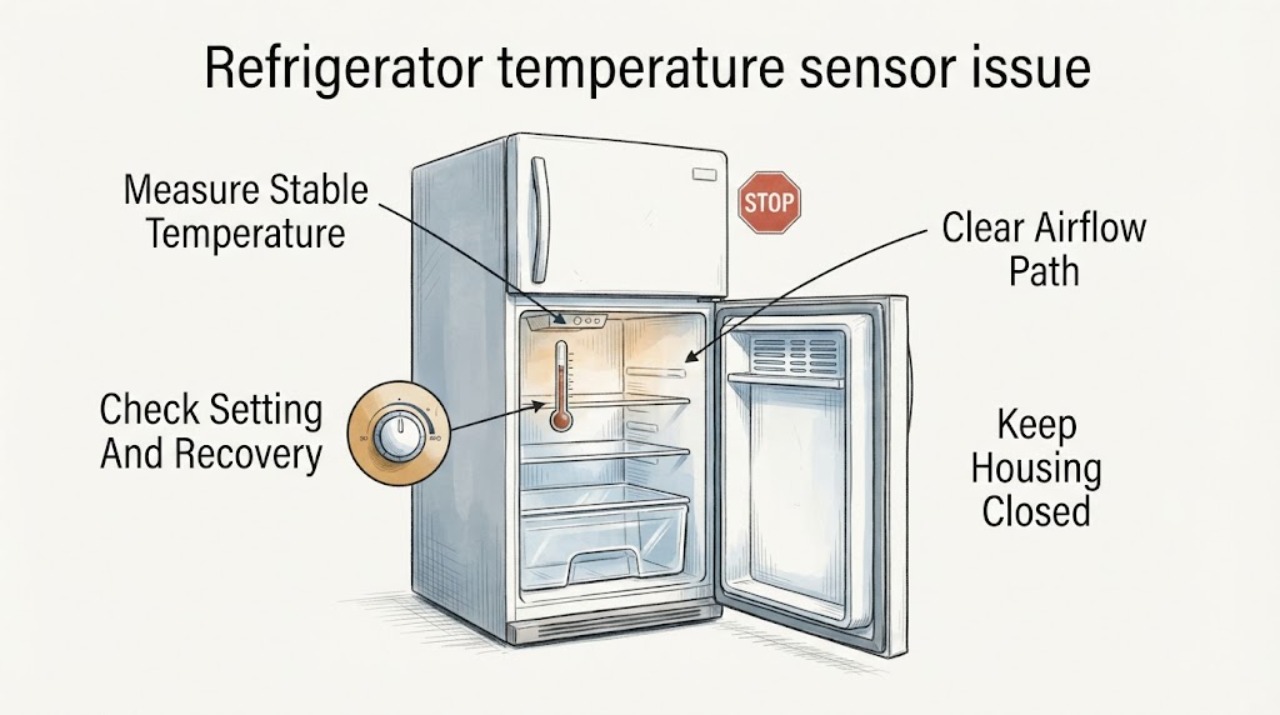
Do not replace a temperature sensor based only on the topic label. Beko says some refrigerator door displays show the set temperature rather than the actual internal temperature, so place a thermometer in a glass of water on the middle shelf for 12 hours or overnight. Record the model, setting, measured temperature and any display code; check that the door seal closes, vents are not blocked, the cabinet is not overpacked and recently added food or prolonged door opening is not the explanation. If the measured temperature remains unsafe or differs from the control after these external checks, use the exact Beko manual and arrange service. Do not open panels, probe a sensor circuit or order a sensor without model-matched evidence.
Work through in order
Diagnostic checks
Use only checks that match the exact appliance or system and its official guide.
-
Check 1
Place a thermometer in a glass of water on the middle shelf and leave it undisturbed for 12 hours or overnight. Record the measured temperature, the refrigerator’s selected/displayed value and any display code.
Expected result: The internal measurement is near the expected food-storage range, clearly warm/cold, or cannot stabilize.
Next step: Use the result to choose the display-mismatch, cooling-condition or service branch; do not open the control area.
Why this matters
Why: Beko says this method measures the internal temperature while an external display may show only the set temperature; one quick reading or display value cannot confirm a sensor fault.
-
Check 2
Check the temperature setting against the exact manual, then note whether the door was open for a long period, a large amount of food was recently added or hot food was placed inside. Allow the appliance time to recover without repeatedly changing the setting.
Expected result: The abnormal reading follows a recent load/door event or incorrect setting, or it persists after a stable period.
Next step: Correct only the user setting/load condition described by the manual and repeat the stable measurement. If it remains abnormal, arrange service rather than diagnosing a sensor.
Why this matters
Why: Beko says these conditions can temporarily raise temperature and recommends about 5°C average storage temperature; persistence after recovery is more significant than a transient reading.
-
Check 3
Inspect the door gasket and visible interior vents from outside the sealed cabinet. Look for a cracked/raised seal, a door that does not close, overpacked shelves or food blocking airflow; do not remove panels or touch internal wiring.
Expected result: A seal, door closure, blocked vent or overpacking issue is visible, or these external conditions appear normal.
Next step: Correct only accessible placement/loading or clean/close the gasket as the manual permits. If the measured temperature stays unsafe, request professional service.
Why this matters
Why: Beko lists warm-air entry, damaged seals and restricted internal circulation as possible reasons for temperature variation. These findings can imitate a sensing problem and do not prove a sensor failure.
-
Check 4
Find the complete Beko model number and region, then use Beko’s manual lookup to read the matching display, alarm and temperature-sensing sections. Save the exact displayed code or symbol rather than paraphrasing it as “sensor issue.”
Expected result: A matching manual explains the display/code, or the model/code remains unknown.
Next step: Follow only the matching manual’s external checks. If the model or code cannot be confirmed, give the recorded observations to service instead of ordering a part.
Why this matters
Why: Beko says manuals are searched by model number and contain model-specific safety and troubleshooting information; a generic sensor location or resistance test is not supported without that identity.
-
Check 5
Stop user diagnosis if the stable temperature remains unsafe, food is spoiling, the refrigerator gives an unresolved alarm, there is an electrical shock/breaker trip, burning smell, visible wiring damage or water near electricity.
Expected result: A persistent temperature problem or safety warning is present, or the issue clears after external checks.
Next step: Keep the door closed, protect/discard food according to applicable food-safety guidance, disconnect only from a dry safe position when electrical danger requires it, and arrange qualified Beko service.
Why this matters
Why: Beko treats persistent cooling problems and electrical warnings as professional-service matters; the supplied topic does not identify a sensor or compatible replacement.
Use your observations
Decision map
Find the observation that best matches what you see, then follow the next safe action.
-
PATH 01Next step
What you see
The external display is abnormal-looking but the 12-hour water-glass measurement is stable and the manual identifies the display as a set value or normal mode.
Do this next
Keep the documented setting and monitor the measured temperature. Use the exact manual if the display behavior changes or a code appears.
Why this path and its safety boundary
Why it matters: The display does not establish a failed sensor; it may represent a selected setting rather than measured cabinet temperature.
-
PATH 02Next step
What you see
The measured temperature rises after prolonged door opening, hot food or a large load, and returns toward the target after recovery.
Do this next
Reduce door opening, allow the refrigerator to stabilize and avoid overpacking; repeat the stable measurement before escalating.
Why this path and its safety boundary
Why it matters: Beko identifies these as common temporary causes of temperature variation rather than evidence of a failed sensor.
-
PATH 03Next step
What you see
The stable measurement remains too warm/cold after the setting, seal, loading and airflow checks, or the display/code continues to disagree with the manual.
Do this next
Provide the model, region, measurements and exact code to Beko service. Do not open the cabinet, test the sensor circuit or order a generic sensor.
Why this path and its safety boundary
Why it matters: A real refrigeration/control problem remains, but Beko’s general guidance does not identify the sensor as the failed part; thermostat, airflow, compressor, fan or other causes remain possible.
-
PATH 04Next step
What you see
There is an electrical shock, repeated breaker trip, burning smell, damaged wiring, water near electricity or food has been held at an unsafe temperature.
Do this next
Stop using the appliance and seek qualified appliance/electrical assistance; handle food according to local food-safety guidance.
Why this path and its safety boundary
Why it matters: This is a safety/service condition, not a user sensor diagnosis.
Helpful context
Understand the symptom
A displayed temperature is not proof that the sensor failed
Beko says some models show the selected set temperature on the door rather than the actual temperature inside. A sensor issue therefore needs a stable measurement and the exact model’s display behavior. Measure before assuming a sensor, thermostat or control has failed.
Measure the food compartment correctly
Place a refrigerator thermometer in a glass of water on the middle shelf and leave it for 12 hours or overnight, as Beko recommends. Record the measured result, the displayed/set value, the time and whether doors were opened or warm food was added. This separates a real temperature problem from a display or timing misunderstanding.
Check external conditions before suspecting a sensor
Beko identifies repeated warm-air entry through damaged door seals, hot food, overpacking and incorrect settings as reasons temperature may vary. Check the seal and visible airflow space without removing covers or treating a cold or warm shelf as proof of a sensor fault.
Use the exact model manual for any code or sensor procedure
Beko’s manual portal requires the product model number and says manuals contain model-specific safety, operation, maintenance and troubleshooting information. A display code or sensor location cannot be decoded safely from this no-model topic; do not probe or replace a sensor based on a generic diagram.
Protect food and stop at hazards
Beko warns that an overly warm refrigerator can allow harmful bacteria to grow and says electrical shocks or repeated breaker trips require immediate professional attention. Keep the refrigerator closed while assessing temperature, move vulnerable food according to local food-safety guidance, and stop using the appliance if there is shock, burning smell, damaged wiring or repeated electrical protection.
When checks do not resolve it
Need a professional?
Have this ready
- complete Beko model and region
- set/displayed temperature and exact symbol/code
- 12-hour or overnight middle-shelf water-glass measurement
- door-seal, loading and airflow observations
- recent door-open or warm-food events
- food-temperature or electrical hazard observations
Common questions
FAQ
Does a Beko door display show the actual refrigerator temperature?
Not always. Beko says some external displays show the set temperature rather than the actual internal temperature. Use a thermometer in a glass of water on the middle shelf for 12 hours or overnight.
Can a warm refrigerator prove the sensor has failed?
No. Beko lists settings, door seals, hot food, overpacking and airflow among possible causes, and its failure guidance also mentions other cooling components. Confirm a stable measurement and model before service or parts decisions.
What model information should I collect?
Record the complete model number and region, the exact display text or symbol, selected temperature, stable middle-shelf measurement and whether the door seal, vents or loading were abnormal. Beko’s manual portal uses the model number for the matching safety and troubleshooting information.
When should I stop using the refrigerator?
Stop and seek professional help for electrical shocks, repeated breaker trips, burning smell, damaged wiring, water near electricity or persistent unsafe temperature. Protect food according to applicable food-safety guidance.
Read the exact guide
Official sources
- How to Tell If Your Fridge is DyingBeko UK · Beko UK refrigerator symptom triage, electrical warning signs, cooling issues, seals/vents and professional-service boundary
- Why is my fridge not cooling?Beko UK · Beko UK refrigerator temperature, door seal, loading, airflow, settings, food-safety and service guidance
- What should the temperature be inside my fridge?Beko UK · Beko UK refrigerator food-temperature guidance and door-opening/thermostat context
- How to check the temperature of a Beko fridgeBeko UK · Beko UK refrigerator measurement method and distinction between displayed set temperature and actual internal temperature
- Beko Manuals and User GuidesBeko UK · Beko model-number manual lookup and model-specific safety/troubleshooting guidance
Community feedback
Share a repair observation
Share a plain-text repair observation. Accepted observations are published automatically; this page may take a moment to update.