
On this page
Start here
Quick answer
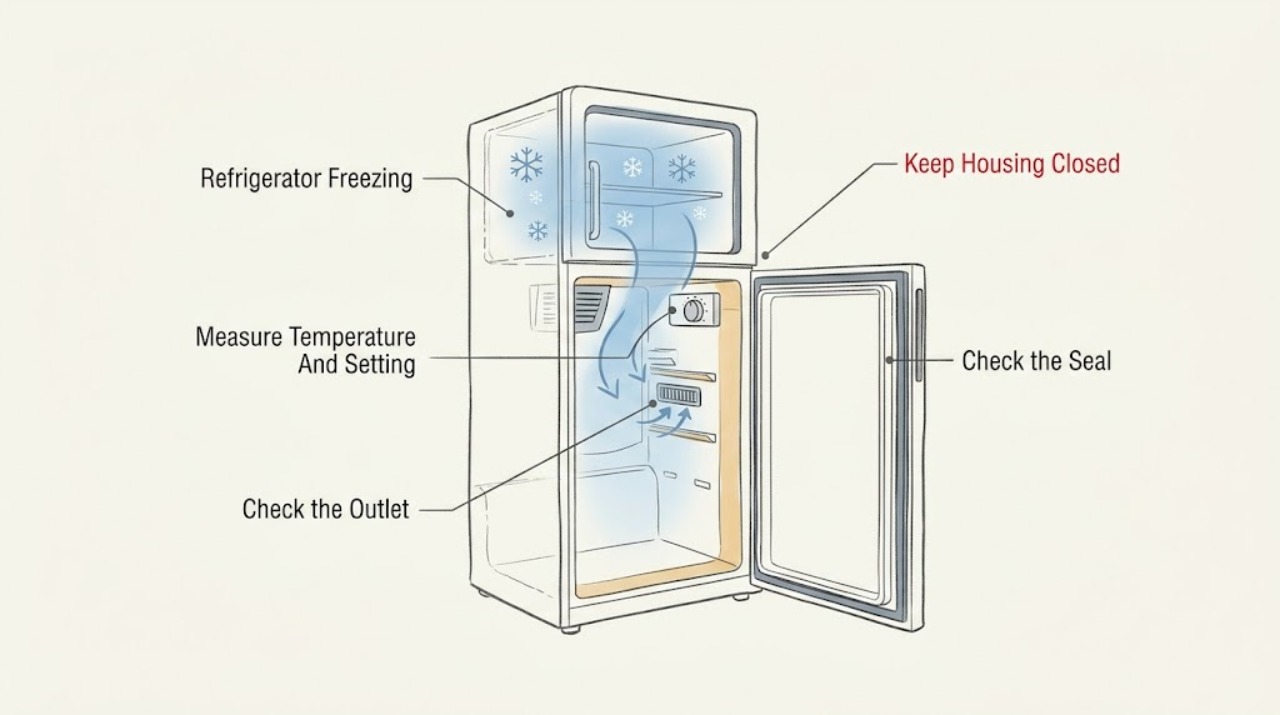
If food is freezing in the refrigerator compartment of a Beko refrigerator or fridge-freezer, first check the temperature setting and measure the actual compartment temperature with a thermometer rather than relying only on the display. Move sensitive food away from top-shelf air outlets and the rear wall, check that the door seal is clean and undamaged, and inspect for unusual frost or an active Fast Freeze setting. A small amount of moisture or ice on the rear wall can be part of normal operation, but thick frost, a damaged seal, or a temperature that stays too cold after the setting and placement checks points to a technical problem. Follow the exact model manual for any defrost procedure and contact an authorized Beko service agent if the measured temperature remains out of range or the seal, controls, or cooling system need repair.
Before you begin
Safety first
- This article covers temperature observation, food placement, accessible seal cleaning, and model-directed settings only. Do not open panels, alter wiring or refrigerant systems, chip or heat ice, or force a gasket or control component.
Work through in order
Diagnostic checks
Use only checks that match the exact appliance or system and its official guide.
-
Check 1
Record the refrigerator setting from the dial or display, then place an accurate thermometer in a cup of water on the middle shelf and leave it undisturbed for the period specified by your model guide; if no period is given, use an overnight reading as Beko's general comparison method.
Expected result: Record the set value, the measured refrigerator temperature, the shelf location, and whether the reading is below the intended refrigerator range or changes substantially between readings.
Next step: Adjust the setting only according to the model manual, then allow the appliance time to stabilize and measure again. Contact authorized service if the measured temperature remains too cold or the control cannot be adjusted normally.
Stop if: Do not repeatedly turn the control to extremes, remove control covers, or test wiring or sensors.
Why this matters
Why: A wrong setting with a matching measured temperature supports a settings issue. A measured temperature that remains too cold after the setting is corrected points toward a temperature-control or other technical problem rather than a display-only misunderstanding.
-
Check 2
From inside the refrigerator, inspect where frozen food was stored and note whether it is directly in front of a visible air outlet, on the top shelf, or touching the rear wall; move the food to a different shelf with clearance without blocking vents.
Expected result: Record whether freezing is limited to items near the outlet or back wall, whether the rear wall has only light moisture or ice, and whether items elsewhere remain at the measured temperature.
Next step: Keep food clear of the outlet and rear wall, then repeat the temperature measurement after the compartment stabilizes. Escalate if multiple shelves freeze or heavy ice returns despite correct placement.
Stop if: Do not pry vents open, remove interior panels, chip ice from the liner, or block an outlet with food.
Why this matters
Why: Freezing limited to an outlet or rear-wall position supports a local cold-air or contact explanation. Freezing across shelves despite clear airflow makes a whole-compartment temperature or technical issue more likely.
-
Check 3
Inspect the refrigerator door gasket around its full perimeter for dirt, a fold, a gap, a crack, or a section that is not seated against the cabinet; clean it gently with a soft cloth or sponge and warm water, then close the door without forcing it.
Expected result: Record whether the gasket contacts the cabinet continuously, whether a gap remains, whether the seal is loose or cracked, and whether frost or freezing is concentrated near the door edge.
Next step: Recheck the seal after cleaning and monitor the measured temperature. Arrange authorized service for a loose or cracked gasket or for persistent over-cooling after the seal is intact.
Stop if: Do not use abrasive cleaners, glue, unapproved sealant, or force the gasket out of its channel.
Why this matters
Why: A dirty, folded, loose, or damaged seal can let warm air enter and make the appliance overcompensate with more cooling. A clean, intact seal with whole-compartment freezing makes the setting or temperature-control branch more likely.
-
Check 4
Inspect the freezer and refrigerator compartments for the location and thickness of frost or ice, and identify from the model manual whether the appliance is frost-free or requires manual defrosting before taking any defrost action.
Expected result: Classify the condition as light occasional rear-wall moisture or ice, thick frost on an interior wall, frost around the door seal, or no unusual frost; note whether airflow or food space is being obstructed.
Next step: Follow only the exact model manual for a permitted defrost procedure. If frost is thick, returns quickly, blocks airflow, or is paired with a damaged seal or wrong measured temperature, contact authorized service.
Stop if: Do not scrape, chip, drill, melt with a heat gun, or pour hot water into the compartment, and do not remove interior panels.
Why this matters
Why: Light rear-wall moisture can be normal, while thick or widespread frost can increase cooling workload and may accompany a sealing or defrost problem. A frost-free model should not be manually defrosted unless its instructions specifically require it.
-
Check 5
Check the control panel or manual for Fast Freeze, rapid-freeze, holiday, or other special modes, and note the room conditions and whether the appliance was recently installed, heavily loaded, or exposed to an ambient temperature outside the model's stated range.
Expected result: Record which special mode is active, whether the appliance is in a very cold or hot location, and whether freezing began after a setting, move, installation, or large load changed.
Next step: Cancel a special mode only as the model manual directs, keep the appliance within its stated ambient range, allow it to stabilize, and repeat the temperature measurement. Contact authorized service when the temperature remains too low.
Stop if: Do not disable safety controls, change firmware, move a built-in refrigerator, or alter refrigerant or electrical components.
Why this matters
Why: A special mode or a model-specific ambient condition can change how the appliance cools or runs. If no mode or environmental change explains the measured over-cold condition, an internal temperature-control or other technical issue becomes more likely.
-
Check 6
After correcting only the documented setting, food placement, seal cleaning, or permitted mode, take a second thermometer reading and compare it with the first while checking whether new ice forms.
Expected result: Record improved temperature and no new freezing, improvement only near one location, or persistent whole-compartment freezing and frost.
Next step: Keep the readings, settings, model, and photos; contact an authorized Beko service agent when freezing persists or the appliance cannot maintain the documented target.
Stop if: Stop using improvised repairs and seek service for a damaged seal, exposed wiring, leaking refrigerant or water, abnormal noise, or any need to open the cabinet.
Why this matters
Why: Improvement after placement or settings changes supports an operating-condition cause. Persistent over-cooling after those checks is not resolved by a generic part and may require diagnosis of the temperature-control or cooling system.
Use your observations
Decision map
Find the observation that best matches what you see, then follow the next safe action.
-
PATH 01Next step
What you see
Only food near a visible air outlet, on the top shelf, or touching the rear wall freezes, while food elsewhere and the measured compartment temperature are normal.
Do this next
Keep food clear of the outlet and rear wall, monitor the next temperature reading, and request service if freezing spreads or heavy ice returns.
Why this path and its safety boundary
Why it matters: The pattern makes local cold-air exposure or rear-wall contact more likely than a whole-compartment temperature-control fault.
-
PATH 02Next step
What you see
The measured temperature follows a setting that is colder than intended, and the condition improves after the model-approved setting change and stabilization period.
Do this next
Keep the corrected setting and verify it with another thermometer reading instead of adjusting the control repeatedly.
Why this path and its safety boundary
Why it matters: The control setting was a sufficient explanation; the refrigerator was responding to the selected target rather than proving a failed component.
-
PATH 03Next step
What you see
The gasket has a gap, crack, fold, or poor contact, or thick frost is concentrated around the seal or interior wall.
Do this next
Clean only the accessible seal, follow the exact model manual for any permitted defrost, and arrange authorized service for a damaged seal, recurring frost, or persistent freezing.
Why this path and its safety boundary
Why it matters: Warm-air entry, frost accumulation, or a related sealing/defrost condition is more likely than simple food placement.
-
PATH 04Next step
What you see
Fast Freeze or another special mode is active, or the appliance is in an ambient condition outside the model's documented range and freezing began after that change.
Do this next
Use the model instructions to end the mode or correct the environment, allow the appliance to stabilize, and remeasure before considering service.
Why this path and its safety boundary
Why it matters: A mode or environment may be changing normal cooling behavior, but the exact effect depends on the model and its manual.
-
PATH 05Next step
What you see
Food freezes on several shelves and the measured refrigerator temperature remains too low after the documented setting, placement, seal, frost, and mode checks.
Do this next
Stop changing settings or ordering a generic part and contact an authorized Beko service agent with the model, readings, settings, and photos.
Why this path and its safety boundary
Why it matters: The fault is not explained by a local airflow position or user setting; Beko's guidance makes a temperature-control or other technical issue more likely.
Helpful context
Understand the symptom
First decide whether the problem is local or whole-compartment
One frozen item beside an air outlet or against the rear wall is a different signal from food freezing on several shelves. Start by recording where the ice appears and whether the rest of the compartment is also below the intended temperature. Beko says the set temperature shown on some appliances is not necessarily the actual internal temperature, so a thermometer check is more useful than changing the control repeatedly.
A little rear-wall ice is not the same as a frost fault
Beko describes some drops of water or ice on the back wall as a normal part of the cooling cycle. Food touching that wall can divert moisture and develop more ice, while heavy frost across the compartment can point to a door-seal, defrost, or operating issue. Do not chip ice, heat the liner, or choose a manual-defrost method until the model manual confirms that the appliance is not a frost-free model and gives the safe procedure.
Do not diagnose a control or sealed-system fault by parts swapping
If adjusting the temperature and moving food does not change a measured over-cold condition, Beko treats a temperature-control problem or another technical issue as a service matter. A control, sensor, air path, seal, or refrigeration component cannot be selected safely from the symptom alone. Keep the model information, temperature readings, frost photos, and settings for an authorized technician.
Safety boundary
Stop conditions
- Do not scrape, chip, drill, or heat ice, remove interior panels, or open the sealed refrigeration system.
- Do not use abrasive cleaners, glue, unapproved sealant, or improvised material on the door gasket.
- Do not test or replace a temperature control, sensor, fan, damper, compressor, or other component without model-specific service guidance.
- Stop for exposed wiring, a damaged cord, water or refrigerant leakage, burning odor, abnormal noise, or a door that cannot seal.
- Use only the exact model manual for defrosting and contact authorized service when the measured temperature remains too low.
When checks do not resolve it
Need a professional?
Contact an authorized Beko service agent when the measured refrigerator temperature remains too low after the model-approved setting, placement, seal, frost, and special-mode checks; when the door gasket is cracked, loose, or cannot seal; when thick frost returns; or when freezing affects several shelves. Do not open panels or attempt a temperature-control, fan, damper, compressor, sealed-system, or electrical repair yourself.
Safety scope: This article covers temperature observation, food placement, accessible seal cleaning, and model-directed settings only. Do not open panels, alter wiring or refrigerant systems, chip or heat ice, or force a gasket or control component.
Common questions
FAQ
Why is my Beko refrigerator freezing food?
Check the temperature setting and confirm the actual middle-shelf temperature with a thermometer. Move food away from air outlets and the rear wall, inspect the door seal, and check for frost or an active special mode. If several shelves remain too cold after those checks, contact authorized Beko service.
Where should I place food to prevent it freezing in a Beko refrigerator?
Do not place sensitive food directly in front of an air outlet or against the rear wall. Move it to another shelf with airflow clearance and monitor the compartment temperature. If food freezes throughout the refrigerator, placement alone is not the explanation.
Is ice on the back wall of a Beko refrigerator normal?
Beko says a small amount of water or ice on the rear wall can be part of normal operation. Food touching the wall can increase ice formation. Thick or widespread frost, repeated ice after correcting placement, or freezing across shelves requires model-specific assessment.
Can a damaged Beko refrigerator door seal cause food to freeze?
Yes, Beko explains that a cracked or poorly sealing gasket can let warm air in and make the appliance overcompensate with more cold air. Clean the seal gently with warm water and a soft cloth; a loose or cracked seal needs authorized service rather than glue or an improvised repair.
Should I defrost my Beko refrigerator if food is freezing?
Check the exact model manual first. Beko distinguishes frost-free models, which normally do not need manual defrosting, from models that do. Do not chip or heat ice. Use only the documented procedure, and request service when thick frost returns or the refrigerator remains too cold.
Read the exact guide
Official sources
- How to stop food from getting frozen inside the refrigeratorBeko · Beko U.S. refrigerator support article; exact model instructions control the adjustment and temperature target for the installed appliance.
- Help Center ResultBeko · Beko U.S. refrigerator help center; use the exact model manual for frost-free status and defrost procedure.
- How to fix a refrigerator that won't stop runningBeko · Beko U.S. refrigerator troubleshooting article; exact model instructions control defrost and special-mode behavior.
- Why is my fridge too cold and freezing food?Beko · Beko UK refrigerator FAQ; use the installed model's manual for exact settings, climate range, and defrost instructions.
Community feedback
Share a repair observation
Share a plain-text repair observation. Accepted observations are published automatically; this page may take a moment to update.