
On this page
Start here
Quick answer
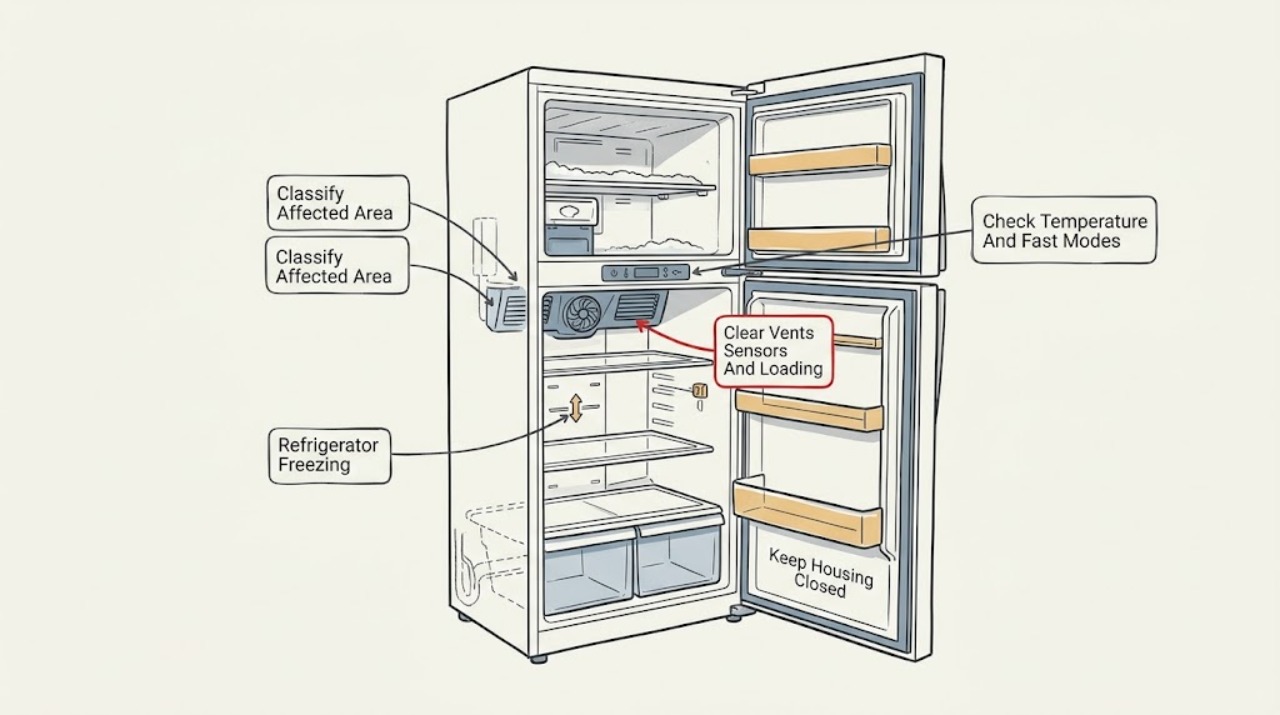
First identify whether food is freezing in the fresh-food compartment, the refrigerator and freezer are both too cold, or only the freezer is colder than expected. Electrolux says food can freeze when it is against a vent or rear wall, when airflow is blocked, or when a temperature or fast-cooling/freezing setting is too cold. Check the exact model's temperature setting and turn off Shopping, Coolmatic, FastCool, Fast/Freeze, or a similar accelerated mode if that model provides it. Move food away from vents and the rear wall, make sure drawers and the door close and seal, and check that sensors are not covered. If frost blocks airflow, use only the exact manual's safe defrost procedure; never chip ice or use a heat tool. If the temperature remains abnormal after the accessible checks, food is at risk, the door seal or damper is damaged, or the issue suggests a sensor, fan, control, or sealed cooling fault, stop experimenting and arrange qualified service.
Before you begin
Safety first
- The user may read model-specific controls, change documented settings, move food away from vents and walls, reseat drawers, inspect and clean an accessible gasket, and follow the exact manual's natural-defrost procedure. Panel removal, fan or damper access, sensor or control work, live tests, electrical repair, and sealed-system work are for qualified personnel.
Work through in order
Diagnostic checks
Use only checks that match the exact appliance or system and its official guide.
-
Check 1
Record where freezing occurs: one item or drawer in the fresh-food section, most of the refrigerator compartment, both compartments, or only the freezer. Note whether the freezer is also colder than usual, whether frost is visible, and whether the problem began after a setting change, power event, move, or long door opening.
Expected result: Only food near one vent or the rear wall freezes; the whole fresh-food compartment is too cold; the freezer is also too cold; or frost and an unstable door are present.
Next step: Use the matching branch below: check placement and vents for a local pattern, settings and modes for a broad pattern, and the seal and natural-defrost procedure when frost or closure is involved.
Stop if: Do not taste or keep questionable food merely to test temperature; move food to safe storage when the appliance cannot maintain the conditions required by the food.
Why this matters
Why: A local pattern makes placement or cold-air flow more likely. A whole-compartment or two-compartment pattern makes a shared setting, accelerated mode, sensor, control, or airflow issue more likely. Frost or a poor seal can disturb temperature and airflow.
-
Check 2
Read the exact model's refrigerator and freezer settings, then check for Shopping, Coolmatic, PowerCool, FastCool, Frostmatic, Fast/Freeze, or another accelerated mode that the model actually provides. Turn off an unintended mode and make one small, manual-approved move toward a warmer setting; do not change several controls together.
Expected result: A setting is unusually cold, an accelerated mode is active, a timer or holiday state is shown, or settings are normal and the freezing persists.
Next step: Leave the corrected setting in place and allow the exact model's normal stabilization period. If freezing remains, continue with loading, sensor, drawer, seal, and frost checks; do not guess at hidden control settings.
Stop if: Do not bypass a control, defeat a sensor, or remove a control panel to change a setting.
Why this matters
Why: A low setting or accelerated mode can explain broad overcooling without a failed part. Control names and the effect of one compartment's adjustment vary by model; normal settings with persistent freezing make an airflow, sensor, damper, control, or defrost issue more plausible.
-
Check 3
With doors and drawers open only as needed, move food away from cold-air vents and the rear wall, keep the sensor area identified by the manual uncovered, slide drawers fully home, and avoid crowding the airflow path. On models with a user-accessible air damper cover, use only the exact manual's permitted position; do not remove the cover.
Expected result: A package is touching a vent or rear wall, a sensor is covered, a drawer is not fully closed, a cold-air path is blocked, or the compartment is clear and food still freezes.
Next step: Restore the documented spacing and leave food in a less exposed position, then monitor a normal cycle. If the same area freezes again with clear airflow, arrange service rather than reaching behind the liner.
Stop if: Do not insert tools into vents, remove the rear liner, touch a fan, or force a damper or drawer.
Why this matters
Why: A local blockage or direct cold-air exposure can freeze food even when the refrigerator's overall control is normal. A clear compartment with persistent freezing makes an internal damper, fan, sensor, or control issue more likely, but does not identify the part.
-
Check 4
Inspect the accessible door or drawer path and gasket. Confirm that containers, shelves, or an ice chute flap on models equipped with one do not prevent closure, and look for gaps, warping, heavy frost, or ice blocking a vent. Clean and dry the gasket as the manual permits. If frost blocks airflow, turn the appliance off and use the exact manual's natural-defrost procedure before restarting.
Expected result: The door or drawer does not close or seal, the gasket is damaged, the chute flap is held open, frost blocks an airflow path, or the seal and accessible frost condition are normal.
Next step: Correct only visible closure, gasket, chute, or loading conditions and let the appliance complete its documented cooling cycle. If frost returns quickly or a gasket, chute, or internal defrost problem remains, arrange service.
Stop if: Do not chip, pry, drill, or heat ice; do not remove the inner liner, gasket retainer, chute, or defrost components.
Why this matters
Why: Warm-air entry from a poor seal can promote frost, while frost and blocked paths can disturb airflow and create cold spots. A normal accessible seal and clear airflow make a hidden defrost, damper, sensor, or control fault more plausible if freezing continues.
-
Check 5
After one documented setting or loading correction, monitor the affected compartment without repeatedly opening the door or changing controls. Note whether the freezing stops, whether the freezer and refrigerator settle differently, whether frost returns, and whether the compressor or fan behavior is accompanied by poor cooling elsewhere, unusual noise, water, or an error display.
Expected result: Freezing stops after the visible correction; a single cold spot returns; both compartments remain too cold; frost returns; or freezing is accompanied by an error, leak, unusual noise, or unstable cooling.
Next step: Continue normal use only when the exact model stabilizes without abnormal frost or performance. Otherwise preserve the settings, observations, and food-safety record and arrange qualified service.
Stop if: Do not keep cycling power or controls to force a result, and do not continue if food temperatures are unsafe, water reaches electrics, smoke or burning odor appears, or the breaker trips.
Why this matters
Why: Improvement after a setting, mode, placement, or seal correction supports an external operating cause. Recurrence with normal settings and airflow makes a damper, sensor, fan, control, defrost, or sealed-system fault more likely. A new safety or performance symptom raises the service priority.
-
Check 6
Prepare the exact model and region, the affected compartment and food location, current settings and modes, frost and seal observations, door or drawer behavior, the time since the last correction, and any display, leak, noise, odor, heat, or breaker event. Keep the appliance closed and move food to safe storage if cooling is unreliable.
Expected result: The issue resolved after an accessible correction; the exact model's documented behavior remains stable; or freezing persists despite normal settings, clear airflow, a sound seal, and the manual's safe frost procedure.
Next step: Use the diagnostic record to arrange qualified Electrolux or appliance service when the problem persists or returns. Do not order a control, sensor, damper, or thermostat from the symptom alone.
Stop if: Do not remove panels, perform live electrical tests, pierce tubing, add refrigerant, or work on the fan, damper, sensor, control, or defrost system.
Why this matters
Why: Resolution after an external correction supports a loading, mode, setting, seal, or frost cause. Persistent freezing after those checks can involve an internal damper, fan, sensor, control, defrost system, or sealed cooling circuit and cannot be safely diagnosed by the user.
Use your observations
Decision map
Find the observation that best matches what you see, then follow the next safe action.
-
PATH 01Next step
What you see
Only food touching a vent, rear wall, or a particularly cold-air path freezes, while other shelves and the freezer appear normal.
Do this next
Move food to a less exposed position, uncover vents and the documented sensor area, and monitor one normal cycle. If the same location freezes with clear airflow, arrange service for the damper, fan, sensor, or control diagnosis.
Why this path and its safety boundary
Why it matters: Direct cold-air exposure or blocked circulation is more likely than a whole-appliance temperature-control failure. Electrolux specifically advises moving food away from vents and the rear wall.
-
PATH 02Next step
What you see
Most of the fresh-food compartment or both compartments are too cold, and a low setting or Shopping, Coolmatic, FastCool, Fast/Freeze, or similar accelerated mode is active on the model.
Do this next
Turn off the unintended mode and make one manual-approved warmer adjustment, then allow stabilization. If broad overcooling persists with normal settings, arrange service rather than changing hidden controls.
Why this path and its safety boundary
Why it matters: The operating setting or accelerated mode is more likely than an immediately failed part. Electrolux notes that control effects differ by model and that one refrigerator adjustment may affect both compartments on some designs.
-
PATH 03Safety boundary
What you see
Frost blocks vents or shelves, the door or drawer does not seal, or an ice chute flap remains open on a model that has one.
Do this next
Correct only visible closure, gasket, chute, and loading conditions. Use the exact manual's power-off, natural-defrost, meltwater, and drying procedure; if frost returns or a component is damaged, arrange service.
Why this path and its safety boundary
Why it matters: Air leakage, frost, or a blocked path is more likely and can create uneven cooling. Electrolux links frost to a poor seal, very low settings, blocked airflow, and an open chute flap.
Safety stop: Do not chip or pry ice, use a heat tool, or remove inner panels.
-
PATH 04Next step
What you see
The freezer is too cold but the fresh-food compartment is normal, and the freezer control or a fast-freeze mode is set colder than intended.
Do this next
Turn off an unintended fast-freeze mode and move the freezer control warmer only as the manual permits. If the freezer remains abnormally cold with normal controls, arrange service for temperature-control diagnosis.
Why this path and its safety boundary
Why it matters: The freezer setting or an accelerated freezing mode is more likely than a fresh-food airflow problem. The exact control behavior must be checked in the model manual.
-
PATH 05Safety boundary
What you see
Freezing continues after the exact model's settings and modes are normal, vents and sensors are clear, food is away from the rear wall, doors and gaskets seal, and accessible frost has been safely addressed.
Do this next
Move vulnerable food to safe storage, preserve the diagnostic record, and arrange qualified Electrolux or appliance service. Stop sooner for a leak near electrics, smoke, burning odor, abnormal heat, or repeated breaker operation.
Why this path and its safety boundary
Why it matters: A damper, fan, sensor, control, defrost system, or sealed cooling fault is more plausible, but this pattern does not identify a replaceable part. Continuing to alter controls can hide the diagnostic state and risk food loss.
Safety stop: Do not open the cabinet, test energized wiring, reach the fan or damper, or work on the sealed cooling circuit.
Helpful context
Understand the symptom
Define what is actually freezing
A frozen lettuce drawer, a fresh-food shelf that freezes, and a freezer that is simply set too cold are different decisions. Start with the location, the affected food, the selected setting, and whether the freezer compartment is also unusually cold. Electrolux notes that refrigerator air changes during a cooling cycle, so do not diagnose the appliance from one brief air reading or from a single item placed directly in a cold-air stream.
Correct settings and accelerated modes before suspecting a part
Read the exact model manual and control display. A warmer refrigerator or freezer setting may be appropriate, and an enabled Shopping, Coolmatic, FastCool, Fast/Freeze, or similar mode can deliberately run faster on models that have it. The control relationship is model-specific: Electrolux warns that changing one refrigerator control may affect both compartments on some designs. Make one documented change, then allow the appliance time to stabilize instead of turning several controls at once.
Restore clear airflow and sensible loading
Keep food from touching vents or the rear wall, leave the sensor area visible, slide drawers fully closed, and avoid placing moist food directly in a cold-air outlet. Food pressed against the back wall can freeze during refrigeration and then collect defrost water on the shelf. Clear only accessible items and vents; a damper, fan, or sensor behind a cover is not a user repair.
Check the door seal and frost without forcing anything
Confirm that nothing prevents the door or drawer from closing and that the gasket is clean, intact, and making contact. Frost can be associated with a poor seal, a blocked vent, a low setting, or a chute flap that does not close on models equipped with one. If frost is obstructing the compartment, follow the exact manual's power-off and natural-defrost instructions, protect food, mop up meltwater, and dry the interior. Do not scrape, pry, melt with a heat gun or hair dryer, or remove panels.
Know when freezing indicates a technical fault
If food continues to freeze after settings, accelerated modes, loading, sensors, drawers, vents, seal, and accessible frost have been checked, the damper, fan, temperature sensor, control, defrost system, or sealed cooling system may need diagnosis. The pattern matters: one cold spot points more toward local airflow or placement, while both compartments being too cold points more toward shared settings or control behavior. These are likelihoods, not a part identification; qualified service should confirm the cause.
Safety boundary
Stop conditions
- Move food to safe storage when the refrigerator cannot maintain reliable cooling or freezing is accompanied by warming elsewhere; do not use questionable food as a test.
- Stop immediately for smoke, sparks, burning or electrical odor, abnormal heat, water near electrical parts, a hot or damaged cord or plug, or repeated breaker or protection operation.
- Do not chip, pry, drill, or force frost or ice, and do not use a heat gun, hair dryer, open flame, or other heat tool inside the appliance.
- Do not remove refrigerator liners or panels, reach fans or dampers, bypass sensors or controls, perform live electrical tests, or open or charge the sealed cooling system.
- Arrange qualified service when freezing persists after the exact model's safe setting, mode, loading, airflow, seal, and natural-defrost checks, or when a sensor, fan, damper, control, or defrost fault is suspected.
Only after diagnosis
Potential parts
- temperature sensor
Consider this only after qualified diagnosis confirms that the exact model's sensor reading or sensor circuit is causing persistent overcooling with normal settings and clear airflow.
Confirm the complete model and manufacturer's fit information; freezing alone does not prove a sensor failure. - air damper or damper motor
Consider this only when qualified diagnosis links a fresh-food cold spot or broad overcooling to a damper that is stuck or not responding on the exact model.
Verify the refrigerator configuration and complete model before ordering; damper arrangements differ across Electrolux families. - evaporator fan motor
Consider this only after qualified diagnosis confirms a fan or airflow fault rather than food placement, frost, a setting, or a blocked vent.
Use the exact model and manufacturer's fit information; do not select a fan from the symptom or sound alone.
When checks do not resolve it
Need a professional?
Arrange qualified Electrolux or appliance service when the refrigerator or freezer remains abnormally cold after the exact model's settings and accelerated modes are corrected, food and vents are positioned correctly, the door and gasket seal, and accessible frost is safely addressed. Call sooner for recurring heavy frost, a damaged seal or chute, an error message, poor cooling in another compartment, water near electrical parts, smoke, burning odor, abnormal heat, or repeated breaker operation. Internal fan, damper, sensor, control, defrost, electrical, and sealed-system work are professional tasks.
Safety scope: The user may read model-specific controls, change documented settings, move food away from vents and walls, reseat drawers, inspect and clean an accessible gasket, and follow the exact manual's natural-defrost procedure. Panel removal, fan or damper access, sensor or control work, live tests, electrical repair, and sealed-system work are for qualified personnel.
Common questions
FAQ
Why is food freezing in my Electrolux refrigerator but the freezer seems normal?
Check whether the food is touching a vent or the rear wall, whether a drawer or airflow path is blocked, and whether a sensor is covered. Electrolux identifies those conditions, a low setting, accelerated cooling, and a damaged seal as possible causes. If one area freezes again after food is repositioned and airflow is clear, arrange service rather than opening the liner.
What Electrolux setting should I change when the refrigerator is too cold?
Read the exact model's controls first. Turn off an unintended Shopping, Coolmatic, FastCool, Fast/Freeze, or similar accelerated mode, then make one documented move toward a warmer refrigerator or freezer setting. Electrolux notes that changing the refrigerator control can affect both compartments on some designs, so do not assume a universal dial direction or control relationship.
Can blocked vents cause an Electrolux refrigerator to freeze food?
Yes. Electrolux says food touching vents can disrupt airflow and cause freezing. Move packages away from vents and the rear wall, keep the manual-identified sensor area clear, and close drawers fully. If the compartment still freezes with clear airflow, the damper, fan, sensor, or control needs qualified diagnosis.
What should I do about frost when my Electrolux refrigerator is freezing?
Check the door seal, closure, vents, rear-wall loading, and any ice chute flap your model has. If frost blocks airflow, turn the appliance off and follow the exact manual's natural-defrost procedure, then mop up meltwater and dry the interior. Do not scrape, pry, drill, or apply a heat tool. Frost that returns needs service diagnosis.
When does an Electrolux refrigerator that is freezing need service?
Arrange service when freezing persists after the exact model's setting and mode checks, clear loading and vents, uncovered sensor, closed drawers, sound gasket, and safe frost procedure. Service is also appropriate for a damaged damper, fan, sensor, control, defrost system, or sealed cooling circuit. Stop sooner for smoke, burning odor, abnormal heat, water near electrics, or repeated breaker operation.
Read the exact guide
Official sources
- Refrigerator Too ColdElectrolux · Applies to Electrolux refrigerators and addresses refrigerator or freezer temperatures that are too cold; exact model controls and regional settings take precedence.
- What should I do if my refrigerator or freezer temperature is too cold?Electrolux · Applies to Electrolux freezers and refrigerators; the page warns that control effects can differ and that the exact model's instructions govern.
- Refrigerators / Freezer - Frost Build UpElectrolux · Applies to Electrolux refrigerators and freezer compartments; the exact model determines safe defrost, door, chute, and airflow procedures.
- Food freezing In fridgeElectrolux · Applies to Electrolux fridge and fridge-freezer families; exact model controls temperature, fan, damper, sensor, drawer, and defrost details.
Community feedback
Share a repair observation
Share a plain-text repair observation. Accepted observations are published automatically; this page may take a moment to update.