
On this page
Start here
Quick answer
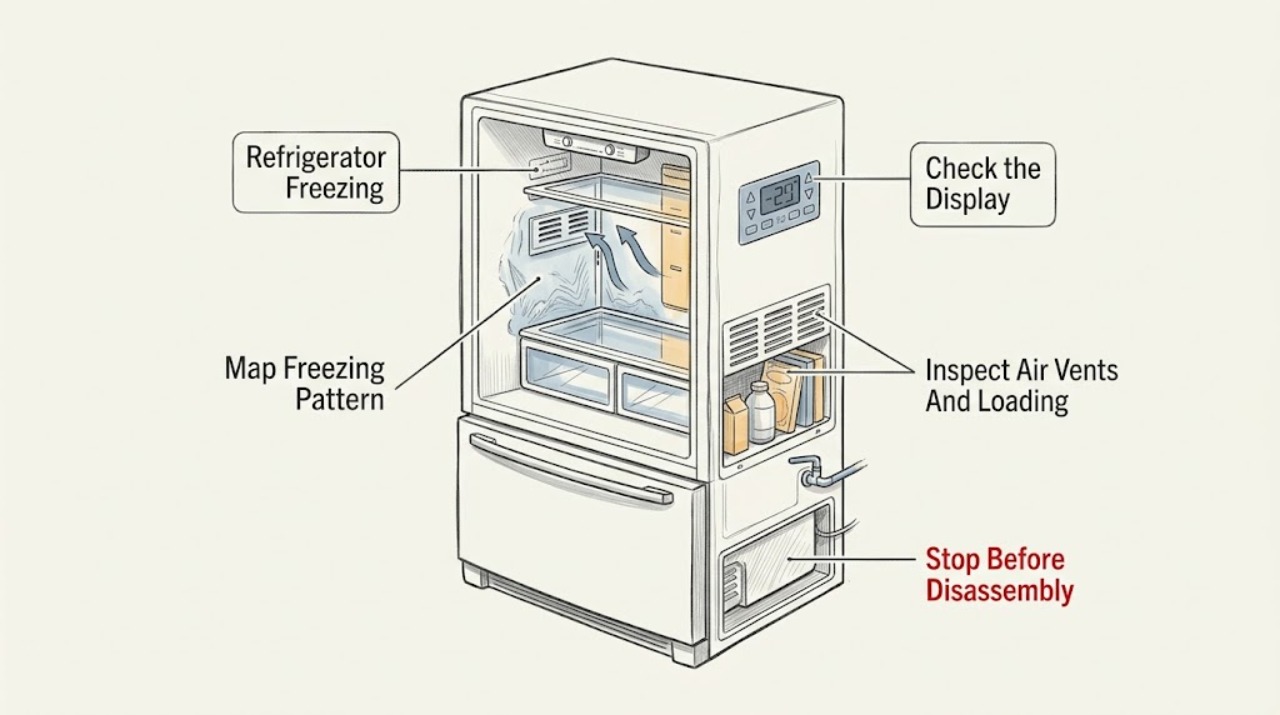
First identify whether only food near a vent or back wall is freezing, the entire fresh-food section is too cold, or both compartments are colder than intended. Amana's guidance points first to temperature settings, blocked vents, an ice maker left on without a water supply, and unusually cold surroundings. Move temperature-sensitive food away from direct freezer airflow, make one small control adjustment using the exact model manual, and allow the documented stabilization period before judging it. If temperatures remain abnormal, frost is extensive, a control cannot be adjusted, or the refrigerator needs sealed-system or electrical access, stop experimenting and arrange qualified service.
Before you begin
Safety first
- This article supports temperature and pattern observation, small model-documented control adjustments, visible vent clearance, food repositioning, and model-documented ice-maker or ambient settings. It does not authorize live electrical testing, hidden airflow or evaporator access, sealed-system work, sensor bypassing, or guessed part replacement.
Work through in order
Diagnostic checks
Use only checks that match the exact appliance or system and its official guide.
-
Check 1
Record which foods or shelves are freezing and measure the refrigerator and freezer temperatures with the method and target ranges in the exact Amana manual. Note whether the freezing is limited to items near a vent or back wall, affects the whole fresh-food section, or also affects the freezer.
Expected result: Only items in direct airflow freeze, the fresh-food section is broadly below its intended range, both sections are unusually cold, or the temperature cannot be confirmed.
Next step: Photograph the food position and display or thermometer result, then perform the corresponding vent and control checks. Protect temperature-sensitive food while the actual temperature is uncertain.
Stop if: Do not remove panels, probe the evaporator, or alter a thermostat or sealed-system control to obtain a temperature reading.
Why this matters
Why: A localized pattern supports a vent or food-placement check; a broad cold pattern makes control settings, ambient conditions, ice-maker state, or a control/sensor fault more important. A visual guess cannot distinguish normal cold spots from whole-compartment overcooling.
-
Check 2
Check the refrigerator and freezer controls against the exact Amana owner's manual. If the model uses a dial, slider, or electronic setting, make only one small warmer adjustment as documented; do not assume a lower or higher number has the same meaning on every model.
Expected result: A compartment is set colder than the manual's normal range, a freezer control is driving excessive cold into the fresh-food section, the setting is already normal, or the control cannot be changed.
Next step: Leave the adjustment unchanged for the model's stabilization interval and remeasure. If the control is normal but temperatures remain abnormal, continue to the vent and ice-maker checks and prepare a service record.
Stop if: Do not turn every control to an extreme setting, force a dial or touch panel, enter service diagnostics, or bypass a thermostat.
Why this matters
Why: An overly cold setting can cause fresh-food freezing, especially near air outlets. A normal setting with persistent broad freezing makes airflow, ambient conditions, ice-maker installation, sensor, or control faults more likely; an unresponsive control needs service rather than force.
-
Check 3
Locate the supply and return vents in both compartments using the model manual. Move containers, bags, eggs, liquids, and other temperature-sensitive food away from direct freezer airflow, and make sure shelves or overpacked bins are not covering a vent.
Expected result: Food or a container blocks a vent, items sit directly in the cold-air stream, frost or moisture surrounds a vent, or the vents are clear but freezing continues across the compartment.
Next step: Restore visible clearance without dismantling the refrigerator, then recheck the same shelf after the manual's stabilization interval. Do not scrape hidden frost or remove an air duct as a user fix.
Stop if: Do not insert tools into vents, remove covers, chip ice near wiring, or block a vent to divert cold air.
Why this matters
Why: A blocked or poorly loaded vent can create a local cold spot or disturb circulation, making food near the airflow freeze while other areas behave differently. Clear vents with persistent broad freezing point away from simple placement and toward settings, ambient, ice-maker, or service causes.
-
Check 4
If the refrigerator has an ice maker, confirm from the exact manual whether it is connected to a water supply and whether it should be ON. Also note whether the refrigerator is in a very cold garage, unheated room, or other environment outside the model's intended conditions.
Expected result: The ice maker is ON without a connected water line, the room is unusually cold, a garage-ready mode exists, or water connection and ambient conditions are normal.
Next step: Turn the ice maker OFF only as the exact manual directs when it is not connected to water, and use a documented garage or ambient setting if the model has one. Recheck after stabilization; do not change hidden controls.
Stop if: Do not disconnect or modify water tubing, move the refrigerator with a connected line under strain, or use a garage setting from another model.
Why this matters
Why: Amana says an ice maker left on without water can contribute to a refrigerator section becoming too cold, and a cold surrounding room can change cycling patterns. Normal water and ambient conditions make control, airflow, or a component issue more likely without proving which one.
-
Check 5
After one documented control or placement change and the model's stabilization period, remeasure both compartments and compare the pattern with the original notes. Inspect for excessive frost, alarms, unusual cycling, or a control that has returned to an abnormal setting.
Expected result: Temperature and food placement normalize, only a local cold spot remains, the whole section still freezes, frost builds heavily, or the problem returns despite normal settings and clear vents.
Next step: Arrange qualified Amana appliance service for a persistent or recurring condition and provide the temperature readings, control changes, food locations, ice-maker state, ambient conditions, and frost photos.
Stop if: Do not open electrical or sealed-system components, bypass a sensor or thermostat, or keep storing perishable food in a compartment whose temperature is not controlled.
Why this matters
Why: Improvement after a small setting or airflow correction supports an external cause. Persistent broad freezing, heavy frost, repeated abnormal cycling, or an unresponsive control may involve a sensor, damper, thermostat, control, defrost, or sealed-system issue that cannot be identified safely from the user checks.
Use your observations
Decision map
Find the observation that best matches what you see, then follow the next safe action.
-
PATH 01Safety boundary
What you see
Only food directly in front of a freezer vent or against the rear wall freezes, while other shelves are near the intended temperature.
Do this next
Move temperature-sensitive items away from the vent, restore clearance around supply and return vents, and recheck the same shelf after the documented stabilization period.
Why this path and its safety boundary
Why it matters: The pattern is more consistent with food placement or disrupted local airflow than whole-compartment overcooling.
Safety stop: Do not block the vent, insert objects into the duct, or remove an air cover.
-
PATH 02Safety boundary
What you see
The fresh-food section is broadly too cold and the refrigerator or freezer control is set colder than the model's normal setting.
Do this next
Make one small warmer adjustment using the exact manual and wait the model-specified interval before measuring again. Do not change multiple controls at once.
Why this path and its safety boundary
Why it matters: An incorrect setting is a supported first cause, especially where cold air is shared between freezer and refrigerator sections.
Safety stop: Do not use extreme settings, force the control, or enter service diagnostics.
-
PATH 03Safety boundary
What you see
The refrigerator section freezes while the ice maker is ON without a water connection, or the appliance is operating in an unusually cold room or garage.
Do this next
Use the model manual to turn the disconnected ice maker OFF and select any documented garage or ambient mode, then recheck after stabilization.
Why this path and its safety boundary
Why it matters: Amana identifies both conditions as factors that can change cooling behavior; they are not evidence that an ice-maker motor or thermostat needs replacement.
Safety stop: Do not alter hidden controls, disconnect water tubing under strain, or apply another model's garage-mode setting.
-
PATH 04Safety boundary
What you see
Vents are clear, food is placed normally, controls are within the documented range, the ice maker and ambient conditions are normal, but broad freezing or heavy frost continues.
Do this next
Stop changing settings and arrange qualified Amana service with temperature history, frost pattern, control state, and model information.
Why this path and its safety boundary
Why it matters: A sensor, damper, thermostat, defrost, control, airflow, or sealed-system issue is possible, but the symptom does not identify the failed component.
Safety stop: Do not bypass a sensor or thermostat, open sealed-system or electrical covers, chip hidden ice, or continue storing food at an unverified temperature.
Helpful context
Understand the symptom
The location of the ice is diagnostic
Food frozen directly in the airflow from the freezer, against the rear wall, or in one cold spot suggests placement or airflow before it proves a failed thermostat. If items throughout the fresh-food compartment freeze, compare the actual temperature with the setting and check whether the freezer control is too cold. Record whether the freezer is also unusually cold, because the two compartments share air on many Amana architectures.
Use small adjustments and wait for stabilization
Amana publishes different wait intervals in its temperature guidance, and controls differ between electronic panels, dials, sliders, and architecture-specific airflow controls. Make one documented adjustment at a time and wait the interval stated for that model. Do not move every control to its warmest or coldest position, because that erases the observation needed to separate airflow, setting, ambient, and component causes.
Safety boundary
Stop conditions
- Stop and arrange service for heavy or returning frost, water or ice near electrical parts, a hot or damaged cord, smoke, burning smell, repeated breaker trips, or a control that cannot be operated safely.
- Do not block or probe vents, remove evaporator or control covers, chip hidden ice, bypass a thermostat or sensor, or alter sealed-system components.
- Do not disconnect or modify a water line, use a garage or airflow setting from another model, or turn multiple controls to extremes as a troubleshooting experiment.
- Protect or relocate perishable food when compartment temperature is uncertain; freezing can damage food even when the refrigerator appears to run normally.
Only after diagnosis
Potential parts
- Amana refrigerator temperature sensor or thermostat
Consider this category only if qualified testing confirms that temperature feedback or thermostat control remains incorrect after settings, airflow, ice-maker, and ambient causes are ruled out.
Confirm the complete model, sensor or thermostat specification, location, wiring, and manufacturer's fit information; broad freezing alone does not prove this part is faulty. - Amana refrigerator air damper or control
Consider this category only when a qualified diagnosis identifies improper freezer-to-refrigerator airflow or a control fault after visible vent and setting checks.
Confirm the exact model, architecture, damper or control design, connector, and manufacturer's fit information; do not remove air ducts as a user test. - Amana refrigerator defrost or sealed-system component
Consider this category only after qualified service confirms a frost-control or sealed-system cause and rules out placement, settings, airflow, sensor, and ambient conditions.
Confirm the exact model and professional repair specification; electrical and sealed-system work are not ordinary user checks.
When checks do not resolve it
Need a professional?
Arrange qualified Amana or appliance service when one documented setting or airflow correction does not resolve broad freezing, the problem recurs with normal controls and clear vents, heavy frost or an alarm appears, the control is unresponsive, or diagnosis requires sensor, damper, thermostat, defrost, electrical, compressor, or sealed-system access.
Safety scope: This article supports temperature and pattern observation, small model-documented control adjustments, visible vent clearance, food repositioning, and model-documented ice-maker or ambient settings. It does not authorize live electrical testing, hidden airflow or evaporator access, sealed-system work, sensor bypassing, or guessed part replacement.
Common questions
FAQ
Why is food freezing in only one area of my Amana refrigerator?
Food directly in the freezer airflow or against the back wall can freeze even when other shelves are normal. Move temperature-sensitive items away from vents, restore visible airflow clearance, and recheck after the model's stabilization period before assuming a thermostat fault.
What temperature should I set my Amana refrigerator to stop freezing food?
Use the exact model manual. Amana's general fresh-food guidance gives 38–40°F, while another Amana guide discusses 37–40°F and warns that temperatures at or below 34°F can freeze food near outlets. Make one small adjustment and wait the documented interval rather than changing every control at once.
Can the Amana ice maker cause the refrigerator section to freeze?
Amana says an ice maker left ON without a connected water supply can contribute to a refrigerator section becoming too cold. If that matches your installation, turn it OFF only as the owner's manual directs; do not alter the water line or assume the ice-maker motor is defective.
When should I call for Amana refrigerator service because it is freezing?
Arrange service when broad freezing continues after a documented control adjustment, clear vents, normal ice-maker and ambient conditions, and the model's stabilization period; also call for heavy frost, alarms, an unresponsive control, or any repair requiring electrical, sensor, damper, thermostat, defrost, compressor, or sealed-system access.
Read the exact guide
Official sources
- Preventing Food from Freezing in the Refrigerator - Product Help | AmanaAmana · Official Amana Product Help article tagged for multiple refrigerator architectures. It provides general prevention guidance while directing model-specific settings to the owner's manual.
- Too Cold in Both Sections - Top Freezer Refrigerator - Product Help | AmanaAmana · Official Amana Product Help guide limited to top-freezer refrigerator architecture. Its garage, control, and airflow details must not be copied to another model without its manual.
- What to Check if the Refrigerator Section is Too Cold - Product Help | AmanaAmana · Official Amana Product Help guidance for fresh-food sections of Amana refrigerators. It says control adjustment and stabilization vary by model; the exact owner's manual controls.
- How to Check the Air Vents for Blockage-Ensuring Proper Air Flow - Product Help | AmanaAmana · Official Amana Product Help article tagged for several refrigerator architectures. It explains the airflow principle but requires the exact model manual for vent locations and controls.
Community feedback
Share a repair observation
Share a plain-text repair observation. Accepted observations are published automatically; this page may take a moment to update.