
On this page
Start here
Quick answer
If a Bosch refrigerator is freezing food, first separate a cold spot or package touching the rear wall from a whole refrigerator compartment that is below its normal setting. Check the exact model's refrigerator temperature control for an accidental high-cooling setting, keep food and containers clear of the rear wall and interior vents, and make sure the door closes fully. A thin layer of frost on the rear wall can be part of normal automatic defrosting on some Bosch models, but food frozen throughout the compartment, persistent thick frost, a blocked condensation drain, or temperatures that remain wrong after one documented setting correction needs service. Do not chip ice with a sharp tool, remove interior panels, bypass a sensor, or change a sealed refrigeration component.
Before you begin
Safety first
- This article covers model-authorized setting changes, food repositioning, visible door and gasket checks, and a documented accessible condensation-path check. A qualified professional must handle panels, sensors, dampers, defrost hardware, wiring, refrigerant, sealed-system work, and component replacement.
Work through in order
Diagnostic checks
Use only checks that match the exact appliance or system and its official guide.
-
Check 1
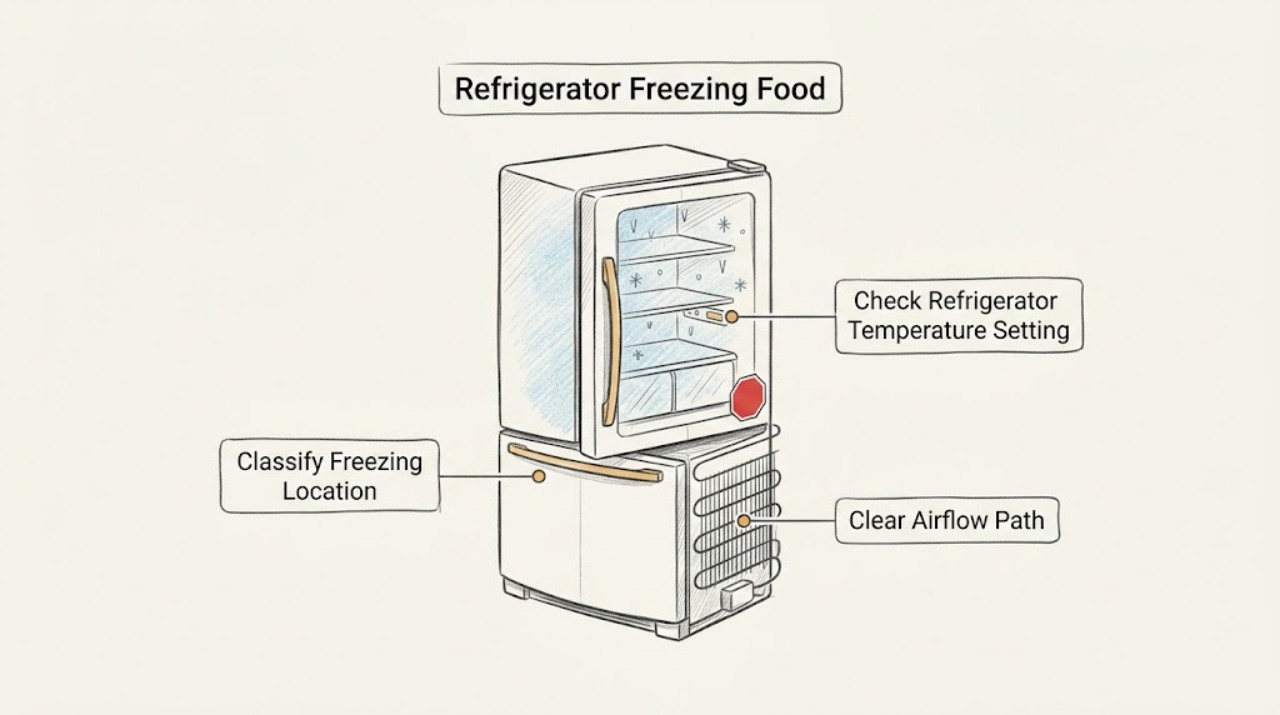
Map where the ice or frozen food appears: one item or drawer, food touching the rear wall, the coldest lower area, several shelves, or the entire refrigerator compartment. Note whether the freezer is normal, whether frost is thin or thick, and whether the problem began after a large loading or setting change; do not scrape the ice.
Expected result: Only rear-wall-contact items freeze, one zone is affected, frost covers much of the rear wall, or food across the refrigerator compartment freezes.
Next step: For local freezing, reposition food and check clearance. For broad freezing or thick recurring frost, continue with the exact model setting and airflow checks, then arrange service if the condition persists.
Stop if: Do not chip frost with a knife, heat the compartment, remove a panel, or disturb refrigerant tubing.
Why this matters
Why: A local contact pattern keeps placement and cold-zone behavior in view. Broad freezing across shelves makes an incorrect setting, airflow, control, or refrigeration fault more likely. A thin rear-wall frost layer may be a normal defrost cycle on some Bosch models; thick or recurring frost changes the next step.
-
Check 2
Using the exact Bosch manual, check the refrigerator compartment temperature control and whether a special cooling or freezing mode was enabled accidentally. Make one documented user-setting correction toward the normal refrigerator setting; do not alter hidden service settings or repeatedly turn the control back and forth.
Expected result: The refrigerator was set colder than intended, a special mode is active, the control appears normal, or the control cannot be changed or does not match the display.
Next step: After one documented correction, allow the refrigerator to stabilize and reassess the same locations. If the setting is normal, cannot be changed, or food continues freezing, arrange Bosch service rather than selecting a control part.
Stop if: Do not bypass a temperature sensor, enter service mode, or remove the control housing.
Why this matters
Why: A colder-than-intended user setting or temporary special mode can explain broad freezing on models that provide it. A normal setting with persistent overcooling makes a sensor, damper, control, defrost, or sealed-system fault more likely, but the setting check cannot identify the component.
-
Check 3
Rearrange food and containers so nothing touches the rear panel and the visible interior air openings remain clear. Keep delicate produce and liquids out of the model's coldest zone when the exact manual identifies one; do not pack items against the back wall or block an air outlet.
Expected result: Food or packaging was against the rear panel, a container blocked an air opening, the affected item was in a designated cold zone, or the interior was spaced correctly but freezing continues across shelves.
Next step: Move the affected food, leave circulation space, and observe one normal operating period without repeatedly opening the door. If broad freezing or heavy frost remains, continue to the door, drain, and service boundary.
Stop if: Do not force food against shelves, block vents, remove an air duct, or use a sharp tool to clear ice from an opening.
Why this matters
Why: Rear-panel contact or blocked circulation can create a local frozen package without proving whole-appliance overcooling. A correctly spaced refrigerator that freezes broadly points away from placement and toward the setting, sensor, airflow control, or refrigeration system.
-
Check 4
Inspect the closed refrigerator door and gasket from the outside for an item preventing closure, a visible gap, or a gasket that is folded or displaced. If there is water or ice at the base, use the exact manual to identify the accessible condensation channel or drain; clean only the normal user-accessible path without removing panels.
Expected result: The door does not close fully, the gasket is damaged or displaced, the condensation channel or drain is visibly blocked, or the door and accessible drain appear normal.
Next step: Remove only a clear door obstruction, reseat a gasket if the exact manual allows it, or clean the documented accessible drain. If the seal is damaged, panels are required, or freezing persists, arrange service.
Stop if: Do not dismantle the door, puncture a gasket, push wire into a drain, or remove an interior or rear panel.
Why this matters
Why: A door that remains open can disturb temperature and frost behavior, while a blocked condensation path can leave water that later freezes. A normal door and drain do not rule out a control or airflow fault when the whole compartment remains too cold.
-
Check 5
After the documented setting, placement, door, and accessible-drain checks, reassess the same food locations and frost pattern without repeated door opening. Record whether freezing stops locally, the whole compartment remains too cold, frost returns quickly, the compressor runs unusually often, or an alarm or error appears.
Expected result: The affected item no longer freezes after repositioning, the compartment improves after one setting correction, freezing persists broadly, thick frost returns, or another fault appears.
Next step: If the problem persists or another fault appears, protect food as appropriate, keep the refrigerator operating only if it is safe and stable, and arrange Bosch service. Provide the model, locations, setting, frost pattern, door and drain results, and timing.
Stop if: Do not continue operating with smoke, burning odor, damaged wiring, a refrigerant leak, repeated electrical trips, or a temperature that threatens food safety; do not attempt internal repair.
Why this matters
Why: Improvement after a placement or setting correction supports that user condition as the immediate cause. Persistent broad freezing, recurrent frost, abnormal running, alarm, or error makes a sensor, damper, control, defrost, or sealed-system fault more likely and requires model-specific diagnosis.
Use your observations
Decision map
Find the observation that best matches what you see, then follow the next safe action.
-
PATH 01Safety boundary
What you see
Only food or packaging touching the rear wall or placed in a documented cold zone freezes, while other shelves remain normal and the refrigerator setting is normal.
Do this next
Move food away from the rear panel and visible vents, cover or package it as the manual advises, and monitor the same item after one normal operating period. Arrange service if multiple shelves begin freezing.
Why this path and its safety boundary
Why it matters: Local air circulation or cold-zone placement is more likely than whole-appliance overcooling.
Safety stop: Do not scrape the rear wall with a sharp tool or remove an air duct.
-
PATH 02Safety boundary
What you see
The refrigerator compartment is broadly too cold and the temperature setting was colder than intended, a special mode was active, or the door was not closing fully.
Do this next
Correct the setting or door obstruction once according to the exact manual and reassess after stabilization. If the control is normal or the problem returns, arrange service.
Why this path and its safety boundary
Why it matters: A documented user setting or door condition is more plausible than an immediate internal control failure.
Safety stop: Do not bypass the door sensor, alter hidden settings, or dismantle the control or door.
-
PATH 03Safety boundary
What you see
A thick or recurring frost pattern accompanies water or ice at the refrigerator base, or the exact manual identifies a blocked condensation channel or drain.
Do this next
Clean only the exact manual's accessible condensation path and confirm the door closes. If the drain is inaccessible, the gasket is damaged, frost returns, or the compartment remains too cold, call service.
Why this path and its safety boundary
Why it matters: An accessible drainage or defrost condition may be contributing, but recurring frost can also reflect a door seal, airflow, defrost, or control fault.
Safety stop: Do not push wire into the drain, melt ice with a heat source, or remove interior panels.
-
PATH 04Safety boundary
What you see
Food across the refrigerator compartment freezes despite normal placement, clear vents, a fully closed door, normal user setting, and one documented reassessment.
Do this next
Arrange Bosch appliance service and provide the exact model, temperature setting, food locations, frost pattern, compressor or fan behavior, door and drain results, and any display or alarm information.
Why this path and its safety boundary
Why it matters: A temperature sensor, damper, control, defrost, or sealed-system issue is more likely than a local package problem, but the safe checks cannot identify a component.
Safety stop: Do not replace a sensor or control board based on symptoms, open refrigeration panels, or handle refrigerant or live wiring.
Helpful context
Understand the symptom
Local freezing and whole-compartment overcooling are different problems
A bottle or vegetable touching the rear panel can freeze even when the rest of the refrigerator is normal. Bosch manuals describe different chill zones and warn that contact with the rear panel impairs air circulation and can freeze food or packaging. If everything in the refrigerator compartment is freezing, treat it as a temperature-control or airflow problem instead of moving one package and assuming the appliance is fixed.
Some rear-wall frost can be normal
Bosch's newer KIN96 information states that a layer of frost on the rear wall can form for functional reasons and that the rear wall defrosts automatically at intervals. The same material says to open the door only as needed, cover food, let hot food cool before storage, and leave space between food and interior walls. Thick frost across the compartment, recurring ice after those practices, or a temperature that does not follow the control setting is not a reason to scrape the wall; use the exact manual or service.
Temperature controls and models differ
Bosch refrigerator families use different dials, displays, chill drawers, and special modes. One opened manual says a higher controller setting lowers refrigerator and freezer temperatures, while the Bosch owner-support page exposes model-specific categories such as food frozen and refrigerator compartment too cold. Find the exact model before changing a setting or diagnosing a sensor, damper, or control board.
Safety boundary
Stop conditions
- Stop and arrange prompt service for smoke, burning odor, damaged wiring, water near electrical parts, repeated electrical trips, a refrigerant concern, or a temperature condition that threatens food safety.
- Do not chip ice with a knife or other sharp tool, use a heat source to defrost an interior passage, puncture a drain or evaporator area, or remove refrigerator panels.
- Do not bypass a temperature, door, or defrost sensor, enter undocumented service modes, or replace a control, damper, or sealed-system component from the freezing symptom alone.
- If one documented setting, placement, door, or accessible-drain correction does not resolve broad or recurring freezing, stop repeated testing and arrange Bosch service.
Only after diagnosis
Potential parts
- Bosch model-matched door gasket or condensation-drain component
Consider this category only when the exact manual and a qualified technician confirm a damaged gasket or serviceable drain component after visible door and accessible-drain checks do not resolve recurring frost or freezing.
Confirm the full model, door configuration, and technician-approved component identification before ordering; do not puncture or dismantle the door or drain yourself. - Bosch model-matched temperature sensor, damper, or control assembly
Consider this category only after a qualified technician confirms a control, sensor, or airflow fault when the setting, food placement, door, vents, and accessible drain are normal but the whole compartment remains too cold.
Confirm the exact model, revision, and technician-approved diagnosis before ordering; internal electrical and refrigeration work is not an owner repair.
When checks do not resolve it
Need a professional?
Safety scope: This article covers model-authorized setting changes, food repositioning, visible door and gasket checks, and a documented accessible condensation-path check. A qualified professional must handle panels, sensors, dampers, defrost hardware, wiring, refrigerant, sealed-system work, and component replacement.
Common questions
FAQ
Why is my Bosch refrigerator freezing food near the back wall?
Food or packaging touching the rear panel can freeze locally because it impairs air circulation. Move items away from the wall and visible vents, then monitor the same location. If food across the compartment freezes, treat it as a broader temperature problem and call service if setting and placement checks do not help.
Is frost on the back wall of a Bosch refrigerator normal?
A thin rear-wall frost layer can be functional on some Bosch models because the panel defrosts automatically. Keep food away from the wall and cover it as the manual advises. Thick or recurring frost, broad freezing, or a temperature that remains wrong needs model-specific service assessment.
What temperature setting should I check if my Bosch refrigerator is freezing?
Use the exact Bosch manual to confirm the refrigerator compartment setting and whether a special cooling mode was enabled. Make one documented correction toward the normal refrigerator setting and reassess after stabilization. Do not infer a sensor or control failure until that model-specific check is complete.
Can blocked airflow make a Bosch refrigerator freeze food?
Blocked interior or external ventilation can disturb temperature distribution, while a package against the rear wall can freeze locally. Clear only visible obstructions without removing panels. If the compartment remains broadly too cold with clear vents and normal placement, arrange service.
When should I call a professional about a Bosch refrigerator that keeps freezing?
Call when the whole refrigerator compartment stays too cold after one documented setting correction, thick frost returns, the door or drain is damaged or inaccessible, the control cannot be changed, or diagnosis would require panels, sensors, dampers, wiring, or refrigerant work. Treat electrical damage, smoke, leaks near electrical parts, and food-safety risk as urgent.
Read the exact guide
Official sources
- Spare parts, accessories & online support - Bosch - KGN36A73/16Bosch Home Appliances · Official Bosch support page for a specific refrigerator model; it demonstrates model-specific categories such as food frozen, ice formation, and refrigerator compartment too cold, while the exact appliance page controls the applicable procedure.
- Use and Care InstructionsBosch · Official Bosch-hosted refrigerator manual; apply its control and placement details to the covered model family and use the exact manual for another Bosch refrigerator.
- Information for Use KIN96..Bosch · Official Bosch-hosted KIN96 refrigerator information; apply the frost and placement guidance to that family and use the exact manual for another model.
- Information for Use KIS..Bosch · Official Bosch-hosted KIS refrigerator information; use its troubleshooting details for that family and the exact manual for another model.
Community feedback
Share a repair observation
Share a plain-text repair observation. Accepted observations are published automatically; this page may take a moment to update.