
On this page
Start here
Quick answer
Confirm the actual refrigerator temperature before changing several settings: place a thermometer in a glass of water on the middle shelf for 12 hours. If the reading is below the intended range, raise the temperature setting and allow the refrigerator to stabilise. Then check whether food is touching the rear wall or blocking vents, whether the door seal is damaged, whether fast-cooling or another special mode is active, and whether the room is unusually cold. If the compartment still freezes food after those external checks, a thermostat, sensor, defrost-control, or airflow fault needs professional diagnosis.
Before you begin
Safety first
- Keep checks external. Do not remove evaporator or electrical covers, probe live wiring, chip ice with a sharp tool, or replace a thermostat or defrost component without qualified diagnosis. Move perishable food if repeated freezing is damaging it, and use the exact model manual for any accessible drain or control procedure.
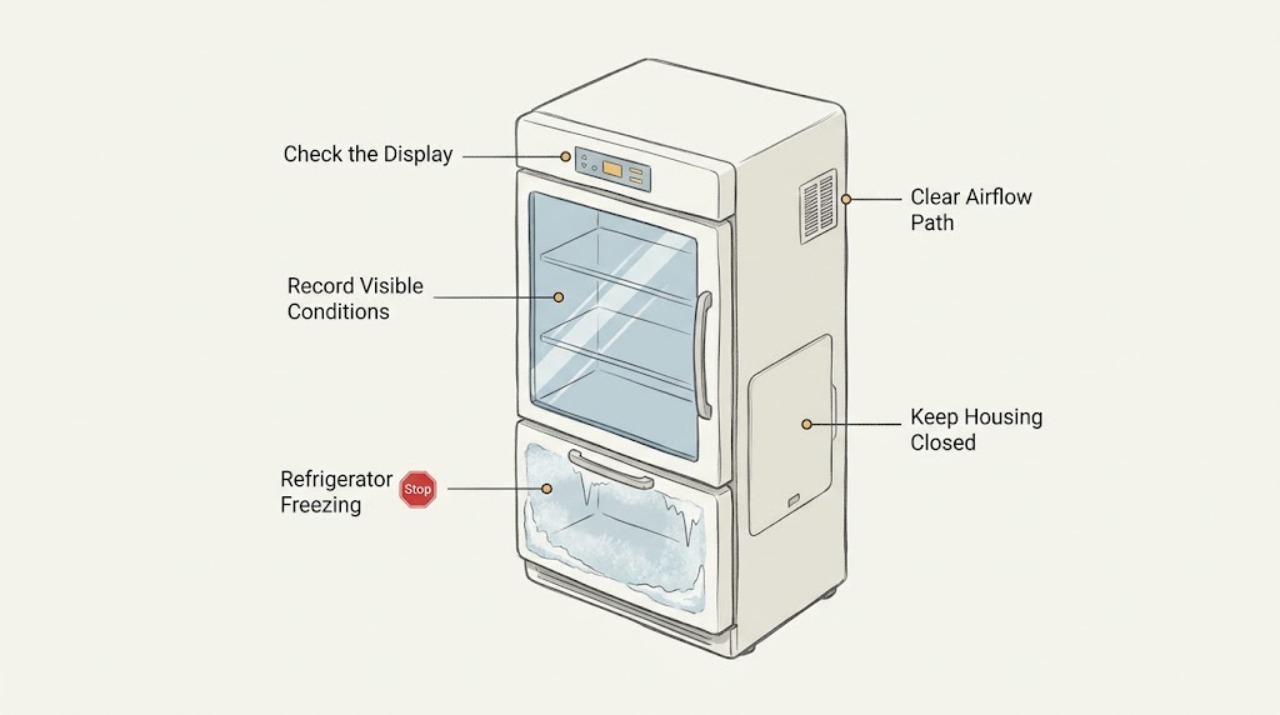
Work through in order
Diagnostic checks
Use only checks that match the exact appliance or system and its official guide.
-
Check 1
Place a refrigerator thermometer in a glass of water on the middle shelf and leave it undisturbed for 12 hours. Record the reading, the control setting, and whether the frozen food is near the rear wall, a vent, or the door.
Expected result: The measured temperature is within the model's intended refrigerator range, clearly too low, or only one item near a cold surface is frozen while the rest of the compartment is normal.
Next step: Use the measured result and location to continue. If the temperature is normal, move food away from the rear wall or vent and monitor rather than lowering the setting further. If it is too low, check the setting and special modes next.
Why this matters
Why: A stable measurement separates a compartment-wide overcooling problem from a local cold spot or an unreliable quick hand test. Blomberg says its general refrigerator target is commonly 3°C to 5°C, but the exact model manual controls when settings differ.
-
Check 2
Check the refrigerator compartment temperature dial or display against the exact model manual. Cancel any fast-cooling, rapid-cooling, or similar temporary mode that is active, then select a warmer setting by the model's normal control method.
Expected result: The setting is at a very cold value or a rapid-cooling mode is active, or the setting and modes are already appropriate.
Next step: After one adjustment, allow the refrigerator to stabilise before measuring again. If the control cannot be changed, changes by itself, or the temperature remains too low at the appropriate setting, arrange service rather than repeatedly cycling modes.
Why this matters
Why: Blomberg identifies an overly low setting as a direct cause of a refrigerator that is too cold, and some models use a temporary rapid-cooling function. An appropriate setting with continued low readings makes a simple control selection less likely.
-
Check 3
Inspect the shelf layout and the interior airflow path. Move food away from the rear wall and any visible vent, leave space for air circulation, and avoid pressing containers against the coldest surface. Do not block or remove an air duct.
Expected result: Food is touching the rear wall, a vent is blocked, or the compartment is overpacked; alternatively, there is clear space and the frozen items are distributed throughout the compartment.
Next step: Rearrange the load and repeat the temperature measurement after stabilisation. If the freezing pattern persists with clear airflow, continue to the seal and room-condition checks.
Why this matters
Why: Blomberg says overpacking and blocked airflow can create uneven cooling and cold spots. If food is clear of the airflow path but several areas still freeze at a measured low temperature, arrangement alone is unlikely to be the whole cause.
-
Check 4
Inspect the door gasket all the way around for dirt, gaps, looseness, tears, or a section that does not meet the cabinet. Close the door normally and check that it latches without a package preventing a full seal.
Expected result: The gasket has a visible gap or damage, the door is not closing fully, or the seal and door closure look normal.
Next step: Clean a dirty gasket with a suitable damp cloth and remove any package blocking the door. If the gasket is torn, loose, or will not seal, arrange a model-matched replacement or service rather than gluing it in place.
Why this matters
Why: Blomberg says a damaged or loose seal can disturb temperature control and contribute to condensation or ice formation. A sound seal and complete closure make warm-air entry a less likely explanation for a consistently low measured temperature.
-
Check 5
Check the room where the refrigerator is installed and note whether it is unusually cold, such as an unheated garage or utility space. Compare the condition with the ambient limits in the model manual, and look for persistent ice on the rear wall or a blocked defrost drain only where it is visibly accessible.
Expected result: The room is below the model's recommended ambient range, the rear wall has excessive or constant ice, the defrost drain is visibly obstructed, or the room and accessible areas are normal.
Next step: Restore a suitable ambient location and clear only an accessible drain obstruction using the model's instructions. Do not dismantle the evaporator or defrost system; call service if ice returns or the measured temperature remains too low.
Why this matters
Why: Blomberg lists an environment that is too cold as a possible contributor and says a blocked defrost drain can allow water to freeze on the rear wall. Persistent ice or a normal environment with confirmed overcooling makes a thermostat, sensor, defrost, or airflow fault more concerning.
Use your observations
Decision map
Find the observation that best matches what you see, then follow the next safe action.
-
PATH 01Next step
What you see
The thermometer shows a normal compartment temperature and only food touching the rear wall or a vent is frozen.
Do this next
Keep containers clear of the rear wall and vents, avoid overpacking, and continue periodic temperature checks. Escalate if food freezes across multiple areas or the measured temperature falls again.
Why this path and its safety boundary
Why it matters: This pattern points to a cold-surface or airflow cold spot rather than a whole-compartment control failure.
-
PATH 02Next step
What you see
The measured refrigerator temperature is too low and the control setting or rapid-cooling mode was incorrect, with no persistent seal or airflow obstruction.
Do this next
Leave the control at the model-recommended setting and avoid changing it repeatedly. Recheck after loading changes or unusual room conditions.
Why this path and its safety boundary
Why it matters: Improvement after the control correction makes the setting or temporary mode the likely cause rather than a failed thermostat.
-
PATH 03Next step
What you see
Several foods freeze across the compartment, the measured temperature stays too low at an appropriate setting, or ice returns despite clear airflow, a sound seal, and suitable room conditions.
Do this next
Move sensitive food away from the freezing area, avoid opening panels or probing the control system, and arrange Blomberg-authorised service with the measured temperature and completed checks.
Why this path and its safety boundary
Why it matters: This combination is less consistent with a user-setting or loading issue and more consistent with a thermostat, temperature sensor, defrost-control, or internal airflow fault that cannot be confirmed safely from outside.
Helpful context
Understand the symptom
Food freezing in the refrigerator compartment is different from the freezer operating normally. A cold spot near the rear wall, a setting that is too low, a fast-cooling mode, blocked airflow, or a control fault can all make the symptom look similar. Start with a stable temperature measurement and the location of the frozen food; a single frozen item against a cold surface does not establish that the whole compartment is too cold.
Use only external, low-risk checks. Blomberg recommends consulting the model manual and customer care if the refrigerator remains too cold, and thermostat or defrost-timer work is generally professional work. Do not remove interior covers, probe wiring, or chip ice with a sharp tool.
Only after diagnosis
Potential parts
- refrigerator thermostat or temperature sensor
Consider this only when a stable thermometer reading confirms overcooling after the setting, special-mode, airflow, seal, and ambient checks, and a technician identifies the control or sensor as the failed component.
Confirm the full refrigerator model and the manufacturer's fit information before ordering; do not assume a thermostat or sensor from another Blomberg model is compatible.
When checks do not resolve it
Need a professional?
Arrange Blomberg-authorised service when the measured refrigerator temperature remains too low after the setting, special-mode, airflow, seal, and ambient checks; when the control changes unexpectedly; when persistent ice returns; or when a thermostat, sensor, defrost system, or internal air duct needs inspection.
Safety scope: Keep checks external. Do not remove evaporator or electrical covers, probe live wiring, chip ice with a sharp tool, or replace a thermostat or defrost component without qualified diagnosis. Move perishable food if repeated freezing is damaging it, and use the exact model manual for any accessible drain or control procedure.
Have this ready
- Provide the exact model and serial details, the thermometer method and readings, the control setting and any active special mode, where food is freezing, the door-seal and airflow observations, room conditions, and whether rear-wall ice or a fault indicator is present.
Common questions
FAQ
How do I confirm that my Blomberg refrigerator is actually too cold?
Place a thermometer in a glass of water on the middle shelf for 12 hours and record the result. Also note whether the frozen food is touching the rear wall or a vent. Use the exact model manual for the target setting; Blomberg's general guidance commonly uses 3°C to 5°C for a refrigerator compartment.
What setting should I use when my Blomberg fridge is freezing food?
If the measured temperature is too low, raise the temperature setting according to the model manual and cancel any active rapid-cooling mode. Let the refrigerator stabilise before measuring again, rather than changing the control repeatedly.
Why does food freeze near the back wall of a Blomberg refrigerator?
A local cold surface or blocked airflow can freeze an item even when the rest of the compartment is within range. Move food away from the rear wall and vents, leave space for air circulation, and use a stable thermometer reading to determine whether the whole compartment is overcooling.
When should a professional inspect a Blomberg refrigerator that keeps freezing food?
Arrange service when the temperature remains too low after the setting, rapid-cooling mode, airflow, seal, and ambient checks; when the control behaves unexpectedly; or when rear-wall ice returns. Thermostat, sensor, defrost, and internal airflow work should not be attempted as a home repair.
Read the exact guide
Official sources
- Why are there droplets of water or ice on the fridge rear wall?Blomberg · Blomberg refrigerator rear-wall ice, defrost-drain, airflow, loading, temperature-setting, and seal checks
- Refrigerator User ManualBlomberg · Blomberg refrigerator temperature controls, compartment settings, air-flow cautions, rear-wall conditions, and model-specific service boundaries
- Why is my fridge too cold?Blomberg · Blomberg refrigerator temperature measurement, settings, airflow, door seal, thermostat, defrost, and ambient checks
Community feedback
Share a repair observation
Share a plain-text repair observation. Accepted observations are published automatically; this page may take a moment to update.