
On this page
Start here
Quick answer
If food is freezing in the refrigerator compartment, first make a small adjustment toward a warmer temperature using the exact Danby model's control. Move food away from the interior air outlet and back wall, and do not pack items against vents. Check that packages are not holding the door open, the gasket is clean and contacting the cabinet, and the refrigerator has the ventilation and room conditions required by its manual. A single cold spot near a vent or rear wall points first to airflow and placement; food freezing throughout the compartment, a setting that does not change the temperature, heavy frost, a door that will not seal, or temperatures that cycle abnormally makes a sensor, damper, control, defrost, or sealed-system problem more likely. Let the compartment stabilize after the setting or loading change and protect perishable food elsewhere while it is too cold. Do not remove interior covers, adjust a damper, probe a sensor, open the control area, or work on the sealed refrigeration circuit; persistent or widespread freezing needs Danby or qualified appliance service.
Before you begin
Safety first
- The user may adjust the documented temperature control, rearrange food, inspect visible outlets and gasket, check closure and placement, and record the symptom. Qualified service personnel must handle dampers behind covers, sensors, controls, fans, defrost assemblies, wiring, compressors, and sealed-system work.
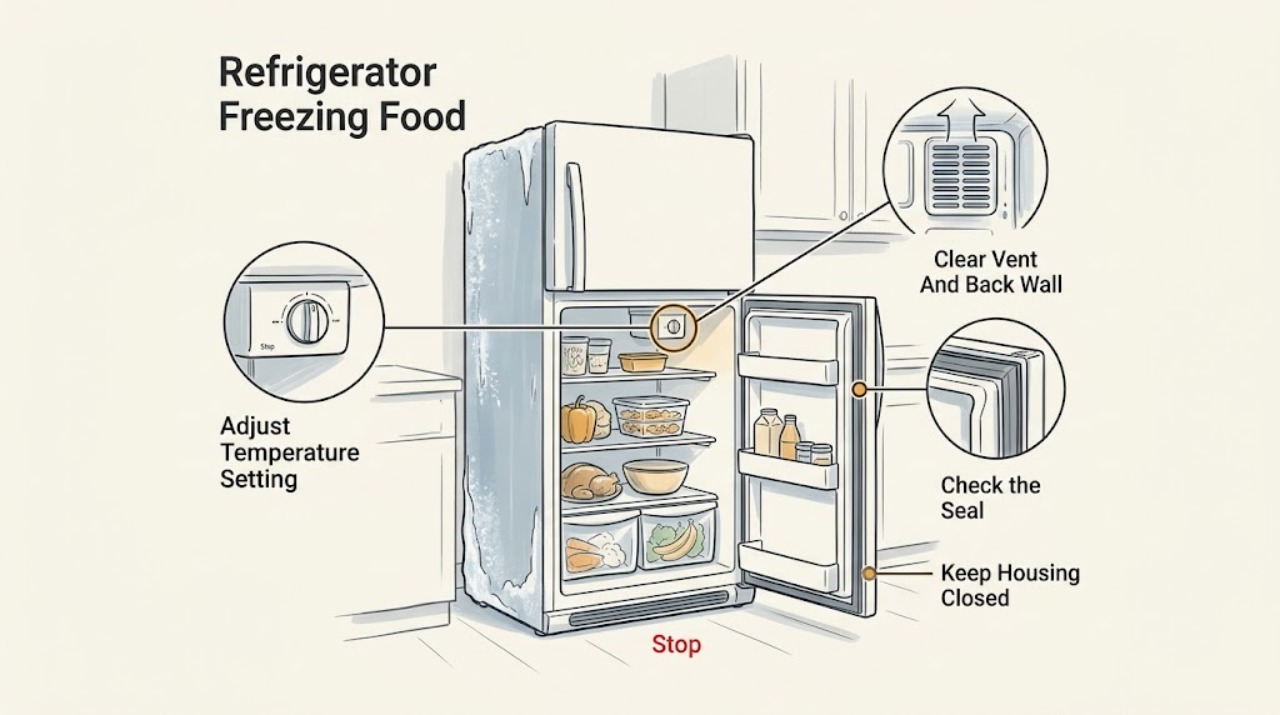
Work through in order
Diagnostic checks
Use only checks that match the exact appliance or system and its official guide.
-
Check 1
Identify the exact Danby model and note whether the thermostat is a knob, display, or separate refrigerator/freezer control. Make a small adjustment toward warmer using the documented control, record the starting and new setting, and allow the compartment to stabilize before judging the result. Move food that is already frozen to a safe location while the temperature is corrected.
Expected result: The control was set unusually cold, the displayed setting changes but food remains frozen, the control does not respond, or the control behavior is model-specific and unclear.
Next step: Keep the warmer setting only if it is within the exact manual's operating range and reassess after stabilization. If the setting cannot be verified or the compartment stays too cold, stop adjusting and arrange Danby or qualified appliance service.
Stop if: Do not remove the thermostat or control panel, turn a hidden adjustment screw, or repeatedly change settings before the compartment can stabilize.
Why this matters
Why: A setting that was too cold can explain freezing without a failed part. A control that changes but does not change the compartment, or one that is unresponsive, makes sensing, damper, control, or cooling behavior more likely.
-
Check 2
Inspect the refrigerator compartment without removing panels. Find the visible interior air outlet and rear wall, then move food, bottles, liners, and containers away from those areas and leave the outlet unobstructed. Check whether only the items directly in the cold-air path are frozen or whether items on several shelves are affected.
Expected result: Frozen items touch the vent or back wall, a shelf or package blocks the outlet, frost covers the outlet or rear wall, or food freezes throughout the compartment despite clear airflow.
Next step: Rearrange the load and allow the unit to stabilize. If frost blocks the outlet, follow only the exact manual's defrost guidance; if frost returns or the whole compartment remains too cold, call service rather than removing covers.
Stop if: Do not chip frost, scrape the evaporator, insert tools into an outlet, or use a heat source to clear an internal obstruction.
Why this matters
Why: A localized cold spot supports an airflow and placement cause. Frost or compartment-wide freezing makes air distribution, door sealing, defrost, sensor, damper, or control problems more plausible than one misplaced package.
-
Check 3
Check that no package, shelf, drawer, or door bin prevents the refrigerator door from closing. Inspect the visible gasket for dirt, a fold, gap, or damage and confirm it contacts the cabinet around the full perimeter. Check that the unit is level and that frequent or prolonged door openings are not allowing warm humid air to enter.
Expected result: The door does not close fully, the gasket has a visible gap or damage, the unit is out of level, frost is building near the seal, or the door and gasket appear normal.
Next step: Remove the obstruction, clean the accessible gasket, and correct only an obvious safe leveling issue according to the model manual. If the gasket, hinge, cabinet, or seal needs adjustment or replacement, arrange service.
Stop if: Do not reshape a gasket with a heat tool, remove the door, adjust hinges beyond the manual, or continue if the seal remains open or frost is severe.
Why this matters
Why: A poor seal changes airflow and temperature distribution and can create frost that sends cold air unevenly. A normal gasket and closure make a setting, vent, environment, or internal control issue more likely.
-
Check 4
Check the refrigerator's location against the exact Danby installation instructions: note whether it is in a temperature-controlled room, near a heat source, on a stable level surface, fully enclosed, or pressed against a wall. Confirm that visible ventilation space and the front opening match the manual, and do not place food directly against a side or rear surface just to make room.
Expected result: The refrigerator is in an unsuitable hot, cold, outdoor, or enclosed location, its clearance is restricted, it is unstable or unlevel, or the environment and clearance match the manual.
Next step: Restore only the manual's required placement and clearance without moving a loaded appliance unsafely, then let temperatures stabilize. If the location is fixed or the unit still freezes food in a compliant environment, arrange service.
Stop if: Do not fully enclose a free-standing model, block ventilation, place it on an unstable surface, or move it while the cord, doors, or water connections could be damaged.
Why this matters
Why: Ambient conditions and restricted ventilation can change run time and temperature distribution. A model intended for one placement type should not be assumed suitable for a garage, outdoor location, or sealed cabinet.
-
Check 5
After the setting, load, gasket, and placement checks have had time to take effect, record whether one shelf or the entire refrigerator freezes food, the actual temperature if measured without disturbing the unit, frost location, compressor cycling, and any display or alarm behavior. Do not open covers to reproduce or measure the fault.
Expected result: The problem stops after an external correction, returns quickly, affects the whole compartment, occurs with heavy frost, persists despite a warmer setting, or is accompanied by abnormal cycling, noise, odor, or a fault display.
Next step: Protect food from freezing and arrange Danby or qualified appliance service for persistent overcooling, heavy frost, or abnormal operation. Provide the model and recorded pattern so the technician can use the correct service information.
Stop if: Do not replace a sensor, damper, control, fan, or compressor from the symptom alone, and do not perform live electrical or refrigerant checks.
Why this matters
Why: Recovery after a setting, airflow, loading, gasket, or environment correction supports that condition as the immediate cause. Persistent or widespread freezing makes an internal damper, sensor, control, defrost, fan, or sealed-system fault more likely.
Use your observations
Decision map
Find the observation that best matches what you see, then follow the next safe action.
-
PATH 01Safety boundary
What you see
Only food directly under a visible outlet or against the rear wall is frozen, and the control is otherwise responsive.
Do this next
Move food away from the outlet and rear wall, keep the air path clear, use a slightly warmer documented setting, and allow stabilization before reassessing.
Why this path and its safety boundary
Why it matters: Localized airflow and placement are more likely than a compartment-wide control fault.
Safety stop: Do not insert tools into the outlet or remove an internal cover.
-
PATH 02Safety boundary
What you see
The refrigerator setting is at a very cold position, or changing it does not change the food-freezing pattern after stabilization.
Do this next
Set the temperature warmer only within the exact manual's range and reassess once. If the control does not respond or overcooling persists, arrange service.
Why this path and its safety boundary
Why it matters: A user setting may be the cause when it responds; a nonresponsive control makes a thermostat, sensor, damper, or control problem more likely.
Safety stop: Do not open the control area or turn hidden adjustment screws.
-
PATH 03Safety boundary
What you see
The door does not close fully, the gasket has a gap or damage, or frost is concentrated around the seal or outlet.
Do this next
Remove loading obstructions, clean the gasket, and correct only a safe leveling issue. Call service for a damaged gasket, hinge, cabinet, severe frost, or a seal that still does not contact.
Why this path and its safety boundary
Why it matters: Warm-air entry and disturbed airflow are more likely than an isolated temperature-setting issue.
Safety stop: Do not heat, cut, glue, or remove the gasket or door yourself.
-
PATH 04Safety boundary
What you see
The refrigerator is outside its specified environment, fully enclosed, pressed against a wall, unlevel, or lacking the manual's ventilation clearance.
Do this next
Restore the exact manual's placement and clearance if safe, then allow stabilization. If the environment cannot be corrected or food still freezes, call service.
Why this path and its safety boundary
Why it matters: Installation and ambient conditions can alter cooling and airflow, so an internal part should not be blamed yet.
Safety stop: Do not move a loaded appliance unsafely or create an improvised enclosure or ventilation opening.
-
PATH 05Safety boundary
What you see
Food freezes on multiple shelves or the entire compartment, the warmer setting has no effect, heavy frost returns, or abnormal cycling or a fault display is present after accessible checks.
Do this next
Protect food, leave the refrigerator operating only if there is no hazard and food can be kept safe, and arrange Danby or qualified appliance service. Give the technician the model, temperature pattern, frost location, and setting history.
Why this path and its safety boundary
Why it matters: An internal damper, sensor, control, fan, defrost, or sealed cooling fault is more likely and cannot be identified safely from the symptom alone.
Safety stop: Do not remove panels, probe sensors or wiring, bypass a control, or work on refrigerant or sealed-system parts.
Helpful context
Understand the symptom
A cold spot is not the same as a compartment-wide fault
Danby's own answer to food freezing starts with a warmer temperature setting and moving food away from the interior vent and rear wall. If only packages touching that area freeze, airflow and placement are the first checks. If food freezes on multiple shelves or the whole refrigerator is below its intended range, the control, sensor, damper, defrost behavior, or cooling system needs a different diagnosis.
Door sealing and placement affect temperature distribution
A package can hold the door open or block an outlet even when the gasket looks intact. Danby manuals call for fully closed doors, clear air outlets, and model-specific clearance around the unit; Danby also notes that many refrigerators are free-standing and should not be fully enclosed without the manual's ventilation allowance. Check the room and installation before assuming an internal component has failed.
Keep internal controls and sealed cooling parts closed
A user can change the documented temperature setting, rearrange food, inspect the gasket, and check visible clearance. A damper behind a cover, thermistor or sensor, control board, defrost assembly, compressor, or sealed-system component is not identified safely by a food-freezing symptom alone. Stop if diagnosis would require panels, wiring, refrigerant work, or a live measurement.
Safety boundary
Stop conditions
- Protect perishable food elsewhere while the refrigerator is freezing food; stop use for smoke, burning odor, damaged wiring, water near electrical parts, a hot cord, or repeated protection trips.
- Do not remove evaporator or interior covers, probe air outlets or sensors, bypass controls, or perform live electrical tests.
- Do not chip frost, use improvised heat, work on the compressor or sealed refrigeration circuit, or add refrigerant.
- Do not fully enclose a free-standing Danby refrigerator, block its ventilation, or move a loaded or connected appliance unsafely.
- If a warmer documented setting, clear airflow, correct loading, gasket, and placement do not stop compartment-wide freezing, stop repeated adjustments and arrange qualified service.
When checks do not resolve it
Need a professional?
Safety scope: The user may adjust the documented temperature control, rearrange food, inspect visible outlets and gasket, check closure and placement, and record the symptom. Qualified service personnel must handle dampers behind covers, sensors, controls, fans, defrost assemblies, wiring, compressors, and sealed-system work.
Common questions
FAQ
Why is my Danby refrigerator freezing food?
Start with a small warmer adjustment using the exact model's control, then move food away from the interior vent and back wall. Check the door gasket, loading, level, clearance, and room placement. If food freezes throughout the compartment or the setting does not change the result after stabilization, arrange service for a possible sensor, damper, control, defrost, or sealed cooling fault.
Can food near the vent freeze in a Danby refrigerator?
Yes. Danby specifically recommends moving food away from the interior vent and back wall when food is freezing. Clear the visible outlet and compare the pattern: a local cold spot supports placement and airflow, while freezing on several shelves needs a broader diagnosis.
Which way should I turn the Danby thermostat if food is freezing?
Move the setting slightly toward warmer, but use the exact model manual because Danby controls differ. On a numbered knob, the meaning of the numbers must be confirmed for the model; do not assume that a higher or lower number is warmer. Allow the compartment to stabilize before making another change.
Can a Danby door seal cause food to freeze?
A poor seal can disturb airflow and create frost, which may produce uneven temperatures. Check that packages are not holding the door open and that the gasket is clean and contacting the cabinet. A damaged gasket, hinge, cabinet, or recurring frost pattern needs service.
When should I call a professional for a Danby refrigerator that is too cold?
Call when the warmer documented setting, clear vents, corrected loading, gasket, level, and placement do not stop freezing after stabilization; when the whole compartment freezes; when heavy frost returns; or when a damper, sensor, control, fan, defrost assembly, wiring, compressor, or sealed system would need access. Do not remove covers or perform live tests.
Read the exact guide
Official sources
- DCR049B1BSLDB Owner's ManualDanby · Official Danby model-family manual used for examples of temperature-too-cold, blocked-air-outlet, door-closure, level, frost, clearance, and stabilization checks; do not transfer its exact layout to another model.
- Refrigeration FAQsDanby · Official Danby category guidance used for model variation, placement and clearance, door-seal, temperature, and service boundaries; it is not a substitute for the exact model manual.
- Things are freezing in the fridge what's happening?Danby · Official Danby answer used for the primary warmer-setting and vent/back-wall checks; exact model controls and temperature range still come from the owner's manual.
- Danby 7.3 cu. ft. - DPF073C1WDBDanby · Official Danby product page used to show that a refrigerator model can have mechanical controls and model-specific placement/temperature FAQs; it does not establish universal settings or internal parts.
Community feedback
Share a repair observation
Share a plain-text repair observation. Accepted observations are published automatically; this page may take a moment to update.