
On this page
Start here
Quick answer
First confirm that the ice is on food in the fresh-food compartment, not only in the freezer. On Fisher & Paykel ActiveSmart models, check the fresh-food temperature setting rather than changing the freezer setting, and make sure chill-sensitive food is not directly in front of a cold-air outlet or pressed against the centre back of a shelf. Leave clear space around the cabinet air ducts, avoid overfilling, and check that the door gasket sits flat and seals cleanly. The exact control layout and extra features vary by model; do not assume a freezer function such as Fast Freeze is the cause or the cure for fresh-food freezing. If all fresh-food shelves freeze after the setting and placement checks, the temperature is unstable, frost is forming behind an interior cover, or a sensor, control, fan, or sealed refrigeration component would need access, keep food safe and arrange Fisher & Paykel or qualified appliance service.
Before you begin
Safety first
- This article covers compartment identification, model-guided temperature selection, visible outlet clearance, food placement, external gasket checks, and recording warnings. Internal panels, sensors, fans, dampers, electronic controls, defrost components, sealed-system parts, refrigerant work, and live electrical tests require qualified service.
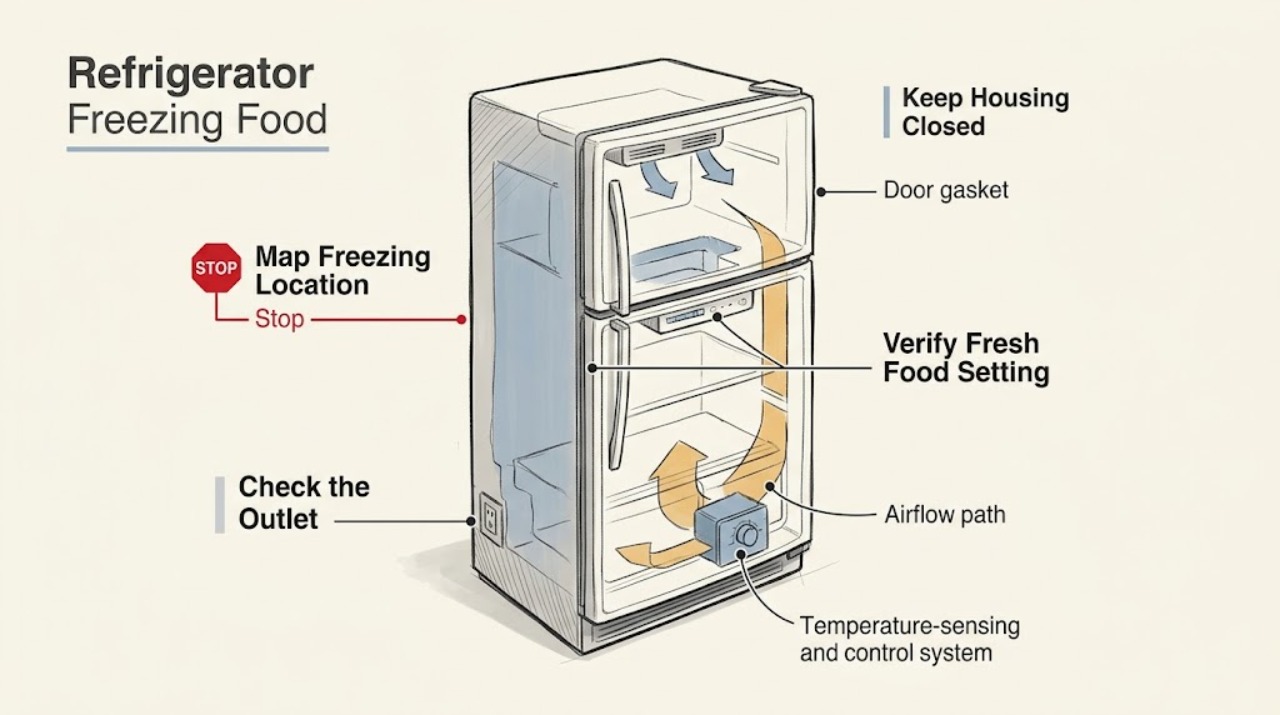
Work through in order
Diagnostic checks
Use only checks that match the exact appliance or system and its official guide.
-
Check 1
With the doors open only as long as needed, record whether the frozen item is in the fresh-food compartment, a humidity drawer, the freezer, or directly against the rear wall/air outlet. Note whether it is one item or many items across multiple shelves, and photograph the placement if useful.
Expected result: Only one or two items near the centre back or an outlet are frozen; one drawer is affected; the entire fresh-food section is freezing; or the freezer is the only cold compartment.
Next step: If the freezer is the only affected compartment, use the freezer-specific guide for that model. Otherwise continue with the fresh-food control and placement checks below.
Stop if: Do not chip ice with a sharp tool, remove an interior cover, or probe an air outlet with an object.
Why this matters
Why: A localized pattern makes cold-air placement or a drawer/zone difference more likely. Whole-compartment freezing points first to the selected fresh-food setting or temperature-control/airflow regulation. Freezer-only freezing is not the fresh-food symptom covered here.
-
Check 2
Read the exact model number and use its official User Guide to select the fresh-food/refrigerator compartment on the internal control panel. Check that the refrigerator setting was not accidentally changed to a colder level, then make only the small adjustment permitted by that guide. Do not change the freezer setting as a substitute.
Expected result: The fresh-food control is set colder than intended; the panel was adjusted while the freezer compartment was selected; the setting appears normal; or the controls do not respond or show a fault indication.
Next step: Correct the fresh-food setting once, close the door, and allow the compartment to stabilize before judging the result. If the setting is already appropriate or the fault indication returns, move to the airflow/seal checks and plan service if freezing persists.
Stop if: Do not enter hidden service modes, repeatedly change settings, or open the control panel to test wiring.
Why this matters
Why: An incorrect fresh-food setting can explain broad freezing without proving a failed part. ActiveSmart controls use the selected compartment and fewer illuminated lights mean a colder setting in the cited guide. A nonresponsive panel or fault indication needs model-specific service diagnosis.
-
Check 3
Inspect the visible cold-air outlets and the space around them without removing panels. Move chill-sensitive food away from the centre back of shelves and leave the duct openings clear; do not overfill the compartment or press containers against the rear wall. Keep a consistent position for the affected item after the change.
Expected result: The item was directly in front of an outlet or blocking a duct; the cabinet is overfilled; the item is away from outlets but still freezes; or there is visible frost/ice behind a cover.
Next step: After repositioning, let the refrigerator run normally and compare the same shelf area. If freezing remains widespread or frost is hidden behind a panel, stop at external checks and arrange service.
Stop if: Never scrape behind a cover, force a damper, block a vent to hide the symptom, or use a heat source to melt internal ice.
Why this matters
Why: Direct exposure to the air stream or restricted distribution can create a local freezing pocket and is the first model-supported placement correction. Frost behind a cover or continued freezing away from outlets raises the likelihood of an airflow-control, fan, sensor, or defrost-related fault that is not a user-accessible check.
-
Check 4
Close the refrigerator door and inspect the gasket from the outside: look for food or packaging preventing closure, a gasket that is folded or dirty, and a corner that does not sit flat. Confirm shelves and bins are not preventing the door from closing, and note whether the cabinet is visibly out of level or the door springs back open.
Expected result: The gasket is clean and continuously seated; a package or bin holds the door open; the seal has a gap or damage; or the door closes but the fresh-food section still freezes everywhere.
Next step: Remove only the external obstruction and clean/dry the gasket as the model guide permits. If the gasket is damaged, the cabinet/hinge needs alignment, or the seal remains uneven, arrange service; if the seal is sound, continue to the pattern-based decision below.
Stop if: Do not bend the door, remove hinge hardware, or use a flame, solvent, or sharp tool on the gasket.
Why this matters
Why: A door that does not seal can destabilize temperature and cause the refrigerator to run for long periods, but a sound seal does not rule out an internal control or airflow problem. A damaged or displaced gasket is a model-specific replacement/alignment issue, not a reason to adjust internal controls.
-
Check 5
Without opening any service panel, note whether the refrigerator has visible fault lights/beeps, unusual frost, an abnormal fan sound, water near electrical parts, a burning smell, or a damaged cord. If the model has a documented display or warning sequence, record the exact pattern and model number for service.
Expected result: There are no warnings and only localized freezing; a warning/fault pattern or hidden frost is present; the temperature is unstable across the whole fresh-food compartment; or there is an electrical or water hazard.
Next step: Keep the appliance closed while arranging service if food safety permits, and provide the model, compartment temperatures/locations, setting changes, and warning pattern. Isolate power from a safe location for smoke, burning odor, sparking, damaged wiring, or water entering electrical areas.
Stop if: Do not run live voltage tests, remove panels, bypass a sensor or control, or continue operation after smoke, sparking, burning odor, or water near electrics.
Why this matters
Why: No warning with a local outlet pattern supports a placement correction. A warning, hidden frost, broad instability, or abnormal operating sound makes an internal fan, sensor, control, defrost, or sealed-system diagnosis more likely. Electrical or water hazards require immediate stop-use.
Use your observations
Decision map
Find the observation that best matches what you see, then follow the next safe action.
-
PATH 01Safety boundary
What you see
One item or one small area of the fresh-food compartment freezes, especially when it is directly in front of an outlet or at the centre back, while other shelves remain normal.
Do this next
Move chill-sensitive food away from the outlet and rear centre, restore clear duct space, and monitor that same area. If the same area freezes after repositioning, arrange model-specific airflow or control service.
Why this path and its safety boundary
Why it matters: A local cold-air placement effect is more likely than a whole-appliance temperature failure.
Safety stop: Do not block the outlet or remove a damper/panel to redirect air.
-
PATH 02Safety boundary
What you see
Food freezes across several fresh-food shelves or drawers, including items that are not near an outlet, and the freezer is also operating.
Do this next
Verify the refrigerator compartment selection and setting against the exact User Guide once. If the setting is correct or the compartment remains below its intended range, protect food and arrange service.
Why this path and its safety boundary
Why it matters: The fresh-food setting being too cold is the first supported check; if it is correct, a temperature-sensing, airflow-control, fan, or electronic fault becomes more likely. This pattern does not identify a compressor or refrigerant part by itself.
Safety stop: Do not keep lowering or raising settings repeatedly, access the sealed system, or attempt a refrigerant repair.
-
PATH 03Safety boundary
What you see
The symptom began after a control change, a mode was selected, or the user is unsure whether the panel was adjusting the refrigerator or freezer; the exact model has not yet been identified.
Do this next
Read the full model code and follow only that model's control instructions. Verify the refrigerator setting separately from the freezer setting and return optional modes to the documented state before reassessing.
Why this path and its safety boundary
Why it matters: A selected-compartment or model-feature mismatch is more likely than a part failure. Fisher & Paykel feature sets differ: some product pages list Rapid Cool and Fast Freeze, but those features cannot be assumed to affect the fresh-food compartment in every model.
Safety stop: Do not copy a button sequence from another Fisher & Paykel model or infer a mode's effect from its name alone.
-
PATH 04Safety boundary
What you see
A door does not seal, frost is visible behind a cover, temperature swings despite a correct setting, or freezing remains after food is moved away from outlets.
Do this next
Remove only visible obstructions and document the model, frost location, and temperature pattern. Arrange qualified service for gasket alignment, hidden airflow, sensor, fan, control, or defrost diagnosis.
Why this path and its safety boundary
Why it matters: A gasket/alignment issue or an internal airflow, fan, sensor, defrost, or control problem is more likely. External checks cannot safely distinguish those components.
Safety stop: Do not remove liners, panels, sensors, fans, or wiring, and do not melt hidden ice with a hair dryer or other heat source.
-
PATH 05Safety boundary
What you see
There is smoke, sparking, a burning odor, damaged insulation, water entering an electrical area, or a repeated electrical fault alongside the freezing symptom.
Do this next
Keep clear of the hazard and isolate power at the plug or circuit only if that can be done safely. Arrange Fisher & Paykel or qualified appliance service and give the exact model and observed symptoms.
Why this path and its safety boundary
Why it matters: This is a safety stop, not a temperature-setting problem. Continued operation or repeated resets can increase electrical or fire risk.
Safety stop: Do not operate, make live measurements, or remove electrical covers.
Helpful context
Understand the symptom
Define what is actually freezing
This diagnosis is for food or liquid freezing in the fresh-food/refrigerator compartment. A normal freezer, a single bottle that was stored beside an outlet, and an appliance that has stopped operating are different problems. Note the compartment, shelf, drawer, and whether one item or the whole fresh-food area is affected before changing a setting. Fisher & Paykel's ActiveSmart family controls the refrigerator and freezer temperatures separately, but buttons and optional features vary among models.
Why one shelf can freeze while the rest looks normal
Cold air is delivered through cabinet outlets. Food directly in front of an outlet or at the centre back of a shelf can freeze even when the wider compartment has not obviously become a freezer. Move vulnerable produce and drinks away from that local stream, keep the ducts clear, and do not pack food tightly against the rear wall. This is a placement correction, not evidence that a compressor or refrigerant part should be replaced.
When a normal owner check is no longer enough
A setting and placement correction should not require removing an interior cover. Persistent freezing across several shelves, visible frost behind a panel, a door that cannot seal, or a temperature that swings unpredictably can involve airflow control, a sensor, a fan, the electronic control, or the sealed system. Those components are model-specific and should be assessed by Fisher & Paykel or a qualified appliance technician, with the appliance disconnected if there is damage, water near electrics, burning odor, or another electrical hazard.
Only after diagnosis
Potential parts
- refrigerator door gasket
Consider this only if external inspection shows the gasket is damaged or cannot sit flat and the exact model's service information confirms replacement is appropriate.
Gasket profile, dimensions, and attachment vary by Fisher & Paykel model; match the complete model code before ordering. - temperature sensor or control assembly
Consider this only after qualified diagnosis confirms that the fresh-food temperature remains wrong with the documented setting, clear airflow, and sound door seal.
Sensor and electronic-control assemblies are model-specific and are not identified by a freezing symptom alone. - airflow fan or damper assembly
Consider this only if service diagnosis links persistent localized or whole-compartment freezing to an internal airflow component after safe external checks.
Internal airflow parts differ by cabinet and control architecture; confirm the complete model and technician diagnosis.
When checks do not resolve it
Need a professional?
Safety scope: This article covers compartment identification, model-guided temperature selection, visible outlet clearance, food placement, external gasket checks, and recording warnings. Internal panels, sensors, fans, dampers, electronic controls, defrost components, sealed-system parts, refrigerant work, and live electrical tests require qualified service.
Common questions
FAQ
Why is my Fisher & Paykel refrigerator freezing food but the freezer seems normal?
Start with the fresh-food compartment setting and the location of the frozen food. Fisher & Paykel lists an incorrect temperature setting and food directly in front of an air outlet as causes, and recommends moving chill-sensitive food away from the centre back of shelves. If food freezes on several shelves after those checks, arrange model-specific service.
Should I change the freezer temperature when the refrigerator compartment freezes food?
No. ActiveSmart guides describe the refrigerator and freezer as independently controlled compartments. Select the fresh-food/refrigerator compartment and follow the exact model's setting instructions; do not infer that Fast Freeze or another freezer feature controls the fresh-food air temperature.
Can food freeze because it is against the back wall?
It can be a local airflow clue. Fisher & Paykel specifically directs owners to move chill-sensitive foods away from the centre back of shelves when food is freezing in the refrigerator. Keep visible air outlets clear and do not block them to mask the symptom.
When does freezing food mean I need a technician?
Arrange service when the whole fresh-food compartment freezes despite a correct model setting, when frost is behind a cover, the temperature is unstable, the door cannot seal, or diagnosis would require access to a fan, damper, sensor, control, defrost system, or sealed circuit. Smoke, sparking, a burning smell, damaged wiring, or water near electrics requires immediate stop-use and safe power isolation.
Read the exact guide
Official sources
- 18.2cu ft Series 5 Refrigerator Freezer: RF178WRNJX1Fisher & Paykel · Specific RF178WRNJX1 product page; its controls and optional features cannot be generalized to every Fisher & Paykel refrigerator.
- ActiveSmart Refrigerator User GuideFisher & Paykel · Model-family guide for E372B, E402B, E442B, E522B, RF372B, RF402B, RF442B, RF522A, RF522W, RF522B, RF610A, and RF540A; confirm the exact model before applying control steps.
Community feedback
Share a repair observation
Share a plain-text repair observation. Accepted observations are published automatically; this page may take a moment to update.