
On this page
Start here
Quick answer
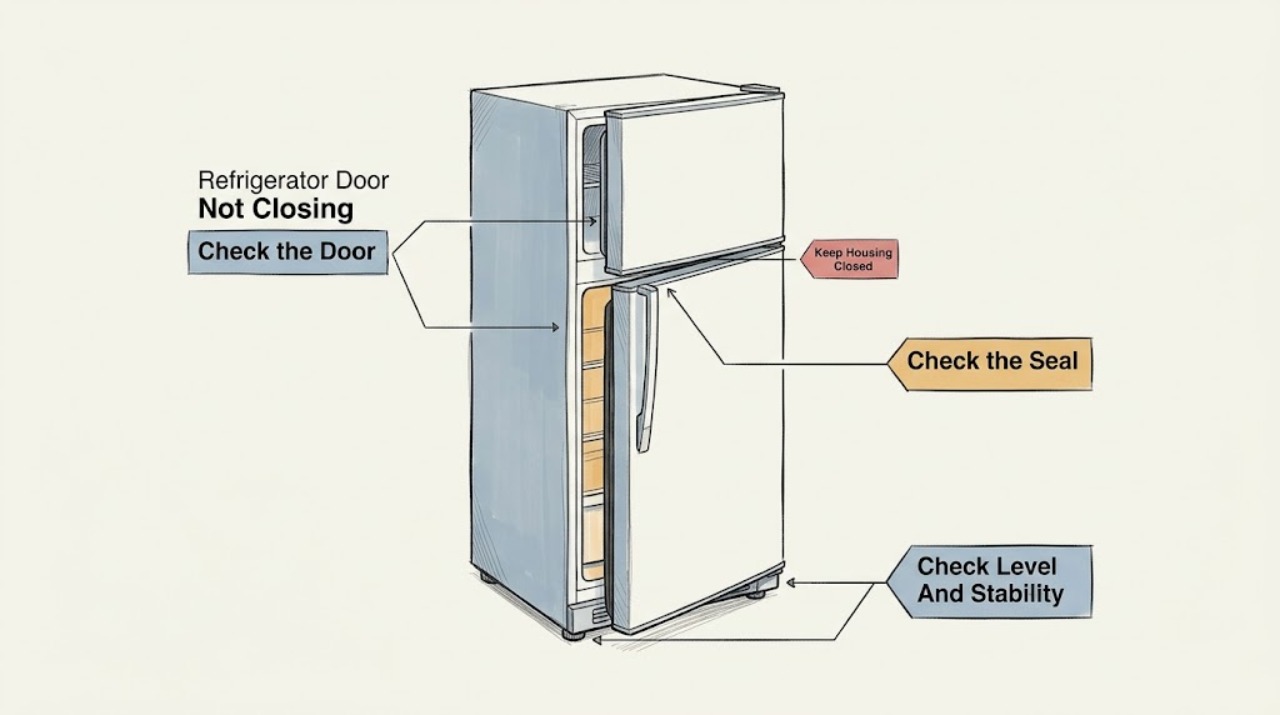
For a Beko refrigerator door that will not close, first remove any container or shelf item that projects into the door path, then check whether the refrigerator stands stable and whether the gasket has a visible gap, crack, tear, or loose section. Inspect the freezer edge for frost that prevents closure, but do not chip ice or force the door. If the door remains low, twisted, damaged, or unable to seal after these external checks, use the exact model manual or arrange authorized appliance service; hinge adjustment, door removal, and moving a heavy refrigerator are not generic DIY steps.
Before you begin
Safety first
- This article covers moving a clearly obstructing item, inspecting and gently cleaning or reseating an accessible gasket edge, and safe visual observations. A qualified professional must handle door or hinge removal, alignment hardware, heavy-appliance movement or tilting, damaged cabinet work, electrical or leak repairs, and any repair that requires dismantling the appliance.
Work through in order
Diagnostic checks
Use only checks that match the exact appliance or system and its official guide.
-
Check 1
Open the Beko refrigerator door normally and inspect the door bins, shelves, drawers, and cabinet lip for a container, package, drawer, or shelf edge projecting into the closing path. Move only the clearly obstructing item and close the door gently once.
Expected result: The door closes after one item is moved, remains blocked at the same location, or closes but leaves a visible uneven gap.
Next step: If the door closes evenly, reload without allowing items to project into the path. If it still stops or sits unevenly, continue with the gasket and stability checks; do not push harder on the door.
Stop if: Do not force a drawer, shelf, package, or door past resistance, and do not use the door as a lever to move stored food.
Why this matters
Why: A one-time recovery after clearing a package supports a loading obstruction. A repeatable stop with the cabinet empty, or an uneven gap after closure, shifts attention toward frost, gasket seating, leveling, or door alignment.
-
Check 2
With the door open, visually follow the full gasket around the door and the matching cabinet surface. Look for dirt, a folded or displaced section, a persistent gap, crack, tear, or a section that does not contact the cabinet; clean only accessible residue with a soft cloth and warm water, then gently reseat a loose edge with your fingers.
Expected result: The gasket contacts evenly, a loose edge reseats and the gap disappears, or the gasket remains loose, cracked, torn, or unable to contact the cabinet.
Next step: Make one gentle recheck after cleaning or reseating. Arrange appliance service if the gap remains, the gasket is damaged, or the door must be pressed to maintain contact; do not stretch or glue the seal.
Stop if: Do not use abrasive cleaners, solvents, heat, adhesive, or a sharp tool on the gasket.
Why this matters
Why: A loose edge or residue can keep an otherwise aligned door from sealing. A persistent gap or damaged gasket can let warm air enter even if the latch feels closed and generally requires a model-matched seal decision.
-
Check 3
From a clear floor position, look at the refrigerator's stance and compare the door gap at the top and bottom. If it is safe and the appliance is not rocking or tipping, apply only a very gentle side-to-side stability check; do not tilt or move the loaded refrigerator.
Expected result: The appliance is stable with an even stance, rocks or sits visibly out of level, or the floor appears uneven or unable to support it properly.
Next step: Use the exact Beko manual for any foot-leveling procedure. If leveling would require unloading, tilting, pulling out, or supporting the appliance, arrange qualified service; do not improvise with shims or move it alone.
Stop if: Stop if the refrigerator rocks significantly, leans, could tip, or the floor is damaged or wet; keep people away until it is safely assessed.
Why this matters
Why: An unbalanced appliance or unsuitable floor can change the door's resting position and prevent a good seal. A stable, level-looking cabinet makes an obstruction, gasket, frost, hinge, or door deformation more likely instead.
-
Check 4
Inspect the freezer door edge, gasket area, and nearby cabinet surfaces for frost or ice that physically prevents the door from reaching the frame. Do not chip, pry, or scrape the ice; if defrosting is appropriate for the exact model, follow the manual's safe defrosting procedure and protect the floor from meltwater.
Expected result: No frost interferes with the door, a visible frost layer contacts the door or frame, or defrosting does not remove the closure problem.
Next step: Keep the affected door closed as much as practical and use only the model's defrost instructions. Arrange service if frost returns, the gasket does not seal, water accumulates, or the door still will not close.
Stop if: Never use a knife, pick, heat gun, hair dryer near water, or other forceful method to remove ice, and do not operate the appliance with damaged wiring or water near electrical parts.
Why this matters
Why: Frost can be a direct physical obstruction, but persistent frost or a continuing gap after model-authorized defrosting points to a sealing, drainage, defrost, or alignment issue that the external check cannot identify.
-
Check 5
After the clear-path, gasket, stability, and frost observations, compare the door's top and bottom corners and the gap along the hinge side without removing covers or hardware. Record whether the door is visibly low, twisted, rubbing one corner, or has hinge movement.
Expected result: The door is evenly aligned and closes, or it remains low, twisted, rubbing, loose at a hinge, or unable to hold a seal despite the external checks being normal.
Next step: If the alignment symptom persists, identify the exact model and arrange authorized appliance service. Provide photos of the gap, the obstruction and gasket results, the stability observation, and any frost or leak history; do not adjust hinge screws from a generic guide.
Stop if: Do not remove the door, hinge, hinge cover, brackets, or door liner unless the exact model procedure and safe support are provided by a qualified professional.
Why this matters
Why: Normal alignment after the simple checks points away from a major door-hardware fault. A low, twisted, rubbing, or loose door makes hinge, bracket, door-shell, cabinet, or leveling work more likely and cannot be diagnosed safely from appearance alone.
Use your observations
Decision map
Find the observation that best matches what you see, then follow the next safe action.
-
PATH 01Safety boundary
What you see
The door stops at one package, shelf, drawer, or bin location and closes evenly after that item is moved.
Do this next
Rearrange the item so it stays behind the door plane and monitor the next closure. If the same stop returns with the cabinet correctly loaded, reassess the gasket and alignment rather than forcing it.
Why this path and its safety boundary
Why it matters: A loading obstruction is more likely than a damaged seal or hinge, provided the door does not need force and no gap remains.
Safety stop: Do not compress food or shelves against the gasket to make the door shut.
-
PATH 02Safety boundary
What you see
The cabinet is loaded correctly, but a gasket gap, displaced seal, torn section, or frost layer prevents even contact with the frame.
Do this next
Clean or gently reseat only an accessible gasket edge, or follow the exact model's defrost guidance when frost is the direct obstruction. Arrange service for damage, recurrent frost, leaks, or a gap that persists.
Why this path and its safety boundary
Why it matters: A sealing or frost-interference path is more likely than a simple shelf obstruction; continued warm-air entry can worsen condensation or frost.
Safety stop: Do not glue, heat, scrape, cut, or stretch the gasket, and do not chip ice with a tool.
-
PATH 03Safety boundary
What you see
The door gap changes with the cabinet stance, the refrigerator rocks or leans, or the floor is visibly uneven or unsuitable.
Do this next
Keep the refrigerator stable and use the exact manual or qualified service for leveling. Do not unload, tilt, shim, or move a heavy appliance without suitable assistance and procedure.
Why this path and its safety boundary
Why it matters: Cabinet balance or floor support is more likely than a door seal alone, although a second gasket or hinge issue can coexist.
Safety stop: Stop if the appliance could tip, the floor is wet or damaged, or the door movement is sudden or uncontrolled.
-
PATH 04Safety boundary
What you see
The path is clear, the gasket and frost checks do not explain the symptom, but the door remains low, twisted, rubbing, loose, or unable to seal.
Do this next
Arrange authorized appliance service and provide the exact model, door-gap photos, stability result, gasket condition, frost result, and any recent move or door reversal. Keep the door closed only as far as it can close without force and protect food if the seal is unreliable.
Why this path and its safety boundary
Why it matters: A hinge, bracket, door-shell, cabinet, or model-specific alignment problem is more likely than a user-loading issue, and appearance alone cannot select the correct repair or part.
Safety stop: Do not remove hinges or the door, force alignment, or continue use when the refrigerator is unstable, leaking, or the door could fall.
Helpful context
Understand the symptom
A door that will not close is usually an interference or alignment clue
Separate a single obstruction from a door that sits unevenly or leaves a continuing seal gap. Beko's own guidance lists misplaced food packages, an appliance that is not upright or balanced, an uneven supporting surface, damaged or poorly seated door seals, and freezer frost as different paths. The visible symptom does not identify whether the gasket, feet, hinge, or cabinet needs work.
Protect the cold-air seal while you inspect
A door that stays ajar lets warm air into the cabinet and can increase condensation, frost, and running time. Keep the inspection short, move only clearly misplaced items, and close the door gently after each check. If the gasket is torn, the door is sagging, or the cabinet is unstable, do not use force to make it shut.
Use the exact model instructions for leveling or hinge work
Beko publishes more than one refrigerator and door design. Its door-reversal guide shows that some work involves supporting the appliance, removing hinge covers, and repositioning hinges, while its support guidance directs owners to the user manual for model-specific alignment. That is different from simply clearing a package or cleaning a gasket, and it is a sensible service boundary when the model or hardware is uncertain.
Safety boundary
Stop conditions
- Do not force the door, use it to shift the refrigerator, or bypass a damaged latch or hinge.
- Do not chip or pry frost, heat the gasket, use solvents or abrasive cleaners, or glue a damaged seal.
- Do not tilt, unload, move, or support a heavy refrigerator alone, and do not remove a door or hinge without exact model instructions and safe assistance.
- Stop and arrange prompt service for a falling or unstable door, damaged cabinet, active leak, water near electrical equipment, exposed wiring, or a seal that remains open.
Only after diagnosis
Potential parts
- Beko model-matched refrigerator door gasket
Consider this category only when the exact model uses the inspected gasket design and the seal is confirmed torn, cracked, persistently loose, or unable to contact the cabinet after a gentle clean or reseat.
Confirm the full model, door position, gasket profile, and manufacturer's fit information before ordering; a similar-looking seal is not proof of compatibility. - Beko model-matched door hinge or alignment hardware
Consider this category only after a technician confirms that the door remains low, twisted, rubbing, or loose with the loading, gasket, frost, and stability paths ruled out.
Confirm the exact model, door configuration, hinge side, and manufacturer's fit information; hinge work and door support are professional tasks.
When checks do not resolve it
Need a professional?
Safety scope: This article covers moving a clearly obstructing item, inspecting and gently cleaning or reseating an accessible gasket edge, and safe visual observations. A qualified professional must handle door or hinge removal, alignment hardware, heavy-appliance movement or tilting, damaged cabinet work, electrical or leak repairs, and any repair that requires dismantling the appliance.
Common questions
FAQ
Why will my Beko refrigerator door not close?
Start with the simple distinctions: a package or drawer may block the path, the refrigerator may be out of balance, the gasket may be dirty, loose, cracked, or torn, or frost may interfere with the door. If those checks do not explain the gap, the door or hinge may need model-specific service.
Can food inside a Beko refrigerator stop the door from closing?
Yes. Beko specifically advises checking for food packages or other items obstructing the door. Move only the clearly projecting item and recheck the closure without forcing the door.
How do I check the Beko refrigerator door gasket?
Look around the complete gasket for a gap, dirt, a folded section, crack, tear, or loose seating. Clean accessible residue with a soft cloth and warm water and gently reseat a loose edge. A persistent gap or damaged gasket needs a model-matched replacement decision or service.
Can an uneven floor keep a Beko refrigerator door from closing?
Yes. Beko's troubleshooting guidance links door closure to the refrigerator standing upright and to a flat, sufficiently strong surface. Use the exact model manual for leveling, and do not tilt or move a heavy appliance alone.
Should I adjust the hinges if my Beko refrigerator door is sagging?
Do not assume a generic hinge adjustment applies. Beko describes different door types and model-specific hinge procedures, so a low or twisted door that remains after external checks should be assessed using the exact manual or by authorized service.
Read the exact guide
Official sources
- TroubleshootingBeko · Official Beko refrigerator troubleshooting document; exact model documentation governs where the document's design differs.
- How to reverse your fridge freezer doorsBeko · Official Beko UK guide for its illustrated door-reversal procedures; it is not a universal repair procedure for every Beko refrigerator.
- How to fix a refrigerator door that won’t shut?Beko · Official Beko support article; it gives general checks and directs owners to the exact user manual for model-specific work.
Community feedback
Share a repair observation
Share a plain-text repair observation. Accepted observations are published automatically; this page may take a moment to update.