
On this page
Start here
Quick answer
If your Blomberg refrigerator door is not closing, first remove any food package, shelf, or drawer that is stopping the door and make sure the refrigerator is standing level and fully upright. With the appliance disconnected before cleaning, inspect the complete door seal for debris, folds, gaps, looseness, or damage and check that the door is aligned without rubbing. Do not remove the door or hinge yourself. If the door still will not close after the obstruction, level, and seal checks—or if a hinge, door, cabinet, or seal is bent or damaged—keep the door closed as far as it safely goes, protect perishable food, and arrange qualified appliance service.
Before you begin
Safety first
- The user may remove obstructions, clean the accessible gasket with power disconnected, and perform only the model-documented accessible leveling check. Door removal, hinge adjustment, cabinet repair, and seal fitment that requires disassembly belong to qualified service.
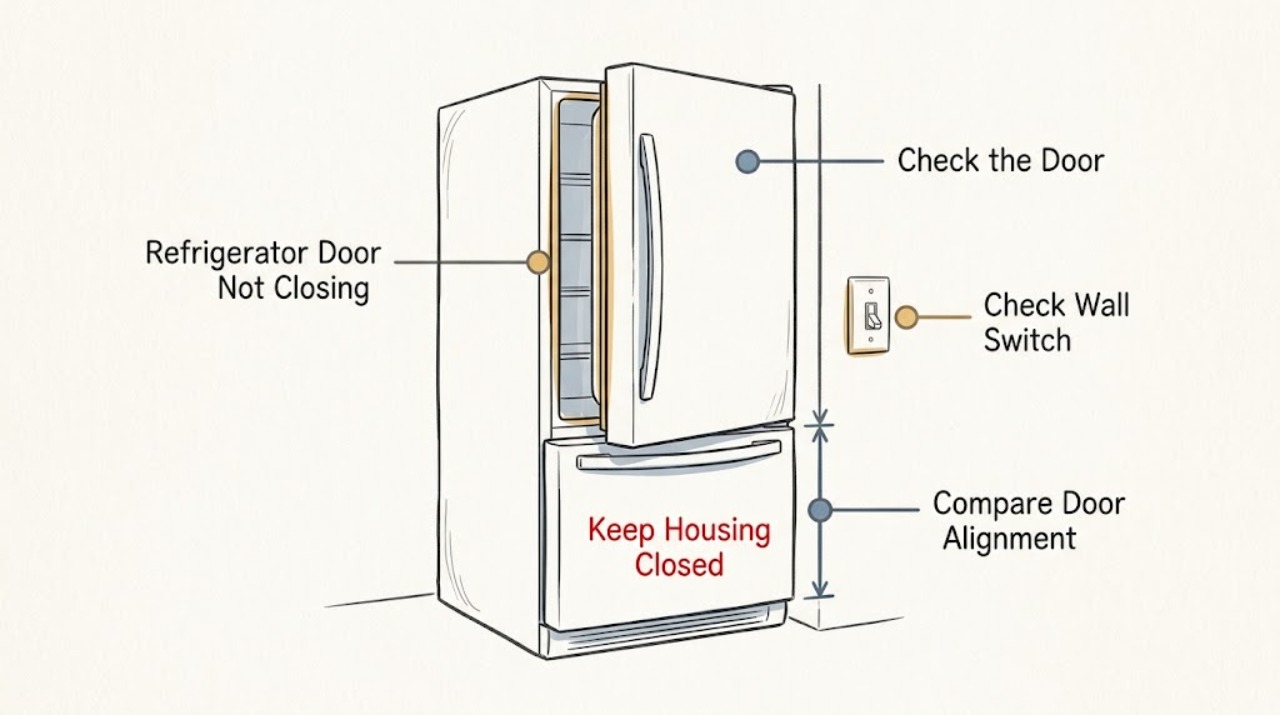
Work through in order
Diagnostic checks
Use only checks that match the exact appliance or system and its official guide.
-
Check 1
Open the refrigerator only as far as needed and inspect the door shelves, interior shelves, drawers, and packages for anything projecting into the closing path. Reposition or remove one obvious obstruction, then close the door normally without slamming it.
Expected result: The door closes and stays closed after an item is moved, or it still stops, rebounds, or leaves a gap with the interior clear.
Next step: Keep containers below the shelf and bin edges and confirm the drawers are fully seated. If the clear door still will not close, continue with the disconnected seal inspection.
Why this matters
Why: A repeatable improvement after moving a package supports a simple obstruction. If the door remains open with no item in the way, the cause is more likely the seal, level, alignment, or hinge path rather than storage layout.
-
Check 2
Switch the refrigerator off and disconnect power before cleaning. Wipe the accessible door gasket and the cabinet contact surface with a suitable soft cloth, then inspect the gasket all the way around for food debris, a fold, separation, hardening, a tear, or a section that has pulled out of its channel.
Expected result: Debris or a displaced fold is removed and the seal now contacts evenly, or the gasket remains damaged, loose, distorted, or visibly separated.
Next step: If the gasket is intact and only dirty or slightly displaced, refit it only as the exact model manual describes and check the door without force. If it is torn, loose, or still leaves a gap, stop using the door as a repair project and arrange service or model-confirmed gasket replacement.
Why this matters
Why: Debris or a displaced section can hold the door ajar and is a plausible maintenance issue. A damaged or loose gasket can prevent an airtight seal and may allow warm air and condensation into the cabinet; cleaning cannot restore a torn gasket.
-
Check 3
With the refrigerator empty enough to see the base and the door closed, check whether the cabinet rocks, leans, or sits on an uneven or soft surface. Compare the door gap at the top and bottom, and make only the model-documented accessible foot adjustment if the manual permits it.
Expected result: The cabinet is visibly uneven or rocks and the door alignment improves after a safe model-directed leveling adjustment, or the cabinet is stable and level but the door still sits out of alignment.
Next step: Keep the refrigerator stable and level; do not place improvised shims under it or tilt it while loaded. If it is level but the door remains misaligned, arrange qualified service for an alignment assessment.
Why this matters
Why: An uneven appliance or floor can change the door's alignment and closing path. If leveling does not change the gap, the issue is less likely to be corrected by further foot adjustment and may involve the hinge, door, or cabinet.
-
Check 4
After the obstruction, seal, and level checks, make one gentle closing test and inspect for rubbing, a corner gap, a sagging door, a loose-looking hinge, cabinet damage, or a seal that does not compress around the perimeter. Do not loosen or remove hinge hardware to test it.
Expected result: The door closes evenly with continuous seal contact, or it still will not close and a hinge, door, cabinet, or persistent perimeter gap is visible.
Next step: If the door closes, restore power and monitor for a recurring gap or condensation. If it does not close or any structural damage is visible, keep the refrigerator door closed as far as safely possible and arrange qualified service; do not force or tape the door shut.
Why this matters
Why: Even contact after the checks indicates the immediate closing problem has been corrected. A persistent gap or structural misalignment cannot be assigned to a particular hinge or gasket from appearance alone and needs model-specific assessment.
Use your observations
Decision map
Find the observation that best matches what you see, then follow the next safe action.
-
PATH 01Next step
What you see
The door closes normally as soon as a package, drawer, or shelf item is moved out of the closing path.
Do this next
Rearrange items so they do not project past the shelves or bins, and check that drawers are fully seated before closing the door.
Why this path and its safety boundary
Why it matters: The immediate cause is a storage obstruction rather than evidence of a failed hinge or seal.
-
PATH 02Next step
What you see
The cabinet rocks or leans, the top and bottom door gaps differ, and the gap improves after the model-directed leveling check.
Do this next
Keep the refrigerator on a stable, level surface and follow the exact model instructions for its feet. If the cabinet remains unstable or the door does not stay aligned, use qualified service.
Why this path and its safety boundary
Why it matters: The appliance position was contributing to the closing path. Improvement after leveling supports an installation/alignment issue, not a confirmed replacement part.
-
PATH 03Next step
What you see
The door closes at one edge but the gasket has a visible tear, separation, fold, or continuous gap, with condensation or warm-air symptoms inside.
Do this next
Keep the door closed as far as it safely goes, protect perishable food, and have qualified service confirm the gasket and door alignment before ordering a replacement.
Why this path and its safety boundary
Why it matters: The seal is not making the intended contact. A damaged gasket is a conditional part possibility, but the appearance does not prove the correct model-specific replacement or rule out alignment.
-
PATH 04Next step
What you see
The interior is clear, the gasket is clean and intact, and the refrigerator is stable and level, but the door still rubs, sags, rebounds, or leaves a gap.
Do this next
Stop forcing the door and arrange qualified Blomberg or appliance service. Do not remove the door, loosen hinges, or bend the cabinet to make it close.
Why this path and its safety boundary
Why it matters: The remaining cause may be a hinge, door, cabinet, or model-specific alignment condition that cannot be diagnosed safely by continued home adjustment.
Helpful context
Understand the symptom
Separate an obstruction from an alignment problem
A door that springs back immediately, rubs at one corner, or leaves a visible gap points to a different next check than a door blocked by a container. Look at the whole perimeter of the door rather than pushing harder: a tight seal is expected, but the door should align with the cabinet and close without force. The exact hinge and foot arrangement varies by Blomberg model, so use the manual for model-specific adjustments.
Do not turn a door adjustment into a heavy-appliance repair
Disconnect power before cleaning the seal or working near the appliance. Do not tip the refrigerator, remove a loaded door, loosen hinge hardware, force a bent door, or use the door as a lever. If the appliance is unstable, the door is heavy or damaged, or food may spoil while it is open, stop and arrange qualified service.
Only after diagnosis
Potential parts
- refrigerator door gasket
Consider this only if a qualified assessment confirms that the gasket is torn, detached, or unable to seal after the door and cabinet alignment are correct; a door that will not close does not identify the gasket by itself.
Confirm the exact refrigerator model and the manufacturer's fit information before ordering any gasket.
When checks do not resolve it
Need a professional?
A qualified technician should assess persistent misalignment, a damaged or detached seal, a sagging or rubbing door, unstable installation, or any cabinet or hinge damage after the safe external checks.
Safety scope: The user may remove obstructions, clean the accessible gasket with power disconnected, and perform only the model-documented accessible leveling check. Door removal, hinge adjustment, cabinet repair, and seal fitment that requires disassembly belong to qualified service.
Common questions
FAQ
Why will my Blomberg refrigerator door not close?
Check for packages or drawers blocking the door, then check that the refrigerator is upright and level. Inspect the clean door gasket for folds, gaps, looseness, or damage. If the door still will not close, arrange qualified service rather than forcing or removing the door.
Can an uneven floor stop a Blomberg refrigerator door from closing?
Yes. Blomberg's refrigerator troubleshooting guidance lists an appliance that is not standing fully upright and an uneven or insufficiently durable floor as possible causes. Follow only the leveling procedure for your exact model.
Should I replace the Blomberg refrigerator door seal?
Only consider a replacement after the seal is confirmed torn, detached, or unable to contact the cabinet with the door correctly aligned. Confirm the exact model and fit information; a closing problem can also be caused by storage obstruction, leveling, the hinge, or the door.
When should I call for service on a Blomberg refrigerator door?
Call when the door remains open after the safe obstruction, seal, and level checks, or immediately if the door, hinge, cabinet, or gasket is damaged or unsafe to handle. Do not remove the door, loosen hinges, tip the appliance, or force it shut.
Read the exact guide
Official sources
- Why are there droplets of water or ice on the fridge rear wall?Blomberg · Blomberg refrigerator door not closing when a damaged or loose seal may allow warm humid air and condensation
- Contact Us | BlombergBlomberg · Blomberg refrigerator door not closing after safe external checks
- Refrigerator / User ManualBlomberg · Blomberg refrigerator door not closing because food packages block it, the refrigerator is not upright, or the floor is uneven or not durable
- Fridges Buying Guide | BlombergBlomberg · Blomberg refrigerator door not closing or sealing when debris or gasket damage may be present
- RefrigeratorBlomberg · Blomberg refrigerator door not closing or leaving a gap after installation or door alignment work
Community feedback
Share a repair observation
Share a plain-text repair observation. Accepted observations are published automatically; this page may take a moment to update.