
On this page
Start here
Quick answer
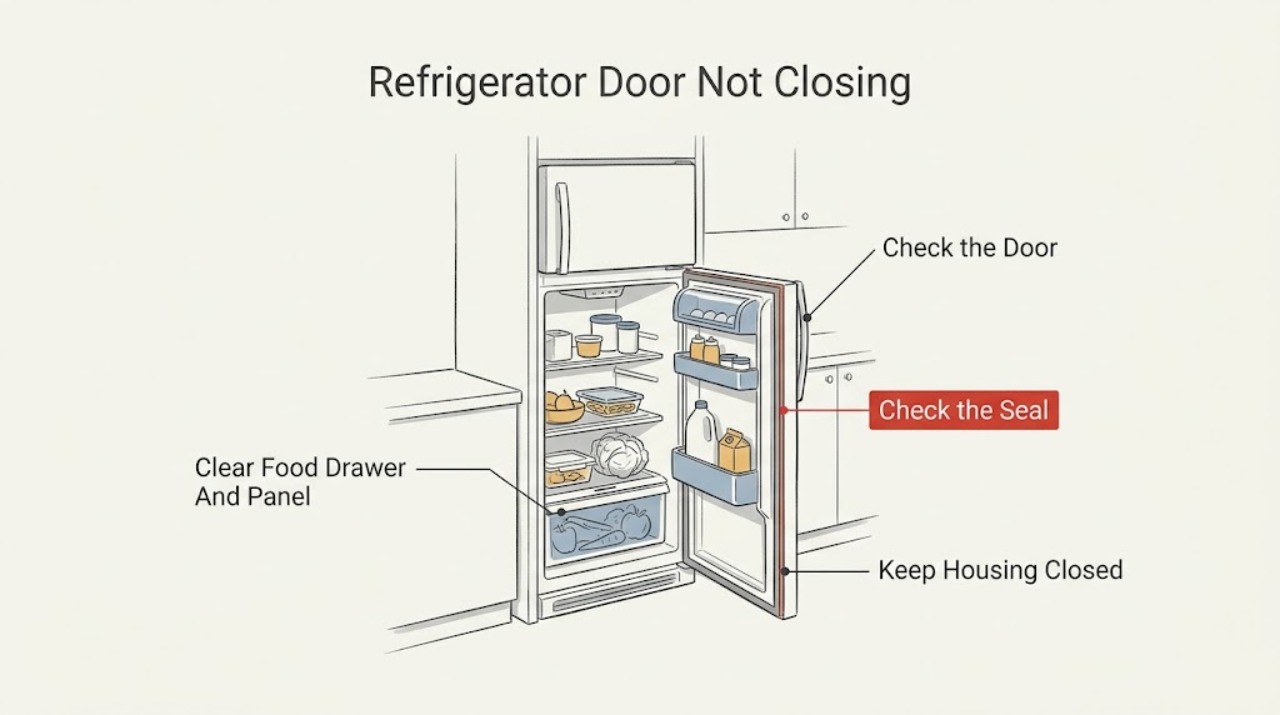
Start by identifying the exact Dacor model and architecture: a built-in French-door refrigerator, a single-door column, or another configuration may use different panels, hinges, closing assists, water lines, and adjustment procedures. With the refrigerator stationary and the door supported, remove only loose items that safely obstruct the closing path. Reseat shelves, drawers, door bins, and the front panel so nothing projects into the frame; a full-width drawer or door bin can stop a French door before the gasket reaches the cabinet. Inspect the gasket around the complete perimeter for debris, folds, tears, hard spots, or a section pulled out of its channel, then clean it gently with a soft damp cloth and allow it to dry. Do not cut, glue, heat, stretch, or substitute a seal. Check from the front whether the cabinet is stable and level, whether both French doors align, and whether a column door or decorative panel is rubbing the surrounding cabinetry. Use a leveling adjustment only when the exact Dacor installation manual explicitly makes it an owner-accessible step; built-in or panel-ready units should not be pulled, tipped, or shimmed casually. A persistent one-corner gap, dropped door, rubbing panel, loose hinge, unusual closing-assist behavior, or door that closes but does not seal points to alignment, hinge, panel, door-stop, gasket interface, or installation work. Do not remove a heavy door, loosen hinges, disconnect hinge wiring or water tubing, or move an integrated refrigerator alone. If the gasket remains open, the door sags, the cabinet is unstable, cooling is affected, or any hinge, panel, wiring, water connection, or refrigerant area may be damaged, keep use to a minimum and contact Dacor Care or a qualified appliance technician with the exact model and serial information.
Before you begin
Safety first
- This article covers only unloaded, stable, external checks of the closing path, gasket surface, cabinet stability, and model-documented user adjustments. A qualified provider must handle built-in movement, door removal, hinge/pin/stop work, custom panels, electrical or water connections, refrigerant concerns, structural damage, and exact-model seal or closing-assist replacement.
Work through in order
Diagnostic checks
Use only checks that match the exact appliance or system and its official guide.
-
Check 1
Record the complete Dacor model number and note whether the refrigerator is built-in or freestanding, French-door or single-door column, panel-ready or finished, and connected to water/ice equipment. Observe whether the door stops against something, rebounds, sags, rubs, or closes with a gasket gap.
Expected result: The door is blocked at a repeatable point, one French door is lower than the other, a column door or panel rubs cabinetry, the gap is around the seal, or the configuration includes hinge wiring or water tubing.
Next step: Continue only with the matching external check below and use the model-specific Dacor manual for any adjustment. Do not infer a part from the symptom or from a different Dacor family.
Stop if: Stop if the door drops, the cabinet rocks, or wiring, water tubing, glass, panel, or hinge hardware appears damaged.
Why this matters
Why: A repeatable stop makes an external obstruction or panel interference more likely. A one-sided gap or drop makes alignment/hinge geometry more relevant, while a perimeter gap makes gasket seating or installation position more relevant. Architecture determines which manual and service boundary apply.
-
Check 2
Open the door carefully and inspect the entire closing path. Push food behind the shelves, fully close drawers, reseat door bins and shelves, and check the French-door center area or column face for a bottle, package, trim piece, custom panel, or drawer that projects into the frame. Remove only loose items that can be lifted safely.
Expected result: A bin, shelf, drawer, food package, door panel, or trim was projecting into the path, or the path is clear but the door still stops or rebounds.
Next step: Close the door gently and check whether the gasket contacts the cabinet continuously. If the path is clear but the door still binds or rebounds, do not force it; continue to the seal and level observations.
Stop if: Do not pry a drawer, bend a shelf, remove a decorative panel, or use the door as a step or support.
Why this matters
Why: A corrected obstruction should let the door close without force. A clear path with the same stop shifts suspicion to gasket seating, cabinet position, panel alignment, door stop, closing assist, or hinge geometry.
-
Check 3
With the cabinet and door surfaces clean and dry, inspect the gasket around all sides for crumbs, folds, tears, hardening, flattening, or a section pulled out of its channel. Wipe it with a soft damp cloth, let it dry, and gently press only a loose edge back into its existing seat without using heat, adhesive, a blade, or force.
Expected result: The seal was dirty or folded and now lies flat, one section does not contact the cabinet, the gasket is torn or deformed, or it appears sound but the door remains misaligned.
Next step: Close the door without slamming and check contact around the perimeter. If the gasket is damaged or remains open, stop short of choosing a generic replacement and contact Dacor or qualified service.
Stop if: Do not cut, glue, heat, stretch, magnetize, or substitute the gasket, and do not continue if the door cannot stay safely supported.
Why this matters
Why: Debris or a displaced gasket can create a localized leak path. A torn or persistently non-contacting gasket needs an exact-model service diagnosis; an intact gasket with a dropped door makes level or hinge geometry more likely.
-
Check 4
From the front, check whether the cabinet sits firmly and whether the door reveal and gasket contact change when the refrigerator is observed in its installed position. For a built-in or panel-ready model, inspect only for visible cabinet, trim, or panel interference; use leveling or clearance adjustments only if the exact Dacor installation guide explicitly identifies them as safe owner steps.
Expected result: The cabinet rocks or sits unevenly, a door gap changes with cabinet position, the custom panel rubs surrounding cabinetry, or the cabinet is stable and the panel has clearances but the door is still low or crooked.
Next step: If the exact model permits an external leveling adjustment, make only that documented adjustment in small increments. Otherwise leave the appliance in place and arrange a qualified installer or Dacor technician.
Stop if: Do not pull out, tip, lift, shim, or slide a built-in refrigerator, remove anti-tip restraints, or adjust a panel while the door is unsupported.
Why this matters
Why: An unstable or incorrectly positioned cabinet can change the door's closing and sealing geometry. Built-in flush installation and decorative panels can make a seemingly small misalignment an installation issue rather than a gasket failure; a stable cabinet with a dropped door points more toward door alignment or hinge work.
-
Check 5
Compare the top and bottom door edges, hinge-side reveal, handle-side reveal, French-door center meeting point if applicable, and gasket contact through the safe swing. Note a dropped corner, rubbing, loose hinge cover, unusual push-to-open/closing-assist behavior, visible damage after moving, or a door that closes but allows frost or condensation.
Expected result: Only the door is out of square, a hinge/pin/stop or panel appears loose or bent, wiring/tubing is visible at the hinge area, the gasket gap persists, or the door seals evenly.
Next step: If any misalignment or damage remains, keep use to a minimum and contact Dacor Care or a qualified appliance technician with the model, installation type, photos, and location of the gap. If the seal is even, monitor for cooling or condensation changes.
Stop if: Do not remove the door, loosen hinge fasteners, disconnect hinge wiring or water tubing, or pry a panel or closing-assist mechanism.
Why this matters
Why: A door-specific shift or rubbing pattern makes hinge, pin, bearing, door stop, panel fit, or closing-assist geometry more likely than cabinet leveling. Dacor's product families can include door water or electrical features, so visual evidence is a service clue rather than permission to dismantle the door.
Use your observations
Decision map
Find the observation that best matches what you see, then follow the next safe action.
-
PATH 01Safety boundary
What you see
The door stops at the same location and a shelf, drawer, bin, package, panel, or trim piece projects into the closing path.
Do this next
Reseat or remove only the loose obstruction and verify gentle closure and continuous gasket contact. Arrange service if a fixed panel or cabinetry is the obstruction.
Why this path and its safety boundary
Why it matters: An external obstruction or installation interference is more likely than a failed hinge or gasket.
Safety stop: Do not force, pry, or reshape an interior component or custom panel.
-
PATH 02Safety boundary
What you see
The path is clear but the gasket is folded, dirty, torn, hardened, or leaves an open corner or perimeter gap.
Do this next
Clean and gently reseat an intact loose edge once. Arrange service for a damaged or persistent gap and do not select a generic seal by appearance alone.
Why this path and its safety boundary
Why it matters: Seal seating or an exact-model gasket interface is more likely; the door can appear closed while allowing warm air and condensation.
Safety stop: Do not cut, glue, heat, stretch, or replace the gasket without the exact model procedure.
-
PATH 03Safety boundary
What you see
The gasket and closing path are sound, but the cabinet is unstable/out of position or a built-in/panel-ready door rubs surrounding cabinetry.
Do this next
Use only the exact Dacor installation guide's documented external adjustment. For an integrated unit, panel, anti-tip restraint, or heavy movement, arrange qualified installation/service.
Why this path and its safety boundary
Why it matters: Installation level, flush fit, panel alignment, or clearance is more likely than a generic door-part failure.
Safety stop: Do not pull, tip, shim, lift, or slide the refrigerator or adjust a heavy panel alone.
-
PATH 04Safety boundary
What you see
The cabinet is stable and the path is clear, but the door is dropped, out of square, rubbing, has a loose/bent hinge or stop, or still fails to seal.
Do this next
Stop forcing the door and contact Dacor Care or a qualified appliance technician with the exact model, architecture, and photos of the gap and hinge area.
Why this path and its safety boundary
Why it matters: A hinge, pin, bearing, door stop, closing-assist, panel interface, wiring/tubing connection, or structural issue is more likely; the symptom does not establish a compatible part.
Safety stop: Do not remove the door, loosen hinges, disconnect wiring/tubing, or use improvised shims or tools.
Helpful context
Understand the symptom
Identify the Dacor refrigerator before adjusting anything
A Dacor door that will not close may be blocked by an item, leaking past a gasket, affected by cabinet level, rubbing a custom panel, or shifted at a hinge. A built-in French-door model has different door interactions from a single-door column: Dacor lists internal water, ice, full-extension drawers, push-to-open assistance, and left/right hinge configurations across these families. Record the model number and whether the door is French, column, panel-ready, or another layout before opening an installation manual or ordering a part.
Keep the inspection unloaded, stable, and external
Do not let a heavy door swing into a person, and keep fingers out of hinge and closing-assist gaps. Remove or stabilize loose food before inspecting the seal, but do not lift the door or appliance. Disconnect power before any cleaning or model-approved movement, and never pull, tip, shim, or slide a built-in refrigerator without qualified help. Stop for damaged glass, a dropped door, exposed wiring or tubing, refrigerant damage, smoke, burning odor, water near electrical parts, or an unstable cabinet.
The location of the gap changes the diagnosis
A door that stops at the same point usually meets an object, drawer, panel, or cabinet. If it reaches the frame but one corner stays open, compare gasket contact and the door's height and reveal from the front. A gap around the full perimeter points more toward a displaced gasket, cabinet position, or panel fit; a gap that follows a visibly dropped door points more toward hinge or alignment geometry. These observations help a technician, but they do not prove that a hinge, gasket, panel bracket, or closing-assist component is interchangeable.
Safety boundary
Stop conditions
- Stop immediately for a dropped or damaged door, broken glass, unstable cabinet, damaged cord, exposed wiring or water tubing, refrigerant-circuit damage, water near electrical parts, smoke, or burning odor.
- Do not lift, tip, pull out, shim, or slide a built-in or heavy refrigerator alone, and do not remove anti-tip restraints or a door to make it close.
- Do not loosen or remove hinges, pins, stops, closing-assist mechanisms, panels, wiring, or water tubing as an owner troubleshooting step.
- Do not cut, glue, heat, stretch, or substitute a gasket, and do not order a hinge, panel bracket, roller, or seal from the symptom without the exact Dacor model match.
When checks do not resolve it
Need a professional?
Safety scope: This article covers only unloaded, stable, external checks of the closing path, gasket surface, cabinet stability, and model-documented user adjustments. A qualified provider must handle built-in movement, door removal, hinge/pin/stop work, custom panels, electrical or water connections, refrigerant concerns, structural damage, and exact-model seal or closing-assist replacement.
Common questions
FAQ
Why will my Dacor refrigerator door not close all the way?
Clear the closing path first by reseating drawers, shelves, bins, food, and any visible panel interference. Then inspect the gasket and cabinet position. If one corner remains open, the door sags, or it rubs built-in cabinetry, alignment, hinge, panel, or installation work is more likely and should be serviced for the exact model.
How do I check a Dacor refrigerator door gasket?
Inspect the full perimeter for debris, folds, tears, flattening, or a section pulled from its channel. Wipe it gently with a soft damp cloth, let it dry, and press only a loose edge back into place. Do not heat, glue, cut, stretch, or substitute the gasket; a damaged or persistent gap needs an exact-model service diagnosis.
Can an unlevel Dacor refrigerator make the door stay open?
Yes. An unstable or incorrectly positioned cabinet can change the door and gasket geometry. For a freestanding model, use a leveling procedure only if the exact Dacor manual documents it for the owner. For a built-in or panel-ready model, do not pull, tip, shim, or move the unit alone; arrange qualified installation/service.
Should I tighten or remove Dacor refrigerator door hinges?
Not as a generic troubleshooting step. Dacor product families differ in door layout, hinge side, panel fit, and possible door wiring or water connections. A dropped or rubbing door should be assessed by Dacor Care or a qualified technician with the exact model; do not remove the heavy door or disconnect hinge hardware yourself.
What if my Dacor door closes but does not seal?
Check for a continuous gasket contact path, a folded or damaged seal, cabinet/panel interference, frost, condensation, or a door alarm. A door can feel closed while a corner gap admits warm air. If cleaning and gentle reseating do not restore contact, stop forcing the door and arrange exact-model service.
Read the exact guide
Official sources
- 24-Inch Column Refrigerator, Panel Ready, Right Hinge | DacorDacor · Official Dacor US product page for a single-door column model family; its push-to-open, panel-ready, hinge, and installation details must not be assumed for French-door or other Dacor families.
- 36-Inch Built-In French Door with SteelCool | DacorDacor · Official Dacor US product page for one built-in French-door model family; it establishes architecture and features but does not provide a universal hinge, gasket, panel, or leveling procedure for every Dacor refrigerator.
- Self Repair | DacorDacor · Official Dacor US self-repair guidance; it does not authorize door, hinge, panel, wiring, tubing, or built-in movement work without the product-specific guide and appropriate qualifications.
Community feedback
Share a repair observation
Share a plain-text repair observation. Accepted observations are published automatically; this page may take a moment to update.