
On this page
Start here
Quick answer
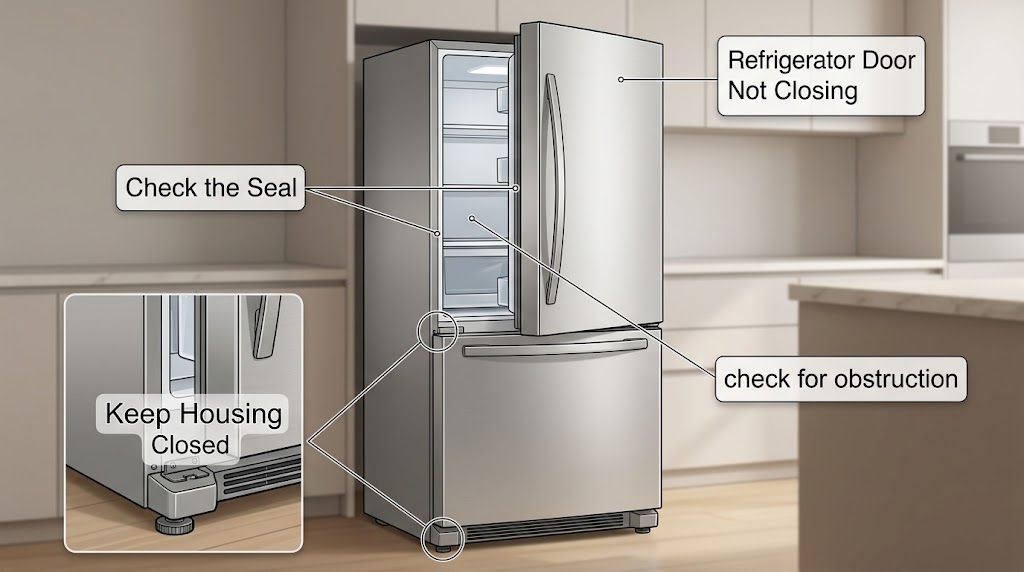
For an Admiral refrigerator whose model label or manual identifies the Whirlpool Corporation family, start with the simple mechanical causes: remove anything preventing the door from reaching the cabinet, clean and inspect the gasket, and check that the cabinet is level and the door sits correctly. A French-door model may also have a vertical hinged seal that must fold inward before closing. Because the Admiral name is used in more than one market and model family, use the exact model manual for hinge, leveling, and door-removal details; do not force a door, bend a hinge, or order a gasket by brand name alone.
Before you begin
Safety first
- This article supports ordinary-access inspection, cleaning visible residue as allowed by the model manual, reseating loose interior items, and repositioning a clearly identified French-door hinged seal. It does not authorize hinge disassembly, door removal, water-line or electrical work, cabinet tipping, gasket alteration, or improvised part replacement.
Work through in order
Diagnostic checks
Use only checks that match the exact appliance or system and its official guide.
-
Check 1
Open the affected Admiral refrigerator door normally and inspect the door bins, shelves, drawers, ice bin, cabinet edge, and the space behind the appliance for anything contacting the door or keeping a drawer from seating.
Expected result: The door stops at the same point against a container or bin, a drawer or ice bin projects past its track, packing material remains, or nothing visible contacts the door.
Next step: Remove only the loose item or reseat the user-removable bin, drawer, or ice bin as the exact model instructions allow, then close the door gently and recheck the gap.
Stop if: Do not force a drawer, pry a stuck bin, cut packaging near wiring or tubing, or move the refrigerator if doing so could strain a water line or power cord.
Why this matters
Why: A repeatable contact point supports an obstruction or mis-seated interior component as the immediate cause. If the door is clear but still springs open or leaves a gap, move to the gasket, cabinet level, and alignment checks instead of pushing harder.
-
Check 2
With the door open, inspect the full rubber gasket and the mating cabinet surface for food residue, dirt, cracks, brittleness, warping, folds, or a section pulled out of its channel; wipe visible residue with a method allowed by the model manual and do not stretch the seal.
Expected result: The gasket is clean and lies flat all around, or one section is dirty, folded, hardened, cracked, warped, or visibly separated from the channel; note whether the gap is localized or runs along most of one side.
Next step: Correct only a simple fold or visible residue using the model's care instructions. If the gasket is damaged, displaced, or will not lie flat, record the model and arrange model-specific seal guidance rather than choosing a generic replacement.
Stop if: Do not glue, trim, heat, stretch, or permanently reshape the gasket, and do not use a sharp tool to clean its channel.
Why this matters
Why: A localized gap, fold, or damaged section can prevent the magnetic seal from seating even when the door appears aligned. A flat, intact gasket makes an obstruction, cabinet tilt, hinge/alignment issue, or model-specific door feature more likely.
-
Check 3
From a stable position, observe whether the refrigerator cabinet is level side to side and front to back and whether the door naturally moves toward the closed position when released from a small opening; use a bubble level only if the model instructions permit it.
Expected result: The cabinet visibly leans, the door swings open instead of tending toward closed, the two doors sit at different heights, or the cabinet appears level and the door still will not seal.
Next step: Use only the exact model's leveling procedure and user-accessible leveling legs or rollers; recheck the door after each small change. If the procedure requires hinge-cover removal or unsupported door hardware, stop and obtain the model instructions or qualified service.
Stop if: Do not place shims under the cabinet by guesswork, fully remove hinge bolts, tip the refrigerator, or work near a water line, electrical connection, or unsupported heavy door.
Why this matters
Why: An unlevel cabinet can keep a refrigerator door from sitting flush or self-closing. A level cabinet with a persistent height difference or gap points more toward model-specific door alignment, hinge hardware, or a damaged seal.
-
Check 4
Identify the door architecture from the model manual: for a French-door design, look at the vertical hinged seal between the doors; for a single-door or side-by-side design, compare the door edge and hinge side without loosening hardware.
Expected result: The French-door hinged seal is folded outward, the doors are uneven after installation or removal, the hinge side visibly sags or rubs, or no feature or hardware problem is visible.
Next step: Fold only the identified hinged seal inward by hand, if the model has that feature, and test closure. For uneven, sagging, or recently removed doors, follow the exact model alignment procedure or arrange service with the model and installation history.
Stop if: Do not loosen or remove a hinge, lift a heavy door, disconnect a water line, or work under an unsupported door without the exact model procedure and suitable support.
Why this matters
Why: An outward-folded French-door seal can block closure and must fold inward before the doors meet. Uneven doors or visible sag after installation can indicate model-specific alignment or hinge support; an unseen problem should not be diagnosed by tightening random screws.
Use your observations
Decision map
Find the observation that best matches what you see, then follow the next safe action.
-
PATH 01Safety boundary
What you see
The door stops against a bin, container, drawer, ice bin, packaging piece, or object behind the refrigerator.
Do this next
Remove or reseat only the accessible item according to the model instructions and repeat the gentle closure test. If the door still stops at the same point, inspect the frame and hinge side rather than forcing it.
Why this path and its safety boundary
Why it matters: The closure failure is most consistent with a physical obstruction or mis-seated interior component, not a failed gasket or hinge.
Safety stop: Stop if the contact involves wiring, tubing, a fixed panel, a swollen cabinet, or an item that cannot be removed without force.
-
PATH 02Safety boundary
What you see
The door reaches the cabinet but a gasket section is folded, dirty, cracked, hardened, warped, or separated from its channel.
Do this next
Clean or reposition only what the exact manual allows; if the seal remains damaged or displaced, have the model-specific gasket and installation checked before ordering a part.
Why this path and its safety boundary
Why it matters: A seal seating problem is more likely than a cabinet-level problem, and continuing to run the refrigerator with a large gap can allow warm air and frost to enter.
Safety stop: Do not glue, heat, trim, stretch, or substitute a seal by appearance.
-
PATH 03Safety boundary
What you see
The interior is clear and the gasket is intact, but the cabinet leans, a door does not tend toward closed, or the doors are visibly uneven.
Do this next
Use the exact model installation instructions for leveling or alignment, or arrange qualified appliance service when hinge covers, door support, or water-line disconnection is required.
Why this path and its safety boundary
Why it matters: Cabinet leveling or model-specific door alignment is more likely than an interior obstruction. The correct adjuster differs between top-freezer, side-by-side, French-door, and other architectures.
Safety stop: Do not fully remove hinge hardware, tip the refrigerator, or support a heavy door improvisedly.
-
PATH 04Safety boundary
What you see
A French-door Admiral refrigerator has a vertical hinged seal on the left door and that seal is folded outward while the doors are open.
Do this next
Fold the hinged seal inward by hand before closing both doors. If it will not move normally or the doors remain uneven, stop and use the exact model manual.
Why this path and its safety boundary
Why it matters: The seal itself can block the two doors from meeting; this is a feature-position issue, not evidence that the gasket or hinge needs replacement.
Safety stop: Do not force, remove, or permanently bend the hinged seal.
Helpful context
Understand the symptom
Confirm which Admiral architecture you have
Admiral is a cross-market brand name, so the model and service documentation matter more than the badge alone. Whirlpool's U.S./Canada owner documentation lists Admiral among its Whirlpool Corporation appliance brands, while the current Admiral Appliances site covers a separate international product portfolio. Before adjusting a hinge or buying a seal, record the complete model and serial information and check which manufacturer's manual and support instructions are printed on the appliance. The checks below are limited to ordinary, visible inspection and to features that the installed model actually has.
A door that pops back open is not the same as a blocked door
If the door stops before touching the cabinet, look first for a bin, drawer, tall container, ice bin, shipping material, or something behind the refrigerator. If it reaches the frame but does not seal, the gasket, cabinet level, hinge position, or door alignment becomes more likely. A gap can allow warm air in and lead to temperature fluctuation, frost, and food spoilage, so keep the door closed as much as practical while you diagnose it.
Safety boundary
Stop conditions
- Stop and arrange qualified appliance service for a cracked cabinet, bent hinge, sagging door, damaged mounting point, persistent gap after the approved checks, or a door that needs to be lifted or supported.
- Do not fully remove hinge bolts, disconnect a water line, tip the refrigerator, or work near electrical parts without the exact model procedure and safe support.
- Do not glue, trim, heat, stretch, or force a gasket, hinged seal, drawer, bin, door, or hinge; do not use a generic part based only on the Admiral name.
- If the door has stayed open long enough for food temperature to be uncertain, follow applicable food-safety guidance and discard food when safety cannot be established.
Only after diagnosis
Potential parts
- refrigerator door gasket
Consider this category only if inspection confirms that the installed gasket is cracked, hardened, warped, or unable to remain seated after the model-approved cleaning or repositioning check.
Confirm the complete model, door position, market, gasket profile, and manufacturer's fit information; Admiral branding alone does not establish compatibility. - refrigerator door hinge or hinge hardware
Consider this category only if a qualified diagnosis finds a bent, worn, or damaged hinge or mounting point after obstruction, gasket, and leveling causes have been evaluated.
Confirm the exact model, door side, architecture, hardware specification, and safe door-support procedure before any replacement. - refrigerator leveling foot or roller
Consider this category only if the exact model uses a replaceable leveling component and inspection or service diagnosis confirms damage rather than a simple adjustment.
Confirm the exact model and load-rated component through the manufacturer's documentation; do not substitute a generic support or shim.
When checks do not resolve it
Need a professional?
Arrange model-specific Admiral/Whirlpool-family or qualified appliance service when the obstruction and visible gasket checks do not restore closure, the cabinet or door is uneven, a hinge or mounting point is bent, the gasket is damaged or will not stay in its channel, the exact architecture is uncertain, or any repair requires door removal, water-line work, electrical access, or heavy lifting.
Safety scope: This article supports ordinary-access inspection, cleaning visible residue as allowed by the model manual, reseating loose interior items, and repositioning a clearly identified French-door hinged seal. It does not authorize hinge disassembly, door removal, water-line or electrical work, cabinet tipping, gasket alteration, or improvised part replacement.
Common questions
FAQ
Why does my Admiral refrigerator door close and then pop back open?
Check for a projecting bin, drawer, container, ice bin, or packaging first. If the frame is clear, inspect the gasket and cabinet level. On a French-door model, a vertical hinged seal folded outward can also block the doors from meeting. If the door still springs open after those checks, use the exact model instructions or arrange service rather than forcing it.
Can an unlevel Admiral refrigerator keep the door from closing?
Yes, an unlevel cabinet can keep the door from sitting flush or moving toward the closed position. Check the model's leveling instructions and use only its user-accessible legs or rollers. Do not tip the appliance or remove hinge hardware as a generic leveling step.
Should I replace the Admiral refrigerator gasket?
Only after inspection confirms that the gasket is cracked, hardened, warped, displaced, or still unable to seal after an allowed cleaning or repositioning check. Confirm the complete model and door position first; a gasket that looks similar is not proof of fit.
What information should I have before getting help with an Admiral refrigerator door?
Have the complete model and serial information, the market or purchase location, the manufacturer named in the manual, whether the door stops or leaves a gap, photos of the gasket and hinges, and any recent moving, installation, door removal, or repair history. This prevents a Whirlpool-family procedure or replacement part from being applied to the wrong Admiral architecture.
Read the exact guide
Official sources
- Doors Not Closing Properly - Product Help | WhirlpoolWhirlpool · Official Whirlpool Product Help page tagged for multiple refrigerator brands and listed refrigerator architectures. Use it for an Admiral appliance only when the exact model documentation identifies the same Whirlpool-family construction; exact model instructions control.
- Aligning the Refrigerator Doors - Product Help | WhirlpoolWhirlpool · Official Whirlpool Product Help guide for listed multi-door refrigerator configurations. It is family-level guidance, not permission to apply a particular adjuster to an unidentified Admiral model.
- Owner's ManualWhirlpool Corporation · Official Whirlpool-hosted owner manual for an Amana appliance; its assistance section explicitly lists Admiral with Whirlpool Corporation brands and directs callers to provide the complete model and serial number. It is used only to establish family identity and the need for exact documentation, not as an Admiral refrigerator manual.
- Contact Us | Admiral Appliances | Home Appliances for the Middle East & AfricaAdmiral Appliances · Official Admiral Appliances site that identifies its regional site and product organization. It is used to show why the model label and market must be confirmed, not to supply refrigerator repair instructions.
Community feedback
Share a repair observation
Share a plain-text repair observation. Accepted observations are published automatically; this page may take a moment to update.