
On this page
Start here
Quick answer
A flickering light in a Beko refrigerator is usually a light-source or door-activated contact issue, but first check whether the refrigerator is also losing cooling or whether other household lights are flickering. Beko says many of its refrigerators use an LED light and that LED faults should be handled through Beko support; only a model that uses a standard bulb should be inspected or replaced, with the appliance unplugged and the exact manual followed. If the flicker accompanies power instability, burning odor, heat, sparking, or reduced cooling, stop using the appliance and arrange qualified electrical or appliance service.
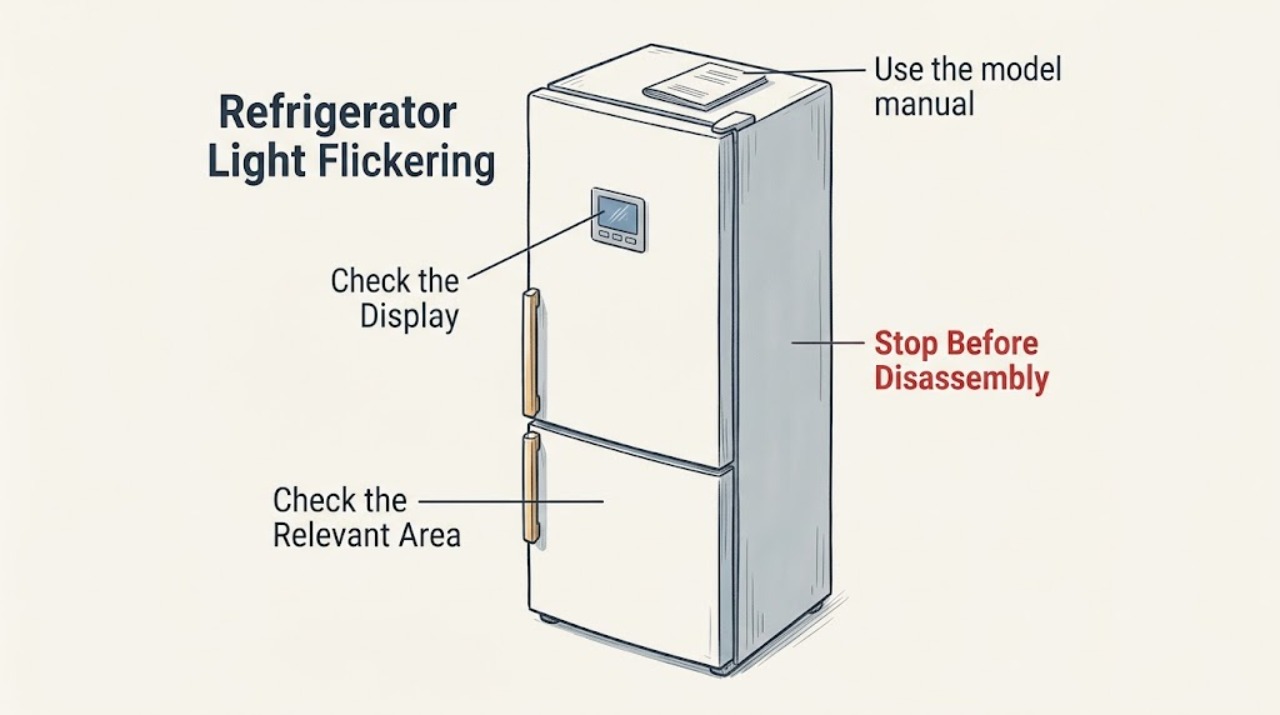
Work through in order
Diagnostic checks
Use only checks that match the exact appliance or system and its official guide.
-
Check 1
Open the refrigerator door normally and note whether the light flickers only as the door moves or remains open, while checking that the refrigerator display and cooling continue to operate.
Expected result: The light changes when the door reaches a particular position, or the light flickers continuously while the refrigerator otherwise keeps cooling normally.
Next step: Do not hold the door switch down, bypass it, or pull the door apart. Continue by identifying whether the model has an LED or standard bulb and use the manual for that exact model.
Why this matters
Why: A door-activated contact, alignment, light connection, or light module is more likely than a whole-house power interruption; a continuous flicker still does not identify a safe user-replaceable part.
-
Check 2
Check whether other lights or appliances in the home flicker and whether the refrigerator loses cooling, display power, or normal operating sounds at the same time.
Expected result: Other household lights also flicker, or the refrigerator's display, cooling, or operating power drops with the interior light.
Next step: Stop using the refrigerator if there is heat, smell, sparking, or repeated power loss, and use a qualified electrician or appliance technician. Do not test live voltage or remove electrical covers.
Why this matters
Why: The pattern makes a supply, plug, fuse, or broader electrical fault more likely than an isolated interior lamp problem.
-
Check 3
Use the model manual or the lamp's visible form to determine whether the refrigerator has a standard bulb or an LED light; do not remove a cover until the manual confirms the access method.
Expected result: The manual identifies a standard bulb, or it identifies an LED light/module and no user bulb replacement procedure.
Next step: For a documented standard-bulb model only, unplug the appliance, replace the bulb with the exact type specified in the manual, and refit the cover. For an LED model or unclear lamp type, leave the cover closed and contact Beko or an authorized service agent.
Why this matters
Why: A standard bulb may be a user-replaceable consumable on that model. An LED light fault is a support or service issue according to Beko, not proof that a generic bulb will fit.
-
Check 4
After a documented standard-bulb replacement or a service reset, observe the light through several door openings and confirm the refrigerator maintains its normal temperature; if the light still flickers, do not repeat replacements.
Expected result: The replacement stops the flicker and cooling remains normal, or the flicker returns and cooling is abnormal or difficult to verify.
Next step: Record the model number and the pattern, then arrange authorized service for recurrence or any cooling change. Do not substitute another bulb or work inside the light housing while powered.
Why this matters
Why: A successful replacement supports a failed bulb as the limited cause. Recurrence or cooling change makes a contact, control, wiring, or refrigeration fault more likely.
Use your observations
Decision map
Find the observation that best matches what you see, then follow the next safe action.
-
PATH 01Next step
What you see
Only the interior lamp flickers when the door moves, while cooling and household power remain normal.
Do this next
Identify the lamp type from the manual. Replace only a documented standard bulb with the appliance unplugged; send an LED or persistent contact fault to authorized service.
Why this path and its safety boundary
Why it matters: An isolated door-contact, lamp connection, or light-module issue is more likely than a household supply fault.
-
PATH 02Next step
What you see
The interior light flickers together with other household lights, display resets, cooling interruptions, or abnormal electrical behavior.
Do this next
Stop using the appliance for sparking, burning odor, hot plug, or repeated power loss and call a qualified electrician or appliance technician. Do not open panels or test live circuits.
Why this path and its safety boundary
Why it matters: The pattern makes a supply or appliance electrical fault more likely than a failed bulb alone.
-
PATH 03Next step
What you see
The refrigerator has an LED light, or the lamp type and access method cannot be confirmed from the model manual.
Do this next
Keep the housing closed and contact Beko or an authorized service agent with the full model number and a description of when the flicker occurs.
Why this path and its safety boundary
Why it matters: The evidence does not support a safe generic bulb replacement; Beko treats LED light faults as a support matter.
-
PATH 04Next step
What you see
A documented standard bulb was replaced with the exact manual-specified type, but flickering returns or the refrigerator no longer maintains its normal temperature.
Do this next
Stop replacing bulbs and arrange authorized service. Preserve the failed bulb and record whether the refrigerator display and compressor behavior changed.
Why this path and its safety boundary
Why it matters: A recurring lamp fault or simultaneous cooling change makes a socket, door control, wiring, or refrigeration-system problem more likely than the bulb itself.
Helpful context
Understand the symptom
Separate a light problem from a refrigerator power problem
A light that flickers only when the door moves is a different pattern from a refrigerator that is also losing cooling or a home with unstable power. Check the visible symptoms first: display or control operation, cooling, compressor behavior, and other household lights. This keeps a small lamp issue from masking a broader electrical fault.
Beko light types are not interchangeable
Beko notes that many models have an LED light, while some models use a standard bulb. The cover and access method therefore depend on the appliance. Do not assume that a bulb from another refrigerator fits, and do not open an LED module or bypass the door-activated light control.
When to stop
Keep the user checks to visible symptoms and, for a standard bulb only, a documented replacement with the appliance unplugged. Stop for sparking, a hot plug, burning odor, damaged wiring, moisture at electrical parts, or any need to remove panels. A persistent LED or control fault belongs with authorized service.
When checks do not resolve it
Need a professional?
Contact Beko or an authorized appliance service agent for any LED light fault, a lamp that flickers after the exact documented bulb replacement, a door-contact or wiring issue, or any simultaneous loss of cooling or display power. Use a qualified electrician for unstable household power. Stop immediately for sparking, a hot plug, burning odor, exposed wiring, moisture near electrical parts, or a need to remove panels; do not bypass the door switch or test live voltage.
Common questions
FAQ
Why is my Beko refrigerator light flickering but the fridge is still cold?
An isolated flicker with normal cooling points more toward the lamp, door-activated contact, or light module than a whole refrigerator power failure. Identify the lamp type from the model manual; use service for an LED or persistent fault.
Can I replace the light in a Beko refrigerator myself?
Only if the exact model uses a standard bulb and its manual describes replacement. Beko says many models use LED lighting and advises contacting Beko for LED faults. Always unplug the appliance before replacing a documented standard bulb.
What if the refrigerator light flickers with the display or other lights?
That pattern is broader than an isolated lamp problem. Stop if there is heat, sparking, burning odor, or repeated power loss, and use a qualified electrician or appliance technician instead of opening the refrigerator.
Should I hold or bypass the refrigerator door switch to test the light?
No. Observe the light during normal door movement only. Do not bypass the switch or work inside the housing while powered; a persistent door-contact or control issue needs authorized service.
Read the exact guide
Official sources
- How do I replace the internal light in my Beko fridge or fridge freezerBeko UK · Beko refrigerator interior LED and standard-bulb light faults, replacement safety, and manual guidance
- Why is my fridge not cooling?Beko UK · Beko refrigerator cooling verification, temperature measurement, airflow and seal checks, and service escalation
- How to fix a refrigerator that won't workBeko · Beko refrigerator power checks, temperature control, door seal, airflow, and technical-service boundary
- Beko Manuals and User GuidesBeko UK · Beko model-specific refrigerator manuals and troubleshooting instructions
Community feedback
Share a repair observation
Share a plain-text repair observation. Accepted observations are published automatically; this page may take a moment to update.