
On this page
Start here
Quick answer
A thin frost layer on the rear wall of a Beko refrigerator can be normal, but dense or recurring ice is a symptom to investigate. First identify whether frost is limited to the rear wall or covers shelves, side walls, or the freezer, then check the temperature setting and the door seal for gaps, cracks, or tears. Warm humid air from frequent or prolonged door opening, a door that does not seal, warm food, or a setting outside the model's intended range can add moisture that freezes. If the appliance is not a no-frost model, defrost it only by the exact Beko manual; no-frost models should not need routine manual defrosting. Frost that returns quickly after the door and setting checks, food is warming, or a seal is loose or cracked needs authorized service.
Before you begin
Safety first
- This article covers observation, ordinary loading, gasket cleaning, and model-authorized settings or defrost instructions only. Do not chip ice, apply improvised heat, open panels or airflow covers, work on defrost wiring, or access the sealed refrigeration system.
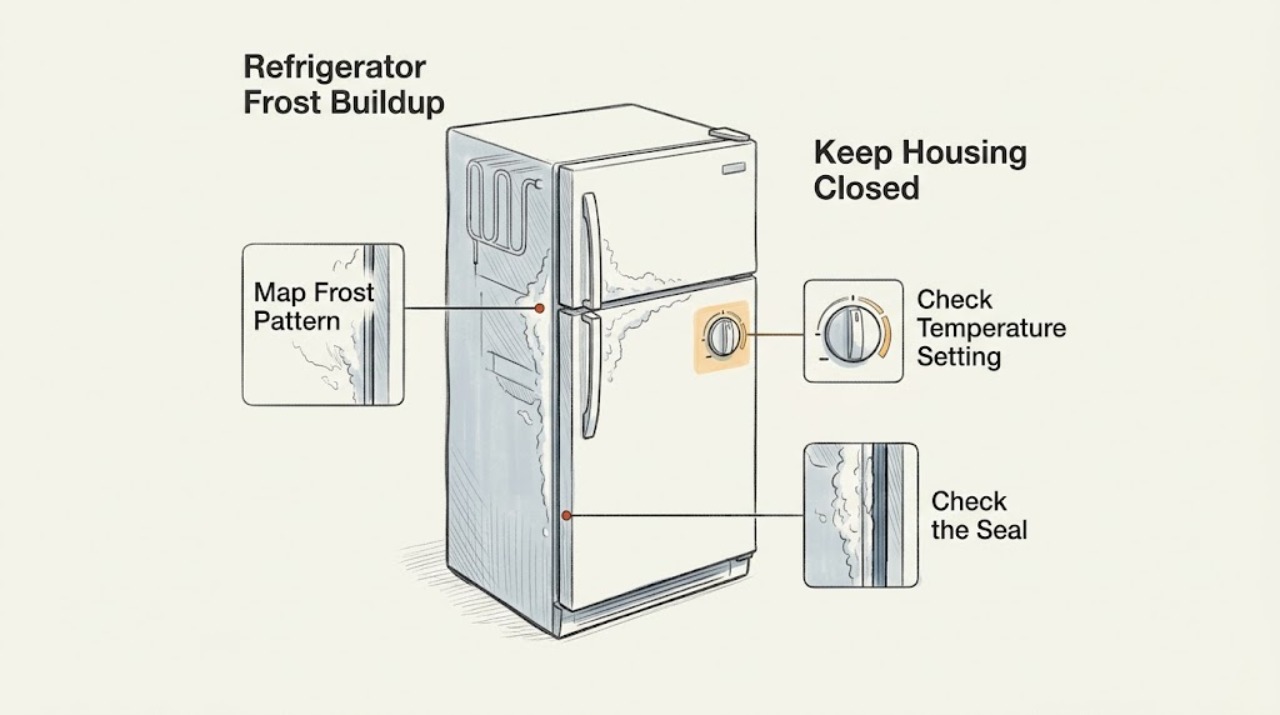
Work through in order
Diagnostic checks
Use only checks that match the exact appliance or system and its official guide.
-
Check 1
With the doors open only briefly, photograph the frost pattern and record whether it is a thin layer on the rear wall, a dense sheet on several walls, ice around a drawer or air path, or frost limited to one compartment. Note whether the refrigerator and freezer are holding food at their normal condition.
Expected result: Classify the frost as thin and localized, dense and widespread, concentrated around a door edge or opening, or recurring after a previous defrost; also record any warming, dripping, or blocked storage space.
Next step: Use the pattern to choose the seal and setting checks. Keep the doors closed as much as practical and do not chip or pry at the ice.
Stop if: Stop if food is thawing, water is reaching electrical parts, shelves or drawers are frozen in place, or removing ice would require force or a sharp tool.
Why this matters
Why: Beko says a thin rear-wall frost layer is not unusual, while dense ice can reduce performance. Frost concentrated near a door edge keeps the seal and air entry in view; widespread or quickly recurring frost is not explained by a single normal condensation event and needs further checks.
-
Check 2
Read the refrigerator and freezer temperature controls without changing other settings, then compare them with the exact Beko model manual. If the controls were recently changed, record the previous setting and the time the frost pattern began.
Expected result: Record whether the setting is within the model's documented range, unusually cold or warm, unknown because the control is faulty, or normal while frost remains dense.
Next step: Make only a model-authorized setting correction and allow the appliance to stabilize as the manual specifies. If the setting is normal but frost continues or food temperature is unsafe, arrange service.
Stop if: Do not repeatedly move the control, disable a protective function, or treat a temperature display as proof that the internal air is at that temperature.
Why this matters
Why: Beko identifies an incorrect temperature setting as a frost contributor and gives around 40°F or below for the refrigerator and around 0°F for the freezer as general recommendations. A normal setting with dense or recurring frost shifts attention toward door sealing, moisture entry, airflow, or a technical fault rather than another blind adjustment.
-
Check 3
Inspect the visible gasket around the affected door for gaps against the cabinet, cracks, tears, flattening, or a section that has pulled away. Check that shelves, drawers, packages, and ice are not preventing the door from closing evenly; clean the gasket only with a soft cloth or sponge and warm water.
Expected result: Record whether the seal contacts the cabinet continuously, has a persistent gap or damaged section, or the door is held open by a load or frost buildup.
Next step: Remove only an obvious storage obstruction and close the door normally. If the gasket is loose, cracked, or still leaves a gap, keep the appliance from prolonged use and arrange authorized service.
Stop if: Do not use abrasive cleaners, adhesives, heat, tools, or force to reshape or replace the gasket, and do not bend the door or hinge.
Why this matters
Why: A gap or damaged gasket allows warm room air into the cold compartment and makes localized or edge frost more likely. Beko says persistent openings may require seal replacement and directs users to an authorized service agent for a loose or cracked seal.
-
Check 4
Review the hours before frost appeared: check whether a door was left open, opened unusually often, hot or uncovered food was added, or packages blocked the door or internal air path. Do not rearrange food in a way that blocks vents or forces the door seal.
Expected result: Record a clear recent moisture or door-opening event, hot food placed inside, a blocked closure or air path, or no behavior change before the frost formed.
Next step: Keep doors closed as much as practical, allow hot food to cool before storage, and restore only normal loading. If frost returns despite ordinary use, continue to the design and recurrence check rather than repeating the same habits advice.
Stop if: Do not scrape ice to make room, block vents with packages, or keep the door open while trying to diagnose the appliance.
Why this matters
Why: Beko attributes frost primarily to warm humid air entering through door openings and says moisture from hot food can increase frost. A one-time event that does not recur makes a usage-related cause more plausible; repeated frost with ordinary loading makes the seal, setting, airflow, or service path more important.
-
Check 5
Identify the exact model and whether it has a no-frost or automatic-defrost feature, then follow the Beko manual's defrost instructions if manual defrosting is allowed. After the appliance is restored according to the manual, observe whether frost returns in the same place and how quickly without repeatedly opening the doors.
Expected result: Record a static or manual-defrost model with frost that clears, a no-frost model with persistent frost, frost that returns quickly after an allowed defrost, or an exact model and manual that cannot be identified.
Next step: Arrange authorized refrigerator service for recurrence, a no-frost model with heavy frost, warming food, or an unknown manual. Provide the model, photos, settings, seal observations, and what happened after the documented defrost.
Stop if: Do not use knives, picks, heat guns, hair dryers, or other improvised methods to remove ice, and do not open the liner, airflow cover, defrost wiring, or sealed system.
Why this matters
Why: Beko says no-frost refrigerators should not need manual defrosting, while other models require regular defrosting; Beko also explains that dense frost can make the appliance work harder and reduce performance. Quick recurrence, persistent frost in a no-frost model, or an unknown design keeps an airflow, defrost, sensor, or sealed-system fault in view and cannot be resolved by more scraping.
Use your observations
Decision map
Find the observation that best matches what you see, then follow the next safe action.
-
PATH 01Safety boundary
What you see
Frost is a thin layer limited to the rear wall, the doors seal evenly, the setting is normal, and food remains at its expected condition.
Do this next
Monitor the pattern, keep door openings brief, and maintain ordinary loading. Arrange service if it becomes dense, spreads, returns rapidly, or is paired with warming or water.
Why this path and its safety boundary
Why it matters: This matches Beko's description of a frost layer that can be normal rather than proving a failed part.
Safety stop: Do not remove a normal frost layer with a sharp tool or change controls repeatedly.
-
PATH 02Safety boundary
What you see
Frost is concentrated near the door edge and the gasket has a persistent gap, crack, tear, or uneven contact with the cabinet.
Do this next
Remove only visible loading obstructions, keep the appliance closed, and arrange authorized service for the damaged or loose seal, door, or hinge.
Why this path and its safety boundary
Why it matters: Air entry through the door seal is more likely than a setting-only issue, and the gap can continue adding moisture even after ice is removed.
Safety stop: Do not bend the door, glue the gasket, or continue normal operation with a door that cannot seal.
-
PATH 03Safety boundary
What you see
The model is not no-frost, dense ice covers the freezer or cold compartment, and the seal and settings are otherwise normal.
Do this next
Follow the exact Beko manual's defrost procedure, protect food and the floor from meltwater, and monitor the return pattern after the appliance is restored.
Why this path and its safety boundary
Why it matters: Periodic manual defrosting is a plausible maintenance step for that design; the ice itself can reduce performance.
Safety stop: Do not chip, puncture, heat aggressively, or disassemble the compartment to accelerate defrosting.
-
PATH 04Safety boundary
What you see
Heavy frost returns quickly after a documented defrost, appears in a no-frost model, spreads despite an intact seal and normal settings, or food is warming.
Do this next
Keep doors closed as much as practical, protect food, and arrange authorized Beko refrigerator service with the model and frost timeline. Do not keep defrosting or scraping as a substitute for diagnosis.
Why this path and its safety boundary
Why it matters: The problem is not established as ordinary condensation alone; airflow, defrost control, sensor, door alignment, or another technical condition may need diagnosis.
Safety stop: Stop for water near electrical components, a damaged power cord, burning odor, smoke, or a compartment that cannot safely hold food.
Helpful context
Understand the symptom
Start with the frost pattern, not a part replacement
Frost on only the rear wall is different from a dense layer across shelves and side walls. Note which compartment is affected, whether food is warming, and whether frost returns after a manual defrost or a door-seal check. A broad or recurring pattern can reflect air entry or a cooling or defrost problem, but frost alone does not identify a failed component.
Door openings and the seal control how much moisture enters
Every prolonged or frequent opening lets warmer, humid room air enter the cold compartment. Beko recommends checking the seal for gaps, cracks, and tears and cleaning it with a soft cloth and warm water if needed. Do not use abrasive products or assume a seal is acceptable when the door does not close evenly.
Manual defrosting depends on the refrigerator design
Beko distinguishes no-frost refrigerators from models that require periodic manual defrosting. Confirm the feature and exact model manual before switching off the appliance or moving food. If the manual permits defrosting, protect the floor and food from meltwater and let the ice release using the documented method; do not improvise a repair to a no-frost airflow or defrost system.
Only after diagnosis
Potential parts
- refrigerator door gasket
Consider this category only if inspection shows a persistent gap, crack, tear, or loose gasket and a technician confirms that the seal is causing air entry and frost.
Confirm the full Beko model number, door configuration, gasket profile, and manufacturer fit information before ordering. - refrigerator defrost sensor or control component
Consider this category only when a technician confirms recurring frost in a no-frost or automatic-defrost model and identifies the sensor or control component as the cause.
Confirm the exact model, revision, connector arrangement, and manufacturer fit information; frost buildup alone does not identify this part.
When checks do not resolve it
Need a professional?
Arrange authorized Beko refrigerator service when a door seal is loose or cracked, frost returns quickly after the exact model's allowed defrost, heavy frost occurs in a no-frost model, food is warming, the temperature control does not behave normally, or the model-specific defrost procedure cannot be identified. Stop and seek qualified electrical help for a damaged cord, smoke, burning odor, sparks, or water near electrical equipment. Do not open airflow covers, defrost wiring, or the sealed refrigeration system.
Safety scope: This article covers observation, ordinary loading, gasket cleaning, and model-authorized settings or defrost instructions only. Do not chip ice, apply improvised heat, open panels or airflow covers, work on defrost wiring, or access the sealed refrigeration system.
Common questions
FAQ
Is a thin layer of frost on the back wall of a Beko refrigerator normal?
Beko says a thin rear-wall frost layer is not unusual. Dense ice, frost that spreads beyond the rear wall, food warming, or frost that returns quickly needs checks of the temperature setting and door seal and may require authorized service.
Why does my Beko refrigerator keep building frost?
Warm humid air from frequent or prolonged door opening, a gap or tear in the door seal, hot food, or an unsuitable temperature setting can add moisture that freezes. If those conditions are normal and frost keeps returning, the problem may need model-specific service diagnosis.
Do I need to manually defrost every Beko refrigerator?
No. Beko says no-frost refrigerators do not need manual defrosting, while other models require periodic defrosting. Confirm the exact model's design and follow its manual before disconnecting power or attempting to remove ice.
Can a damaged Beko refrigerator door gasket cause frost?
Yes. A persistent gap, crack, tear, or uneven contact lets warm air enter and can create frost near the door edge. Inspect and gently clean the visible gasket, but arrange authorized service for a loose or damaged seal rather than forcing or gluing it.
When should frost buildup on a Beko refrigerator be serviced?
Call when heavy frost occurs in a no-frost model, returns quickly after the model-authorized defrost, appears despite a normal setting and intact seal, or is accompanied by warming food, water near electrical parts, or an abnormal control. Do not open the defrost or sealed refrigeration system.
Read the exact guide
Official sources
- Help Center ResultBeko · Beko's official refrigerator Help Center; the exact product manual controls defrost method and operating limits.
- How to prevent frost build-up in your freezerBeko · Beko's official guidance for freezer compartments in refrigerators; model-specific no-frost and defrost instructions control.
- How to fix a refrigerator that's frosting upBeko · Beko's official troubleshooting guidance for refrigerators; exact model settings, defrost design, and service instructions control a particular appliance.
Community feedback
Share a repair observation
Share a plain-text repair observation. Accepted observations are published automatically; this page may take a moment to update.