
On this page
Start here
Quick answer
A small amount of ice or water on the rear wall of a Blomberg refrigerator can occur during normal cooling and defrosting, but constant droplets, thick frost, or frost that blocks airflow needs investigation. First note whether the frost is on the refrigerator rear wall, around the door edge, or across the freezer compartment, and whether it returns after a defrost cycle. Check that the door closes fully, the gasket has no gaps, food is not blocking vents, and the temperature is not set colder than the exact model requires; Blomberg's general fridge guidance gives 3°C to 5°C as a refrigerator range. If the appliance is not frost-free, manual defrost is only appropriate when the model manual permits it. Turn the appliance off at the mains before clearing an accessible defrost drain, never chip ice or heat the liner, and arrange service when frost rapidly returns, the gasket is damaged, water refreezes, or a frost-free system is not removing ice.
Before you begin
Safety first
- This article covers ordinary-access observation only. Do not chip or puncture ice, use an open flame or high-heat tool, remove the liner or service panels, access the defrost heater, fan, thermostat, sensor, control, refrigerant circuit, or wiring, or reconnect power while water is near electrical parts.
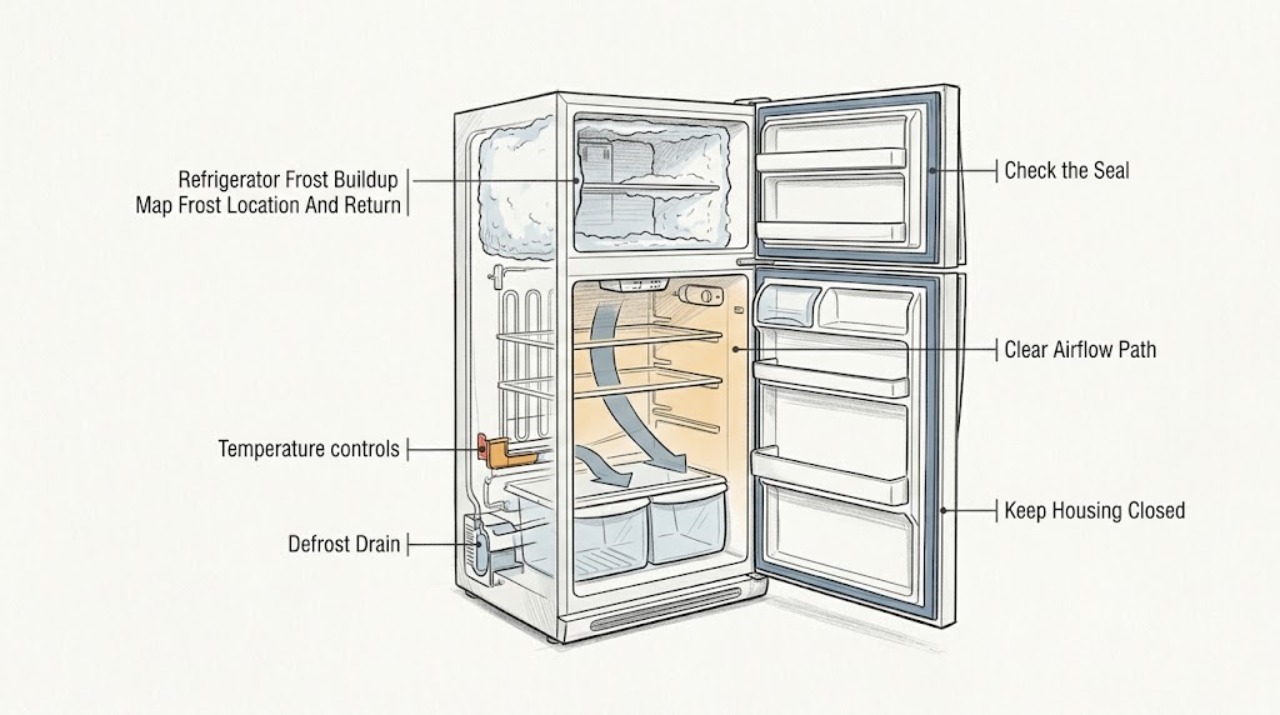
Work through in order
Diagnostic checks
Use only checks that match the exact appliance or system and its official guide.
-
Check 1
Without moving or opening the appliance's service panels, photograph the frost and record whether it is on the refrigerator rear wall, around a door edge, at a vent, on the freezer walls, or around a drain. Note whether it is a thin patch, droplets that freeze, a solid sheet, or frost that blocks a drawer or fan area, and when it returns after the door has remained closed.
Expected result: Record frost location, thickness, affected compartment, door-opening or humidity history, food-temperature concern, and whether the pattern is stable, clearing during defrost, or rapidly recurring.
Next step: Use the location-based branches below and keep the door closed as much as practical. Stop and protect food according to its safety requirements if the appliance is no longer maintaining a safe temperature, and do not run it with ice contacting a fan or wiring.
Stop if: Do not chip, stab, pry, or melt ice with an open flame or high-heat tool; stop for a damaged liner, exposed wiring, smoke, burning odor, or water near electrical parts.
Why this matters
Why: Rear-wall droplets or a thin intermittent patch can fit normal condensation or defrosting. Door-edge frost makes warm-air entry more likely, while frost over vents or freezer walls makes airflow restriction or a defrost problem more likely. A rapidly recurring or unexplained pattern needs model-specific service diagnosis.
-
Check 2
With the doors closed and then opened from a dry, stable position, inspect the visible gasket, hinge side, frame, and door contact area for tears, flattening, gaps, trapped packaging, frost preventing closure, or an uneven door. Check whether warm food, an overfilled shelf, or frequent prolonged door opening could be admitting humid air. Do not remove the gasket or adjust hinges.
Expected result: Classify the seal as clean and evenly contacting, obstructed, visibly damaged or loose, or impossible to assess because the door is misaligned or the area is iced over.
Next step: Remove only an obvious loading obstruction and clean the visible gasket as the model manual permits. If the gasket, frame, hinge, or alignment is damaged, keep the door closed and arrange service rather than forcing it or continuing repeated defrost cycles.
Stop if: Do not stretch, glue, cut, pry out, or heat the gasket; do not operate a door that cannot close evenly or has a damaged frame.
Why this matters
Why: Blomberg identifies a damaged or loose door seal and warm humid air as causes of condensation and ice. A frost line at the door perimeter supports air leakage, but an intact-looking gasket does not rule out a drain, temperature, airflow, or defrost fault.
-
Check 3
Check the displayed or dial temperature without changing more than the exact model permits, and arrange food so it does not cover visible air vents or press against the rear wall. If the appliance's refrigerator setting is adjustable, compare it with the exact manual; Blomberg's general guidance gives 3°C to 5°C for the fridge compartment and says to allow time for the temperature to stabilise after an adjustment.
Expected result: Record the setting, measured or displayed temperature if available, blocked vents or overloading, unusual warm or frozen food, and whether frost is concentrated where airflow is restricted.
Next step: Restore ordinary airflow and make one model-appropriate temperature adjustment if needed, then allow the appliance to stabilise. Arrange service if the temperature remains abnormal, food freezes in the refrigerator, or frost continues to grow.
Stop if: Do not block vents with food, set the control to an extreme value to force a test, or dismantle a thermostat, fan cover, or control panel.
Why this matters
Why: A setting that is too cold, blocked airflow, overloading, or temperature fluctuation can produce condensation, uneven cooling, or frost. If settings and airflow are normal but thick ice persists, the thermostat, defrost control, or another internal system remains possible.
-
Check 4
If frost or water is at the lower rear wall of the refrigerator compartment, first switch the appliance off at the mains and keep it disconnected while checking the accessible defrost-drain opening described by the exact model manual. Remove only a plainly visible obstruction with a soft brush or pipe cleaner if the manual permits; do not reach behind panels or use a sharp object.
Expected result: Record whether the drain opening is clear, visibly blocked, frozen over, full of standing water, or inaccessible without removing an interior panel.
Next step: Dry only accessible water as the model manual permits and restore operation only when the appliance is dry and all user-removable parts are correctly installed. Arrange service for a hidden, frozen, damaged, or repeatedly blocked drain.
Stop if: Do not pour boiling water into the appliance, puncture ice, remove the rear liner, touch wiring, or reconnect power while water is near electrical components.
Why this matters
Why: Blomberg says a blocked defrost drain can let defrost water collect and refreeze on the rear wall. A clear drain with persistent heavy frost makes a door seal, temperature, airflow, or internal defrost-system issue more likely.
-
Check 5
Determine from the rating label and exact manual whether the affected compartment is frost-free or requires manual defrost. For a non-frost-free appliance only, follow the manual's complete defrost procedure with food safely transferred and power isolated; for a frost-free appliance, do not treat recurring heavy ice as a routine user defrost task.
Expected result: Record whether the manual authorizes manual defrost, whether frost returns quickly afterward, whether a fan is obstructed, and whether cooling or temperature control remains abnormal.
Next step: Arrange Blomberg or qualified refrigeration service for rapid recurrence, a frost-free system with heavy ice, a blocked fan area, abnormal temperatures, or any fault that cannot be assessed without panels. Provide the exact model and frost photos.
Stop if: Do not access the defrost heater, fan, thermostat, sensor, refrigerant circuit, or wiring; stop for water near electrical parts, smoke, burning odor, or a damaged liner.
Why this matters
Why: Blomberg's freezer guidance treats manual defrost as an option for non-frost-free models and recommends professional help when the appliance still has trouble. Heavy recurring frost on a frost-free model makes the defrost system, fan, sensor, seal, or control path more likely than a one-time humidity event.
Use your observations
Decision map
Find the observation that best matches what you see, then follow the next safe action.
-
PATH 01Next step
What you see
A thin patch or droplets appear on the refrigerator rear wall, the door seal closes evenly, vents are clear, and the pattern clears during normal defrosting rather than becoming a solid sheet.
Do this next
Keep food covered, limit prolonged door openings, maintain the exact model's recommended setting, and monitor the pattern. Arrange service if it becomes constant, thick, or affects temperature.
Why this path and its safety boundary
Why it matters: Normal condensation or a defrost cycle is more likely than a failed component, provided food temperature and airflow remain normal.
-
PATH 02Next step
What you see
Frost forms mainly around the door edge or gasket, with a visible gap, damaged seal, obstruction, uneven door, or frequent warm humid-air entry.
Do this next
Remove only an obvious obstruction and clean the visible seal as the manual permits. Arrange service for a damaged gasket, hinge, frame, or alignment and do not keep operating with an unevenly closing door.
Why this path and its safety boundary
Why it matters: A door-sealing problem is more likely than a blocked defrost drain; humid air entering at the perimeter can freeze inside the compartment.
-
PATH 03Next step
What you see
Water or ice repeatedly collects at the lower rear wall, the accessible defrost-drain opening is blocked or frozen, and the door seal and temperature setting appear normal.
Do this next
With power isolated, clear only the accessible opening using the exact manual's permitted soft tool. Arrange service for a recurring, hidden, or inaccessible blockage and do not puncture the liner.
Why this path and its safety boundary
Why it matters: A defrost-drain restriction is more likely, although a hidden drain or defrost fault cannot be ruled out by a visible opening alone.
-
PATH 04Next step
What you see
Thick frost covers freezer walls or vents, airflow is restricted, and the model is not frost-free or the manual authorizes a complete manual defrost.
Do this next
For a non-frost-free model, follow the exact manual's power-isolated defrost procedure; for an uncertain or frost-free model, arrange service instead of dismantling or heating the compartment.
Why this path and its safety boundary
Why it matters: Frost is plausibly reducing airflow and cooling performance, but the appliance's frost-free status and manual procedure determine whether defrosting is a user task.
-
PATH 05Next step
What you see
Heavy frost rapidly returns after a model-authorized defrost, appears on a frost-free model, blocks a fan, or persists despite normal seal, airflow, drain, and temperature checks.
Do this next
Keep the appliance operating only if temperatures remain safe and no safety symptom is present, and arrange qualified Blomberg refrigeration service promptly. If cooling is failing, protect food and follow food-safety guidance.
Why this path and its safety boundary
Why it matters: An internal defrost system, fan, sensor, thermostat, control, or sealed cooling issue is more likely than a simple loading or humidity event.
Helpful context
Understand the symptom
The frost location tells you which path to inspect
Thin ice or droplets limited to the refrigerator rear wall can be part of normal cooling and defrosting, while a solid sheet, frost around the door perimeter, or ice across freezer walls changes the diagnosis. Record the first location, thickness, food temperatures, and whether the frost disappears and returns. Do not scrape the liner or keep opening the door to watch the frost form.
Warm humid air and blocked airflow create different patterns
Blomberg links excessive condensation and ice to doors left open, damaged seals, high humidity, overpacking, and blocked vents. A gasket gap tends to concentrate frost near the entry path; a blocked vent or overloaded compartment can make cooling uneven. Check only visible loading, vent, and gasket conditions before considering internal parts.
Frost-free and manual-defrost appliances have different boundaries
Blomberg advises manual defrost only for a freezer that is not frost-free and says to use the product manual when unsure. A frost-free appliance that develops heavy recurring ice may have an airflow or defrost-system fault rather than a routine cleaning need. Never use a knife, sharp tool, open flame, or high heat to remove ice, and do not access the heater, fan, thermostat, or wiring yourself.
Only after diagnosis
Potential parts
- refrigerator or freezer door gasket
Consider this category only when a technician confirms a damaged or permanently deformed gasket is allowing humid air to enter and create the frost pattern.
Confirm the full Blomberg model, compartment, gasket profile, and manufacturer fit information before ordering; frost alone does not establish gasket failure. - defrost drain or drain-heater assembly
Consider this category only when qualified diagnosis confirms a recurring drain restriction or drain-heater fault after the accessible drain path is checked.
Confirm the exact model and complete manufacturer service assembly. Do not insert a substitute heater or open the liner to reach the drain. - defrost sensor, thermostat, or control assembly
Consider this category only when a frost-free or rapidly recurring frost condition is traced by a technician to the defrost control, sensor, or thermostat path.
Match the exact model, revision, connector layout, and manufacturer part information; the frost symptom alone does not establish a compatible replacement.
When checks do not resolve it
Need a professional?
Arrange Blomberg or qualified refrigeration service when frost rapidly returns, a frost-free compartment develops heavy ice, the gasket or door is damaged, a drain is hidden or repeatedly blocked, food temperature is abnormal, or frost persists after the exact model's safe checks. Keep power isolated for water near electrical parts, a damaged liner, smoke, burning odor, or exposed wiring; do not access the defrost heater, fan, thermostat, control, or refrigerant circuit.
Safety scope: This article covers ordinary-access observation only. Do not chip or puncture ice, use an open flame or high-heat tool, remove the liner or service panels, access the defrost heater, fan, thermostat, sensor, control, refrigerant circuit, or wiring, or reconnect power while water is near electrical parts.
Common questions
FAQ
Is ice on the rear wall of a Blomberg refrigerator always a fault?
No. Blomberg says some rear-wall condensation or moisture can occur during normal cooling and defrosting. A thin intermittent patch may be normal when temperature and airflow are stable, but constant droplets, a solid sheet, abnormal food temperature, or rapidly returning frost needs investigation.
What causes frost around the Blomberg refrigerator door?
A damaged or loose gasket, an uneven door, an obstruction, or repeated warm humid-air entry can allow moisture in and create frost at the perimeter. Check only visible conditions and arrange service for a damaged seal, frame, hinge, or latch; do not force or heat the gasket.
Can a blocked defrost drain cause Blomberg refrigerator frost?
Yes. Blomberg says a blocked defrost drain can let water collect and freeze on the rear wall. Switch the appliance off at the mains before checking an accessible opening, and use only the soft tool and procedure allowed by the exact manual. A recurring or hidden blockage needs service.
Should I manually defrost my Blomberg refrigerator?
Only if the exact manual identifies the affected appliance as non-frost-free and gives a defrost procedure. Blomberg recommends manual defrost for a freezer only when that condition applies; a frost-free model with heavy recurring ice should be assessed by a professional. Never chip ice or use an open flame or high heat.
What information should I provide when booking Blomberg frost repair?
Provide the full model and serial information, frost location and photos, whether the appliance is frost-free, temperature setting and symptoms, gasket and airflow observations, drain findings, and how quickly the frost returns. Blomberg says model and serial details are needed for manuals, repairs, accessories, and spare parts.
Read the exact guide
Official sources
- Why are there droplets of water or ice on the fridge rear wall?Blomberg · Official Blomberg fridge support guidance for droplets or ice on the refrigerator rear wall; exact model instructions and defrost design control a particular appliance.
- Why is my fridge too cold?Blomberg · Official Blomberg fridge support guidance for overcooling; temperature settings and stabilisation time are model-dependent.
- Contact Us | BlombergBlomberg · Official Blomberg support contact page; service channels and availability vary by region.
- My Blomberg freezer is no longer running?Blomberg · Official Blomberg freezer support guidance that addresses frost buildup and airflow; the exact refrigerator or freezer model determines whether it is frost-free and how defrosting may be performed.
Community feedback
Share a repair observation
Share a plain-text repair observation. Accepted observations are published automatically; this page may take a moment to update.