
On this page
Start here
Quick answer
A light, even frost layer or a few ice droplets can be normal, especially on a manual-defrost freezer, near vents, after a humid door opening, or during a defrost cycle. For heavier or recurring Amana refrigerator frost, first make sure the doors close fully and the gaskets are clean and unobstructed. Keep freezer and refrigerator air vents clear, avoid overpacking and frequent or prolonged door openings, cover liquids, and let hot food cool before storing it. Check the temperature control against the exact model manual and allow time for the compartments to stabilize after a change. If frost quickly returns, a door will not seal, airflow is blocked behind a cover, cooling is abnormal, or the unit needs an internal defrost repair, stop at these external checks and arrange qualified service.
Before you begin
Safety first
- Do not chip or pry ice, remove evaporator or vent covers, dismantle doors or hinges, use knives, heat guns, or open flames, or test energized defrost, fan, or control components.
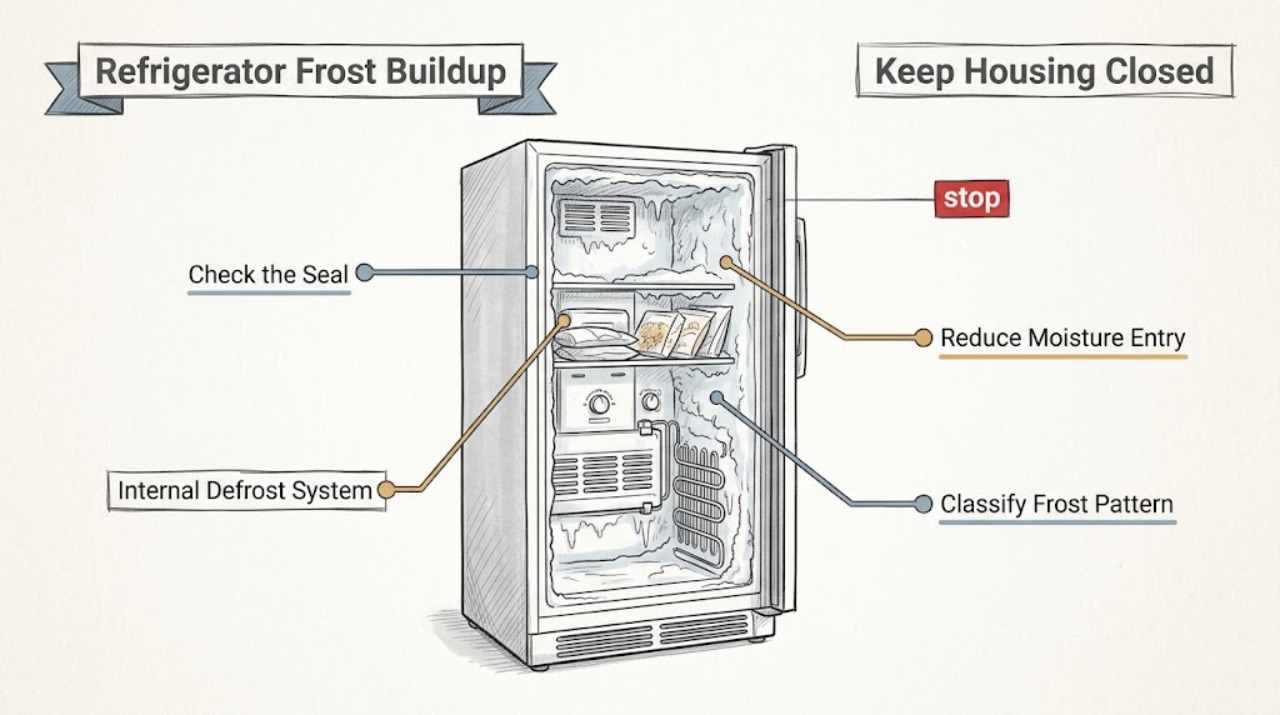
Work through in order
Diagnostic checks
Use only checks that match the exact appliance or system and its official guide.
-
Check 1
Record where the frost appears, how thick or widespread it is, whether it is a light layer near a vent or back wall, and whether it clears after the model's normal defrost behavior. Also note whether food temperature and airflow remain normal.
Expected result: The frost is light and even with normal cooling, or it is thick, rapidly returning, blocking an air path, concentrated around a door edge, or accompanied by poor cooling.
Next step: If the pattern is light with normal cooling, monitor and continue the moisture and door checks if it bothers you. If it is thick or recurring, continue with the door seal, usage, airflow, and control checks.
Stop if: Do not scrape or pry ice from a liner, vent, evaporator cover, or other internal panel.
Why this matters
Why: Amana describes light frost or brief moisture as a normal result of cold surfaces, humidity, and defrosting. Thick or recurring frost, a blocked vent, a door-edge pattern, or poor cooling makes excess moisture entry, sealing, airflow, control, or defrost trouble more likely, but does not identify an internal part.
-
Check 2
Check that each refrigerator and freezer door closes completely, that no package or shelf prevents closure, and that the visible gasket is clean, seated, and free of tears or deformation. Close a sheet of paper in the gasket only as a simple external seal observation if the door can be handled normally.
Expected result: A door is held open, the gasket has dirt or food particles, the paper slips out with little resistance, the gasket is damaged, or the door and visible gasket appear to seal normally.
Next step: Remove only movable obstructions and clean and dry the visible gasket as described in the manual. If the gasket is torn, deformed, or the door will not align or close, arrange model-specific service rather than forcing the door.
Stop if: Do not remove the door, hinge, gasket, or cabinet trim, and do not use heat to reshape the seal.
Why this matters
Why: Amana says a door left open or an improper gasket seal lets humid air in and can cause frost or moisture. A clean-looking seal makes that cause less likely but does not rule out a hinge, alignment, or hidden defrost issue.
-
Check 3
Review the recent use pattern: long or frequent door openings, hot or unwrapped food, uncovered liquids, humid room conditions, or a large load added at once. Close the doors promptly, cover liquids, let hot food cool before storing, and keep food organized without overpacking.
Expected result: Frost appeared after a humid period, frequent openings, warm groceries, uncovered food, or a large load, or it continues despite normal door habits and covered, cooled food.
Next step: Reduce the confirmed moisture source and allow the compartment time to stabilize. If frost continues to build despite normal use, continue to the vent and control checks.
Stop if: Do not store hot food to test the refrigerator and do not leave a door open while trying to accelerate a diagnosis.
Why this matters
Why: Amana identifies humid room air, hot or unwrapped food, frequent or prolonged openings, and large loads as contributors to condensation and frost. Improvement after the moisture source is reduced supports a usage explanation; no improvement makes sealing, airflow, control, or defrost concerns more important.
-
Check 4
Locate the internal air vents shown in the exact Amana manual and move packages away from them without removing covers. Check that shelves are not overpacked and that food is not pressed against the rear wall. Inspect only the visible external ventilation area for obstruction.
Expected result: Food or packaging blocks a vent or rear airflow path, the refrigerator is overpacked, external ventilation is obstructed, or the visible paths are clear.
Next step: Rearrange movable food and restore the spacing shown in the manual, then allow the appliance to stabilize. If a vent is blocked behind a cover, frost returns immediately, or cooling remains abnormal, arrange service.
Stop if: Do not remove vent covers, chip ice behind panels, block a fan, or use a heat source inside the appliance.
Why this matters
Why: Amana says cool air enters and exits between compartments through vents and that blocked vents reduce circulation, causing moisture or excessive frost. Clearing movable items can restore airflow, while clear paths do not prove that a fan or defrost system is working.
-
Check 5
Read the exact Amana owner manual to identify whether the unit is manual-defrost or automatic-defrost and to check the temperature control and any humidity or Energy Saver feature. Make only the user-accessible adjustment the manual describes, then allow the stated stabilization period before judging frost.
Expected result: The unit is manual-defrost, a control is set unusually cold or a humidity feature is changed, the model requires a documented defrost, or the setting and defrost mode are already correct.
Next step: Follow the exact manual for a user-allowed setting or defrost procedure and protect food during any required defrost. If the model requires panel removal, the frost is behind a cover, or the buildup returns after a correct defrost, stop and arrange service.
Stop if: Do not force a defrost cycle, remove internal panels, use a knife or sharp tool, or apply a heat gun or open flame.
Why this matters
Why: A small amount of frost can be normal on manual-defrost models, while Amana says controls, humidity features, and defrost behavior vary by model. A setting or mode change can affect moisture, but a persistent heavy buildup after the model-appropriate correction does not identify a specific failed component.
-
Check 6
Record the exact Amana model and product number, frost location and thickness pattern, door and gasket condition, recent humidity or loading history, vent and food arrangement, temperature-control setting, defrost type, and whether frost returned after the manual's user-level correction.
Expected result: Frost quickly returns, blocks airflow or a door, cooling is poor, the gasket or hinge is damaged, the required defrost is not user-accessible, or the source is behind a panel.
Next step: Protect perishable food while the temperature is uncertain and arrange qualified appliance service with the recorded pattern. Do not continue dismantling or repeatedly defrosting the appliance without model-specific guidance.
Stop if: Do not order or replace a gasket, fan, defrost heater, thermostat, control, or other part from frost location alone.
Why this matters
Why: These patterns exceed a safe external diagnosis. Amana directs owners to the owner manual or service when frost and condensation do not resolve after the listed checks; the model information determines which defrost, control, and seal instructions apply.
Use your observations
Decision map
Find the observation that best matches what you see, then follow the next safe action.
-
PATH 01Next step
What you see
Frost is a thin, even layer or light dusting near the back wall or a vent, cooling is normal, and there is no blocked door or airflow path.
Do this next
Monitor the pattern, keep doors closed promptly, and avoid excess moisture. Do not remove panels or replace parts unless the frost becomes heavy, recurring, or affects cooling.
-
PATH 02Next step
What you see
Frost appeared after long or frequent door openings, warm or uncovered food, humid conditions, or a large grocery load, and the door seal is visibly sound.
Do this next
Reduce the moisture source, close doors promptly, cover liquids, and let hot food cool before storage. Allow stabilization; escalate if heavy frost persists.
-
PATH 03Next step
What you see
A door does not close or seal, food blocks a vent, the shelves are overpacked, or air circulation is visibly restricted.
Do this next
Remove movable obstructions, clean the gasket, and restore the model's airflow arrangement. Arrange service if the gasket, hinge, vent cover, or installation cannot be corrected safely.
-
PATH 04Next step
What you see
Frost rapidly returns after normal moisture, seal, airflow, and model-appropriate control or defrost checks, or the frost is behind an internal cover with poor cooling.
Do this next
Stop at external checks, protect food, and arrange qualified Amana or appliance service. Do not chip ice, remove panels, or replace an internal part based on the frost pattern.
Helpful context
Understand the symptom
First decide whether the frost is normal or excessive
A small amount of moisture or frost is expected in refrigeration. Amana describes a thin, even layer on a manual-defrost freezer back wall and a light dusting near vents in an automatic-defrost unit as normal patterns that can clear after a defrost cycle. A thick, fast-returning layer, frost that blocks a vent or door, or frost paired with poor cooling needs a different decision.
Most safe checks are about moisture entering and air moving
Frost grows when humid room air enters through a door that stays open or does not seal, when warm or unwrapped food adds moisture, or when internal vents are blocked. Keep the checks at the door, controls, food arrangement, and visible airflow boundary. Do not pry ice from panels or remove an evaporator cover.
Do not assume every Amana model defrosts the same way
Amana's guidance says controls and vent locations vary by refrigerator type and model. A manual-defrost freezer, an automatic-defrost unit, and a refrigerator with a humidity or Energy Saver feature can show different normal patterns. Use the exact owner manual before changing a mode or attempting a full defrost.
Only after diagnosis
Potential parts
- refrigerator or freezer door gasket
Consider only when the exact model is confirmed and the visible gasket is torn, deformed, or confirmed by service to be the source of humid-air entry after obstructions and closure are addressed.
Gasket shape and fit vary by Amana model; confirm the model number and the manufacturer's fit information before ordering.
When checks do not resolve it
Need a professional?
Arrange qualified appliance service when frost rapidly returns, blocks airflow or a door, cooling is poor, the door or gasket is damaged, the required defrost is not user-accessible, or external checks do not resolve the buildup. Use the exact Amana owner manual for model-specific defrost and control instructions.
Safety scope: Do not chip or pry ice, remove evaporator or vent covers, dismantle doors or hinges, use knives, heat guns, or open flames, or test energized defrost, fan, or control components.
Have this ready
- Exact Amana model and product number
- Where frost forms and how quickly it returns
- Whether the frost is light and even or thick and blocking
- Door, gasket, hinge, vent, and food-loading observations
- Temperature-control, humidity or Energy Saver, and defrost-type information
- Measured cooling or food-temperature symptom if present
Common questions
FAQ
Is a small amount of frost normal in an Amana refrigerator?
Often, yes. Amana describes small ice droplets, brief moisture, a thin even layer on a manual-defrost freezer wall, or light frost near vents on an automatic-defrost unit as normal patterns. Heavy, fast-returning, or cooling-disrupting buildup needs further checks.
Can an Amana refrigerator door seal cause frost buildup?
Yes. Amana says an improper gasket seal or a door left open lets humid air into the refrigerator or freezer and can cause frost. Check for obstructions, clean the visible gasket, and arrange service for a torn, deformed, or misaligned seal.
Why does frost keep returning after I remove it from my Amana freezer?
Removing visible frost does not correct the source. Repeated buildup can come from humid air, a door or gasket that does not seal, blocked vents, a control or defrost condition, or a model-specific installation issue. Use external checks once and arrange service if it quickly returns.
Can I use a hair dryer or knife to remove Amana refrigerator frost?
Do not use a knife, sharp tool, heat gun, or open flame. Follow the exact owner manual for any user-allowed defrost procedure; if ice is behind a cover or the procedure requires disassembly, stop and arrange qualified service.
Read the exact guide
Official sources
- How to Help Eliminate Condensation and FrostAmana · Amana refrigerator and freezer frost causes, door-opening, gasket, vent, humidity, and model-specific control guidance
- Doors Not Sealing - RefrigeratorAmana · Amana refrigerator door sealing, obstruction, gasket, leveling, and frost implications for applicable models
- Preventing Frost or Ice Crystals on FoodAmana · Amana refrigerator and freezer frost on food, defrost-cycle context, door sealing, and temperature-control adjustment
- Frosting in the Freezer Section - Side by Side RefrigeratorAmana · Amana side-by-side freezer frost, door gasket, air vent, humidity-control, and service guidance for applicable models
- What's Normal Condensation or FrostAmana · Amana refrigerator normal condensation and frost patterns, humidity, controls, seals, airflow, and moisture management
Community feedback
Share a repair observation
Share a plain-text repair observation. Accepted observations are published automatically; this page may take a moment to update.