
On this page
Start here
Quick answer
A light layer of frost or condensation on the rear wall of a Bosch refrigerator compartment can be part of normal cooling when that wall defrosts automatically. Frost that is thick, returns quickly, covers a freezer broadly, forms around a door edge, or appears with water at the base needs a different check. Start by recording where the frost is, cleaning and inspecting the accessible door seal, keeping food away from vents and the back wall, checking the model's temperature setting, and cleaning an accessible condensation drain only as the manual allows. Minimize door openings and let hot food cool before storing it. If a full model-directed defrost does not resolve recurring frost, the freezer is warm, the door will not seal, or the frost points to an internal defrost, fan, sensor, or sealed refrigeration fault, stop dismantling and arrange qualified service.
Before you begin
Safety first
- This article covers frost-pattern recording, accessible door and gasket checks, food placement, settings, and model-directed accessible drain or defrost care. A qualified technician must handle internal defrost, fan, sensor, control, wiring, sealed-system, refrigerant, and cabinet work.
Work through in order
Diagnostic checks
Use only checks that match the exact appliance or system and its official guide.
-
Check 1
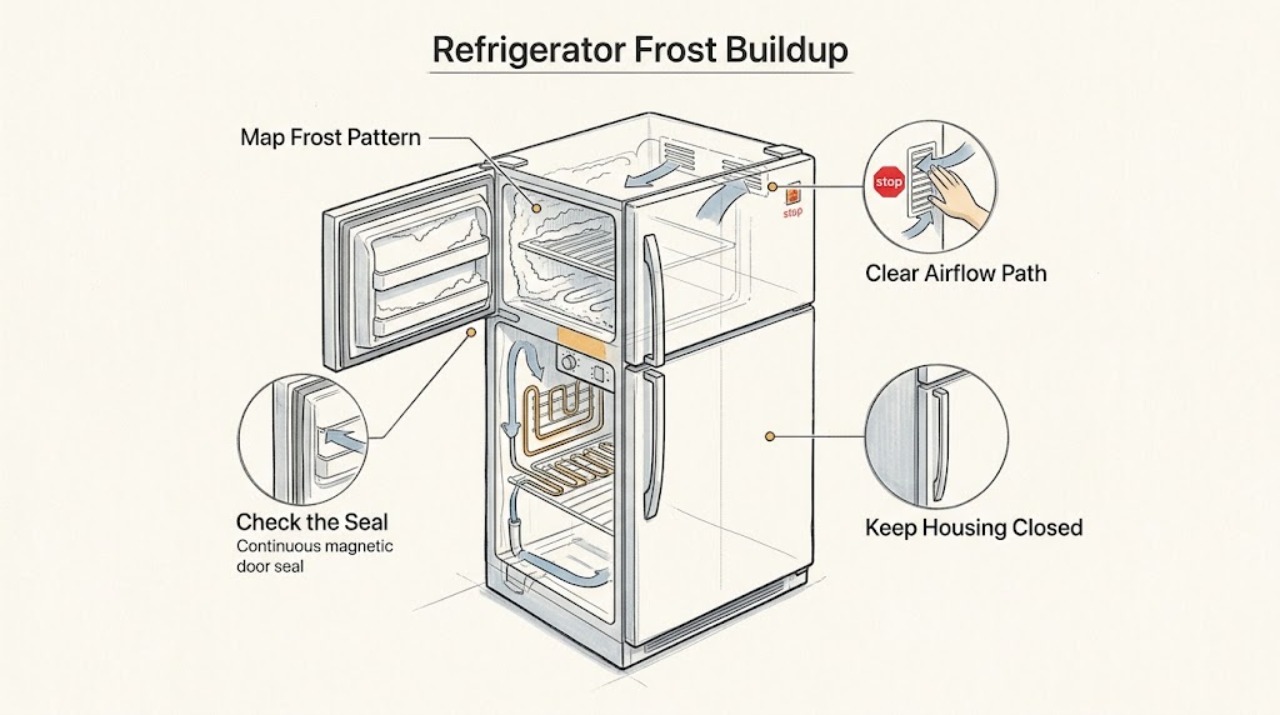
Photograph or write down the frost pattern before melting it: refrigerator rear wall, one shelf or vent, door perimeter, freezer drawer or whole freezer, and whether the frost is thin, a sheet, or a solid mass. Note the exact model and whether the manual describes automatic defrost or No Frost operation.
Expected result: The frost is thin and limited to the refrigerator rear wall, concentrated at a door edge or one airflow point, spread across the freezer, or the defrost architecture cannot be confirmed.
Next step: Continue with the matching visible checks only after identifying the compartment and model. If the model manual cannot be found or the pattern is widespread and the freezer is warming, arrange qualified service rather than opening the cabinet.
Stop if: Do not scrape or break the frost to expose hidden components.
Why this matters
Why: A thin rear-wall layer can be a normal part of an automatic cycle. A door-edge pattern makes warm-air entry more likely; a vent or shelf pattern makes storage and airflow relevant; broad or quickly recurring freezer frost makes a door, defrost, fan, or temperature problem more likely. An unknown architecture means model-specific instructions are required.
-
Check 2
Check that the refrigerator and freezer doors or drawers close fully without a container, shelf, or food package holding them open. Inspect the accessible gasket around its full perimeter for dirt, looseness, tears, gaps, or a section that does not contact the cabinet; clean an intact seal with a soft cloth and mild soapy water, then dry it.
Expected result: The door does not close, the gasket has a visible gap or damage, frost forms mainly around the seal, or the seal and closure appear normal.
Next step: Remove only an obvious obstruction and clean an intact gasket. If the gasket is loose or damaged, stop short of dismantling the door and arrange model-specific replacement or service; if closure is normal, continue to the airflow and setting checks.
Stop if: Do not stretch, glue, cut, or remove the gasket or adjust hinges as a frost test.
Why this matters
Why: A door gap lets warm, moist air enter and can create frost while making the appliance work harder. A clean, continuous seal and a fully closing door make a door leak less likely, but do not rule out a defrost or internal temperature fault.
-
Check 3
Rearrange food so it is not touching the refrigerator rear wall or blocking interior vents, leave the clearance specified by the manual, and avoid overloading. Check the selected temperature and any special cooling mode against the exact Bosch manual; keep door openings brief and allow hot food to cool before storage.
Expected result: Food or packaging is against the rear wall, a vent is blocked, the setting is colder than intended, the appliance has had frequent or prolonged door openings, or the layout and setting are normal.
Next step: Restore the model's recommended arrangement and setting, then allow the appliance to stabilize without repeated adjustments. If frost continues or food remains abnormally cold, proceed to the drain and defrost decision rather than lowering the setting further.
Why this matters
Why: Direct contact with a cold rear wall can freeze food and make a localized frost complaint look like a general fault. Blocked vents, an overly cold setting, warm food, and humid air from long openings can promote frost or delay stabilization. Normal loading and settings make those causes less likely.
-
Check 4
If water is pooling at the bottom of the refrigerator compartment or frost is melting into a puddle, switch off and disconnect power as the manual directs before cleaning. Inspect only the accessible condensation channel and drainage hole described for the model, and clear visible debris with the model-approved soft method; do not push objects into hidden tubing.
Expected result: The channel or hole is visibly blocked, water is pooling without visible blockage, the base is dry, or the drain location cannot be confirmed.
Next step: Clean and dry only the accessible drain path described in the exact manual. If water returns, the hole is inaccessible, or the drain needs disassembly, arrange qualified service; do not run water into the appliance to test the path.
Stop if: Keep moisture away from the light and electrical parts, and do not remove a rear panel or force a blockage through the drain.
Why this matters
Why: A blocked condensation path can leave water in the compartment and allow it to refreeze. A dry base does not explain every frost pattern, while a pool without an accessible blockage can indicate a hidden drain, leveling, or defrost issue.
-
Check 5
If the exact Bosch manual permits a user defrost, follow only that procedure after protecting food and disconnecting power as instructed. After the appliance returns to normal operation, record whether the frost returns, how quickly it returns, the compartment temperature behavior, and any door alarm or unusual noise.
Expected result: Frost clears and does not return under normal use, frost returns quickly or broadly, the freezer is warmer than expected, or the appliance has an electrical, heat, smell, or leak warning.
Next step: Monitor a normal cycle if the frost stays absent. If it recurs, the freezer is warm, or any warning is present, stop using the appliance as appropriate and arrange qualified Bosch or appliance service with the model and frost record.
Stop if: Do not repeat improvised defrosts, remove covers, probe wiring, or handle refrigerant tubing.
Why this matters
Why: A lasting improvement after correcting a door, loading, or temporary humidity condition supports an operating-condition cause. Rapid recurrence, broad freezer frost, or a warm freezer after a proper defrost makes an internal defrost, fan, sensor, control, or sealed refrigeration issue more likely; the pattern does not identify a part.
Use your observations
Decision map
Find the observation that best matches what you see, then follow the next safe action.
-
PATH 01Next step
What you see
The frost is a thin, intermittent layer on the refrigerator compartment rear wall, the door seals, loading, and setting are normal, and the wall clears during the model's automatic cycle.
Do this next
Leave the wall unobstructed, keep food from touching it, and monitor the pattern. Use the exact manual if the layer becomes thick, covers a large area, or stops clearing.
Why this path and its safety boundary
Why it matters: This pattern is consistent with normal condensation and automatic rear-wall defrost rather than a confirmed appliance failure.
-
PATH 02Next step
What you see
Frost is concentrated at a door edge or perimeter, the door was held open, the gasket has dirt or a gap, or the seal does not contact the cabinet continuously.
Do this next
Remove obstructions, clean an intact gasket, and keep openings brief. Arrange model-specific gasket or door service if the gap or damage remains and do not dismantle the door.
Why this path and its safety boundary
Why it matters: Warm, humid air entering through the door is more likely than a primary sealed-system failure, although a door alignment issue can coexist with gasket damage.
-
PATH 03Next step
What you see
Frost or frozen food is localized near a vent or rear wall, food touches the wall, a vent is blocked, or the temperature setting is colder than the manual's intended range.
Do this next
Restore clearance and the model-appropriate setting, avoid hot food and prolonged openings, and allow stabilization. Escalate if the localized frost persists despite normal placement and setting.
Why this path and its safety boundary
Why it matters: Storage position, restricted airflow, or the selected setting is a plausible immediate contributor; the localized pattern does not prove a failed thermostat.
-
PATH 04Safety boundary
What you see
Frost is accompanied by water pooling at the refrigerator base, and the accessible condensation channel or drainage hole is visibly dirty or blocked.
Do this next
Disconnect power as directed, clean only the accessible drain path allowed by the manual, and seek service if water returns or the path needs disassembly.
Why this path and its safety boundary
Why it matters: A restricted condensation path can leave meltwater in the compartment where it may refreeze; this is different from a frost layer that is only on the rear wall.
Safety stop: Do not force a blockage into hidden tubing or run the appliance with moisture near electrics.
-
PATH 05Safety boundary
What you see
Frost covers much of a No Frost freezer, returns quickly after a complete model-directed defrost, the freezer is warm, or the door and visible operating conditions are normal.
Do this next
Stop repeated defrost cycles and arrange qualified Bosch or appliance service. Keep the model, temperature observations, frost return time, and door-seal results for the technician.
Why this path and its safety boundary
Why it matters: An internal defrost, airflow, sensor, control, or refrigeration problem is more likely than a simple loading or door-opening condition, but the visible frost pattern cannot identify the failed component.
Safety stop: Do not remove panels, bypass a defrost control, test internal wiring, or open the refrigeration circuit.
-
PATH 06Safety boundary
What you see
There is water near electrical parts, a damaged cord, exposed wiring, burning smell, smoke, unusual heat, refrigerant-tube damage, or a freezer temperature warning.
Do this next
Keep clear, stop using the appliance, and arrange qualified appliance or electrical service. Isolate power or water only when the control can be reached without contacting the hazard.
Why this path and its safety boundary
Why it matters: The immediate concern is an electrical, fire, leak, or food-safety hazard rather than a frost adjustment.
Safety stop: Do not touch wet electrical areas, open covers, or attempt a live check.
Helpful context
Understand the symptom
The frost pattern matters more than the word frost
A few droplets or a thin layer on the cold rear wall of a refrigerator compartment may be normal on Bosch models that automatically defrost that wall. A sheet that covers shelves, frost that returns soon after defrosting, a band around the door, or frost throughout a No Frost freezer is a different pattern. Before changing settings or ordering a part, record the compartment, exact location, thickness, time to return, food or packaging touching the wall, door condition, and whether water collects below.
Defrosting and internal refrigeration work have different boundaries
If the exact manual permits a user defrost, switch the appliance off, disconnect power as directed, protect the food, and let the frost thaw naturally. Do not chip ice with a sharp object, use an improvised high-heat source, remove rear panels, pierce tubing, handle refrigerant, or open live electrical areas. A wet electrical area, damaged cord, burning smell, smoke, or repeated frost after a proper manual-directed defrost is a stop-and-service condition.
Safety boundary
Stop conditions
- Stop using the appliance for water near electrical parts, damaged cord, exposed wiring, burning smell, smoke, unusual heat, refrigerant-tube damage, or a freezer temperature warning.
- Do not chip ice with sharp tools, use an improvised high-heat source, remove rear panels, bypass a defrost control, or open the refrigeration circuit.
- Disconnect power before cleaning an accessible drain or carrying out a manual-directed defrost, and keep meltwater away from lights and electrical parts.
- Arrange qualified service when frost is broad or rapidly recurring after a proper model-directed defrost, the freezer is warm, or the door and gasket cannot be made to seal.
Only after diagnosis
Potential parts
- refrigerator or freezer door gasket
Consider this only if the exact model's gasket has a confirmed gap, tear, loss of contact, or damage after cleaning and door closure are checked; frost alone does not prove the gasket is the cause.
Confirm the exact Bosch E-Nr. and the manufacturer's fit information before ordering; do not assume a gasket from another refrigerator family fits. - Bosch refrigerator condensation or defrost component
Consider an internal drain, defrost, sensor, fan, or control component only after qualified diagnosis confirms that recurring frost is not caused by the door, loading, setting, or accessible drain.
The exact model and diagnostic result must identify the component and approved fit; do not order or replace an internal part from the frost pattern alone.
When checks do not resolve it
Need a professional?
Safety scope: This article covers frost-pattern recording, accessible door and gasket checks, food placement, settings, and model-directed accessible drain or defrost care. A qualified technician must handle internal defrost, fan, sensor, control, wiring, sealed-system, refrigerant, and cabinet work.
Common questions
FAQ
Is frost on the back wall of a Bosch refrigerator normal?
A thin or intermittent layer on the rear wall can be normal on Bosch models whose refrigerator compartment defrosts automatically. It should not become a thick, rapidly recurring sheet; check door sealing, food placement, temperature, and the exact manual if it does.
Why does my Bosch refrigerator keep frosting up around the door?
A door that stays open or a seal with dirt, a gap, or damage can let warm humid air into the cabinet and promote frost. Remove obstructions, clean an intact seal with mild soapy water, and arrange model-specific service if the gasket or closure remains defective.
Can blocked vents cause localized frost in a Bosch refrigerator?
Yes. Bosch advises leaving room for air vents and keeping food from direct contact with the rear wall or cold airflow. Rearrange the compartment and use the model-appropriate temperature setting before assuming a thermostat or sealed-system fault.
Why is there ice and water at the bottom of my Bosch refrigerator?
A blocked condensation channel or drainage hole can leave meltwater in the compartment, where it may refreeze. Disconnect power as the exact manual directs and clean only the accessible drain path it describes; recurring water or an inaccessible drain needs service.
When should I call service for Bosch refrigerator frost buildup?
Arrange service when frost is widespread or returns quickly after a proper model-directed defrost, the freezer is warm, a door or gasket will not seal, water returns after accessible drain care, or there is an electrical, heat, smoke, leak, or refrigerant-tube hazard. Internal defrost, fan, sensor, control, and sealed-system work is not a user check.
Read the exact guide
Official sources
- Water buildup inside the fridgeBosch · Bosch refrigerator water or refreezing symptoms associated with an accessible condensation channel or drain; exact model instructions control access.
- Defrosting in the refrigerator compartmentBosch · Bosch refrigerator compartments represented by the opened manual page; exact model controls the applicable cleaning procedure.
- How to clean your refrigerator door sealBosch Home Appliances · Bosch refrigerator gasket cleaning; a loose or damaged seal requires model-specific support.
- Ice buildup inside the fridgeBosch · Bosch refrigerator compartment frost on the rear wall, door-seal, temperature-setting, and door-opening checks; follow the exact model manual.
- Common Freezer ProblemsBosch Home Appliances · Bosch freezer compartments with excessive frost or temperature problems after the door-seal check.
- Fridge is freezing foodBosch · Bosch refrigerator compartment frost or food freezing when temperature setting and airflow around vents or the rear wall need checking.
- Bosch Refrigerator Instruction ManualBosch · Bosch refrigerator model family represented by the opened manual; use the matching model manual for exact controls, temperature, and defrost procedure.
- Refrigerator Troubleshooting: What to do if your refrigerator door does not shut properlyBosch Home Appliances · Bosch refrigerator doors that do not close properly or allow cold air to escape.
Community feedback
Share a repair observation
Share a plain-text repair observation. Accepted observations are published automatically; this page may take a moment to update.