
On this page
Start here
Quick answer
If a Thermador gas cooktop will not turn on, first separate no power or no spark from a burner that sparks but does not light. From a cool, dry cooktop, check that the unit is plugged in and its breaker has not tripped, then confirm the main gas supply is on. With the burner cool, make sure the burner cap is seated in its notches and the igniter and visible ports are clean and dry; Thermador says a damp igniter may not light. Turn one knob to the normal lighting position only briefly and observe whether there is a spark. If there is a gas odor, continuous or unexplained sparking, delayed ignition, a flare-up, an unusually high or uneven flame, or a burner will not shut off, turn the knob off, stop using the cooktop, and follow the gas-safety and service boundary. Do not dismantle the cooktop, adjust the regulator, or work on gas or ignition wiring.
Before you begin
Safety first
- This article covers brief normal-control observations and cool, dry external cleaning only. Do not dismantle the cooktop, access gas or ignition wiring, adjust the regulator, use an external flame, bypass a safety device, or continue after gas odor, delayed ignition, flare-up, abnormal flame, continuous sparking, smoke, heat damage, or a burner that will not turn off.
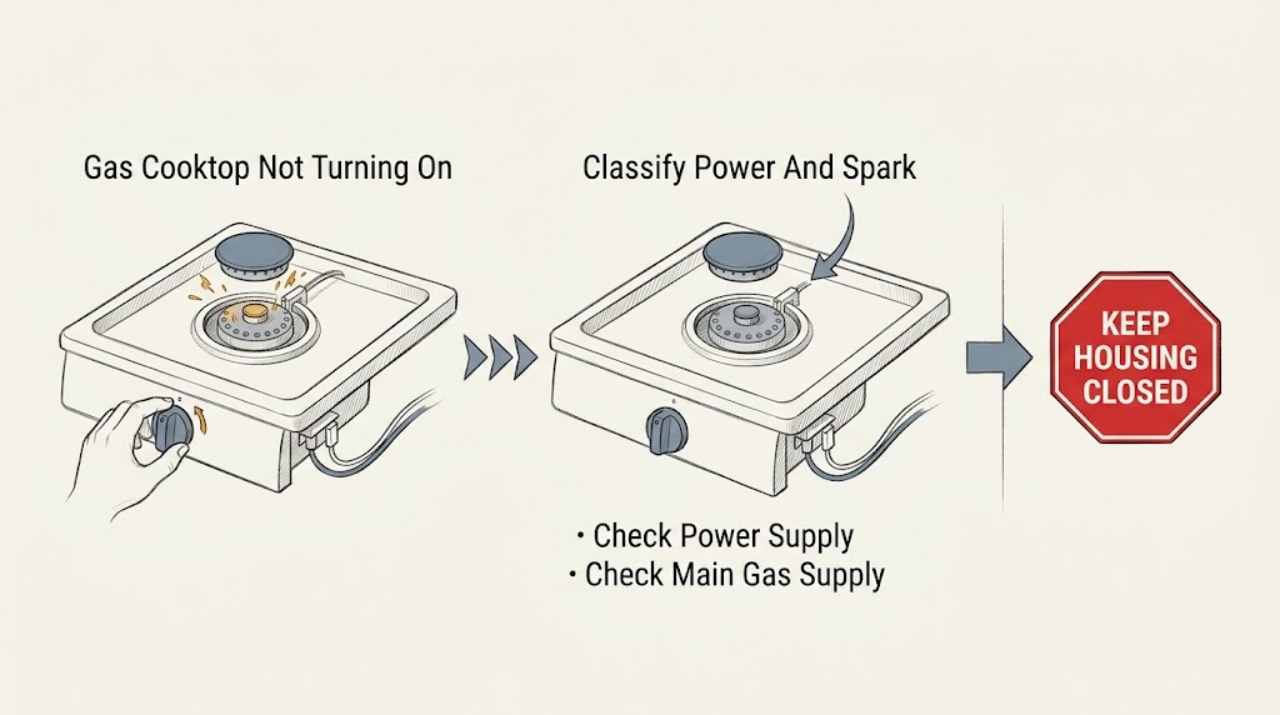
Work through in order
Diagnostic checks
Use only checks that match the exact appliance or system and its official guide.
-
Check 1
With the cooktop off and cool, turn one burner knob to its normal lighting position only briefly and observe whether the igniter clicks or sparks; do not continue if gas accumulates, a flame flares, or the knob will not return to OFF.
Expected result: No burners click or spark, only one burner is silent, all burners spark but no flame appears, or sparking continues after the knob is returned to OFF.
Next step: Follow the matching branch and keep the test brief; never repeat a failed ignition attempt enough to allow unburned gas to accumulate.
Stop if: Stop immediately for gas odor that persists, delayed ignition, a flare-up, continuous sparking, abnormal flame, smoke, heat damage, or a knob that cannot be turned fully OFF.
Why this matters
Why: No spark on all burners points toward shared power or ignition control; one silent burner points toward its igniter, cap, or burner circuit; spark without flame points toward gas supply or burner alignment; OFF-position sparking indicates a control, moisture, or ignition fault that should not be ignored.
-
Check 2
If no burners spark, check from a dry, safe position that the cooktop plug is seated and the dedicated circuit breaker has not tripped; do not open the outlet, breaker panel, or cooktop wiring.
Expected result: The breaker is tripped, the outlet or plug is wet/hot/damaged, the breaker trips again, or power appears normal but no burner sparks.
Next step: Only if the area is dry and there is no damage or odor, follow the household breaker's normal single reset procedure; if it trips again or power is normal but sparking does not return, keep the cooktop out of service and request qualified help.
Stop if: Do not repeatedly reset, touch wet equipment, use a temporary connection, remove covers, or continue after a spark outside the burner, hot plug, burning smell, or smoke.
Why this matters
Why: Thermador lists the power supply, plug, and circuit breaker as first checks for burners that do not start. A damaged supply or repeated trip is an electrical safety fault; normal household power with no spark shifts the issue to the cooktop's ignition system.
-
Check 3
If there is no gas odor and the cooktop has a normal spark, check only the visible position of the main gas supply or shutoff according to the exact installation manual; do not loosen, test, or adjust gas fittings or the regulator.
Expected result: The main supply is visibly off, other gas appliances also lack gas, the supply appears on but the cooktop still will not light, or any gas-like odor is present.
Next step: For a clearly closed supply with no odor, have the supply restored only through the normal safe household control or qualified installer guidance; if the supply is on or uncertain, arrange Thermador service. For any gas odor, follow the gas-odor branch immediately.
Stop if: Do not relight repeatedly, adjust the regulator, open a gas connection, use a flame to test for leaks, or operate switches in a suspected gas-odor area.
Why this matters
Why: A closed supply or building gas interruption can leave a normal spark without a flame. An open-looking valve does not prove correct pressure, leak-free connections, or a functioning burner valve.
-
Check 4
After the cooktop has cooled, with knobs OFF and no gas odor, remove only the affected cool burner cap as the manual permits; check that its tabs fit the base notches, and wipe the cap and igniter gently so both are clean and thoroughly dry.
Expected result: The cap is misaligned, the igniter is damp or dirty, visible ports are wet or obstructed, the cap is cracked or distorted, or the parts seat correctly but the burner still will not light.
Next step: Reassemble only the cap in its normal position and make one brief ignition attempt; if the result is unchanged, stop using that burner and request service.
Stop if: Do not soak the cap, flood the igniter, scrape aggressively, insert tools into gas passages, force parts, or clean while hot or while a knob is ON.
Why this matters
Why: Thermador identifies cap position and damp/dirty igniters as common reasons for failed or intermittent ignition. A damaged cap/base, a persistent obstruction, or a correctly seated dry burner that still fails needs model-specific service rather than force or adjustment.
-
Check 5
If a burner lights, observe from a normal standing position whether the flame is stable and even, whether the clicking stops after ignition, and whether the flame responds normally when the knob is returned to OFF; do not lean over the flame or move a hot cap.
Expected result: The flame is stable and even, goes out unexpectedly, is high or uneven, the igniter keeps clicking, or the burner does not shut off normally.
Next step: Turn the knob OFF; if the abnormal result persists, close the main gas supply when safe and arrange qualified service with the model and affected burner recorded.
Stop if: Stop immediately for a high/uneven flame, delayed ignition, flare-up, persistent gas odor, continued sparking in OFF, or a burner that cannot be shut off normally.
Why this matters
Why: Thermador links unexpected flame behavior to drafts, cap position, or regulator/service conditions and says persistent clicking can involve wet ports/igniters, a shutoff issue, or a re-ignition function. An abnormal or uncontrollable flame is not a user adjustment problem.
-
Check 6
Classify the result as a corrected power, gas-supply, cap, or moisture issue, or as a persistent cooktop fault after the safe external checks; record the model, burner, spark behavior, gas-supply observation, cap/igniter condition, and flame result.
Expected result: The burner remains silent, sparks without lighting, keeps clicking, lights late, has an uneven/high flame, shows a recurring issue after cleaning, or the symptom occurs on every burner.
Next step: Keep the affected burner or entire cooktop out of service as appropriate and arrange an authorized Thermador servicer; provide the exact model and the observation record.
Stop if: Do not dismantle the gas appliance, adjust the regulator, access wiring, bypass ignition or flame safety, repeatedly light the burner, or continue after any gas, fire, electrical, or abnormal-flame symptom.
Why this matters
Why: Persistent failure can involve an igniter, electrode, burner valve, spark module, regulator, wiring, or control. The visible symptom cannot establish which part is compatible or safe to replace.
Use your observations
Decision map
Find the observation that best matches what you see, then follow the next safe action.
-
PATH 01Safety boundary
What you see
No burner clicks or sparks, and the plug, outlet, or breaker is off, tripped, damaged, or otherwise abnormal.
Do this next
Use one normal safe breaker check only if dry and undamaged; call a qualified electrician or Thermador servicer for a repeated trip, damaged supply, or persistent no spark.
Why this path and its safety boundary
Why it matters: The immediate fault domain is the electrical supply or shared ignition power, not necessarily the gas supply.
Safety stop: Do not touch wet/hot equipment, open the outlet or panel, repeatedly reset, or continue after smoke, sparks, odor, or heat damage.
-
PATH 02Safety boundary
What you see
The cooktop has normal power but none of the burners produces a spark.
Do this next
Keep the cooktop out of service and arrange authorized diagnosis without opening the appliance.
Why this path and its safety boundary
Why it matters: A shared ignition control, wiring, or power-entry fault is possible; a gas adjustment will not restore a missing spark.
Safety stop: Do not dismantle the cooktop, access ignition wiring, or repeatedly turn knobs to search for a spark.
-
PATH 03Safety boundary
What you see
A burner sparks normally but no flame appears, with no gas odor and no abnormal flame event.
Do this next
Check the visible main gas-supply position and the cool burner's cap/igniter alignment and dryness; make one brief attempt only, then request service if it fails.
Why this path and its safety boundary
Why it matters: The visible gas supply may be off, another gas interruption may exist, or the cap/ports may not be correctly positioned or dry.
Safety stop: Do not keep clicking, open gas fittings, adjust a regulator, probe gas ports, or use an external flame.
-
PATH 04Safety boundary
What you see
Only one burner fails, and its cap is misaligned or its igniter/visible ports are damp, dirty, or obstructed.
Do this next
After cooling, clean and dry accessible parts and seat the cap in its notches; stop and call service if the burner still fails or parts are damaged.
Why this path and its safety boundary
Why it matters: Thermador identifies cap position and moisture or soil at the igniter/ports as causes of failed or intermittent ignition.
Safety stop: Do not soak the cap, force it, scratch the base, insert tools into gas passages, or clean with a knob ON.
-
PATH 05Safety boundary
What you see
Gas odor remains after an ignition attempt, ignition is delayed, there is a flare-up, or the smell is present while the burner is not lit.
Do this next
Turn knobs OFF; if the odor persists and it is safe to do so, turn off the main gas supply, leave the area, avoid switches and ignition attempts, and contact Thermador service or the gas supplier from a safe location.
Why this path and its safety boundary
Why it matters: Treat the symptom as a possible gas hazard, not as a cap or spark adjustment.
Safety stop: Do not light anything, operate electrical switches, use a phone inside the odor area, relight the burner, or re-enter to investigate until cleared by the responsible authority.
-
PATH 06Safety boundary
What you see
The burner has a high or uneven flame, goes out unexpectedly, keeps clicking or sparking in OFF, or will not shut off normally.
Do this next
Turn the knob OFF and stop using the affected burner or cooktop; close the main gas supply when safe and arrange authorized service.
Why this path and its safety boundary
Why it matters: The cooktop may have a cap, draft, moisture, regulator, ignition, valve, or control fault requiring qualified service.
Safety stop: Do not adjust a regulator, bypass flame recognition, dismantle the gas appliance, or keep operating to see if the flame stabilizes.
Helpful context
Understand the symptom
First identify whether the cooktop has power and a spark
A completely silent burner with no click or spark follows a power, control, or ignition-supply path. A clear click and spark with no flame follows a gas-supply, cap, port, or ignition-position path. If other burners work, compare only the visible, cool parts of the affected burner; if none work, check shared power and gas conditions before touching any burner component. The exact Thermador model manual controls knob positions and any child-lock behavior.
Keep caps and igniters correctly positioned and dry
Thermador says burner caps must be properly positioned and that damp or dirty igniters may not light. Let the cooktop cool fully, then wipe the cap and igniter carefully and allow them to dry. Do not soak caps, flood the igniter, force a cap into place, or use a metal tool near a gas outlet unless the exact manual gives a safe cleaning procedure. A cap that is cracked, distorted, or cannot seat should go to service.
Stop for gas, ignition, or flame abnormalities
A brief gas smell during a normal ignition attempt may be expected according to Thermador, but a smell that remains after ignition is not. Turn every knob off; if the smell persists, turn off the main gas supply if this can be done safely and arrange service. Leave the area and avoid switches or ignition attempts when a gas leak is suspected. Continuous clicking, delayed ignition, flare-up, a high or uneven flame, or a burner that does not shut off is a stop condition rather than a reason to adjust the regulator or open the cooktop.
Only after diagnosis
Potential parts
- gas-cooktop igniter or electrode
Consider this only when qualified diagnosis confirms that a particular burner lacks a usable spark after the cap and igniter are clean, dry, and correctly positioned.
Electrode shape, lead routing, and insulation vary by model; do not order or install from a no-light symptom alone. - gas-cooktop spark module
Consider this only when qualified testing finds a shared no-spark or intermittent-spark fault in the ignition module.
Spark modules are model-specific electrical/gas-appliance components and require qualified installation. - gas-cooktop burner valve or regulator
Consider this only after qualified gas-appliance diagnosis links a persistent gas-flow or flame-control fault to the valve or regulator.
Gas components require exact model fitment and qualified service; never adjust or replace them from flame symptoms alone.
When checks do not resolve it
Need a professional?
Safety scope: This article covers brief normal-control observations and cool, dry external cleaning only. Do not dismantle the cooktop, access gas or ignition wiring, adjust the regulator, use an external flame, bypass a safety device, or continue after gas odor, delayed ignition, flare-up, abnormal flame, continuous sparking, smoke, heat damage, or a burner that will not turn off.
Common questions
FAQ
Why does my Thermador gas cooktop have no spark?
Check the visible plug and breaker from a dry safe position. If power is normal but no burner sparks, the shared ignition system may need service. Do not open the cooktop or access ignition wiring.
Why does my Thermador burner spark but not light?
With no gas odor and the burner cool, confirm the visible gas supply is on and the cap is seated in its notches; make sure the igniter and ports are clean and dry. If it still fails, stop repeated attempts and call service.
Can a wet igniter stop a Thermador burner from lighting?
Yes. Thermador says a damp igniter may not light. Let the cooktop cool, wipe it carefully, and allow it to dry. Do not flood the igniter or keep clicking while gas may be accumulating.
What should I do if a Thermador burner keeps clicking?
Turn the knob OFF. Thermador lists moved caps, wet or clogged ports, damp igniters, drafts, and model-specific re-ignition behavior as possibilities, but persistent clicking or sparking in OFF needs service.
When is a Thermador gas odor an emergency?
A gas odor that remains after ignition, appears with a burner off, or accompanies delayed ignition or a flare-up must not be investigated by relighting. Turn knobs OFF, leave the area without operating switches, and contact the gas supplier, emergency service, or Thermador service from a safe location.
Read the exact guide
Official sources
- TroubleshootingThermador · Official Thermador gas-cooktop and rangetop troubleshooting; exact model instructions control.
- Cleaning & CareThermador · Official Thermador gas-cooktop care guidance; exact model manual controls removable parts and cleaning procedure.
- Customer Support, Service, Repair & PartsThermador · Official Thermador support portal for gas-cooktop owners.
Community feedback
Share a repair observation
Share a plain-text repair observation. Accepted observations are published automatically; this page may take a moment to update.