
On this page
Start here
Quick answer
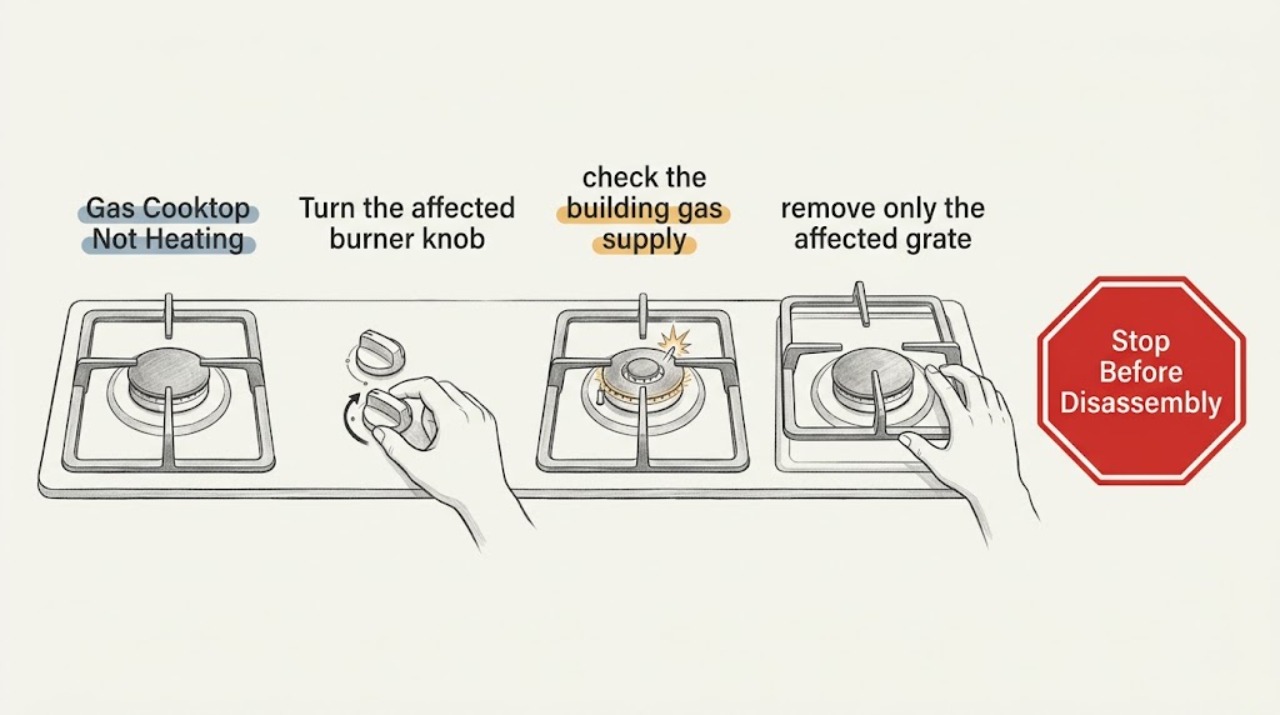
If a Thermador gas cooktop is not heating, first turn the affected knob off and decide whether there is no flame, a weak or uneven flame, or a flame that lights but does not deliver normal heat. With no gas odor or other danger sign, confirm the main gas supply and appliance power, then let the cooktop cool before checking that the burner cap and head are correctly seated, dry, and free of blocked ports. If the igniter keeps clicking, gas flows without a normal flame, the flame is yellow or unusually high, you hear delayed ignition or a boom, or you smell gas, stop immediately. Do not adjust the regulator, open gas tubing, or dismantle the cooktop; leave it unused and call qualified gas or appliance service.
Work through in order
Diagnostic checks
Use only checks that match the exact appliance or system and its official guide.
-
Check 1
Turn the affected burner knob fully to OFF and assess the area before trying again. If you smell gas, see gas without a normal flame, hear a boom or delayed ignition, see smoke, or see an abnormal flame, do not continue operating the cooktop.
Expected result: A gas odor remains, ignition is delayed or explosive, a flame is outside the burner area, or smoke or fire is present.
Next step: Stop immediately, avoid flames and electrical switches, leave the area if the odor persists, and contact the gas supplier or emergency services from outside. Do not repeat ignition attempts.
Why this matters
Why: Unburned gas or an abnormal combustion event is possible; this is not a cleaning or heat-setting problem.
-
Check 2
If there is no gas odor or other danger sign, check the building gas supply and the cooktop's electrical supply from outside the appliance. Confirm the main gas shutoff is open and the appliance is connected to power; do not open a gas connection or remove an electrical panel cover.
Expected result: The gas supply is off, the cooktop has no power, a breaker or fuse has tripped, or both supplies appear normal but the burner remains cold.
Next step: Correct only an obvious external supply state once and stop if protection trips again. Leave the cooktop off and call qualified service when supplies are normal but heating does not return.
Why this matters
Why: A supply interruption can prevent ignition or heating across multiple burners, while normal supplies move the diagnosis toward the burner, igniter, control, or regulator.
-
Check 3
After the cooktop has cooled, remove only the affected grate, cap, and burner head as allowed by the manual. Confirm the cap matches the burner, sits flat in its locating position, and that visible ports and the igniter are dry and free of food or cleaning residue. Do not force a part or scrape near a live igniter.
Expected result: The cap or head is misaligned, ports are clogged, or the igniter is wet or dirty; or the parts are correctly seated and dry.
Next step: With power and gas controls safely off, perform only the manual-approved cool cleaning or drying, reassemble the matched parts, and stop if the burner still fails or clicks continuously.
Why this matters
Why: Thermador identifies cap position, blocked ports, and igniter moisture or dirt as common causes of slow or failed ignition; correct fit is necessary for a stable flame but does not prove internal parts are good.
-
Check 4
Make one normal ignition observation from a safe position after the burner parts are cool, dry, and correctly seated. Note whether the igniter clicks, whether a stable flame appears, and whether the flame remains after the control is released; do not hold the knob down through repeated failed attempts.
Expected result: There is no click, there is clicking without a flame, the flame goes out, or clicking continues after the control is OFF.
Next step: Turn the knob OFF. If ignition does not occur normally or clicking persists, keep the gas cooktop unused and arrange authorized service; never bypass the igniter or safety system.
Why this matters
Why: No click can indicate an electrical or ignition-control issue; clicking without a flame can involve moisture, ports, cap fit, gas supply, or a service fault; persistent clicking with the control off is not normal operation.
-
Check 5
Observe the flame only while the burner is operating normally and there is no odor or abnormal sound. Note whether it is stable and even around the burner, or yellow, very high, lifting, or repeatedly going out; keep drafts away and do not adjust the regulator.
Expected result: The flame is uneven, excessively high, yellow or orange beyond the model's documented fuel guidance, lifted by a draft, or repeatedly extinguishes.
Next step: Turn the burner OFF and arrange qualified gas or appliance service. Do not modify the regulator or gas pressure and do not continue cooking on an unstable flame.
Why this matters
Why: Thermador links abnormal flame patterns to cap position, drafts, gas pressure, or regulator installation, which are not safe user adjustments.
-
Check 6
Compare the affected burner with another burner only by documenting the visible symptom, not by repeatedly cycling gas. Record the model number, burner location, cap and igniter condition, click or flame behavior, gas-supply status, and any error or spill history.
Expected result: Only one burner fails, all burners fail, or the problem returns after the cool cleaning and seating check.
Next step: Use the model manual and give these observations to an authorized Thermador servicer or qualified gas professional. Do not dismantle the cooktop or open gas lines.
Why this matters
Why: A one-burner issue narrows attention to that burner and ignition path; an all-burner issue keeps supply, power, or shared controls in consideration. Neither observation identifies a safe part replacement.
Use your observations
Decision map
Find the observation that best matches what you see, then follow the next safe action.
-
PATH 01Next step
What you see
There is no gas odor, the supply and power are available, and one burner has a misaligned, wet, or dirty cap, head, port, or igniter.
Do this next
Reassemble only matched, dry parts and make one normal ignition attempt; stop and call service if the burner does not light normally.
Why this path and its safety boundary
Why it matters: A cool, manual-approved cleaning, drying, and reseating check may address the burner condition.
-
PATH 02Next step
What you see
The cooktop has no power, the main gas supply is off, or all burners fail together.
Do this next
Correct only an obvious external supply state once; if it remains nonfunctional or protection trips again, call qualified service.
Why this path and its safety boundary
Why it matters: A shared supply, power, or control issue is possible.
-
PATH 03Next step
What you see
A burner clicks without lighting, has no click, or keeps clicking after the knob is OFF.
Do this next
Turn the knob OFF, do not bypass or repeat the ignition, and arrange authorized service if the safe cool check does not resolve it.
Why this path and its safety boundary
Why it matters: An ignition, moisture, cap, port, gas-supply, or control fault may be present.
-
PATH 04Next step
What you see
The flame is yellow or unusually high, uneven, unstable, or repeatedly goes out.
Do this next
Turn the burner OFF and call a qualified gas or appliance professional; do not adjust the regulator or gas pressure.
Why this path and its safety boundary
Why it matters: Cap fit, draft, gas pressure, regulator installation, or another gas fault is possible.
-
PATH 05Next step
What you see
Gas odor, persistent sparking, delayed ignition, a boom, smoke, fire, water in the controls, or a repeated breaker trip occurs.
Do this next
Stop operation, avoid flames and electrical switches, leave the area for persistent gas odor, disconnect power or gas only if safe, and call emergency or qualified service.
Why this path and its safety boundary
Why it matters: The issue has crossed the immediate safety boundary.
Helpful context
Understand the symptom
“Not heating” on a gas cooktop can mean the burner never lights, the flame is too small or uneven, or the flame is present but the pan does not heat as expected. The safest first split is whether gas is being released without a normal flame and whether the issue affects one burner or the whole appliance. A control or cap check is appropriate only when there is no gas odor, no delayed ignition, and no electrical or fire warning sign.
Thermador gas cooktops use model-dependent burner and ignition arrangements. Work only with cool, accessible parts and the exact owner manual. Burner caps and igniters must be dry and correctly positioned, but gas lines, regulators, valves, wiring, and internal ignition components are service work.
When checks do not resolve it
Need a professional?
Call an authorized Thermador servicer or qualified gas professional when a burner remains cold after the cool cap, port, and igniter checks, when all burners fail, or when ignition is absent or unstable. Stop immediately for gas odor, persistent clicking or sparking, delayed ignition or a boom, yellow or abnormally high flame, smoke, water in controls, damage, or a repeated breaker trip.
Common questions
FAQ
Why is one Thermador gas burner not heating while the others work?
With no gas odor or abnormal flame, let the cooktop cool and check that the affected cap and burner head match, sit correctly, and are dry, with visible ports and igniter free of residue. If it still will not light or heat, leave it off and arrange service.
What does continuous clicking mean on a Thermador gas cooktop?
Turn the knob fully OFF and stop repeated attempts. Moisture, a moved cap, blocked ports, a draft, or an ignition fault can be involved, but clicking that persists or occurs with gas odor requires authorized service and must not be bypassed.
Can I adjust the Thermador gas regulator if the flame is weak or yellow?
No. Thermador links abnormal flame height or color to cap position, drafts, gas pressure, or regulator installation; do not adjust the regulator or gas pressure. Turn the burner off and call a qualified gas or appliance professional.
Read the exact guide
Official sources
- Cleaning & Care | Gas Cooktops & Rangetops Support | ThermadorThermador · Thermador gas burner and igniter care
- Troubleshooting| Ranges Support| ThermadorThermador · Thermador troubleshooting routing by appliance type
- Troubleshooting | Electric Cooktops Support | ThermadorThermador · Thermador electric cooktop power and fuse safety
- Troubleshooting | Gas Cooktops & Rangetops Support | ThermadorThermador · Thermador gas cooktop ignition, flame, and gas-odor troubleshooting
Community feedback
Share a repair observation
Share a plain-text repair observation. Accepted observations are published automatically; this page may take a moment to update.