
On this page
Start here
Quick answer
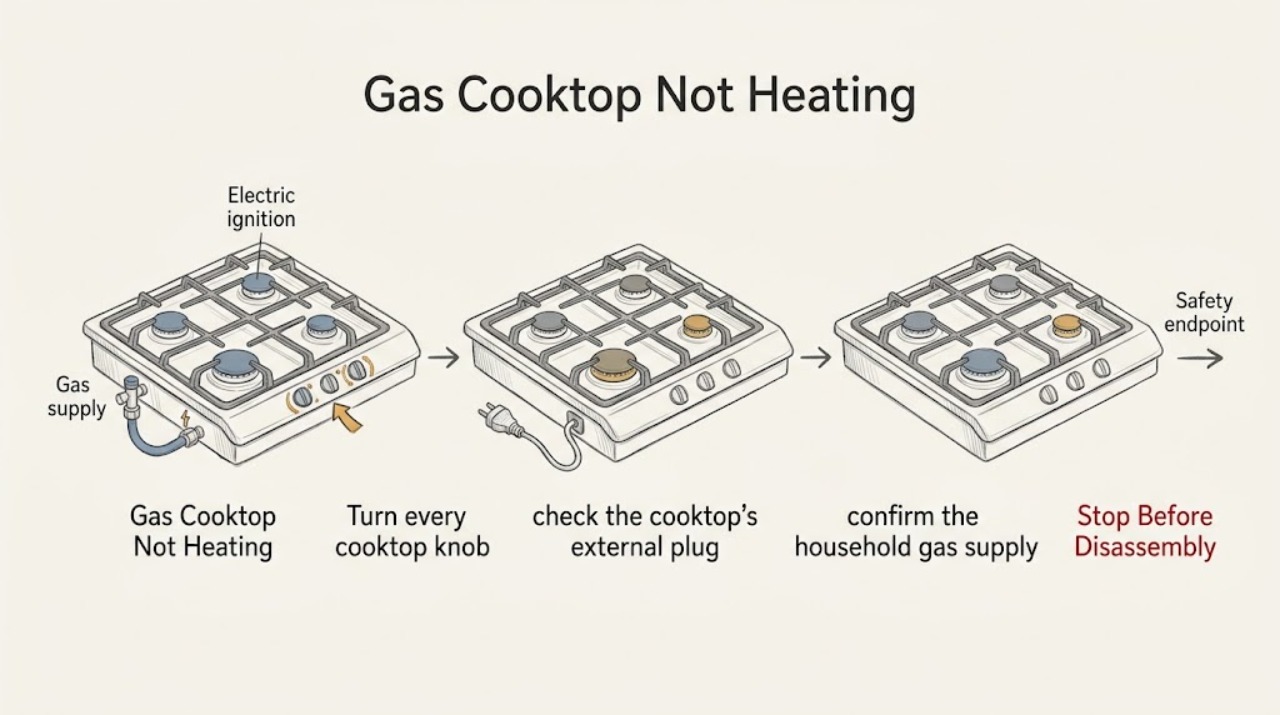
A Viking gas cooktop that is not heating may have no spark, no gas reaching the burner, a wet or dirty igniter, a cap or burner head that is misaligned, blocked ports, an unsuitable gas setup, or a flame that is too weak for the cookware. First turn every control off and stop if you smell unburned gas, hear delayed ignition or popping, see a yellow or unstable flame, or the igniters keep sparking after ignition. When the surface is cool, check the external power and gas-supply status, dry and correctly seat the accessible burner cap and head, and use the exact Viking manual for cleaning. Never match-light as a routine workaround, adjust gas or air hardware, or continue using an abnormal flame.
Work through in order
Diagnostic checks
Use only checks that match the exact appliance or system and its official guide.
-
Check 1
Turn every Viking cooktop knob to Off and inspect from a safe position for gas odor, smoke, a bang, flame outside the burner area, or igniters that keep clicking after a flame is present.
Expected result: There is no abnormal odor or flame, or a gas-safety or continuous-sparking symptom is present.
Next step: If any hazard is present, do not relight or touch switches; leave the area and follow the local gas-emergency procedure. Otherwise continue with the external checks.
Why this matters
Why: A normal off state allows low-risk observation. Odor, delayed ignition, abnormal flame or continued sparking creates an immediate stop boundary.
-
Check 2
With all controls off, check the cooktop's external plug or circuit status only from a dry position; do not open the junction box or appliance panels.
Expected result: The circuit is tripped or power appears normal, and the igniter clicks when one burner is turned on briefly in a safe, odor-free test.
Next step: Restore a clearly tripped household device once only when there is no hazard. If it trips again or the igniters remain silent, stop and arrange service.
Why this matters
Why: Viking identifies a tripped circuit, blown fuse or missing power as causes of non-working igniters. Clicking indicates that ignition power is present, not that the gas path is healthy.
-
Check 3
If the igniter clicks but no burner lights, confirm the household gas supply valve is open and that the supply has not been interrupted, without loosening any gas connection or repeating ignition attempts.
Expected result: The external gas supply is on and other gas appliances behave normally, or the supply is off or abnormal.
Next step: If the supply is abnormal or there is any gas odor, stop and contact the gas supplier from a safe location. If supply is normal, turn the control Off and inspect only the cool burner assembly.
Why this matters
Why: Viking lists an Off or interrupted gas supply as a cause of clicking without flame. A supply problem affecting multiple appliances is not a cooktop burner adjustment issue.
-
Check 4
After the burner is completely cool and all controls are Off, lift only the accessible burner cap and head as the Viking manual permits; dry them thoroughly and reseat the head tabs and cap level with the igniter clear.
Expected result: The cap or head was wet, tilted, or not seated over the base, or the assembly was dry and correctly aligned.
Next step: Make one brief normal ignition attempt only after the parts are dry and the area is odor-free. Stop immediately for delayed ignition, abnormal flame or repeated clicking.
Why this matters
Why: Moisture and misalignment can interrupt ignition or distribute gas unevenly. A correctly seated dry assembly with no improvement points beyond simple assembly.
-
Check 5
With the burner cool and removed parts dry, check the visible burner ports for spill residue or blockage and clean only with the non-damaging method in the exact Viking manual; never enlarge, distort or probe into the gas path.
Expected result: Residue or blocked visible ports are present, or the ports appear clear.
Next step: Reassemble the burner exactly as documented and test once from a safe position. If the flame remains abnormal, turn it Off and arrange service.
Why this matters
Why: Viking links clogged ports to a large, distorted or yellow flame. Clear visible residue may explain uneven heating; clear ports with an abnormal flame require service diagnosis.
-
Check 6
Compare the affected burner with another burner only through normal controls and a safe visual observation; note whether the flame is absent, weak, uneven, large, lifting, yellow, or blue and stable.
Expected result: Only one burner is affected, every burner is affected, or the flame is yellow, unstable or produces unusual noise.
Next step: For an abnormal flame or popping, turn the control Off, shut the gas supply if the manual provides an accessible shutoff, leave the unit unused and contact qualified service. Do not adjust air shutters or gas pressure.
Why this matters
Why: A single-burner difference supports a local cap, port or igniter branch. An all-burner symptom supports supply or installation diagnosis. Yellow, lifting, noisy or unstable flame is not a heat-setting problem.
-
Check 7
Place a flat, stable pan centered over the correct burner and keep the flame within the pan base; compare heating only after the flame is blue and stable, without using an oversized or warped pan.
Expected result: The pan heats normally, the flame extends around the sides, or a normal flame still gives little heat.
Next step: Use suitable cookware and reduce an excessive flame. If a stable blue flame still cannot heat normally, stop using the burner and arrange service rather than raising gas settings.
Why this matters
Why: Viking notes that cookware condition and flame coverage affect cooking performance. A normal flame with poor cookware performance does not identify a gas fault; a flame that extends beyond the pan is unsafe and wasteful.
-
Check 8
After one safe reassembly and ignition attempt, record the model, serial number, affected burner, click behavior, flame appearance, gas odor, recent spill or cleaning and whether other burners work.
Expected result: The burner now heats normally, or the no-heat or abnormal-flame symptom remains.
Next step: Leave the cooktop Off and arrange authorized Viking service for a persistent fault, continuous sparking, abnormal flame, repeated interruption or any need to open gas or electrical components.
Why this matters
Why: A successful dry, correctly seated assembly points to a temporary maintenance issue. A persistent or recurring symptom needs model-specific diagnosis of ignition, gas delivery or burner components.
Use your observations
Decision map
Find the observation that best matches what you see, then follow the next safe action.
-
PATH 01Safety boundary
What you see
There is unburned-gas odor, a delayed pop, smoke, flame outside the burner or continuous sparking after ignition.
Do this next
Turn controls Off, do not touch switches or use a flame, leave the area and follow the local gas-emergency procedure; keep the cooktop out of service.
Why this path and its safety boundary
Safety stop: Continue with the dry external power and gas-supply checks.
-
PATH 02Safety boundary
What you see
The igniter does not click on the affected burner.
Do this next
Check only the external circuit from a dry position; stop for a repeat trip or wet control area and arrange service.
Why this path and its safety boundary
Safety stop: The ignition circuit is producing a click; follow the no-flame and gas-supply branch.
-
PATH 03Safety boundary
What you see
The igniter clicks but no flame appears.
Do this next
Check the external gas supply status without loosening fittings; stop for gas odor or an interrupted supply.
Why this path and its safety boundary
Safety stop: Continue with the cool, dry burner-cap and head check.
-
PATH 04Safety boundary
What you see
The burner cap or head is wet, tilted or not seated correctly.
Do this next
Let accessible parts dry completely and reseat them exactly as the manual shows; do not force the assembly.
Why this path and its safety boundary
Safety stop: Continue to visible port and flame-pattern checks.
-
PATH 05Safety boundary
What you see
Only one burner has weak, uneven, large or yellow flame.
Do this next
Treat it as a local cap, head or port issue first; stop and arrange service if the abnormal flame remains.
Why this path and its safety boundary
Safety stop: If every burner is affected, stop and have supply or installation diagnosed.
-
PATH 06Safety boundary
What you see
All burners are weak or fail to heat while the igniters behave normally.
Do this next
Stop repeated tests and arrange qualified diagnosis of gas supply, gas type or installation; do not adjust pressure or air hardware.
Why this path and its safety boundary
Safety stop: Continue with the cookware and single-burner comparison.
-
PATH 07Safety boundary
What you see
The flame is blue and stable but the pan heats poorly.
Do this next
Check pan flatness, size, centering and flame coverage; do not increase the flame beyond the pan base.
Why this path and its safety boundary
Safety stop: For abnormal flame or no heat, leave the burner Off and arrange service.
-
PATH 08Safety boundary
What you see
The symptom remains after one safe cool reassembly and normal test.
Do this next
Record the model and serial information and arrange authorized Viking service; do not open gas or electrical components.
Why this path and its safety boundary
Safety stop: Resume use only while the flame stays blue, stable and within the cookware base.
Helpful context
Understand the symptom
Make the gas-safety decision first
Turn all cooktop knobs to Off and keep the area clear. An unburned-gas odor, a delayed pop, a flame that lifts or rolls out, yellow flame with odor, smoke, scorching, or continuous sparking after ignition is not a normal heat setting. Do not touch electrical switches or use a flame to check for leaks; leave the area and use the local gas-emergency procedure. A damp or recently cleaned cooktop should remain off until accessible parts are cool and completely dry.
No heat has several different meanings
No clicking usually points to the electrical ignition path or a wet control area. Clicking without a flame points toward gas supply or burner assembly. A flame on one burner that is weak or uneven points toward that burner cap, head or ports; the same symptom on every burner raises a supply or gas-type question. A normal blue flame that does not heat a large pan efficiently can be a cookware or flame-size mismatch rather than a failed burner.
Stay within the user-safe boundary
Use only cool, accessible parts and the exact Viking manual. Do not enlarge burner ports, remove a gas valve, adjust air shutters or pressure, open the manifold, bypass ignition, or continue a test when a flame is abnormal. If the issue remains after the low-risk checks, record the model and serial details and arrange authorized service.
Only after diagnosis
Potential parts
- burner cap or burner head
Only consider this class if the accessible part is cracked, distorted or cannot be seated correctly after the cooktop is cool and clean.
Confirm the complete Viking model and manufacturer fit information; a cap or head does not resolve an unsafe gas-supply or air-mixture fault. - electric spark igniter
Only consider this class if qualified diagnosis confirms no spark or a failed igniter after the external power and dry assembly checks.
Confirm the exact model and leave electrical and gas-side replacement to authorized service. - gas burner valve or regulator component
Only consider this class after qualified diagnosis links persistent no flame or low heat to the gas-control or supply component.
Confirm model-specific gas configuration and have gas-path work performed by qualified service; do not adjust it from the symptom alone.
When checks do not resolve it
Need a professional?
Arrange authorized Viking service when an igniter remains silent, a burner clicks without lighting, a flame stays weak, uneven, large, yellow, lifting or unstable after the cool assembly and visible-port checks, every burner is affected, the circuit trips again, or the cooktop needs gas, air, pressure, valve or electrical-panel work. Stop immediately for gas odor, delayed ignition, a bang, flame outside the burner, smoke, fire, continuous sparking after ignition, a damaged cord or any abnormal gas behavior. Do not use an open flame to check for leaks, match-light as a routine workaround, enlarge burner ports or continue testing an unsafe burner.
Common questions
FAQ
Why is my Viking gas cooktop not heating?
Check whether the igniter clicks, whether gas reaches the burner, and whether the cool burner cap and head are dry and correctly seated. Weak, yellow, delayed or unstable flames are stop conditions, not normal heat settings.
What does clicking but no flame mean?
Viking lists an Off or interrupted gas supply as a possible cause. Check only the external supply status without loosening connections, and stop immediately for gas odor.
Why is one Viking burner weak or uneven?
A wet or misaligned cap or head, residue in visible ports, or a local igniter issue can affect one burner. Clean and reseat accessible cool parts only as the manual describes; persistent abnormal flame needs service.
What should a normal Viking gas flame look like?
It should be blue and stable, without lifting or blowing away, and should stay within the bottom of the cookware. Yellow, large, distorted or unstable flame requires stopping the burner.
Can I use a match if the Viking igniter does not work?
Do not use match-lighting as a routine workaround. A failed igniter or electrical fault needs diagnosis, and any gas odor or delayed ignition requires immediate shutdown and a safe gas response.
Could the pan be why the cooktop is not heating well?
Yes, a warped, oversized or poorly centered pan can reduce cooking performance even with a normal flame. Use stable cookware and keep the flame within its base; do not raise an abnormal flame.
When should I stop using a Viking gas cooktop?
Stop for gas odor, delayed ignition, popping, yellow or unstable flame, continuous sparking, smoke, a repeat circuit trip or any need to adjust gas, air, pressure, valves or internal wiring.
Read the exact guide
Official sources
- F21262F EN:Layout 1.qxdViking Range, LLC · Viking professional built-in gas cooktop ignition, flame, burner assembly, cleaning and troubleshooting guidance
- Viking Range, LLC | Support and Docs | DocumentationViking Range, LLC · Viking product documentation and model-specific gas cooktop manuals
- Viking Range, LLC | 30"W. Gas CooktopViking Range, LLC · Viking gas cooktop product features, gas type and model documentation links
Community feedback
Share a repair observation
Share a plain-text repair observation. Accepted observations are published automatically; this page may take a moment to update.