
On this page
Start here
Quick answer
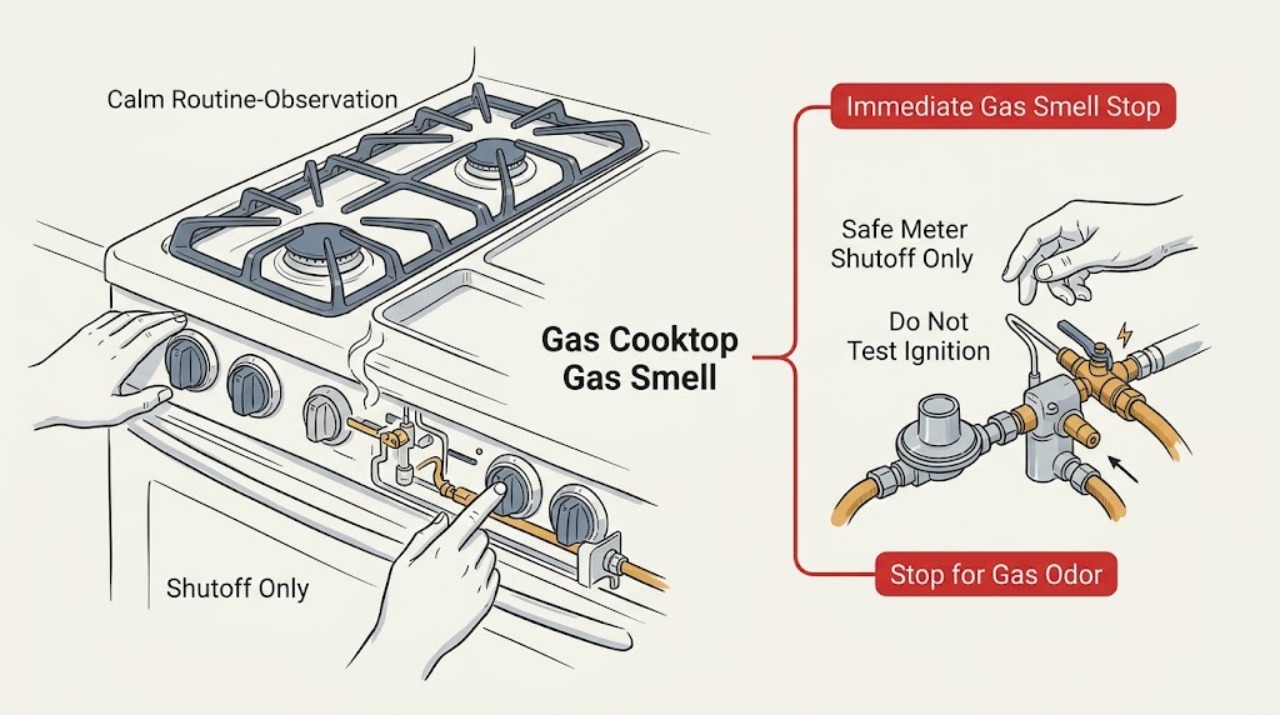
If you smell gas near a Viking gas cooktop, do not light a burner, operate electrical switches or appliances, use a flame, or try to find the leak. If the gas shutoff at the meter is known and safely reachable without passing through the odor or hazard, close it; otherwise leave it alone. Leave the building and contact the local gas emergency service from outside or another safe location. Do not re-enter or use the cooktop until the gas authority or a qualified gas professional says it is safe. Viking's gas-cooktop manual gives the same immediate boundary and reserves installation and service for qualified personnel; HSE says a suspected unsafe gas appliance must not be used until checked by a Gas Safe registered engineer where that scheme applies.
Work through in order
Diagnostic checks
Use only checks that match the exact appliance or system and its official guide.
-
Check 1
Do not light the Viking cooktop or any other appliance, operate electrical switches or appliances, smoke, use a flame, or use a phone inside the building; move people and pets away from the area and leave by a safe route.
Expected result: The gas odor is present, intensifies, is accompanied by hissing, or anyone feels unwell; alternatively, the odor is not currently noticeable but was recently detected.
Next step: Once outside or in another safe location, contact the local gas emergency service and follow its instructions. Do not return to operate or test the cooktop until professionals declare it safe.
Stop if: Stop all troubleshooting and leave; seek gas-emergency assistance from outside.
Why this matters
Why: A suspected gas release can ignite or create an unsafe atmosphere. The absence of odor at a later moment does not establish that the cooktop or installation is safe.
-
Check 2
Only if the meter's gas shutoff location is known and reachable without entering the odor or danger, close it as instructed by the local gas emergency service; otherwise do not approach the meter and do not touch any appliance control.
Expected result: The shutoff can be reached safely without passing through the suspected gas area, or reaching it would require entering the building or a strong-odor area.
Next step: If it is not clearly safe, leave the gas shutoff alone. From outside, contact the local gas emergency service; do not reopen the supply or use the cooktop until authorized.
Stop if: Stop and leave the area if safe access is not certain.
Why this matters
Why: A meter shutoff can isolate supply when safely accessible, but entering a suspected gas atmosphere or operating controls can create additional risk. The local emergency service's instructions take priority.
-
Check 3
Do not retry ignition, turn a burner on to identify the source, use an open flame to check for a leak, spray a substance onto fittings, remove burner parts, or open the cooktop.
Expected result: The odor seems to be near one burner, appears only after an ignition attempt, fades after ventilation, or its source cannot be located without handling the appliance.
Next step: Keep the cooktop out of use and give the gas emergency service or qualified technician the timing and location information from a safe distance. Do not re-enter just to repeat the symptom.
Stop if: Stop; no user leak-finding or ignition test is appropriate.
Why this matters
Why: The apparent location or timing does not establish that the cooktop is safe. Ignition and gas-path checks can release or ignite gas and require qualified personnel.
-
Check 4
After the gas authority or qualified gas professional makes the area safe, provide the exact Viking model and serial information, whether a burner was operating, whether the igniter clicked, when the odor began, and any hissing, flame, soot, alarm, or illness observations; do not open the appliance to collect more evidence.
Expected result: The professional identifies an appliance fault, an installation or supply issue, another source, or no active leak but requires further inspection.
Next step: Follow the professional's written or direct instruction. Keep the cooktop isolated if any defect remains, and use a qualified or Gas Safe registered gas professional for the applicable work.
Why this matters
Why: Viking's gas cooktop uses automatic ignition and gas valves, and the correct repair path depends on the model and professional findings. A cleared odor is not proof that an internal component is safe to use.
-
Check 5
Stop and leave immediately if a carbon-monoxide alarm sounds, anyone has headache, dizziness, nausea, confusion, breathing difficulty, or loss of consciousness, or the cooktop shows an abnormal flame, soot, smoke, or fire.
Expected result: An alarm, illness symptom, abnormal combustion sign, smoke, or fire is present.
Next step: Leave the building and call the appropriate emergency service from outside. Do not re-enter, operate switches, or use the cooktop until authorities or qualified professionals say it is safe.
Stop if: Stop and seek emergency assistance from outside.
Why this matters
Why: These signs may indicate combustion products or a fire in addition to an unburned-gas concern. They require emergency assistance, not appliance troubleshooting.
Use your observations
Decision map
Find the observation that best matches what you see, then follow the next safe action.
-
PATH 01Next step
What you see
Gas odor is present, intensifies, or is accompanied by hissing.
Do this next
Do not operate anything that can create a spark, leave by a safe route, and contact the local gas emergency service from outside. Do not return to test the Viking cooktop.
-
PATH 02Next step
What you see
The gas meter shutoff is known and can be reached without entering the suspected gas area.
Do this next
Close it only as directed by the local gas emergency service, then remain outside. If access is not clearly safe, leave it alone.
-
PATH 03Next step
What you see
The smell was noticed after a failed or delayed ignition, or near a burner that did not establish a flame promptly.
Do this next
Turn no control back on, do not retry ignition or inspect the burner, and have the gas authority or qualified gas professional assess it before use.
-
PATH 04Next step
What you see
The odor has faded but no qualified professional has cleared the appliance and installation.
Do this next
Keep the Viking cooktop out of use and arrange gas-safety inspection. A fading odor is not a safe-to-use finding.
-
PATH 05Next step
What you see
A carbon-monoxide alarm, illness symptom, abnormal flame, soot, smoke, or fire occurs.
Do this next
Leave immediately and call emergency services from outside. Do not re-enter or operate electrical or gas controls until authorities say it is safe.
Helpful context
Understand the symptom
Treat the smell as a gas emergency first
A gas smell is not a burner-adjustment or ignition-testing problem. Do not try to light any appliance, touch electrical switches, use a phone inside the building, smoke, or create a flame. If it can be done without entering the hazardous area, close the gas supply at the meter control; then leave. Contact the local gas emergency service from outside and follow its instructions.
Do not return for a diagnostic test
A smell that fades does not prove that the cooktop is safe. Do not relight a burner, check a connection with a flame, spray a leak-finding solution, remove a burner, or cycle the igniters to reproduce the odor. Viking states that gas installation and service must be performed by qualified personnel; HSE directs users not to touch a suspected unsafe appliance until it has been checked by a Gas Safe registered engineer where applicable.
Separate a confirmed appliance odor from a wider gas event only after professionals make the area safe
Once the emergency service or qualified professional has declared the area safe, report where the smell was noticed, whether a burner had been used, whether ignition clicked without a flame, whether the odor came from the cooktop or another appliance, and whether a carbon-monoxide alarm or symptoms occurred. Do not infer the failed part from the location of the smell. Viking gas cooktops use gas valves and automatic electric ignition, so internal diagnosis remains professional work.
Document the model without handling the appliance
From a safe location, or after the professional says it is safe, provide the cooktop model and serial information, fuel type, installation location, timing of the smell, control position if known, whether the smell occurred before or after ignition, and any visible damage or service history. This information helps the gas professional choose the correct inspection path without asking you to open the cooktop or test the gas path.
When checks do not resolve it
Need a professional?
For any suspected gas odor, contact the local gas emergency service first. After the immediate hazard is controlled, arrange an authorized Viking servicer or qualified gas professional for the cooktop and installation. In jurisdictions using the Gas Safe Register, domestic gas work must be performed by a suitably registered engineer.
Common questions
FAQ
What should I do first if my Viking gas cooktop smells like gas?
Do not light a burner, operate electrical switches, use a flame, smoke, or use a phone inside. Leave by a safe route and contact the local gas emergency service from outside. If the meter shutoff is known and safely reachable without entering the odor, close it only as directed; otherwise leave it alone.
Can I relight a Viking burner to find out where the gas smell is coming from?
No. Do not retry ignition or use a flame or spray to find a leak. A qualified gas professional or emergency service must make the area safe and assess the cooktop and installation before it is used again.
Is a brief gas smell after a Viking burner lights normal?
Do not make that judgment by testing the burner. If gas is smelled, treat it as a safety event, leave, and obtain professional direction. Viking's manual says not to use an appliance when gas is suspected until the gas supplier or qualified service personnel have assessed it.
Who should repair a Viking gas cooktop after a gas smell?
Contact the local gas emergency service first when an odor is present. After the immediate hazard is controlled, use an authorized Viking servicer or qualified gas professional; where applicable, domestic gas work must be done by a Gas Safe registered engineer.
What information should I give the gas professional?
Provide the exact Viking model and serial information, gas type if known, where and when the smell was noticed, whether a burner or igniter was active, whether a flame appeared, and any hissing, soot, smoke, alarm, illness, or fire. Do not open the cooktop to gather more evidence.
Read the exact guide
Official sources
- Viking Range, LLC | Support and Docs | DocumentationViking Range, LLC · Viking model-specific cooktop manuals and installation documentation
- Gas safety - Home ownersHealth and Safety Executive · Domestic gas-appliance safety, suspected gas leaks, unsafe-appliance isolation, and Gas Safe registered engineer boundaries
- Viking Range, LLC | 30"W. Gas CooktopViking Range, LLC · Viking gas cooktop automatic electric spark ignition, automatic reignition, and sealed-burner product features
- Viking Use & Care Manual: Designer DGVU Built-In Gas CooktopsViking Range Corporation · Viking built-in gas cooktop gas-smell emergency instructions, automatic ignition, gas-safety warnings, and qualified-service boundaries
Community feedback
Share a repair observation
Share a plain-text repair observation. Accepted observations are published automatically; this page may take a moment to update.