
On this page
Start here
Quick answer
Break a Viking gas-cooktop failure into four observations: no power or no clicking, clicking with no flame, one burner failing while others work, or a flame that is abnormal or will not stay lit. Viking gas cooktops use electric spark ignition, so a full-cooktop failure can involve the accessible supply, breaker, grounding, or shared ignition system, while a single-burner failure can involve the cap, ports, electrode, or valve path. If you smell gas, hear hissing, see smoke or sparks, have delayed ignition, or cannot turn a burner off, stop immediately, leave the area when needed, and use the appropriate gas, fire, or electrical emergency procedure. For a dry cooktop with no hazard, check power, the known accessible gas shutoff, dry burner parts, and correct cap seating; persistent faults need qualified Viking service.
Work through in order
Diagnostic checks
Use only checks that match the exact appliance or system and its official guide.
-
Check 1
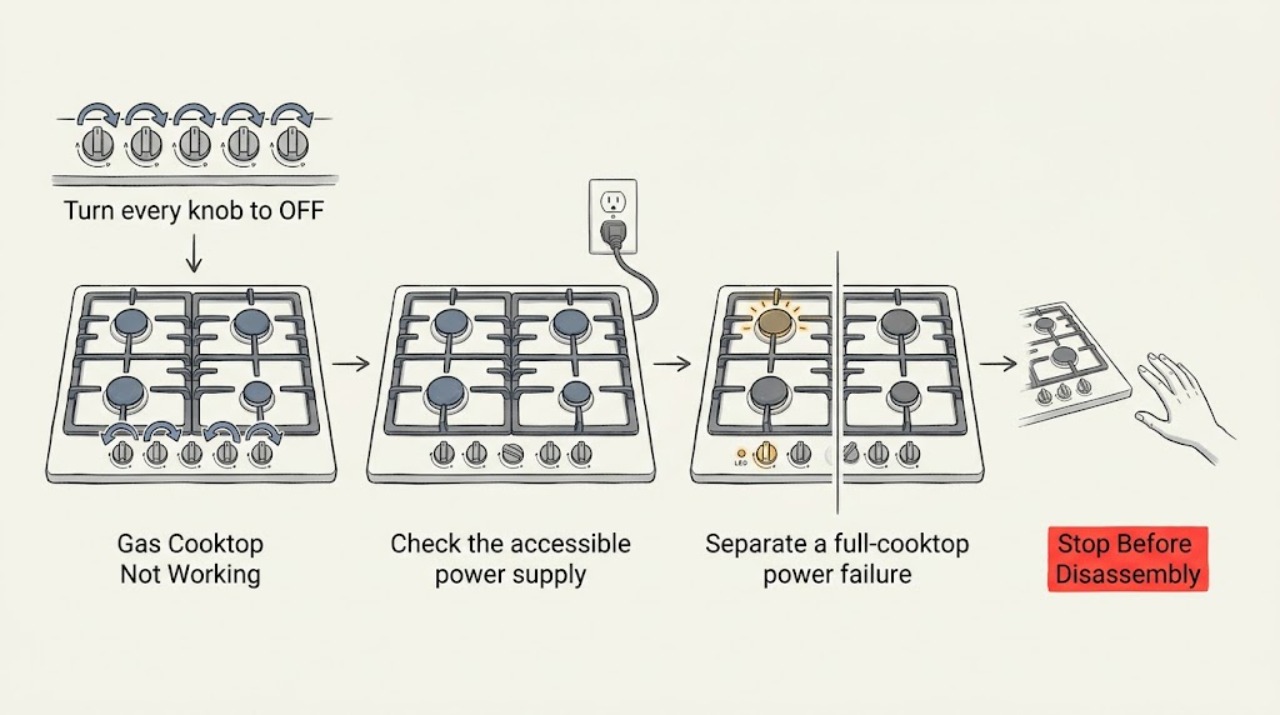
Turn every knob to OFF and screen for immediate gas, fire, and electrical hazards.
Expected result: Check from a safe position for gas odor, hissing, flame that continues after OFF, smoke, sparks, burning smell, melted or scorched parts, or water around electrical controls.
Next step: If gas is smelled, do not try to light the appliance, touch electrical switches, or use a phone in the building. Leave and contact the gas supplier or emergency service from a safe location. For smoke, flame, or electrical danger, use the local emergency procedure and do not return to retry the cooktop.
Why this matters
Why: Unburned gas, uncontrolled flame, or electrical heat damage can cause fire, explosion, or shock. Those conditions make further ignition checks unsafe.
-
Check 2
Separate a full-cooktop power failure from an individual burner failure.
Expected result: With no gas odor and all knobs OFF between observations, note whether any burner clicks or sparks, whether the control area responds, and whether one burner or every burner is affected.
Next step: Record the affected burners and exact sequence. Do not keep turning multiple knobs to compare them if gas may have accumulated or any flame is abnormal; use the single-burner or full-cooktop branch.
Why this matters
Why: No response on every burner keeps the accessible power, circuit, grounding, ignition switches, and shared spark system in view. One affected burner points toward its electrode, cap, ports, or valve path.
-
Check 3
Check the accessible power supply only when the cooktop is dry and no gas or burning odor is present.
Expected result: Look for a tripped breaker, blown fuse, switched outlet, or disconnected accessible plug. Inspect only the outside of the cord, outlet, and controls for scorching or damage; do not remove covers or touch terminals.
Next step: Restore an accessible breaker or switch only once according to its normal instructions and only from a dry safe location. If it trips again or the cooktop remains silent, leave it isolated and call a licensed electrician or qualified Viking servicer. Do not change the fuse rating or bypass protection.
Why this matters
Why: Viking lists a tripped circuit, blown fuse, or missing power as causes of igniters that will not work. A repeated trip, damaged outlet, or uncertain grounding needs electrical diagnosis.
-
Check 4
For a spark with no flame, check only the known accessible gas supply and knob operation.
Expected result: Confirm the control knob is being pushed and turned in the normal direction described by the exact manual. If you know the location and can reach it without disturbing a fitting, note whether the accessible gas shutoff is open. Note whether all burners lack flame or only one.
Next step: Return the knob to OFF and allow any unburned gas to clear before another check. Do not loosen fittings, purge a line, adjust pressure, or use a hand lighter. If supply is uncertain or the burner still will not light, arrange qualified gas-appliance service.
Why this matters
Why: Viking lists an OFF gas-supply valve or interrupted gas supply when igniters spark but no flame appears. All burners affected suggests a shared supply issue; one burner suggests its cap, ports, or valve path.
-
Check 5
With power isolated and the cooktop cool, dry and correctly reseat the affected burner assembly.
Expected result: Remove only the burner cap and other parts that the exact manual identifies as removable. Look for moisture or food residue around the electrode and ports, allow parts to dry fully, and place the cap squarely on the burner before replacing the grate.
Next step: Clean only with the manual-approved method. Do not bend the electrode, enlarge a port, scrape with metal, or leave parts wet. If the burner still has no spark, no flame, continuous clicking, or an abnormal flame, stop and arrange service.
Why this matters
Why: Viking identifies wet or dirty igniters as a cause of continued sparking and clogged ports as a cause of a large, distorted, or yellow flame. An off-center cap can prevent the spark from meeting the gas correctly.
-
Check 6
Document the remaining symptom and arrange model-specific service rather than testing internal parts.
Expected result: Record whether the fault is no spark on all burners, no spark on one, spark without flame, a flame that goes out, continuous clicking after ignition, a knob that will not depress or turn, or a large, yellow, or distorted flame.
Next step: Keep the cooktop off and contact an authorized Viking servicer or qualified gas-appliance technician. Provide the model, serial number, fuel type, affected burner, power and gas observations, and any recent spill, outage, installation, or service history.
Why this matters
Why: The pattern can involve a shared spark module, individual igniter or switch, grounding or polarity, a gas valve, supply pressure, air adjustment, or internal wiring. Timing and appearance narrow the diagnosis but do not identify a safe part for the owner.
Use your observations
Decision map
Find the observation that best matches what you see, then follow the next safe action.
-
PATH 01Safety boundary
What you see
Every burner is silent with no clicking or spark.
Do this next
Check the accessible power connection and whether the circuit or fuse has tripped, without opening the cooktop.
Why this path and its safety boundary
Safety stop: If the cooktop remains silent, arrange service for the power or shared ignition system.
-
PATH 02Safety boundary
What you see
Only one burner does not spark or light while other burners work.
Do this next
With power isolated and the burner cool, dry and reseat its cap and clean accessible ports as the manual permits.
Why this path and its safety boundary
Safety stop: If the burner remains dead, arrange service for the individual electrode, switch, valve, or gas path; do not swap internal parts.
-
PATH 03Safety boundary
What you see
The igniters spark but no burner produces a flame.
Do this next
Turn the knob OFF, allow gas to clear, and check only the known accessible gas shutoff if it can be done safely.
Why this path and its safety boundary
Safety stop: If all burners still click without flame, do not keep turning the gas on or loosen any fitting; arrange service.
-
PATH 04Safety boundary
What you see
A burner lights but the flame is large, yellow, distorted, unstable, or repeatedly goes out.
Do this next
Turn the burner OFF and do not cook on it while the flame is abnormal.
Why this path and its safety boundary
Safety stop: If the flame is stable and normal after an approved dry-and-reseat check, monitor it for recurrence.
-
PATH 05Safety boundary
What you see
The igniter keeps clicking after a flame is established, or ignition is delayed.
Do this next
Turn the burner OFF and stop cooking until the area is cool and the ignition parts are dry.
Why this path and its safety boundary
Safety stop: If the clicking stops and ignition is immediate after a safe external correction, monitor closely and follow the model manual.
-
PATH 06Safety boundary
What you see
There is gas odor, hissing, smoke, sparks, burning smell, heat damage, a breaker trip, or a knob that cannot shut off gas.
Do this next
Stop immediately and do not attempt another ignition or power reset.
Why this path and its safety boundary
Safety stop: Continue only with the low-risk external checks and exact model manual.
Helpful context
Understand the symptom
A cooktop that is “not working” may still have power, gas, or only one failed burner. The quickest safe split is whether there is any response, whether a spark is present, whether gas reaches the burner, and whether the flame is stable and normal. Do not treat a failed ignition as a reason to keep turning the gas on while testing.
Viking's manual says installation, gas conversion, and other servicing belong to qualified personnel. Owner checks should stay outside the appliance: knobs, accessible power, known shutoff position, dry removable caps, and visible burner ports. Do not open the cooktop, adjust air shutters, alter polarity, test live wiring, or bypass ignition protection.
Safety boundary
Stop conditions
- If gas is smelled, do not try to light the appliance, touch electrical switches, or use a phone in the building; leave and follow gas-supplier or emergency instructions from a safe location.
- Stop for hissing, uncontrolled flame, smoke, sparks, burning odor, melted or scorched parts, a damaged cord, water in electrical areas, delayed ignition, or a knob that will not turn gas off.
- Do not repeatedly turn a gas knob after a failed ignition, use a hand lighter as a workaround, purge or loosen fittings, adjust air shutters or fuel conversion parts, or bypass flame or ignition protection.
- Do not open the cooktop, test live wiring, alter grounding or polarity, change a fuse rating, or replace an ignition or gas component without qualified service.
Only after diagnosis
Potential parts
- spark electrode or igniter assembly
Consider only when qualified service confirms a persistent single-burner spark or ignition fault after power, dryness, cap placement, and port checks.
Verify the exact Viking model, burner position, and fuel configuration before selecting a component. - spark module or ignition-switch assembly
Consider only when several or all burners have no spark and service confirms a shared ignition or switch fault.
Do not infer a module or switch failure from silence alone; internal electrical work belongs to qualified service. - burner cap, burner head, or gas-valve assembly
Consider only when service confirms a damaged cap, blocked head, or valve fault after the external cleaning and seating checks.
Fuel type, burner position, and exact model determine fit; never enlarge ports or adjust a gas valve as a user repair.
When checks do not resolve it
Need a professional?
Call a licensed electrician when the cooktop has no power, the breaker or fuse trips again, the outlet or cord is damaged, or grounding is uncertain., Call an authorized Viking servicer or qualified gas-appliance technician when a burner has no spark, a burner will not light, clicking continues, the knob or valve behaves abnormally, or the flame is not stable and normal., Use the gas or fire emergency path for gas odor, hissing, uncontrolled flame, smoke, sparking, delayed ignition, or heat damage; do not reconnect or relight the cooktop while waiting.
Have this ready
- The exact Viking model and serial number, if safely visible
- Natural gas or propane fuel type and whether the unit is a cooktop or rangetop
- Whether all burners or one burner is affected, and whether there is no spark, spark without flame, continuous clicking, delayed ignition, or abnormal flame
- Power, breaker, gas-supply, moisture, cap placement, installation, and prior service observations
Common questions
FAQ
Why is my Viking gas cooktop completely silent?
If every burner has no clicking or spark, check the accessible power supply and whether the breaker or fuse has tripped, only when the cooktop is dry and there is no gas or burning odor. If it remains silent or trips again, keep it isolated and arrange qualified service.
Why does my Viking cooktop spark but not light?
Viking lists an OFF or interrupted gas supply for this pattern. Turn the knob OFF, let any unburned gas clear, and check only the known accessible shutoff and dry, correctly seated cap. Do not loosen fittings or use a hand lighter.
Why does only one Viking burner fail?
A single-burner failure keeps that burner's cap, ports, electrode, switch, or valve path in view. With power isolated and the burner cool, dry and reseat the cap as the manual permits. Persistent failure needs service.
Why does my Viking burner keep clicking after it lights?
Viking lists wet or dirty igniters, grounding, and polarity among possible causes. Turn the burner OFF, let the parts dry, and use only the manual-approved cleaning method. Persistent clicking or delayed ignition needs service.
What should I do about a yellow or unstable Viking flame?
Turn the burner OFF and do not cook on it. Viking lists clogged ports, wrong fuel, or air adjustment as possibilities. Clean only as the manual permits; qualified service must handle fuel or air adjustments.
Read the exact guide
Official sources
- Use & Care Professional Built-in Gas CooktopsViking Range, LLC · Viking VGC5, CVGC5, VGSU5, and related professional built-in gas cooktops, including ignition, burner, safety, and troubleshooting guidance
- 30"W. Gas CooktopViking Range, LLC · Viking VGSU53015BSSLP gas cooktop fuel options, sealed burners, SureSpark, and automatic electric ignition
- Viking Range, LLC | Support and Docs | Support CenterViking Range, LLC · Viking product documentation, customer support, authorized service, and servicer lookup
Community feedback
Share a repair observation
Share a plain-text repair observation. Accepted observations are published automatically; this page may take a moment to update.