
On this page
Start here
Quick answer
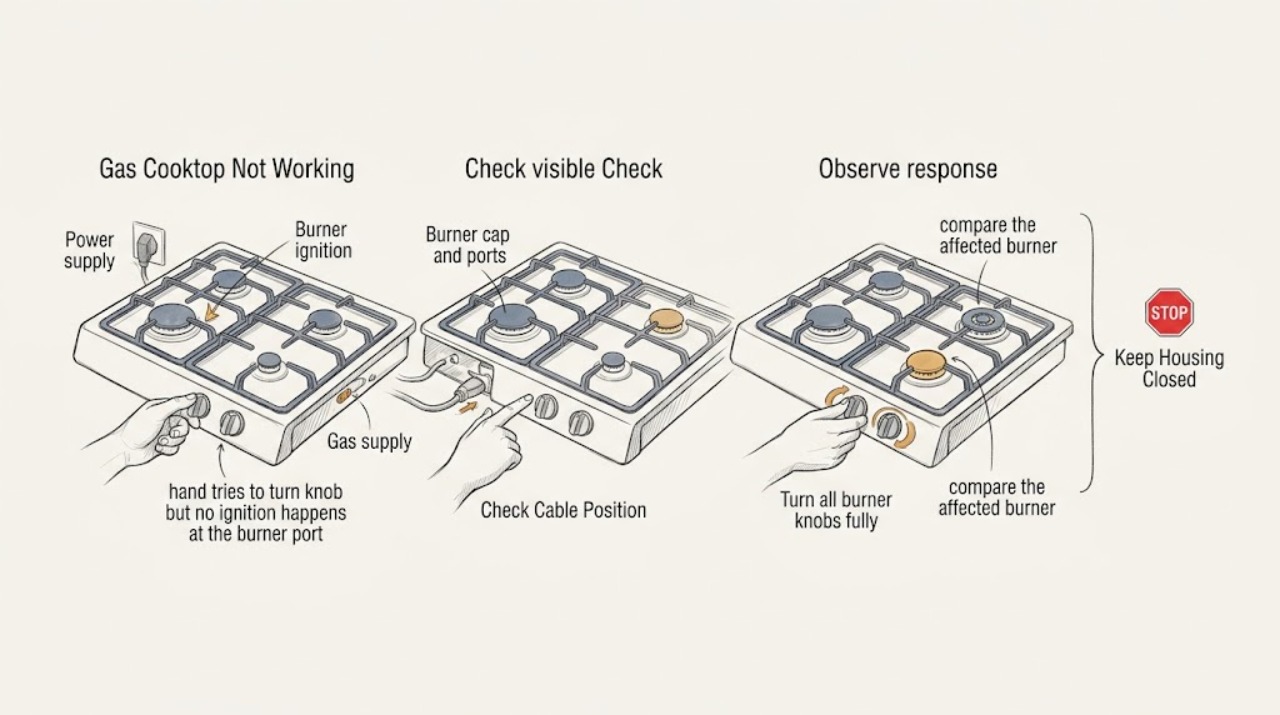
When a Thermador gas cooktop is not working, first identify whether every burner is affected or only one, and whether you have power, clicking or sparking, gas flow, and a stable flame. Check only external items: the plug or breaker, the gas shutoff, cooled and correctly seated burner caps, dry and clear igniters and ports, and drafts. A single burner with no spark points to that burner area; no spark on every burner points to power or ignition control. If there is a gas odor that does not quickly clear, continuous or delayed ignition, an abnormal or unstable flame, smoke, arcing, or a repeated breaker trip, turn the knobs off, stop using the cooktop, avoid flames and electrical switches, and obtain qualified gas-appliance service. Never dismantle the cooktop, adjust a regulator, or work on the gas path yourself.
Work through in order
Diagnostic checks
Use only checks that match the exact appliance or system and its official guide.
-
Check 1
Turn all burner knobs fully to OFF, stand clear of the burners, and check whether the problem affects every burner or only one; do not repeatedly attempt ignition while assessing the pattern.
Expected result: Every burner is silent, one burner has no spark while others work, burners click but do not light, or a flame lights and then goes out or looks abnormal.
Next step: Use the matching branch below and write down which burners, knob positions, and flame behavior were observed before any cleaning or service call.
Stop if: Stop immediately for a persistent gas odor, delayed ignition, flame rollout, smoke, arcing, or repeated breaker trips.
Why this matters
Why: A whole-cooktop symptom points first to shared power or gas supply; a single-burner symptom points to that burner cap, igniter, port, or local control. Clicking without a flame and unstable flames need separate gas and ignition checks.
-
Check 2
From a dry, safe position, verify that the cooktop's plug is seated and the applicable breaker has not tripped, and check whether the building's gas supply or appliance shutoff is intentionally closed; do not remove covers or test wiring.
Expected result: The breaker is tripped, there is no power response or no click on any burner, the gas supply is off, or power and gas appear available.
Next step: Restore a clearly and safely interrupted supply only as permitted by the home's installation. If the breaker trips again, the cord or outlet is damaged, or the supply is uncertain, stop and use a qualified electrician or gas-appliance technician.
Stop if: Do not work near wet surfaces, exposed wiring, burning odor, smoke, or arcing, and do not make live electrical measurements.
Why this matters
Why: A no-power condition can prevent ignition even when gas is available; a closed gas supply can prevent every burner from lighting. A breaker that trips again is an electrical fault, not a reason to keep resetting it.
-
Check 3
After the cooktop and grates are fully cool, compare the affected burner with a working one: confirm the burner cap is seated in its locating notches, the igniter is dry, and the visible port openings are clear; use only the gentle cleaning method in the Thermador care guidance.
Expected result: The cap is displaced, the igniter or ports are damp or soiled, or the cap, igniter, and ports look correctly positioned and dry.
Next step: Correct the cap position, wipe the cooled igniter, clear only accessible residue without gouging the ports, and allow all parts to dry. Make one controlled test; if it still fails, arrange service.
Stop if: Do not soak parts, flood the surface, use flammable cleaner, force a cap, or dismantle the burner or gas path.
Why this matters
Why: Misalignment, moisture, or residue can prevent a local burner from lighting or can cause intermittent sparking. A correctly assembled dry burner with no spark shifts suspicion to wiring, ignition control, or the gas valve.
-
Check 4
If the igniter clicks or sparks, observe from a normal standing position whether gas ignites promptly and the flame is stable and even; keep hands, face, and loose materials away and do not lean over the burner.
Expected result: There is a prompt stable flame, clicking continues after the knob is OFF, ignition is delayed, the flame goes out, or the flame is too high, uneven, or lifts from the burner.
Next step: Turn the knob OFF. For a harmless documented ExtraLow cycling behavior, follow the exact model guide; for continued clicking, delayed ignition, flame instability, or abnormal height, stop using the cooktop and arrange qualified service.
Stop if: Do not repeat an ignition attempt after delayed ignition, a whoosh, flame rollout, persistent odor, or an abnormal flame.
Why this matters
Why: A stable flame after a dry, correctly seated burner supports a local setup issue being corrected. Continuous clicking, delayed ignition, unexpected flameout, or abnormal flame pattern can indicate moisture, draft, cap alignment, regulator, or an internal fault.
-
Check 5
Check the room for a strong draft and, only after the appliance is cool, check whether the cap and grate remain seated; do not alter the supplied regulator or any gas connection.
Expected result: A draft disturbs the flame, the cap is out of alignment, or flames remain unstable or unusually high with no visible external cause.
Next step: Remove a harmless draft source and correct only visible cap alignment. If the flame remains unstable, too high, or uneven, turn the burner OFF and call a qualified gas-appliance technician.
Stop if: Never adjust gas pressure, remove the regulator, or open a gas line to correct flame height.
Why this matters
Why: Thermador identifies drafts and cap position as causes of unexpected flameouts or uneven flames; persistent abnormal flames can involve the regulator or gas system and are not a homeowner adjustment.
-
Check 6
Perform one controlled retest only after the safe external correction has dried and the burner cap is seated; if the symptom returns, stop instead of repeating ignition cycles.
Expected result: The burner now lights promptly with a stable flame, or it still does not light, keeps clicking, smells of gas, or shows an abnormal flame.
Next step: Turn the knob OFF after the test, record the exact burner and symptom, and arrange qualified service for a recurring or unresolved fault.
Stop if: For a lingering gas odor, delayed ignition, flame abnormality, smoke, sparks, or repeated breaker trip, stop immediately, avoid ignition sources, and seek emergency or qualified help.
Why this matters
Why: A corrected cap, dry igniter, cleared port, or restored supply may resolve a user-level issue. A recurring symptom indicates that cleaning or setup did not remove the fault.
Use your observations
Decision map
Find the observation that best matches what you see, then follow the next safe action.
-
PATH 01Next step
What you see
No burner clicks or sparks and every burner is affected.
Do this next
Check the accessible plug, breaker, and gas-supply state. If power or gas is available but ignition remains absent, stop and arrange qualified service for the shared ignition or control system.
-
PATH 02Next step
What you see
Only one burner fails to light while other burners work.
Do this next
After cooling, compare that burner's cap alignment, dry igniter, and visible ports with a working burner. If one controlled retest still fails, arrange service rather than changing gas parts.
-
PATH 03Next step
What you see
The igniter sparks but gas does not light promptly, or ignition is followed by a whoosh or persistent gas odor.
Do this next
Turn the knob OFF, do not try again, avoid flames and electrical switches, leave if needed, and obtain emergency or qualified gas-appliance help.
-
PATH 04Next step
What you see
The burner keeps clicking after the knob is OFF or sparks intermittently.
Do this next
Once cool, check only visible cap position, dry the igniter, clear accessible residue, and allow the surface to dry. If clicking continues, stop using the cooktop and arrange an authorized service visit.
-
PATH 05Next step
What you see
A burner lights but the flame goes out, is too high, uneven, or lifts from the burner.
Do this next
Turn it OFF and check only for a draft or visibly displaced cap after cooling. If the flame remains abnormal, do not adjust the regulator or gas path; call a qualified technician.
-
PATH 06Next step
What you see
Smoke, arcing, a burning smell, a strong or lingering gas odor, water intrusion, or repeated electrical tripping is present.
Do this next
Stop using the cooktop, avoid flames and electrical switches, and leave the area or contact emergency help when appropriate. Arrange qualified gas-appliance or electrical service; do not dismantle the appliance.
Helpful context
Understand the symptom
Start with the symptom pattern
Turn every knob fully to OFF and note what happened without repeatedly trying to light the burner. If no burner clicks or sparks, begin with power and the building's gas supply. If one burner clicks but does not light, compare its cap, igniter, and ports with a burner that works. If a flame lights but goes out, is too high, uneven, or continues sparking, treat that as a flame or ignition symptom rather than a general loss of power.
What the official checks can establish
Thermador lists a turned-off gas supply, tripped breaker, displaced burner cap, dirty or damp igniter, blocked ports, drafts, and incorrect regulator installation among possible causes. These checks can reveal an accessible setup or cleaning issue, but they cannot prove that an internal valve, wiring, ignition module, or regulator is safe to replace. Use the exact owner's manual for the model when a feature or control behavior differs.
Clean only after the cooktop is cool
Thermador's care guidance permits careful external cleaning of cooled burner caps, bases, ports, and igniters, followed by thorough drying. Do not soak caps, flood the surface, gouge ports, or keep trying to ignite while moisture is present. A damp igniter can fail to light and water can contribute to continuing sparks, so let the surface dry before one controlled test.
Stop for gas, flame, or electrical danger
A lingering gas odor, delayed ignition or whoosh, flame lifting or spreading abnormally, smoke, arcing, or repeated tripping is not a routine cleaning problem. Turn knobs OFF, shut the main gas supply only if it can be done safely from a safe location, avoid flames, switches, and other ignition sources, leave the area when necessary, and contact the appropriate emergency or qualified gas-appliance service. Never remove the cooktop or adjust a regulator or gas connection as a homeowner troubleshooting step.
Common questions
FAQ
Why does my Thermador gas cooktop not work on any burner?
Check the accessible power and gas-supply state first. If every burner remains silent or will not ignite with power and gas available, the shared ignition or control system may need qualified service; do not open the cooktop.
What can I safely check when one Thermador burner will not ignite?
After the cooktop is cool, check that the cap is correctly seated and the visible igniter and ports are dry and clear. If one controlled retest fails, arrange service rather than changing a gas component.
Is continuous clicking on a Thermador gas cooktop normal?
Some ExtraLow behavior can cycle the flame, but clicking with the knob OFF, persistent clicking after cleaning, or intermittent sparking needs attention. Check only visible cap position and dryness; if it continues, stop using the cooktop and call qualified service.
When is a Thermador gas-cooktop problem an emergency?
Treat a strong or lingering gas odor, delayed ignition, abnormal or unstable flame, smoke, arcing, or repeated electrical trips as a stop condition. Turn knobs OFF, avoid flames and electrical switches, leave when necessary, and obtain emergency or qualified gas-appliance help.
Read the exact guide
Official sources
- Gas Cooktops & Rangetops - TroubleshootingThermador · Official Thermador support guidance for gas cooktops and rangetops; apply model-specific owner-manual instructions where controls or features differ.
- Gas Cooktops & Rangetops - Cleaning & CareThermador · Official Thermador care guidance for safe external cleaning after the gas cooktop has cooled; it does not authorize internal gas or electrical repair.
Community feedback
Share a repair observation
Share a plain-text repair observation. Accepted observations are published automatically; this page may take a moment to update.