
On this page
Start here
Quick answer
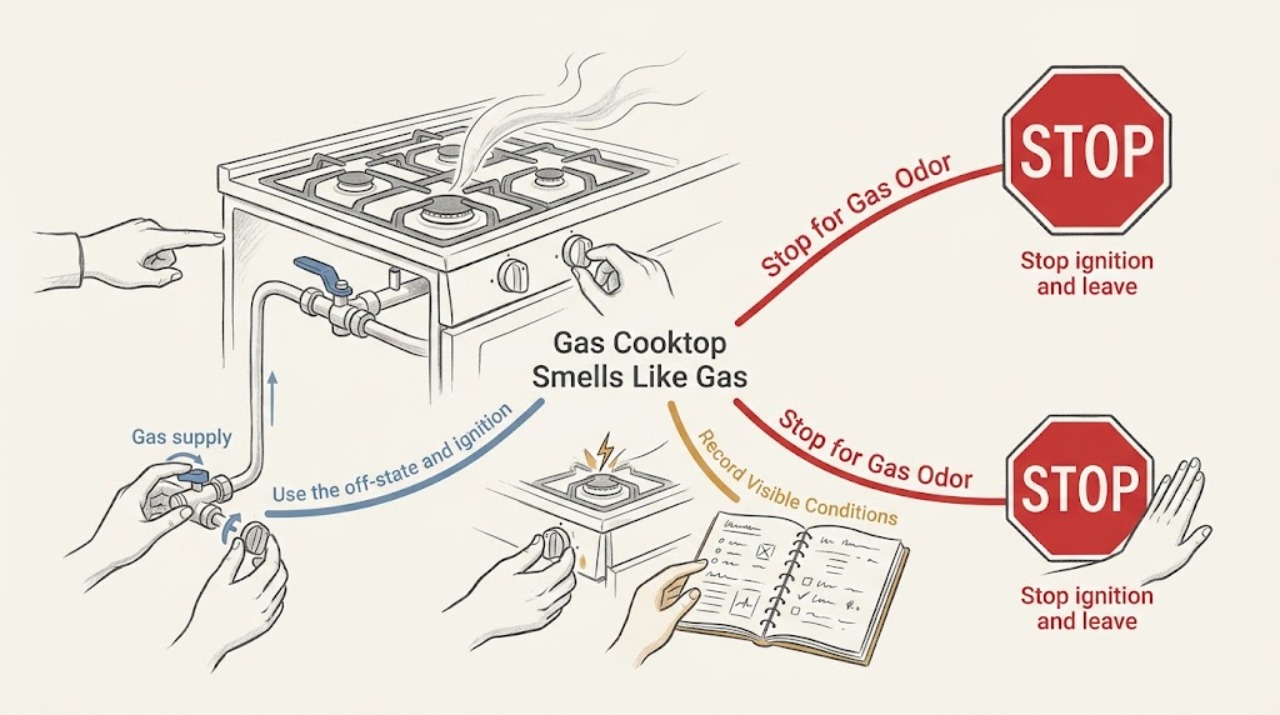
Treat a gas smell from a cooktop as a possible leak or unsafe combustion event: turn controls off only if you can do so without delay or entering danger, leave the building, and do not operate switches, phones, ignition controls, or other electrical equipment in the suspected leak area. Get gas-utility or emergency help from a safe location and do not return to troubleshoot until qualified help says it is safe. A brief odor during a confirmed normal ignition is not a reason to ignore a persistent smell, hissing, delayed ignition, abnormal flame, or an odor while the controls are off. After professional confirmation that the area and appliance are safe, record the model, fuel type, affected burner, ignition timing, flame appearance, recent cleaning or spill, and whether the smell occurs with the burner off. Do not move the cooktop, inspect a connector, test a valve, or replace an igniter yourself.
Work through in order
Diagnostic checks
Use only checks that match the exact appliance or system and its official guide.
-
Stop ignition and leave for any suspected leak
If you smell gas, hear hissing, notice a strong or spreading odor, or cannot tell whether the odor is from the cooktop, stop using it and leave the building. Do not light a flame, touch switches, start an appliance, use a phone in the suspected leak area, or keep trying to ignite a burner. Turn a control off only if it is immediately reachable without delaying exit.
Expected result: The odor persists, is strong, is present with all knobs off, is accompanied by hissing or an abnormal flame, or someone has headache, dizziness, nausea, or breathing trouble; or no odor is detected after qualified help has cleared the area.
Next step: From a safe location, contact the gas utility or emergency responders and follow their instructions. Do not re-enter, operate the cooktop, or resume troubleshooting until qualified help confirms it is safe.
Why this matters
Why: A possible fuel leak, unsafe combustion event, or carbon-monoxide exposure cannot be distinguished safely by repeated burner tests. The correct path is evacuation and professional or emergency assessment.
-
Record what happened from a safe location
After the building and appliance have been professionally cleared, write down the model number, whether the cooktop is gas-only or part of a dual-fuel range, the affected burner, knob position, whether ignition clicked, time to flame, whether the smell occurred before ignition or after the flame was established, and whether the odor returned with controls off. Do not recreate the event for a recording.
Expected result: The odor was linked to one burner, all burners, the oven if present, a recent installation or reconnection, a cleaning or spill, a delayed ignition, an abnormal flame, or no specific control at all.
Next step: Give the record and any safe photographs of the controls or model label to the gas-appliance technician. Keep the cooktop off if the odor was unexplained or returned after clearance.
Why this matters
Why: The pattern helps a qualified technician separate a burner assembly or ignition issue from a supply, valve, installation, combustion, or ventilation concern without exposing anyone to another gas release.
-
Use the off-state and ignition timing as separate clues
Only after qualified help confirms the appliance is safe, compare the documented timing rather than deliberately reproducing the smell: odor while all knobs were off; odor before a flame; a brief odor during an otherwise normal ignition; odor that persists after the flame; or odor with hissing or delayed ignition. Do not interpret a brief event as safe if it was strong, repeated, or unexplained.
Expected result: The smell occurred while off, lasted beyond normal ignition, returned after the flame, or came with delayed ignition or hissing; or the event was brief and has not returned after professional clearance.
Next step: Keep the cooktop out of service and report the exact timing to the qualified gas technician. Do not run a confirmation cycle or attempt to locate a leak yourself.
Why this matters
Why: Whirlpool distinguishes a possible gas leak from a short preheat odor, but a cooktop odor while off, a persistent smell, delayed ignition, or hissing needs professional investigation. Timing alone cannot prove that a gas path is sound.
-
After clearance, document burner and flame symptoms without disassembly
With professional clearance and the appliance cool, inspect only the visible burner-cap seating, obvious moisture or spill residue, and the flame description if the technician authorizes a controlled observation. Do not remove gas tubing, move the cooktop, adjust an air shutter or valve, or continue operation if ignition is delayed or the flame is abnormal.
Expected result: A cap is visibly displaced, a burner is wet or dirty after cleaning, one burner differs from the others, the flame is yellow or unstable, or the parts look correctly seated but the odor returns.
Next step: Provide the observation to the qualified technician and follow the exact owner manual only for a permitted external cleaning step. If the smell returns, stop immediately and evacuate again rather than trying another burner.
Why this matters
Why: Manufacturer guidance recognizes moisture, dirt, electrode seating, cap or head mismatch, and fuel or ignition conditions as possible burner symptoms, but a gas odor raises the boundary above ordinary cleaning.
-
Separate gas supply, ignition power, and combustion concerns
After clearance, have the technician verify the model, recent installation or reconnection, fuel configuration, electrical supply used by the igniters, and whether the issue affects one burner or the whole cooktop. As the user, do not open the appliance, test a valve, inspect a connector by moving the unit, or use a temporary adapter or extension to make ignition work.
Expected result: The issue followed installation or reconnection, all burners fail, only one burner fails, ignition has no click, gas is present without a safe flame, or an electrical fault or breaker trip accompanies the odor.
Next step: Keep the cooktop off and let qualified gas and electrical professionals determine whether service, installation correction, or a supply inspection is required. Do not order a part from the symptom alone.
Why this matters
Why: Gas cooktops may depend on electricity for ignition, while gas supply, burner hardware, valves, and combustion have separate risks. The same smell cannot identify a failed part or safe user repair.
-
Treat recurring odor or carbon-monoxide signs as an escalation
If the smell returns after the appliance was cleared, if a flame is delayed, lifting, unstable, or unusually yellow, or if a carbon-monoxide alarm sounds or anyone feels ill, stop using all fuel-burning appliances in the affected area and leave. Do not ventilate by operating electrical equipment in a suspected leak area or stay to compare symptoms.
Expected result: The odor or abnormal flame recurs, a carbon-monoxide alarm sounds, or anyone has headache, dizziness, nausea, shortness of breath, confusion, or loss of coordination; or no symptom returns after qualified repair.
Next step: Leave and obtain emergency or gas-safety assistance from outside the affected area. Do not return the cooktop to service until qualified personnel identify and correct the cause.
Why this matters
Why: Recurring fuel or combustion symptoms indicate that the prior explanation was not sufficient. Carbon monoxide cannot be detected by smell, so physical symptoms or an alarm must not be dismissed because the odor faded.
Use your observations
Decision map
Find the observation that best matches what you see, then follow the next safe action.
-
PATH 01Next step
What you see
Gas odor, hissing, a strong or spreading smell, or suspected leakage is present.
Do this next
Stop using the cooktop, leave immediately, avoid switches, flames, ignition controls, and phones in the area, and contact gas or emergency help from a safe location. Do not re-enter until cleared.
-
PATH 02Next step
What you see
A carbon-monoxide alarm sounds or anyone reports headache, dizziness, nausea, shortness of breath, confusion, or loss of coordination.
Do this next
Leave for fresh air and obtain emergency help. Do not rely on the absence of a gas smell, and do not use the cooktop or other fuel-burning appliance until qualified personnel clear the home.
-
PATH 03Next step
What you see
The event was a brief odor during a confirmed normal ignition, with no persistent odor, hissing, delayed ignition, abnormal flame, or off-state smell, and qualified help has cleared the appliance.
Do this next
Document the model and event, follow the exact owner manual and technician guidance, and stop immediately if the odor returns or changes. Do not create a test by repeatedly igniting the burner.
-
PATH 04Next step
What you see
After professional clearance, one burner has moisture, visible cap misalignment, or a cleaning-related ignition symptom without a gas odor.
Do this next
Use only the model-approved external cleaning or seating instruction, then have service assess it if ignition remains delayed, clicking continues, or the odor returns.
-
PATH 05Next step
What you see
All burners fail, no igniter clicks, a breaker trips, the cooktop was recently connected, or the gas supply or electrical path is uncertain.
Do this next
Keep the cooktop off and arrange qualified gas-appliance or electrical diagnosis. Do not move the unit, inspect its connector, change a valve, or use a temporary power workaround.
-
PATH 06Next step
What you see
The smell returns after repair or clearance, the flame is delayed or abnormal, or the appliance cannot be shut off normally.
Do this next
Stop, leave the area, and obtain emergency or gas-safety help from a safe location. Do not run another burner or attempt a user repair.
Helpful context
Understand the symptom
A gas smell is a safety event before it is a repair clue
A cooktop can have an ignition or combustion problem even when the surface looks clean. The safe first decision is based on the odor, timing, hissing, flame behavior, and whether anyone feels unwell—not on guessing an igniter or valve. A persistent or unexplained gas odor is never a reason to keep trying burners.
Only document the appliance after it is cleared
Once qualified gas or emergency personnel have confirmed that it is safe to return, document the model and the exact pattern without opening or moving the cooktop. Useful details include which knob or burner was involved, whether the odor occurred with controls off, whether ignition was delayed, whether the flame was uneven or yellow, and whether cleaning or a spill preceded the event.
Safety boundary
Stop conditions
- Stop immediately and leave for any suspected gas leak, strong or persistent odor, hissing, odor with all controls off, delayed ignition, abnormal flame, or a cooktop that cannot be shut off normally.
- Stop for smoke, fire, sparks, arcing, a hot or damaged electrical connection, repeated breaker trips, a carbon-monoxide alarm, or symptoms such as headache, dizziness, nausea, confusion, or breathing trouble.
- Do not operate switches, phones, flames, or ignition controls in a suspected leak area; do not re-enter or resume troubleshooting until qualified help confirms safety.
- Do not move the cooktop to inspect a gas connector, remove panels, alter gas valves, test live wiring, bypass a safety device, or repeatedly ignite a burner to reproduce an odor.
Only after diagnosis
Potential parts
- burner cap, burner head, or electrode
Relevant only after qualified diagnosis finds a model-specific assembly, seating, or ignition fault and confirms that no gas leak or unsafe combustion condition remains.
Confirm the complete model and manufacturer fit information; do not select a gas part from odor alone. - spark igniter or ignition switch
Relevant only when qualified diagnosis links no-click or delayed ignition to the model's ignition circuit after the gas system is confirmed safe.
Electrical and gas-appliance service requires qualified work and exact model confirmation. - gas valve, regulator, or supply-control component
Relevant only after a qualified gas-appliance technician identifies a supply or valve fault; do not inspect, adjust, or replace it as a user check.
Gas components are safety-critical and model-specific; professional installation and verification are required.
When checks do not resolve it
Need a professional?
For any unexplained, persistent, off-state, delayed-ignition, hissing, or recurring gas odor, keep the cooktop out of service and contact the gas utility or qualified gas-appliance service from a safe location. Use an emergency route for a strong odor, suspected leak, uncontrolled flame, smoke, fire, carbon-monoxide alarm, or illness. After the immediate danger is handled, provide the technician the model, fuel type, burner, timing, flame description, installation history, cleaning or spill history, and any breaker behavior.
Common questions
FAQ
What should I do first if my gas cooktop smells like gas?
Stop using it and leave the building. Avoid switches, flames, ignition controls, and phones in the suspected leak area. Contact gas or emergency help from a safe location and do not return to troubleshoot until qualified help confirms it is safe.
Is a brief gas smell during ignition normal?
A manufacturer may distinguish a brief odor during a confirmed normal ignition from a leak, but a strong, persistent, repeated, off-state, delayed-ignition, hissing, or abnormal-flame odor must be treated as unsafe. Do not repeat ignition to test the difference.
Can I check the burner cap or igniter after smelling gas?
Only after qualified gas or emergency personnel have confirmed the area and appliance are safe, and only as the exact owner manual permits. Do not move the cooktop, inspect the connector, alter a valve, or open the appliance yourself.
What if the smell is present when all cooktop controls are off?
Treat it as a possible leak. Leave immediately, avoid operating anything in the area, and get gas-safety or emergency help from outside. A cooktop should not be used again until qualified personnel clear it.
Can carbon monoxide cause a gas smell?
Carbon monoxide has no smell, so the absence or presence of odor cannot rule it in or out. A carbon-monoxide alarm or symptoms such as headache, dizziness, nausea, breathing trouble, confusion, or poor coordination require leaving for fresh air and getting emergency help.
Read the exact guide
Official sources
- Oven Not Working - GasWhirlpool Product Help · Gas-range checks for recent reconnection, grounded ignition power, gas shutoff, and qualified service
- Protect Your Family from Carbon Monoxide PoisoningU.S. Consumer Product Safety Commission · Carbon-monoxide hazards from fuel-burning appliances, symptoms, alarms, and safe-use guidance
- Certain Older Gas Connectors May Be DangerousU.S. Consumer Product Safety Commission · Gas-appliance connector safety, prohibition on moving an appliance to inspect its connector, and gas-leak response
- Gas Range & Cooktop - Common Causes for Slow Ignition, No Ignition or Clicking on Surface BurnersGE Appliances · Gas-cooktop burner ignition checks for moisture, dirt, electrode seating, and burner-cap alignment
- Gas Range & Cooktop - Surface Burners Not Clicking, Not Trying to IgniteGE Appliances · Gas-cooktop burner no-click checks for control selection, Lite position, power, burner-cap match, and service
- Why Does My Oven Smell Like Gas?Whirlpool · Manufacturer guidance distinguishing possible gas leaks, brief ignition odor, off-state odor, delayed ignition, abnormal parts, and safe escalation
Community feedback
Share a repair observation
Share a plain-text repair observation. Accepted observations are published automatically; this page may take a moment to update.