
On this page
Start here
Quick answer
A gas cooktop that is not heating usually has no usable flame, a weak or uneven flame, a blocked or wet burner, a mis-seated cap, a control/ignition issue, or an interrupted gas supply. First turn the control off and check for gas odor, hissing, smoke, burning smell, abnormal flame, or a burner that will not shut off. If gas is smelled or heard, do not operate switches, lights, phones, or other electronics inside; leave immediately and contact local gas authorities from outside. If the area is safe and the cooktop is cool, identify whether one burner or all burners are affected, confirm the correct control and gas supply, then inspect and clean only the visible cap and ports as the exact owner manual permits. A persistent yellow or unstable flame, repeated clicking, no ignition after safe checks, or any spark away from the intended igniter requires qualified gas-appliance service.
Before you begin
Safety first
- This article supports safe identification and cool, ordinary-access visual checks only. Do not operate a gas-smelling or electrically damaged cooktop, test for leaks, alter combustion parts, open panels, or repeat a hazardous ignition.
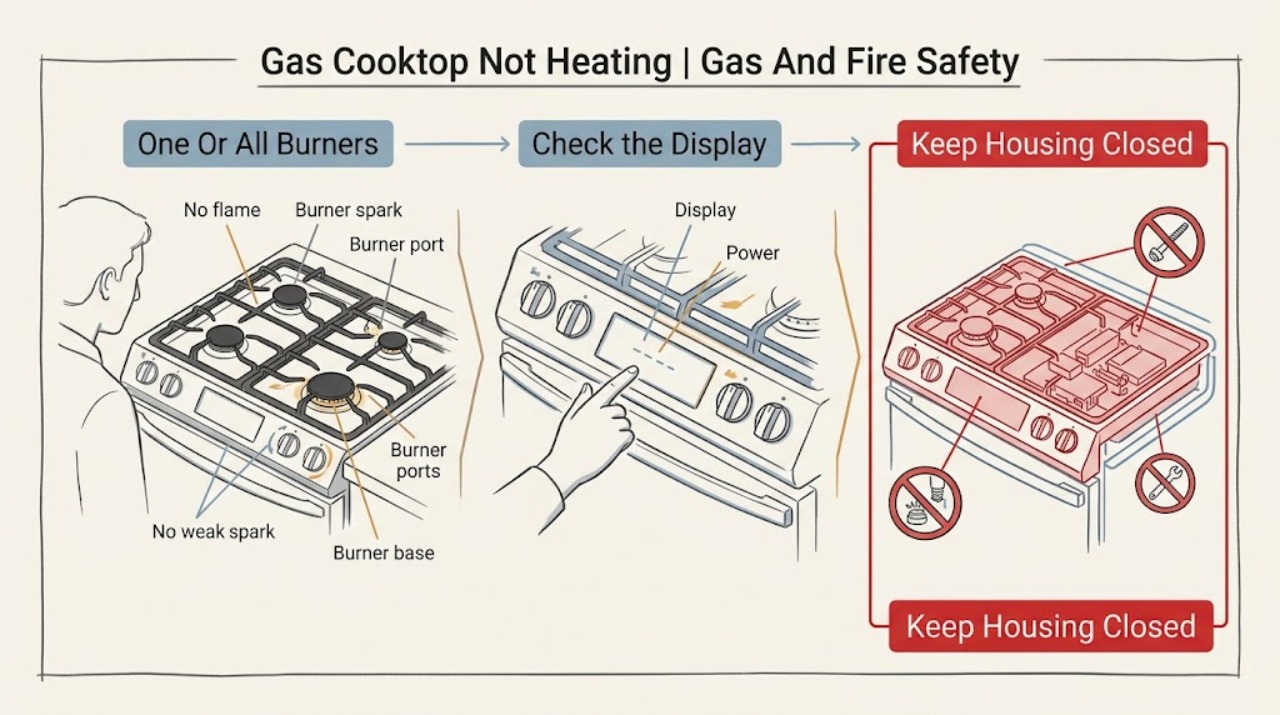
Work through in order
Diagnostic checks
Use only checks that match the exact appliance or system and its official guide.
-
Check 1
From a safe position, turn the affected control to OFF if there is no gas emergency, keep people away, and observe for gas odor or hissing, smoke, burning smell, abnormal flame, visible arcing, or a grease fire.
Expected result: Record no hazard, a gas odor or sound, a flame outside the burner area, smoke/burning smell, or a small pan fire that is still active.
Next step: For suspected gas, do not operate switches or electronics inside; leave immediately and contact local gas authorities or emergency services from outside. For fire, use emergency response and keep clear; do not move the pan.
Stop if: Stop immediately for gas odor, hissing, smoke, burning smell, fire, visible electrical arcing, shock, or a control that will not shut off.
Why this matters
Why: Gas odor or escaping gas can ignite; smoke, arcing, or fire means the cooktop is unsafe to test. A clean no-hazard observation allows only cool, manual-approved checks.
-
Check 2
With all controls off and the cooktop cool, identify whether the problem affects one burner, several burners, or every burner; compare only visible, safe symptoms without repeatedly attempting ignition.
Expected result: Note which burner(s) fail, whether another burner has a stable flame, and whether the affected control produces clicking, no clicking, gas flow without ignition, or no response.
Next step: Record the pattern and use the exact owner manual for the cooktop. If all burners fail or a control behaves unexpectedly, arrange qualified service after safe supply checks.
Stop if: Do not keep turning knobs to release gas, move the cooktop, remove the manifold, or open an electrical or gas compartment.
Why this matters
Why: One-burner failure narrows the check to that burner’s cap, ports, igniter, or local control. All-burner failure raises shared power, gas supply, lockout, or control possibilities and should not be treated as several dirty ports without evidence.
-
Check 3
Verify from a safe position that the correct burner control is being used, the knob reaches the model’s ignition position, any documented control lock is cleared according to the manual, and the accessible gas shutoff is open if you already know its normal position; do not alter a regulator or connection.
Expected result: Record a correct control and supply state, a locked or unpowered ignition system, a closed or unknown shutoff, or a control that feels loose, stuck, or cannot return to OFF.
Next step: Follow only the model manual for unlocking or restoring normal operation. If the supply state is unknown, access requires moving the unit, or the control is damaged, contact qualified gas-appliance service.
Stop if: Do not force knobs, disconnect gas, adjust pressure, bypass a lock, or operate the cooktop if a control will not shut off.
Why this matters
Why: A wrong control, lockout, absent ignition power, or closed supply can prevent heating without a burner obstruction. An unknown or damaged gas control is a service boundary.
-
Check 4
After the burner is cool and all controls are OFF, inspect the removable cap and visible burner base for spill residue, moisture, cracks, warping, or a cap that is not centered and sitting flat; clean and dry only as the exact owner manual permits, without enlarging or probing ports.
Expected result: Classify the burner as clean and correctly seated, wet or dirty, mis-seated, cracked/warped, or not safely accessible.
Next step: Restore only the manual-approved cap/base arrangement and allow parts to dry fully. If the flame remains weak, uneven, or absent, stop and arrange service.
Stop if: Do not clean while hot, use a wooden object that can break off, enlarge or distort ports, sand the burner, or remove fixed gas parts.
Why this matters
Why: Moisture, residue, a mismatched cap, or blocked ports can produce weak, uneven, or delayed ignition. Damage or an inaccessible port path needs qualified service, not aggressive cleaning.
-
Check 5
Only when there is no gas odor or other hazard and the manual permits a normal user observation, note whether the intended igniter clicks/sparks, whether gas ignites promptly, and whether the resulting flame contacts the burner evenly; do not put hands or tools near the burner.
Expected result: Record no click/spark, clicking with no flame, a brief ignition followed by a stable flame, repeated clicking after ignition, delayed ignition, flame lift, flashback, yellow/sooty flame, or flame going out.
Next step: Turn the control OFF and stop testing for any abnormal result. Use qualified gas-appliance service; leave immediately if gas is smelled.
Stop if: Do not light the burner with a match, hold a control open, test for leaks, adjust the air shutter/jet, or repeat an abnormal ignition.
Why this matters
Why: No click can involve power, control, or igniter. Clicking with no flame can involve gas supply, moisture, cap/port alignment, or ignition. Repeated clicking, delayed ignition, flame lift/flashback, yellow/sooty flame, or failure to stay lit is not a safe heating result.
-
Check 6
From a safe distance during an otherwise normal, manual-approved operation, observe flame color, shape, stability, sound, and whether a suitable pan warms evenly; stop rather than extending the test if the flame is abnormal.
Expected result: Note a stable even flame, persistent yellow tips, a lazy or lifting flame, soot, unusual roar, repeated extinction, heat concentrated on one side, or no meaningful heat.
Next step: Turn the control OFF and arrange qualified gas-appliance service for yellow/sooty, lifting, noisy, unstable, or weak flames. Do not adjust combustion settings yourself.
Stop if: Do not operate with persistent yellow/sooty flame, flashback, flame outside the burner, strong odor, smoke, or unusual heat at the controls or surrounding surface.
Why this matters
Why: A stable flame with normal pan heating supports a control or cookware check rather than a confirmed gas fault. Persistent yellow or unstable flame can indicate maladjustment or incomplete combustion; uneven heat can reflect ports, cap alignment, or burner damage.
-
Check 7
Record the cooktop model, fuel type, affected burner, control position, cap/base condition, click/spark behavior, flame description, time of any odor or delay, and whether power or gas service recently changed; use safe photos only.
Expected result: Confirm whether the issue clears after a manual-approved cool cleaning and correct cap placement, remains on one burner, affects all burners, or recurs with an abnormal flame or spark.
Next step: Give the record to the cooktop manufacturer or qualified gas-appliance technician. Leave the cooktop unused after any hazardous symptom or unresolved repeated failure.
Stop if: Do not dismantle the cooktop, perform gas or electrical tests, or retest an odor, delayed ignition, abnormal flame, or spark just to obtain more evidence.
Why this matters
Why: A repeatable no-heat result after the allowed checks points to an igniter, burner, orifice, valve, regulator, control, wiring, or supply diagnosis that cannot be selected safely from symptoms alone.
Use your observations
Decision map
Find the observation that best matches what you see, then follow the next safe action.
-
PATH 01Safety boundary
What you see
Gas is smelled or heard, or gas may be flowing without ignition.
Do this next
Do not operate any switch, light, phone, or electronic device inside; leave immediately and contact local gas authorities or emergency services from outside.
Why this path and its safety boundary
Why it matters: This is a possible gas-leak or unburned-gas emergency.
Safety stop: Do not ignite anything, search for a leak, or re-enter until cleared.
-
PATH 02Safety boundary
What you see
Only one burner is weak or fails, with no gas odor, fire, smoke, or electrical hazard.
Do this next
When cool, inspect and restore the cap/base only as the exact manual permits; use service if the flame remains weak or no ignition follows.
Why this path and its safety boundary
Why it matters: A local cap, base, port, moisture, igniter, or control issue is more plausible than a whole-cooktop supply failure.
Safety stop: Do not probe, enlarge, sand, or remove fixed ports or gas parts.
-
PATH 03Safety boundary
What you see
All burners fail or all igniters are silent.
Do this next
Check only the normal accessible supply and manual-documented control state. If unresolved, arrange qualified service.
Why this path and its safety boundary
Why it matters: Shared power, control lockout, gas supply, or a common control fault is possible; several separate dirty burners are not established.
Safety stop: Do not move the cooktop, open the manifold or electrical compartment, or repeatedly release gas.
-
PATH 04Safety boundary
What you see
A cool visual inspection finds spill residue, moisture, blocked visible openings, or a cap that is off-center but undamaged.
Do this next
Clean, dry, and reseat only as instructed, then make one normal check. Escalate if the burner remains weak, clicks continuously, or leaks.
Why this path and its safety boundary
Why it matters: The obstruction or seating can disturb gas flow and ignition, but cleaning must stay within the manual's user procedure.
Safety stop: Do not use sharp objects to alter openings, clean while hot, or remove fixed components.
-
PATH 05Safety boundary
What you see
The igniter clicks or sparks but the burner does not light promptly or keeps clicking after an attempted ignition.
Do this next
Turn OFF, allow only the manual-approved cool/dry interval, and request service if it repeats. Leave immediately for gas odor.
Why this path and its safety boundary
Why it matters: Supply, moisture, port/cap alignment, igniter, or control issues remain possible; repeated ignition releases gas and increases risk.
Safety stop: Do not use a match, hold the knob open, or continue cycling the burner.
-
PATH 06Safety boundary
What you see
The flame is persistently yellow/sooty, lazy, lifting, noisy, unstable, uneven, or flashes back.
Do this next
Turn the burner OFF, leave it unused, and arrange qualified gas-appliance service; do not adjust the air shutter, jet, pressure, or regulator.
Why this path and its safety boundary
Why it matters: Combustion or burner adjustment may be abnormal and can produce pollutants or heat damage.
Safety stop: Do not continue cooking or attempt a second flame test to compare the result.
-
PATH 07Safety boundary
What you see
The spark appears away from the intended igniter, at a control, wire, plug, or receptacle, or the appliance trips a breaker.
Do this next
Stop use and arrange qualified appliance or electrical service. Isolate power only by a dry, safe method when no gas emergency is present.
Why this path and its safety boundary
Why it matters: An electrical or control fault is possible and is outside ordinary burner cleaning.
Safety stop: Do not touch wiring, open panels, bypass ignition safety, or operate the cooktop again.
-
PATH 08Safety boundary
What you see
The burner cap and visible ports are clean and correctly seated, controls and supply appear normal, but the burner still produces no usable heat.
Do this next
Leave the cooktop off and arrange manufacturer or qualified gas-appliance diagnosis with the recorded observations.
Why this path and its safety boundary
Why it matters: An igniter, electrode, orifice, valve, regulator, control, or supply fault remains possible; no part can be selected from this result alone.
Safety stop: Do not dismantle the cooktop, adjust gas components, or install a guessed part.
Helpful context
Understand the symptom
Define what not heating means
A gas cooktop transfers heat through a flame, so distinguish no flame from a flame that is too small, uneven, unstable, or not reaching the pan. One failed burner points toward its cap, ports, igniter, or local control; every burner failing points toward shared gas supply, power for ignition, lockout, or a broader fault. Do not diagnose by repeatedly releasing gas.
Inspect only cool, ordinary-access parts
With all controls off and the cooktop cool, the safe user-level checks are the visible burner cap, burner base, ports, igniter tip, control position, and accessible supply status. Caps need to sit flat and match their bases; spilled liquid or residue can block ports or affect ignition. Use the exact owner manual for removal and cleaning, and never enlarge ports or adjust gas components.
Flame quality is a service decision
EPA guidance says a persistent yellow-tipped flame can indicate maladjustment and increased pollutants, and recommends properly adjusted burners and outdoor-vented exhaust. A flame that lifts, flashes back, produces soot, stays uneven, or repeatedly goes out is not a normal heating result. Stop and use qualified gas-appliance service rather than adjusting air shutters, jets, pressure, or the regulator.
Safety boundary
Stop conditions
- If gas is smelled or heard, do not operate switches or electronics inside; leave immediately and contact local gas authorities from outside.
- Stop for delayed ignition, gas without a stable flame, abnormal yellow/sooty or lifting flame, flashback, smoke, burning smell, fire, visible electrical arcing, or a burner/control that will not shut off.
- Do not light a burner with a match, test for leaks, adjust jets, air shutters, gas pressure, regulators, or supply fittings, or bypass ignition safety.
- Do not clean while hot, probe or enlarge burner ports, use sharp or breakable objects, open panels, touch wiring, or perform live electrical tests.
- Do not repeatedly cycle a burner or use a generic model's ignition sequence; use the exact owner manual and qualified service.
Only after diagnosis
Potential parts
- gas-cooktop burner cap or burner base
Consider this category only if the exact model inspection confirms a cracked, warped, missing, or incorrectly matched cap/base that affects flame distribution.
Confirm the exact cooktop model and cap/base geometry; do not substitute a cap that does not sit flat or match the burner. - gas-cooktop igniter or electrode
Consider this category only after qualified diagnosis confirms an ignition fault and rules out moisture, cap/port seating, supply, and control causes.
Confirm the exact model, connector, electrode position, and manufacturer fit information; do not replace from clicking or silence alone. - gas-cooktop burner orifice
Consider this category only when qualified service identifies a blocked, damaged, or fuel-incompatible orifice and confirms the repair scope.
Fuel type and exact model determine the orifice; do not clean, enlarge, or swap gas jets as a user adjustment. - gas-cooktop burner valve or regulator
Consider this category only after qualified gas-appliance diagnosis links the no-heat or abnormal-flame symptom to the valve or regulator.
Confirm the exact model and fuel conversion requirements; gas components require qualified installation and leak/safety checks.
When checks do not resolve it
Need a professional?
Arrange qualified gas-appliance service when one or all burners remain unable to heat after the exact manual-approved cap, port, control, and supply checks; when clicking persists, ignition is delayed, the flame is abnormal or unstable, or a spark occurs away from the intended igniter. Use emergency gas or fire response immediately for gas odor, hissing, smoke, or active fire.
Safety scope: This article supports safe identification and cool, ordinary-access visual checks only. Do not operate a gas-smelling or electrically damaged cooktop, test for leaks, alter combustion parts, open panels, or repeat a hazardous ignition.
Common questions
FAQ
Why is my gas cooktop not heating even though I hear clicking?
Clicking means an ignition attempt may be occurring, but gas may be absent, ports may be wet or obstructed, the cap may be mis-seated, or the igniter may not be creating a usable ignition. Turn OFF, check for gas odor, then inspect only cool visible parts as the exact manual permits.
Can a dirty burner cap stop a gas cooktop from heating?
Yes. Spill residue, moisture, a mismatched cap, or blocked ports can disturb gas flow and flame distribution. Clean and dry only when cool and only by the manual; do not probe, enlarge, or remove fixed gas parts.
What does a yellow flame on a gas cooktop mean?
EPA guidance says a persistent yellow-tipped flame can indicate maladjustment and increased combustion pollutants. Turn it OFF and arrange qualified gas-appliance service, especially with soot, lifting, noise, instability, or odor; do not adjust jets or air settings yourself.
What should I do if I smell gas while the cooktop will not heat?
Do not operate switches, lights, phones, or other electronics inside. Leave immediately and contact local gas authorities or emergency services from outside. Do not light a match, search for a leak, or retry the burner.
Why do all burners fail instead of just one?
All-burner failure can involve shared power for ignition, a control lockout, gas supply, or a common control fault. Check only the normal accessible state and exact manual; do not move the cooktop or open gas/electrical compartments.
Can I light the cooktop with a match if the igniter does not spark?
Do not improvise manual ignition for this fault. A no-spark condition may coexist with a gas, control, or combustion problem. Keep the burner OFF and arrange qualified service, particularly if gas odor or delayed ignition occurred.
Read the exact guide
Official sources
- Winter Storms Aren’t Over; CPSC Warns of Deadly Carbon Monoxide Risks and Fires During Power OutagesU.S. Consumer Product Safety Commission · General CPSC emergency guidance applied to gas odor and suspected escaping-gas stop conditions; it does not identify a cooktop component.
- Sources of Combustion ProductsU.S. Environmental Protection Agency · General gas-cooking combustion guidance used for flame-quality and stop conditions; it does not diagnose a particular cooktop model.
- Appliance and Electrical Fire SafetyU.S. Fire Administration · General electrical safety used for spark, damaged connection, and breaker-trip stop conditions; it does not diagnose a cooktop.
- Pictograph: Cook Top Fire Safety TipsU.S. Fire Administration · General cooktop fire-safety guidance used for emergency stop conditions; it does not diagnose gas ignition or heating.
Community feedback
Share a repair observation
Share a plain-text repair observation. Accepted observations are published automatically; this page may take a moment to update.