
On this page
Start here
Quick answer
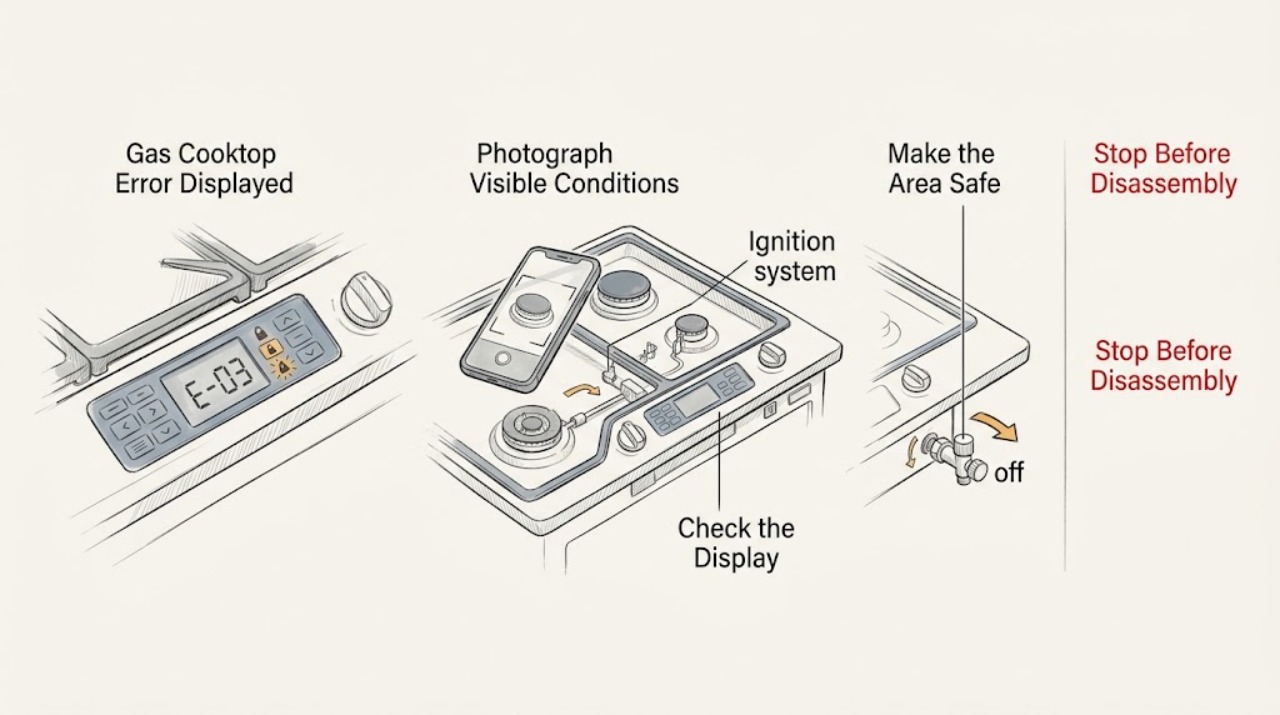
Do not guess what a gas-cooktop code means across brands. Photograph or write the complete code, model number, fuel type, affected burner, and when the message appeared. If there is gas odor, delayed ignition, abnormal flame, smoke, burning odor, arc, or repeated clicking, turn the controls off if safe, leave the area, and seek emergency or qualified help without further testing. Otherwise, check the display and control panel for moisture or an object, verify the cooktop has safe external power, and check whether a lockout is active. Use the exact owner manual for the code and perform at most one model-approved power reset. A code that returns, an ignition fault that remains, or a cooktop that will not light after safe checks needs qualified service. Do not open the appliance, bypass a safety control, alter gas pressure, or repeatedly attempt ignition.
Work through in order
Diagnostic checks
Use only checks that match the exact appliance or system and its official guide.
-
Check 1
Record the complete displayed code or flashing pattern, model number, fuel type, affected burner, control position, and trigger: power-up, cleaning, spill, ignition attempt, overheating, or an interrupted cycle. Photograph the display if it is intermittent, without reaching across a hot or operating burner.
Expected result: One burner with a code or ignition symptom differs from all burners with a display fault. A code that appears only after a spill or hot operation suggests moisture or electronics temperature; a code that returns at power-up or after a reset suggests a persistent fault.
Next step: Use the exact owner manual or manufacturer support page for that model; do not substitute a code explanation from another brand.
Why this matters
Why: Error codes and lock indicators are model-specific, so the exact identity and timing are needed before interpreting the message or choosing a reset.
-
Check 2
If there is no gas odor or other hazard and the cooktop is cool, inspect the control panel for moisture, food, or an object covering a touch area. Dry the accessible surface completely and check for a lock or control-lock indicator. Do not spray cleaner into controls or force a lock key.
Expected result: A message or flashing indicator that clears after the panel is dry or an obstruction is removed supports a moisture, touch-surface, or lockout branch. A dry, clear panel with the same code points toward the model's electronic or control procedure.
Next step: Follow the model manual once for the indicated lock or control state. If the display remains erratic, the code returns, or the panel is cracked or wet internally, stop and arrange service.
Why this matters
Why: Wet controls and lockouts can prevent a gas cooktop from responding even while power and gas are available, but the safe unlock sequence varies by model.
-
Check 3
From a dry, safe position, inspect the accessible power cord and plug for visible damage and check the cooktop's external breaker or fuse once. Do not remove an electrical cover or keep resetting a protective device. If the model has an accessible gas shutoff, do not manipulate it when gas odor is present.
Expected result: A dead outlet or tripped breaker can disable electronic ignition and produce a display or lockout symptom. A warm or damaged cord, wet outlet, repeated trip, or power that cannot be restored safely is an electrical hazard.
Next step: Restore only an obvious, safe external supply condition and perform at most one model-approved reset. If the breaker trips again or the display remains faulty, leave the cooktop off and call qualified service.
Why this matters
Why: Gas cooktops still need electrical power for electronic ignition and controls; a supply fault must be separated from a gas or code fault.
-
Check 4
After the appliance is cool and all controls are off, inspect only the accessible burner cap and burner head for a spill, moisture, visible debris, or a cap that is off-center. Clean and dry them only as the model manual permits; do not enlarge ports, use improvised tools, or remove gas components.
Expected result: A damp burner or mis-seated cap can cause clicking, delayed lighting, uneven flame, or a related ignition indication. A clean, dry, correctly seated cap with a persistent code or no ignition moves the problem to the igniter, electrode, gas supply, valve, or control branch.
Next step: Make one safe, model-approved correction and stop if ignition is not prompt and stable. Arrange qualified service for a recurring error, no spark, abnormal flame, or any suspected gas-valve or ignition-system fault.
Why this matters
Why: Ignition depends on the burner geometry and dry surfaces, but an unresolved ignition fault cannot be safely diagnosed by repeated gas release or spark attempts.
-
Check 5
If the model manual identifies a one-time reset for the displayed code, turn the appliance off or isolate its external power only as instructed, wait the stated interval, and restore it once. Do not reset while smelling gas, seeing smoke or arcing, or standing near water. Record whether the same code returns before attempting any burner operation.
Expected result: A one-off code that clears and does not return may have followed a transient interruption. A code that returns immediately, returns when a burner is selected, or is accompanied by an overheating indication is a persistent fault or safety branch.
Next step: Leave the cooktop off and provide the exact code and reset result to qualified service if the message returns. Do not bypass the control or safety system.
Why this matters
Why: Manufacturer error guidance limits resets to the model procedure and treats a persistent message as a service condition; repeated resets can hide an unsafe fault.
-
Check 6
Classify the final safety state before any further use: gas odor or leak suspicion; delayed ignition, popping, yellow or unstable flame; smoke, burning smell, spark or arc; cracked surface, water near electrics, damaged cord; or repeated breaker trips. Do not perform another ignition test to confirm a concern.
Expected result: Any listed hazard means the code is secondary to immediate safety. A clear safety state with a recurring code or failed ignition still requires qualified diagnosis, not internal owner testing.
Next step: For suspected gas, leave without operating switches or phones nearby and contact emergency help from safety. For smoke, fire, arcing, water, or electrical damage, stop, isolate power only if safely reachable, and obtain emergency or qualified help.
Why this matters
Why: A gas cooktop can release fuel or expose live electrical parts while displaying a code. The absence of an odor does not make repeated ignition or live electrical work safe.
Use your observations
Decision map
Find the observation that best matches what you see, then follow the next safe action.
-
PATH 01Next step
What you see
The code appears once after a safe power interruption and clears after the exact model-approved reset.
Do this next
Record the event and monitor without repeated resets. If the message returns, stop using the cooktop and arrange qualified service.
-
PATH 02Next step
What you see
The display is flashing, the panel is damp or covered, or a lock indicator is present, with no gas odor or other hazard.
Do this next
Dry and clear only the accessible panel, then follow the model manual's lock or control procedure once. Do not force the controls or bypass the lock.
-
PATH 03Next step
What you see
The display is present but electronic ignition does not work, or the code returns when a burner is selected.
Do this next
Turn the burner off promptly and leave the cooktop off. Arrange qualified service for the igniter, electrode, valve, supply, or control; do not repeatedly release gas or test live parts.
-
PATH 04Next step
What you see
A burner is damp, dirty, or has a cap that is not centered, and there is no gas odor or abnormal flame.
Do this next
After the cooktop is cool and off, clean and dry the accessible burner parts and seat the cap as the manual shows. Stop if the burner does not light promptly and stably.
-
PATH 05Next step
What you see
The code remains, is not listed for the exact model, or the breaker trips again after one safe external check.
Do this next
Leave the cooktop off and arrange qualified appliance or electrical service. Give the technician the exact code, model, trigger, power result, and affected burner.
-
PATH 06Next step
What you see
There is gas odor, delayed ignition, popping, abnormal flame, smoke, burning odor, spark, arc, water near electrics, damaged wiring, or another immediate hazard.
Do this next
Stop immediately. Do not operate switches, phones, flames, or engines near suspected gas. Leave the area and contact emergency help from a safe location; do not return to test the cooktop until it is cleared by professionals.
Helpful context
Understand the symptom
The code is only useful with the model and symptom
An error on a gas cooktop may reflect an electronic fault, overheated controls, a lockout, a power interruption, or an ignition problem. Codes are not universal: write every character exactly as shown, including dashes, letters, or flashing segments, and note whether one burner or all burners are affected. Do not use another brand's code table as if it were a diagnosis.
Safety comes before clearing the display
A code accompanied by gas odor, delayed ignition, popping, an unstable or yellow flame, smoke, burning smell, sparks, arcing, or repeated clicking is not a reset exercise. Stop using the cooktop. Do not operate switches or phones near a suspected leak; leave and contact help from a safe location.
Use only external, model-supported checks
From a dry and safe position, check visible controls, the accessible plug or breaker, and the condition of burner caps after the appliance is cool and the gas controls are off. Never remove covers, probe live wiring, bypass a lock or flame-safety device, adjust a regulator, or repeatedly relight a burner.
When checks do not resolve it
Need a professional?
Arrange qualified appliance service when the exact code returns, is not listed for the model, or the cooktop still will not ignite after safe external, control, and burner checks., Arrange electrical service when an outlet or breaker fault cannot be restored safely, the cord or outlet is damaged, or the protective device trips again., Do not open covers, test live wiring, bypass a lock or flame-safety device, adjust gas pressure, disassemble the gas path, or repeatedly attempt ignition., For gas odor, delayed ignition, popping, abnormal flame, smoke, burning odor, sparks, arcing, water near electrical parts, or uncontrolled operation, stop immediately and obtain emergency or qualified help from a safe location.
Common questions
FAQ
What should I do first when a gas cooktop displays an error?
Record the complete code, model number, affected burner, and trigger. If there is any gas odor or combustion abnormality, stop and leave. Otherwise, check the dry control panel and the exact model manual before attempting at most one documented reset.
Can I use another brand's error-code list?
No. Codes and reset sequences are model-specific. Use the owner manual for the exact cooktop and give the complete code to qualified service if it is missing or returns.
Why is the cooktop clicking while an error is displayed?
Moisture, a spill, an incorrectly seated burner cap, a lockout, or an ignition fault can all be involved. Turn the control off promptly; after the appliance is cool and safe, only clean and dry accessible burner parts as the manual permits. Do not repeatedly release gas or spark-test the burner.
Should I reset the breaker to clear the code?
Only if the exact owner manual permits a one-time reset and the area is dry and free of gas odor, smoke, sparks, or damage. A recurring code or a breaker that trips again requires service.
When is a gas-cooktop error an emergency?
Treat gas odor, delayed ignition, popping, abnormal flame, smoke, burning odor, sparks, arcing, water near electrical parts, or uncontrolled operation as stop conditions. Leave without operating switches or phones near suspected gas and contact help from a safe location.
What information should I give a technician?
Give the model number, complete code, fuel type, affected burner, trigger, lock and panel state, power result, burner-cap condition, ignition sound, flame appearance, and the timing of any odor, smoke, spark, trip, water, or overheating.
Read the exact guide
Official sources
- Nothing Will Work - Gas CooktopWhirlpool Product Help · Manufacturer guidance for gas-cooktop power, gas supply, lockout, and safe service escalation
- Recognizing and Responding to Pipeline EmergenciesU.S. Department of Transportation, Pipeline and Hazardous Materials Safety Administration · Natural-gas odor emergency response and evacuation precautions
- Bosch Gas Cooktop Error CodesBosch Home · Manufacturer guidance for gas-cooktop error identification, electronics faults, overheated electronics, exact model support, and model-specific reset or service decisions
- Burner Not Lighting - Gas CooktopWhirlpool Product Help · Manufacturer guidance for accessible gas-burner ports, burner-cap alignment, cleanliness, and ignition service escalation
- Clicking or Ticking - Gas CooktopWhirlpool Product Help · Manufacturer guidance for gas-cooktop clicking, damp burners, ignition observation, and reignition behavior
Community feedback
Share a repair observation
Share a plain-text repair observation. Accepted observations are published automatically; this page may take a moment to update.