
On this page
Start here
Quick answer
If a gas cooktop will not ignite, turn the affected knob fully off first and identify whether you hear clicking, see a spark, smell unburned gas, or have no gas at any burner. A brief click and spark while a knob is in the ignition position can be normal, but a burner that does not light must not be left allowing gas to flow. Check only safe, visible items: the control or cooktop lock, the main gas shutoff, a correctly seated and dry burner cap, and visible spill or port contamination with the appliance cool and controls off. If every burner fails, gas is unavailable, clicking continues with all knobs off, a flame is yellow, unstable, or delayed, or there is gas odor, smoke, electrical arcing, or a damaged connection, stop and use qualified gas or electrical service. Never enlarge ports, open the gas path, or repeatedly attempt ignition.
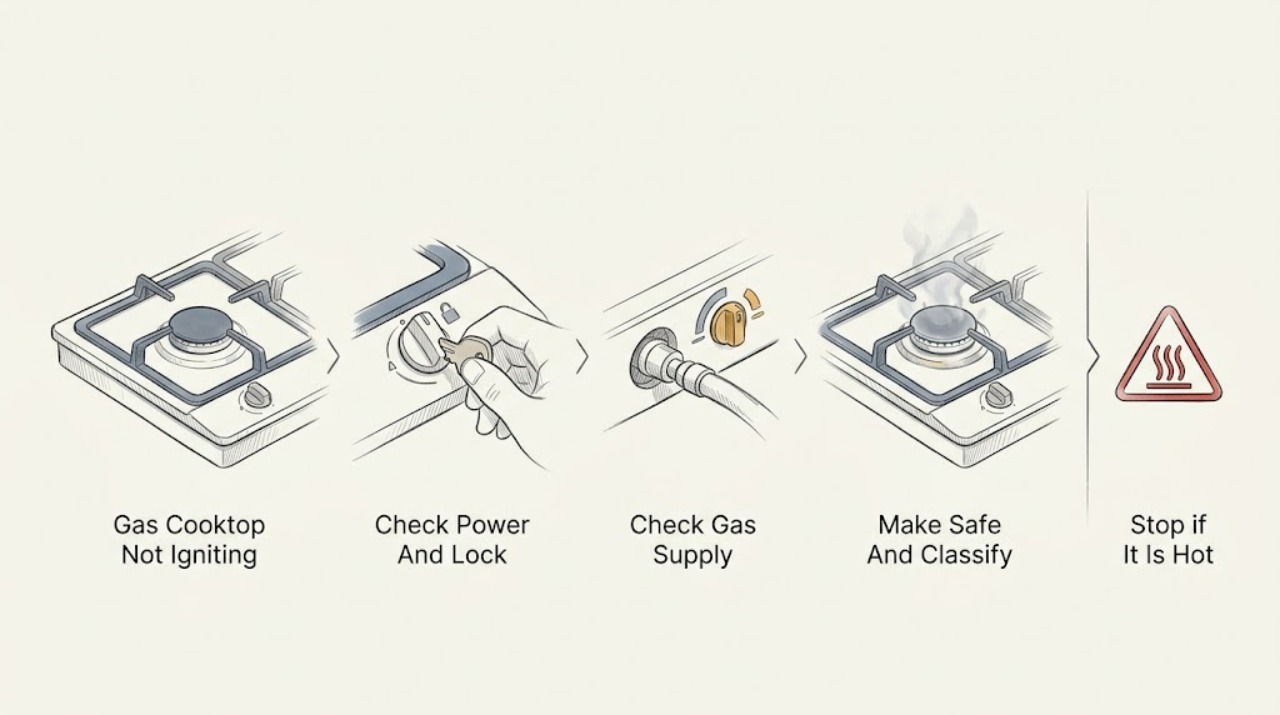
Work through in order
Diagnostic checks
Use only checks that match the exact appliance or system and its official guide.
-
Check 1
Turn the affected control fully off and classify the event from a safe position: one burner fails, every burner fails, the igniter clicks but no flame appears, clicking continues with controls off, or a flame appears abnormal. Do not hold a knob open while investigating.
Expected result: Record which burners are affected, whether a spark is visible, whether gas odor is present, whether the issue followed cleaning or a spill, and whether there is smoke, arcing, or an unusual flame.
Next step: For any safety symptom, keep controls off, ventilate only from a safe position without operating electrical switches, leave the area if the odor is strong, and contact the appropriate emergency or qualified service. Otherwise continue with the shared checks.
Stop if: Do not relight repeatedly, use a match or lighter to test the burner, or operate a burner with a damaged cap or visible gas leak.
Why this matters
Why: One-burner failure supports a local cap, port, moisture, or igniter check. All-burner failure supports shared power, lock, or gas supply. Gas odor, smoke, arcing, delayed ignition, or an abnormal flame is a safety boundary, not a diagnostic invitation.
-
Check 2
If no burner produces a spark, check the accessible appliance power connection and circuit indicator from a dry position, then check whether a control or cooktop lock is displayed or indicated. Use only the model manual's unlock procedure.
Expected result: A breaker or fuse is open, the lock is active, the connection has scorching or damage, or the supply and lock appear normal but no spark is produced.
Next step: Restore a circuit only when there is no damage and it is safe; clear the lock using the exact manual once. If the breaker trips again or no spark remains, leave the cooktop off and arrange licensed electrical or appliance service.
Stop if: Do not open the outlet, alter wiring, bypass a lock, or keep resetting a breaker.
Why this matters
Why: Electronic ignition needs its electrical supply, and a lock can prevent burners from activating even when a knob is turned. Scorching, damaged wiring, or a repeated trip indicates an electrical fault. A normal external supply with no spark can require ignition-system service.
-
Check 3
If the igniter sparks but no burner lights, verify only the accessible main gas shutoff position and whether other gas appliances have normal supply, without disconnecting a hose or opening a regulator. If the cooktop was newly installed or reconnected, stop and have a qualified gas technician verify the installation.
Expected result: The shutoff is closed, all burners fail, one burner fails, gas supply is absent, or the supply appears normal but ignition still fails.
Next step: If the shutoff was accidentally closed and there is no odor or damage, restore it according to the appliance instructions and make one controlled attempt. If supply is absent, uncertain, or accompanied by odor, stop and contact qualified gas service.
Stop if: Do not loosen gas fittings, purge a line yourself, bypass a shutoff, or continue if gas odor is present.
Why this matters
Why: A closed shared shutoff or absent supply can prevent every burner from lighting. One burner with normal supply supports a local burner check. An uncertain connection, conversion, or gas path is professional work.
-
Check 4
With all controls off and the cooktop cool, inspect the affected burner for spill residue or moisture. If the manual permits, remove and dry the cap and visible base, then return the correct cap to its matching burner with alignment features seated and the cap flush.
Expected result: The cap is wet, dirty, on the wrong base, tilted, or clean and correctly seated; after drying, the burner either lights normally or still fails.
Next step: Allow the area to dry fully and make one supervised ignition attempt. If the burner still will not light, turn it off and arrange service rather than adding force or more cleaning.
Stop if: Do not clean while hot, use oven cleaner or bleach, scrape the igniter aggressively, or operate without the burner cap fitted.
Why this matters
Why: Moisture, residue, or a mismatched or tilted cap can stop the spark from lighting the gas or produce an uneven flame. A clean, dry, correctly aligned burner that still fails moves the diagnosis toward the igniter, valve, or gas path.
-
Check 5
If the cap is correctly seated and the burner remains unlit, inspect visible flame ports for spill residue or blockage. Only when the manual permits and the appliance is cool and isolated as directed, clean the accessible ports with the specified non-damaging method; never enlarge, drill, or distort an opening.
Expected result: Ports are visibly blocked, the burner becomes dry and clear, the spark is present but gas does not spread around the ring, or the burner still fails after the allowed cleaning.
Next step: Replace the matching cap and make one controlled test. Persistent failure, port damage, or a need to adjust the burner goes to qualified service.
Stop if: Do not use a wooden pick that can break off, use abrasive tools, change jet size, or remove internal gas parts.
Why this matters
Why: A blocked or wet port can stop gas from reaching the spark or make the flame uneven. If the visible path is clear but gas does not distribute or ignition fails, the cause may be an internal valve, electrode, ground, or installation issue.
-
Check 6
If a flame appears, visually confirm it rather than relying on the sound of the igniter. Observe whether clicking stops when the flame is established, whether the flame is stable and even, and whether airflow from a downdraft hood or a spill is disturbing it.
Expected result: The flame is stable and clicking stops, clicking continues after lighting, the flame is yellow, lifting, flickering, noisy, or a burner repeatedly goes out.
Next step: Turn the knob off if the flame is not stable, let a spill dry, and consult the exact manual. If the condition persists or the gas type or conversion is uncertain, arrange qualified gas service.
Stop if: Do not increase gas flow to compensate, adjust jets, relight a burner that repeatedly goes out, or continue with gas odor or delayed ignition.
Why this matters
Why: A brief click during ignition can be normal. Continued clicking can reflect moisture, an ignition-sensing or reignition condition, or a draft; abnormal color, instability, popping, or repeated extinction can indicate port, cap, gas-type, or adjustment trouble.
-
Check 7
If the cooktop still will not ignite after the safe supply, lock, drying, alignment, and visible-port checks, record the make, model, gas type, affected burner, spark behavior, flame behavior, and any recent installation or cleaning. Keep the controls off until qualified service diagnoses the unit.
Expected result: A qualified technician identifies an igniter, electrode, switch, valve, burner, regulator, grounding, conversion, or supply fault, or the symptom cannot be reproduced safely.
Next step: Arrange qualified appliance or gas service and provide the recorded observations. If there is electrical damage, use licensed electrical service; if there is gas odor or a fire risk, use the emergency gas or fire path.
Stop if: Do not open the gas manifold, probe ignition wiring, bypass flame safety, or conduct another test after a safety symptom.
Why this matters
Why: No ignition is not a single-part diagnosis. The same symptom can arise from power, lockout, gas supply, moisture, port obstruction, cap fit, flame sensing, or an internal component. A model-specific diagnosis is needed before selecting a part.
Use your observations
Decision map
Find the observation that best matches what you see, then follow the next safe action.
-
PATH 01Safety boundary
What you see
There is a strong gas odor, delayed ignition, abnormal flame, smoke, fire, or an uncontrolled burner.
Do this next
Turn controls off if safe without delay, avoid flames and electrical switches, leave the area for a strong odor or fire, and contact local emergency gas or fire help from a safe location.
Why this path and its safety boundary
Safety stop: Do not relight, ventilate by operating switches, search for a leak, or resume use.
-
PATH 02Safety boundary
What you see
There is visible arcing, a scorched connection, damaged wiring, a hot control, or a repeated breaker trip.
Do this next
Leave the cooktop off and use licensed electrical service; isolate power only from a dry, safe position and only when it does not require touching damaged equipment.
Why this path and its safety boundary
Safety stop: Do not open the outlet, bypass protection, or keep resetting the breaker.
-
PATH 03Safety boundary
What you see
Every burner fails and no igniter spark is visible or audible.
Do this next
Check the accessible power and control-lock state using the exact manual; if normal, arrange appliance service for the shared ignition path.
Why this path and its safety boundary
Safety stop: Do not test the igniter with improvised tools or bypass the lock.
-
PATH 04Safety boundary
What you see
Every burner sparks but none lights, and the main gas supply appears closed or unavailable.
Do this next
Verify only the accessible shutoff when there is no odor or damage; uncertain installation, reconnection, or conversion requires qualified gas service.
Why this path and its safety boundary
Safety stop: Do not loosen fittings or attempt to purge a line.
-
PATH 05Safety boundary
What you see
One burner clicks but does not light after a spill or cleaning, or its cap is wet, dirty, or misaligned.
Do this next
With controls off and the cooktop cool, dry and correctly reseat the matching cap using the manual; make one supervised attempt.
Why this path and its safety boundary
Safety stop: Do not enlarge ports, use a flame to dry parts, or keep gas flowing while waiting.
-
PATH 06Safety boundary
What you see
A flame is yellow, unstable, noisy, repeatedly extinguishes, or clicking continues after the flame is established.
Do this next
Turn the burner off, allow moisture to dry, and arrange qualified service if the exact manual does not resolve the condition or gas type is uncertain.
Why this path and its safety boundary
Safety stop: Do not adjust jets, raise the setting to force stability, or relight repeatedly.
-
PATH 07Safety boundary
What you see
Power, lock, supply, cap, moisture, and visible-port checks do not restore ignition.
Do this next
Leave the controls off and request qualified appliance or gas service with the model and observations.
Why this path and its safety boundary
Safety stop: Do not open gas or ignition components or select a replacement part from the symptom alone.
Helpful context
Understand the symptom
First decide whether the problem is one burner or the whole cooktop
A single burner that clicks but does not light points toward its cap, ports, moisture, or igniter area. If all burners fail, check the shared gas and electrical supply and any control lock before focusing on one burner. Models differ: some use electronic ignition, some have reignition, some include a cooktop lock, and gas type and installation requirements vary. Use the exact owner manual for the appliance rather than assuming another cooktop's controls or flame behavior.
Clicking is useful only when it stops after a successful light
With electronic ignition, a click or spark while the knob is held at the ignition position is expected. The flame should be visibly confirmed and the knob moved to the selected setting. Moisture from cleaning or a spill can cause clicking, while a reignition system may click again if a draft or spill extinguishes a flame. Clicking with every knob off, a smell of gas, or a flame that does not establish is not a condition to keep testing.
Clean and align only the accessible burner parts
When the cooktop is cool and every control is off, an owner manual may allow removal and cleaning of the cap and visible burner base. The cap must match its base, sit flush, and be dry. Manufacturer guidance warns not to enlarge or distort burner ports and not to use a wooden toothpick that can break inside. If the burner needs adjustment, gas conversion work, or internal ignition repair, use a trained technician.
Safety boundary
Stop conditions
- Strong gas odor, delayed ignition, fire, an uncontrolled flame, or a burner that repeatedly goes out.
- Smoke, burning smell, visible electrical arcing, a scorched connection, damaged wiring, or a hot control.
- A repeated breaker trip or any need to work on a live electrical circuit.
- A need to open gas fittings, adjust jets, alter conversion parts, or bypass a flame-safety or control-lock function.
- A wet or damaged cooktop that cannot be made safe without touching electrical or gas components.
Only after diagnosis
Potential parts
- gas cooktop spark igniter or electrode
Consider only when a qualified diagnosis confirms an ignition electrode or spark path fault after supply, lock, cap, and moisture checks.
Confirm the exact cooktop model and manufacturer fit information before ordering; no spark or no ignition alone does not identify this part. - gas cooktop burner cap or burner base
Consider only if the matching cap or base is damaged, cannot seat flush, or is confirmed incompatible after the manual's alignment check.
Match the part to the exact burner position and model; do not use a visually similar cap or alter its ports. - gas cooktop ignition switch or valve assembly
Consider only after a qualified technician confirms a switch or valve fault and rules out supply, port, cap, moisture, and installation issues.
Gas-path and electrical components require exact model fit and qualified installation; do not select one from a symptom or code alone.
When checks do not resolve it
Need a professional?
Arrange qualified appliance or gas service when a burner still will not ignite after safe visible checks, or when an internal ignition, valve, grounding, or adjustment fault is suspected., Use licensed electrical service for arcing, scorched connections, damaged wiring, hot controls, or repeated breaker trips., Stop immediately and contact local emergency gas or fire help from a safe location for a strong gas odor, fire, delayed ignition, or an uncontrolled flame., Use the exact owner manual when a control lock, gas type, reignition feature, or cleaning method differs from the general guidance., Request service for a yellow, lifting, unstable, noisy, or repeatedly extinguishing flame, especially after installation or fuel conversion.
Common questions
FAQ
Why does my gas cooktop click but not ignite?
Check that the gas supply is available, the control is at the ignition position, and the cool burner cap is dry, clean, correctly matched, and seated. If gas odor persists or the burner still does not light after one safe check, turn it off and arrange qualified service.
Why are all gas cooktop burners failing to light?
All-burner failure points toward a shared power, control-lock, or gas-supply condition. Check only the accessible circuit and main shutoff from a safe position. An uncertain gas connection or a repeated electrical trip needs qualified service.
Can cleaning cause a gas cooktop to stop igniting?
Yes. Moisture or residue around the burner ports, cap, igniter, or control area can interfere with ignition. Turn controls off, let the cool parts dry fully, and follow the exact manual; do not use a flame to dry them.
Can I clear a gas burner port with a drill?
No. Manufacturer guidance warns not to enlarge or distort burner ports. Use only the cleaning method allowed by the model manual, and request service if a port is damaged or the burner needs adjustment.
When should I stop trying to light a gas cooktop?
Stop immediately for a strong gas odor, delayed ignition, an unstable or abnormal flame, smoke, fire, arcing, a hot or damaged connection, or repeated breaker trips. Turn controls off if safe, leave the area for a strong odor or fire, and contact the appropriate qualified or emergency service.
Read the exact guide
Official sources
- Gas Burners are Clicking but Not Lighting - Product Help | WhirlpoolWhirlpool · Manufacturer guidance for gas cooktop clicking, control lock, gas supply, moisture, ignition position, ports, and reignition
- None of the Burners are Lighting - Product Help | WhirlpoolWhirlpool · Manufacturer guidance for shared gas-cooktop power, gas supply, lockout, ports, and service boundary
- Gas Burner Flame Level Incorrect - Product Help | WhirlpoolWhirlpool · Manufacturer guidance for gas cooktop flame color, stability, port cleanliness, cap alignment, moisture, and fuel conversion
- Burner Not Lighting - Gas Cooktop - Product Help | WhirlpoolWhirlpool · Manufacturer guidance for gas cooktop burner ports, burner bases, caps, alignment, and cleaning limits
Community feedback
Share a repair observation
Share a plain-text repair observation. Accepted observations are published automatically; this page may take a moment to update.