
On this page
Start here
Quick answer
A gas cooktop can click briefly while electronic ignition lights a selected burner, and some models can click again when a draft or spill extinguishes a flame and reignition starts. A popping noise can follow a wet burner or a cap that is not seated correctly. The important split is when the noise occurs and whether a stable blue flame is present: clicking only during ignition is often expected; clicking with all knobs off, repeated clicking after a flame is established, a burner that will not light, a low or lifting flame, humming or rubbing, or a bang at ignition needs a stop and model-specific diagnosis. Turn every control off, keep the burner cap in its intended position, allow only a cool, dry, ordinary-access clean or dry-out, and never enlarge ports or work on the gas path. If you smell gas, hear escaping gas, see an abnormal flame, smoke, scorch marks, an arc, or cannot stop the ignition, leave the area and contact emergency or gas service from a safe location.
Before you begin
Safety first
- This article covers observation and only model-approved cool, dry, ordinary-access burner care. A qualified gas or appliance professional must handle gas connectors, valves, regulators, pressure, jets, ignition wiring, switches, controls, and any persistent or hazardous fault.
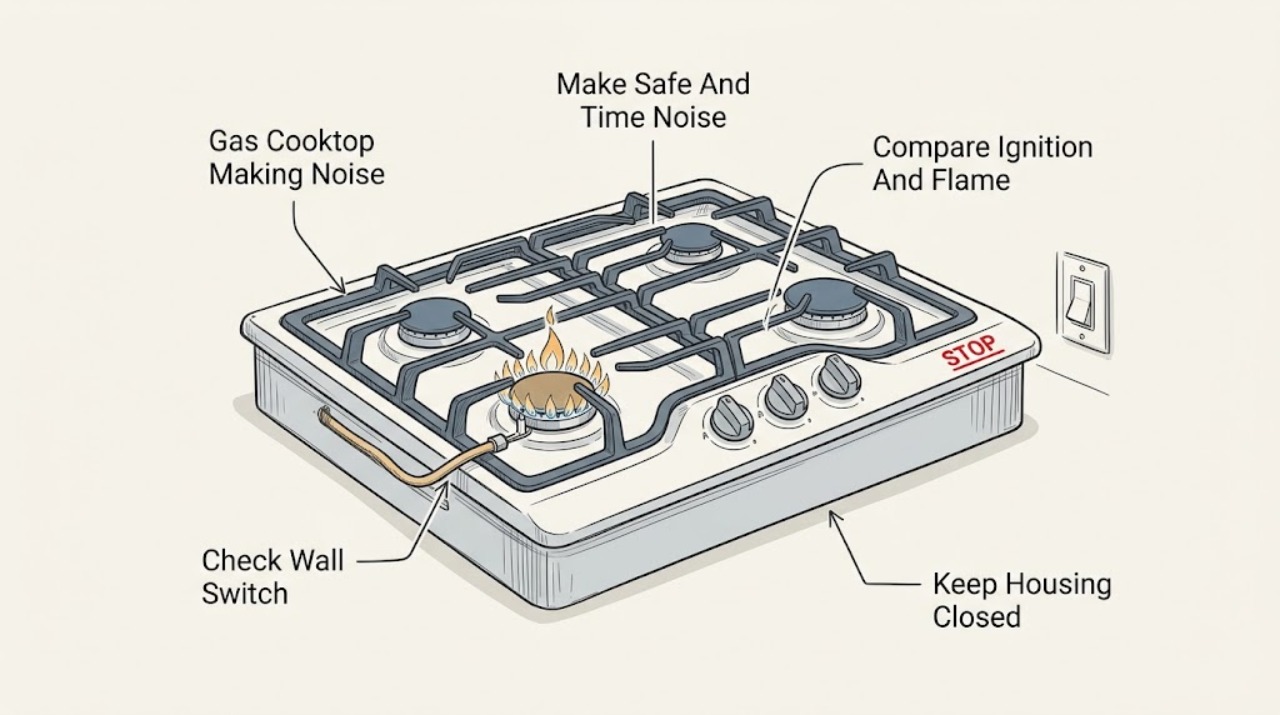
Work through in order
Diagnostic checks
Use only checks that match the exact appliance or system and its official guide.
-
Check 1
Turn every cooktop control to OFF and observe from a safe position. If there is a gas smell or hissing, an uncontrolled flame, smoke, scorch mark, arc, repeated ignition that cannot be stopped, or a damaged electrical connection, leave the area and contact emergency or gas service from outside; do not create a spark or move the appliance.
Expected result: Record whether the sound is a brief click at ignition, repeated click with a stable flame, click with all knobs off, pop or bang, hum, scrape, or rubbing sound, and whether the sound is from one burner or the whole cooktop.
Next step: If no hazard is present, continue only with the branch that matches the sound and flame state. If a hazard is present, keep people away and wait for qualified help.
Stop if: Do not relight, cycle knobs, operate electrical switches, or move the cooktop after a suspected gas leak, uncontrolled flame, smoke, arc, or damaged connection.
Why this matters
Why: Ignition timing and burner count separate an expected spark sequence from a wet switch, reignition, misaligned burner, gas-flow, fan, or electrical fault. A gas or fire symptom ends ordinary checks.
-
Check 2
If there is no gas smell or other hazard, note the selected burner and watch the flame only from normal standing distance while the control is used exactly as the model manual describes; do not place hands near the burner or lean over it.
Expected result: Record whether only the selected burner clicks and lights, whether all burners click when one knob is pushed, whether the flame appears promptly and stays stable, or whether clicking continues after the knob is at its cooking setting.
Next step: If the sound stops with a stable flame, compare the result with the exact manual. If it continues or the flame is abnormal, turn the control off and proceed to drying or service rather than repeated ignition attempts.
Stop if: Stop for delayed ignition, a sudden pop or bang, lifting or yellow flame, flame outside the burner area, gas smell, or a flame that will not stop when the control is OFF.
Why this matters
Why: Whirlpool describes clicking during electronic ignition as expected and says ignition can continue until the control reaches the desired setting. Persistent clicking after a stable flame, or ignition with a knob off, suggests moisture, reignition, switch, sensor, or control trouble.
-
Check 3
With all controls OFF and the burner completely cool, wipe visible moisture from the cap and surrounding surface using the model-approved method and allow the burner and control area to dry thoroughly; use only cool airflow if the manual permits it.
Expected result: Record whether the noise began after cleaning or a spill, whether moisture was visible, whether clicking stops after a complete dry-out, and whether the sound occurs with every control OFF.
Next step: Keep the cooktop unused until it is dry. If the clicking returns with all controls OFF or remains after the manual-approved dry-out, arrange qualified service.
Stop if: Do not spray liquid into the igniter or switch, remove control wiring, use high heat, or keep operating a cooktop that clicks without a selected burner.
Why this matters
Why: Whirlpool says damp burners or moisture from a spill can cause clicking, and a wet burner can contribute to popping. If the noise remains after drying, a switch, igniter, sensor, cap, or control fault is more likely.
-
Check 4
With the burner cool and all controls OFF, lift only the removable cap and head parts that the exact manual identifies as user-serviceable; check that the cap belongs on that base, sits flush, and has no visible spill residue or blocked port, then restore it without force.
Expected result: Record whether the cap is tilted, loose, on the wrong base, wet, visibly dirty, cracked, or correctly seated, and whether the noise is a pop, uneven ignition, or flame instability at that burner.
Next step: Use only the manual-approved cleaning method, let parts dry, reinstall the correct cap, and make one normal ignition observation. If the sound or abnormal flame returns, stop and request service.
Stop if: Do not enlarge or distort ports, use an unapproved wire or tool, swap parts by appearance, remove gas jets, or clean while the burner is hot or lit.
Why this matters
Why: Whirlpool says a cap must be seated and aligned for proper lighting, and that wet or clogged burner parts can produce popping or poor ignition. A damaged cap, blocked port that cannot be cleaned by the manual, or recurring noise needs service.
-
Check 5
If the cooktop has flame sensing or reignition and the clicking occurs while a burner is lit, note whether a spill, wind, ventilation draft, downdraft, or low setting is present; reduce use and turn the burner OFF if the flame cannot remain stable, without adjusting gas pressure or moving the appliance.
Expected result: Record whether the flame was blown out, whether the igniter clicks only while trying to relight, whether a downdraft changes the flame, and whether clicking stops when the burner is OFF and the area is clear.
Next step: Follow only the exact manual's ventilation and operating guidance. If the flame remains unstable or clicking persists with the burner OFF, leave the cooktop unused and arrange service.
Stop if: Do not shield the flame with combustible material, alter the downdraft installation, adjust gas pressure, or keep using a burner that lifts, goes out, or smells of gas.
Why this matters
Why: Whirlpool explains that some systems restart ignition after an external draft or spill extinguishes a flame, and that occasional clicking can continue while the draft remains. Persistent clicking with a stable flame or a flame that repeatedly goes out needs diagnosis.
-
Check 6
Record the model, burner, control position, flame appearance, noise type and timing, recent cleaning or spill, gas type if known, and whether the sound remains with all controls OFF; provide that record to qualified appliance or gas service instead of opening the cooktop.
Expected result: Classify the unresolved condition as persistent clicking, pop or bang, hum, rubbing, flame instability, ignition failure, noise from all burners, or noise with an electrical symptom.
Next step: Keep the cooktop out of use until the technician confirms safe operation; leave gas-supply and electrical work to qualified professionals.
Stop if: Do not remove the cooktop, disconnect gas tubing, open controls, test live wiring, or attempt to repair a regulator or valve.
Why this matters
Why: A persistent or non-ignition noise may involve the igniter, switch, flame sensor, burner assembly, gas supply, regulator, valve, fan, or electrical control. These require model-specific service and cannot be confirmed by sound alone.
Use your observations
Decision map
Find the observation that best matches what you see, then follow the next safe action.
-
PATH 01Safety boundary
What you see
A short, regular click occurs only while a selected burner is being ignited and stops when the flame is stable and the knob reaches its cooking setting.
Do this next
Confirm the flame is stable and compare operation with the exact model manual; keep the cap clean, dry, and correctly seated.
Why this path and its safety boundary
Why it matters: The sound is consistent with an electronic spark sequence described in manufacturer guidance.
Safety stop: Stop if the click continues after a stable flame, the flame is abnormal, or gas is smelled.
-
PATH 02Safety boundary
What you see
Clicking or popping began after cleaning or a spill, moisture is visible, or a cap is not seated flat.
Do this next
Turn controls OFF, let the cool burner dry, and restore the cap only by the exact manual's method; make one normal ignition observation.
Why this path and its safety boundary
Why it matters: Moisture or cap alignment can disturb ignition and flame behavior.
Safety stop: Do not operate while wet, scrape ports aggressively, or continue after a pop, abnormal flame, or recurring click.
-
PATH 03Safety boundary
What you see
Clicking occurs after wind, a spill, a ventilation draft, or downdraft extinguishes a flame on a model with flame sensing or reignition.
Do this next
Turn the burner OFF if the flame is not stable and follow the model manual's ventilation guidance; request service for persistent clicking or repeated flame loss.
Why this path and its safety boundary
Why it matters: The system may be attempting to restore a flame, and occasional clicking can continue while the external cause remains.
Safety stop: Stop for gas smell, a lifting or yellow flame, delayed ignition, or ignition that does not stop.
-
PATH 04Safety boundary
What you see
One or more igniters click while every knob is OFF.
Do this next
Keep controls OFF, allow only a complete model-approved dry-out, and arrange qualified service if clicking remains or returns.
Why this path and its safety boundary
Why it matters: Moisture in switches, a spill, an igniter or control fault, or another electrical issue is possible; this is not the normal selected-burner spark state.
Safety stop: Do not operate the cooktop, remove switches, or expose control wiring.
-
PATH 05Safety boundary
What you see
A burner pops or bangs, lights late, goes out, lifts, rolls outside its ports, or has an abnormal color or sound.
Do this next
Turn the control OFF, leave the area if gas is smelled, and request qualified gas or appliance service; do not keep relighting.
Why this path and its safety boundary
Why it matters: Wet or misaligned parts may be involved, but delayed ignition, unstable flame, or gas-flow problems require a safe stop and diagnosis.
Safety stop: Do not adjust jets or pressure, move the appliance, or operate with an abnormal flame.
-
PATH 06Safety boundary
What you see
The sound is a persistent hum, scrape, rub, harsh buzz, arc, or click unrelated to normal ignition timing.
Do this next
Turn the cooktop OFF and arrange qualified service, documenting which burner and control state produced the sound.
Why this path and its safety boundary
Why it matters: A fan, motor, switch, igniter, control, mounting, or electrical issue may be present and cannot be identified safely by a user listening test.
Safety stop: Stop immediately for smoke, scorch marks, sparks, gas smell, or a hot electrical part; do not open the cooktop.
Helpful context
Understand the symptom
The timing of the sound matters more than the sound alone
A short, regular click while a knob is in the ignition position can be the spark sequence. Some electronic-ignition cooktops make all burners click when one knob is pushed, even though only the selected burner should produce a flame. Noise that continues after the flame is stable, starts with every knob off, or appears as a bang, scrape, or harsh hum is a different branch.
Moisture and burner-cap position are low-risk first checks
Cleaning or a spill can leave moisture around a burner, igniter, or switch and cause clicking or popping. A cap that is not flat on its base can also disturb ignition and flame shape. Turn controls off, let the area cool and dry, and use only the cleaning and cap-position instructions for the installed model. Never poke a port with a way that enlarges it, and never remove a cap while its burner is operating.
A flame or gas symptom changes the safety decision
A stable flame should remain at the burner rather than lifting, rolling, or repeatedly going out. A delayed light, repeated ignition, abnormal flame, gas smell, or hissing sound can indicate a gas, air, burner, or ignition problem. Do not troubleshoot the gas supply, regulator, connector, or valve yourself. CPSC warns not to move an appliance to inspect its gas connector and says suspected gas leaks require immediate exit and no electrical operation.
Use the exact manual before calling a noise normal
Gas cooktops differ in ignition, flame-sensing, downdraft, control-lock, and burner-port design. A manufacturer page can describe a common example, but it cannot establish the procedure for every model. Record the cooktop model, burner, knob position, flame state, and noise timing; then use the installed manual to decide whether a documented cleaning, drying, or cap-alignment step applies.
Safety boundary
Stop conditions
- If gas is smelled or heard escaping, leave immediately and contact emergency or gas service from outside; do not operate lights, switches, or other electrical equipment.
- Stop for a delayed bang, uncontrolled or abnormal flame, smoke, scorch marks, sparks, an arc, a hot connection, or ignition that will not stop.
- Do not move the cooktop to inspect a gas connector, adjust gas pressure, remove jets or valves, disconnect tubing, or open the control panel.
- Do not enlarge, distort, or aggressively probe burner ports; use only the exact manual's cool, dry, ordinary-access cleaning method.
- Do not keep relighting or operating a burner that clicks with its control OFF, repeatedly goes out, lifts, or remains unstable.
Only after diagnosis
Potential parts
- burner cap or burner head
Consider this category only when the exact model inspection confirms a cracked, warped, incorrect, or damaged cap or head after safe cleaning and alignment checks.
Confirm the exact cooktop model and burner position with the manufacturer or technician; do not swap caps by size or appearance. - electronic igniter or ignition switch
Consider this category only when clicking persists with the control OFF, ignition fails, or a service diagnosis identifies an igniter or switch fault.
Confirm the exact model, ignition design, and safety procedure; electrical and gas-control access is professional work. - flame sensor or control component
Consider this category only when a persistent reignition, flame-loss, or control fault is confirmed by model-specific diagnosis.
Confirm the exact model and approved component with qualified service; do not bypass flame sensing or safety controls.
When checks do not resolve it
Need a professional?
Arrange qualified appliance or gas service when clicking persists after a model-approved dry-out, occurs with all controls OFF, returns after cap alignment, or is accompanied by a pop, bang, hum, rubbing, abnormal flame, ignition failure, delayed ignition, repeated flame loss, or a control that will not stop. Leave immediately for a gas smell, hissing gas, smoke, fire, arc, or other urgent hazard and contact emergency or gas service from a safe location.
Safety scope: This article covers observation and only model-approved cool, dry, ordinary-access burner care. A qualified gas or appliance professional must handle gas connectors, valves, regulators, pressure, jets, ignition wiring, switches, controls, and any persistent or hazardous fault.
Common questions
FAQ
Is clicking normal on a gas cooktop?
A brief click while a selected burner is igniting can be normal electronic ignition, and some designs make all burners click when one knob is pushed. It is not normal when clicking continues with a stable flame, occurs with every control OFF, or comes with gas smell, abnormal flame, smoke, or sparks.
Why does my gas cooktop pop after cleaning?
A burner may still be damp, or the cap may not be seated correctly. Turn the control OFF, let the cool parts dry, and restore the cap only according to the exact manual. Stop if the pop returns, ignition is delayed, or the flame is abnormal.
Why does the igniter keep clicking after the burner lights?
A draft, spill, flame-sensing or reignition feature, moisture, switch, igniter, or control fault may be involved. Turn the burner OFF if the flame is unstable, do not adjust the gas path, and arrange qualified service if clicking continues after the area is dry and the flame is stable.
Can I clean a noisy burner port with a pin?
Only use the exact model manual's approved cleaning method. Some manufacturer guidance permits a carefully specified port-cleaning method but warns not to enlarge or distort the opening. Do not clean a hot or lit burner, and request service when the port cannot be cleared safely.
What should I do if a gas cooktop makes a bang or smells like gas?
Turn controls OFF only if this is safe, do not create a spark or move the appliance, and leave immediately for a suspected gas leak. Contact emergency or gas service from outside or another safe location. A delayed bang, abnormal flame, smoke, or ignition that will not stop needs qualified service before use.
Read the exact guide
Official sources
- Popping Noise - Gas CooktopWhirlpool Product Help · Whirlpool gas-cooktop example; exact burner construction and cleaning procedure vary by model.
- Burner is Noisy - LP Gas - CooktopWhirlpool Product Help · Whirlpool LP-converted cooktop example; use the exact installed model manual for fuel and burner procedures.
- Lighting the Burners - Electronic IgnitionWhirlpool Product Help · Whirlpool electronic-ignition example; the installed manual controls a particular cooktop's knob positions and ignition behavior.
- Clicking or Ticking - Gas CooktopWhirlpool Product Help · Whirlpool gas-cooktop guidance used as a clearly marked manufacturer example; ignition and controls vary by installed model.
- Gas Cooktop Clicking when Using a Retractable Downdraft Vent HoodWhirlpool Product Help · Whirlpool downdraft example; ventilation and flame-sensing behavior varies by cooktop and hood model.
- Certain Older Gas Connectors May Be DangerousU.S. Consumer Product Safety Commission · Government safety guidance for suspected gas leaks and gas-appliance connectors; local emergency and utility instructions also apply.
Community feedback
Share a repair observation
Share a plain-text repair observation. Accepted observations are published automatically; this page may take a moment to update.