
On this page
Start here
Quick answer
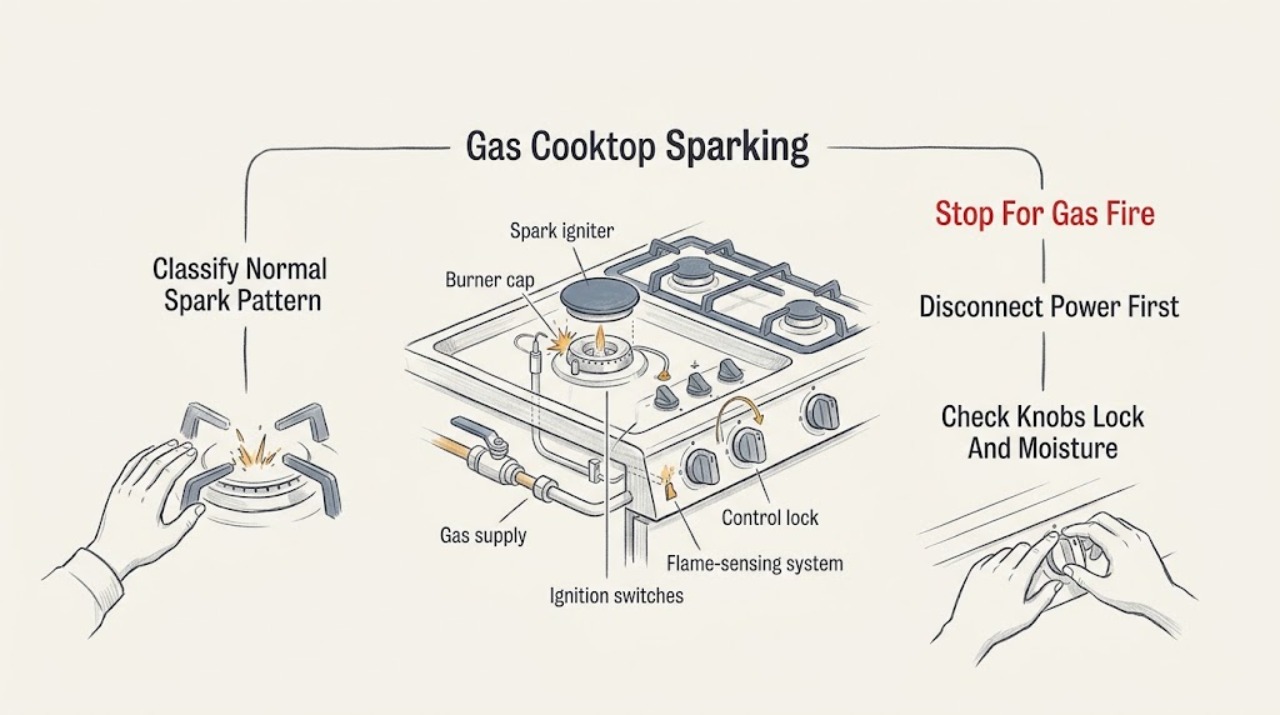
A gas cooktop normally clicks and sparks while a knob is pushed in and turned to Ignite, and some sealed-burner designs make all burners spark when one burner is selected. Sparking should stop after a stable flame appears and all knobs are returned fully to OFF. If every burner clicks with the knobs OFF, or one burner continues sparking after lighting, first turn all controls OFF and consider recent cleaning, a spill, moisture, a cap that is not seated, an active control lock, a draft, or a reignition feature—but do not keep operating it if the cause is not obvious and dry. Check only the user-accessible burner cap/port condition and external gas/power state as the exact manual permits. Gas odor, delayed ignition, a yellow or lifting flame, a flame outside the burner, visible arcing, smoke, burning smell, a hot control, or a spark that cannot be stopped means stop using the cooktop, avoid flames and unsafe electrical switching, leave if needed, and arrange appropriate emergency or qualified gas service. Never open the ignition module, adjust gas pressure, move the appliance to inspect its connector, or bypass a safety device.
Before you begin
Safety first
- This article supports ordinary control, model identification, accessible drying/cap observations, and one normal attended ignition attempt only when hazard-free. Do not access live wiring, gas connectors, valves, spark modules, sealed controls, or internal burner components.
Work through in order
Diagnostic checks
Use only checks that match the exact appliance or system and its official guide.
-
Check 1
Turn every burner control fully OFF and observe from a safe position for gas odor, a flame outside the burner, delayed whoosh, yellow/lifting flame, smoke, burning smell, visible arcing, a hot control, damaged cord, or a spark that continues with the controls OFF.
Expected result: Record whether the spark is limited to a knob in Ignite, continues after a flame appears, continues with all knobs OFF, or occurs away from the intended igniter; note any gas, fire, heat, or electrical symptom.
Next step: For suspected gas leak or visible smoke, leave the area and contact emergency help from a safe location without operating switches or flames. For arcing, burning odor, abnormal heat, or an uncontrollable spark, keep the cooktop off and arrange qualified service.
Stop if: Do not light a match, retry the burner, touch wet controls, operate electrical switches around gas odor, or continue if a flame, smoke, arc, or spark cannot be stopped normally.
Why this matters
Why: A short spark during normal ignition can be expected, but gas odor, delayed ignition, abnormal flame, smoke, arcing, or uncontrollable sparking is a safety event rather than a cleaning check.
-
Check 2
With no hazard present, identify which knob is being used and whether the spark occurs only while that knob is pushed and held at Ignite; compare the visible pattern with the exact model manual without placing hands near a lit burner.
Expected result: Record whether one burner sparks, several burners spark together, a burner lights promptly and the spark stops when the knob leaves Ignite, or the spark continues after the knob is OFF.
Next step: If the pattern matches normal ignition and the flame is stable, move the knob to the documented heat setting and monitor briefly. If sparking continues outside the documented control state, turn the controls OFF and continue with dry/cap/lock checks only when safe.
Stop if: Do not hold a knob in Ignite to force ignition, continue a burner with an unstable flame, or infer that all sparks are normal on a model that does not document that behavior.
Why this matters
Why: Some sealed-burner systems intentionally spark multiple electrodes when one burner is selected. A spark tied to Ignite can be normal; sparking with controls OFF or after a stable flame indicates moisture, reignition, switch, control, or ignition-fault branches.
-
Check 3
After all burners are cool and OFF, confirm each knob is fully returned and popped out, check for a Cooktop/Control Lock indicator, and allow the control area and knob shafts to dry thoroughly after cleaning or a spill; use cool air only if the exact manual allows it.
Expected result: Record whether clicking stops after the knob is fully OFF, whether a lock indicator is active, whether the sparking began after cleaning, and whether drying changes the symptom.
Next step: Correct only the knob position, documented lock state, or accessible moisture condition, then wait until the cooktop is fully dry before one normal ignition attempt. If the symptom returns, request service.
Stop if: Do not remove sealed controls, spray cleaner into switches, use heat near gas, bypass a lock, or continue with persistent OFF-position sparking.
Why this matters
Why: A partially engaged knob, control lock state, or moisture around switches can create clicking or prevent gas from lighting normally. If every knob is OFF and the cooktop remains wet or continues sparking, a control or ignition fault is possible.
-
Check 4
When the cooktop is cool and the knobs are OFF, inspect the user-accessible burner cap and head for a spill, debris, wrong cap, misalignment, or moisture; reseat the cap flush with its alignment features only as the exact manual describes.
Expected result: Record whether the cap sits flat with little movement, whether the spark reaches the burner area, whether the flame carries around the ports, and whether the burner lights promptly after drying and reseating.
Next step: Clean and dry only the accessible parts using the model manual, then make one normal ignition attempt. If the burner still clicks without a stable flame or several burners behave abnormally, turn it off and arrange service.
Stop if: Do not enlarge ports, use a sharp object not specified by the manual, remove internal burner hardware, or continue if gas odor, delayed ignition, yellow flame, smoke, or arcing appears.
Why this matters
Why: Whirlpool guidance links a clean, correctly seated cap and dry ports with reliable ignition. A cap/port correction may resolve a single burner, but it does not explain sparking with all controls OFF or arcing outside the burner.
-
Check 5
If no hazard is present, check the accessible power/breaker state and known external gas-supply status without moving the appliance or loosening a connection; note whether a strong downdraft or ventilation draft is disturbing the flame.
Expected result: Record whether all burners fail or only one, whether the igniter clicks, whether the main gas valve is known to be ON, whether a power interruption preceded the symptom, and whether a draft or spill repeatedly extinguishes the flame.
Next step: Correct only an obvious accessible control, supply, or draft condition described by the manual; otherwise turn the cooktop OFF and arrange qualified electrical or gas service.
Stop if: Do not move the appliance to inspect its gas connector, probe wiring, alter gas pressure, use a flame to search for leaks, or keep resetting a breaker.
Why this matters
Why: A gas cooktop needs both its ignition electricity and gas supply. A lockout or power state can produce clicking without a flame, while a draft or spill can trigger reignition. A missing supply or repeated flame disturbance needs professional diagnosis.
-
Check 6
After the cooktop is cool and dry and the controls, cap, and external conditions are normal, make one attended ignition attempt using the exact manual's normal control sequence, then turn the burner OFF and decide whether service is required.
Expected result: Record whether the burner lights promptly with a stable flame and the spark stops, whether it clicks without lighting, sparks after OFF, reignites repeatedly, or produces an abnormal flame or odor.
Next step: Arrange qualified appliance or gas service and provide the model, burner, knob state, spark pattern, cap/port condition, gas/power observations, draft, and timing. Treat gas odor, smoke, arc, or abnormal flame as immediate escalation.
Stop if: Do not perform additional ignition attempts, open the cooktop, access the spark module or gas valve, or continue a burner that sparks with controls OFF or does not light normally.
Why this matters
Why: A single stable ignition with the spark stopping supports a normal ignition pattern or corrected moisture/cap condition. Persistent sparking, no flame, delayed ignition, unstable flame, or inability to shut off indicates a gas, ignition, switch, control, or safety fault.
Use your observations
Decision map
Find the observation that best matches what you see, then follow the next safe action.
-
PATH 01Safety boundary
What you see
Gas odor, delayed ignition, abnormal flame, flame outside the burner, smoke, burning smell, visible arcing, abnormal heat, or uncontrollable OFF-position sparking is present.
Do this next
Turn controls OFF only if safe, avoid flames and electrical switching, leave the area if needed, and contact emergency gas/fire/electrical or qualified appliance help from safety.
Why this path and its safety boundary
Why it matters: This is a gas, fire, or electrical safety event.
Safety stop: Do not relight, operate switches, move the appliance, open the cooktop, or continue testing.
-
PATH 02Safety boundary
What you see
The selected knob is in Ignite, the expected burner lights promptly with a stable flame, and sparking stops after the knob reaches the documented heat setting.
Do this next
Use the cooktop only as the exact manual specifies and keep the cap seated and the burner area clean and dry.
Why this path and its safety boundary
Why it matters: This is consistent with normal electronic ignition for the applicable model; multiple burners may spark together on some designs.
Safety stop: Stop if sparking continues after OFF, the flame is unstable, or odor, smoke, arc, or unusual heat appears.
-
PATH 03Safety boundary
What you see
Sparking began after cleaning/spill, a burner is wet, or the cap/head is not seated, aligned, or clean; no gas or fire hazard is present.
Do this next
Let the accessible area dry completely and reseat/clean the cap only as the model manual permits, then make one normal attempt.
Why this path and its safety boundary
Why it matters: Moisture or burner geometry can prevent reliable ignition and can cause intermittent clicking.
Safety stop: Do not use improvised tools, enlarge ports, spray into switches, or continue if the burner remains unstable or gas odor appears.
-
PATH 04Safety boundary
What you see
Clicking occurs with a lock indicator, a knob not fully OFF, a reignition feature, or a draft/spill that repeatedly disturbs an otherwise lit flame.
Do this next
Return knobs fully OFF, use only the manual's documented unlock, and remove an obvious draft/spill condition before one normal attempt.
Why this path and its safety boundary
Why it matters: The control state or flame-sensing system may be requesting ignition without an internal spark failure.
Safety stop: Do not bypass the lock, force a knob, or continue when sparking persists with all controls OFF.
-
PATH 05Safety boundary
What you see
All burners fail, the accessible power/gas condition is abnormal, a burner clicks without flame after safe drying/cap checks, or sparking continues with controls OFF.
Do this next
Turn the cooktop OFF and arrange qualified electrical, gas, or appliance service with the exact model and symptom sequence.
Why this path and its safety boundary
Why it matters: A supply, switch, spark module, burner, valve, or other ignition fault may be involved; the symptom cannot select a part safely.
Safety stop: Do not move the cooktop, open gas/electrical assemblies, search for leaks with flame, or repeat failed ignition.
Helpful context
Understand the symptom
Normal ignition is brief and tied to the control position
Electronic ignition replaces a standing pilot on many gas cooktops. A spark while the knob is being pushed and turned to Ignite is expected; depending on the design, more than one burner can click. Once a stable flame is visible and the control is moved away from Ignite, the spark should stop. A spark or click with every control fully OFF is a different symptom.
Water and burner geometry can keep a spark going
Cleaning moisture or a spill can make ignition switches or burner ports click intermittently. A cap that is on the wrong burner, off-center, wet, or not flush can prevent reliable flame carryover. Let the cooktop cool and dry, then use the exact manual's cleaning and cap-alignment instructions. Do not enlarge ports or use improvised tools.
A reignition system can click after a flame is disturbed
Some cooktops automatically spark when wind, a spill, or a ventilation draft extinguishes a flame. Occasional clicking can also occur at a low setting on some flame-sensing systems. Continuous sparking with the knob OFF, a delayed light, an abnormal flame, or an arc outside the intended igniter gap is not a setting to ignore; turn the controls off and arrange service.
Safety boundary
Stop conditions
- Stop immediately for gas odor, delayed ignition, abnormal/yellow/lifting flame, flame outside the burner, smoke, burning smell, visible arcing, abnormal heat, or a spark that continues with all controls OFF.
- Do not light a match, use flame to search for a leak, repeatedly retry ignition, hold a knob open, or operate electrical switches around suspected gas odor.
- Do not move the cooktop to inspect a gas connector, open the cooktop or spark module, probe live wiring, adjust gas pressure, or bypass a lock, flame, or safety device.
- Do not spray cleaner into switches, use improvised sharp tools, enlarge burner ports, or continue with wet, damaged, misaligned, or unstable burner parts.
- Arrange qualified service when sparking persists after the controls are OFF and the accessible area is dry, a burner will not light, several burners fail, or the flame/ignition is abnormal.
When checks do not resolve it
Need a professional?
Arrange qualified appliance or gas service when a burner continues sparking with its knob OFF, several burners fail to light, a burner clicks without flame after safe drying and cap checks, a reignition symptom persists, or the cooktop has a supply, lock, switch, spark, valve, or flame-sensing concern. Use an electrician for recurring power faults and qualified gas service for gas supply, connector, valve, or abnormal-flame concerns. Treat gas odor, delayed ignition, smoke, arcing, burning smell, and abnormal heat as immediate safety escalations.
Safety scope: This article supports ordinary control, model identification, accessible drying/cap observations, and one normal attended ignition attempt only when hazard-free. Do not access live wiring, gas connectors, valves, spark modules, sealed controls, or internal burner components.
Common questions
FAQ
Is it normal for a gas cooktop to spark when I turn on one burner?
Usually, a brief spark while the selected knob is pushed and turned to Ignite is normal. Some sealed-burner designs spark several electrodes at once. The spark should stop after a stable flame appears and the knob leaves Ignite. Sparking with all knobs OFF or after the flame is stable is a different branch.
Why is my gas cooktop clicking after cleaning?
Moisture around burner ports or ignition switches can cause intermittent clicking. Turn all controls OFF, let the cooktop cool and dry thoroughly, and reseat the cap only as the manual directs. If clicking continues with the controls OFF, arrange service rather than operating the cooktop wet.
Why do all burners spark when I turn on just one?
Some sealed-burner gas cooktops use one spark-control module for multiple electrodes, so several burners can click even though gas is selected at only one. Confirm that the selected burner lights normally and the spark stops after the knob leaves Ignite. Use the exact model manual if the pattern is unfamiliar.
What should I do if the burner keeps sparking after it lights?
Turn the burner OFF if it does not stop sparking normally. A reignition system may spark after a spill, wind, or draft extinguishes a flame, but continued sparking can also involve moisture, cap/port alignment, flame sensing, or a fault. Do not keep cooking through the symptom; arrange service if it returns.
When is gas-cooktop sparking dangerous?
Stop immediately for gas odor, delayed ignition, a yellow/lifting flame, flame outside the burner, smoke, burning smell, visible arcing, abnormal heat, or sparking with every control OFF. Avoid flames and electrical switches, leave the area if needed, and contact emergency gas or qualified appliance help from safety. Do not move the cooktop or open its gas or ignition parts.
Read the exact guide
Official sources
- Nothing Will Work - Gas CooktopWhirlpool Product Help · Manufacturer guidance for applicable gas cooktops; exact supply and lock requirements vary by model and installation.
- Certain Older Gas Connectors May Be DangerousU.S. Consumer Product Safety Commission · General CPSC gas-appliance safety guidance, not a cooktop-specific diagnosis; use qualified professionals for connector inspection.
- Gas Range & Cooktop - Surface Burners SparkingGE Appliances · GE guidance for its applicable sealed-burner designs; do not generalize to an unidentified model.
- Gas Range & Cooktop - One or More Burners Are ClickingGE Appliances · GE guidance for its applicable gas ranges/cooktops; model-specific parts and lock states vary.
- Gas Burners are Clicking but Not LightingWhirlpool Product Help · Manufacturer guidance for applicable cooktops and dual-fuel ranges; exact owner manual controls safe procedures.
- Clicking or Ticking - Gas CooktopWhirlpool Product Help · Manufacturer guidance for applicable gas cooktops; model-specific lock and flame-sensing behavior controls.
- Lighting the Burners - Electronic IgnitionWhirlpool Product Help · Manufacturer guidance for applicable Whirlpool-family gas cooktops; exact model controls and burner layout vary.
Community feedback
Share a repair observation
Share a plain-text repair observation. Accepted observations are published automatically; this page may take a moment to update.