
On this page
Start here
Quick answer
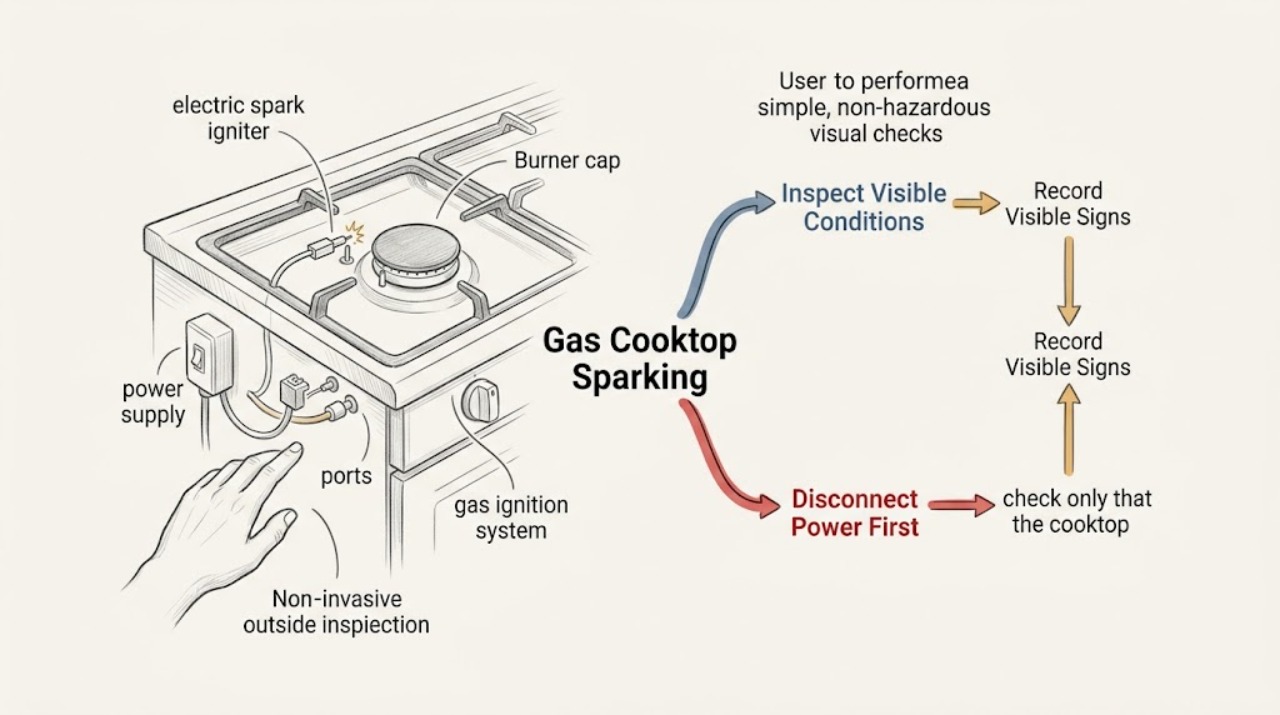
A brief clicking or visible spark while a Viking burner is being turned on is part of its electric spark ignition; the spark should stop once a stable flame is established. If the igniter keeps clicking after the flame is lit, turn the control off and let the cooled burner area dry, then check for a wet or dirty burner cap and an obvious burner-cap alignment problem. If the igniters spark but no flame appears, do not keep trying: the gas valve may be off or the gas supply may be interrupted. A spark away from the burner, an electrical arc, smoke, burning odor, delayed ignition, a large or yellow flame, or any gas smell is a stop condition. Do not touch electrical switches or create an ignition source when gas may be leaking; leave and contact local gas authorities from outside.
Work through in order
Diagnostic checks
Use only checks that match the exact appliance or system and its official guide.
-
Check 1
Before testing a burner, stand back and look for a gas odor, hissing, smoke, scorch marks, a spark jumping to the cooktop surface, a hot or damaged cord, or an abnormal flame. If the burner has already been turned off, do not turn it on again just to reproduce the symptom.
Expected result: Gas is smelled or heard, smoke or scorching is present, an electrical arc is visible, or the flame is delayed, lifting, very large, distorted, or yellow; or the only symptom is a brief spark at the intended igniter while a stable flame forms.
Next step: For gas odor or suspected leakage, leave immediately without operating switches or phones inside and contact local gas authorities from outside. For smoke, fire, or electrical arcing, stop and use emergency help as appropriate. Otherwise continue by identifying when the clicking stops.
Why this matters
Why: The first group can indicate a gas, fire, or electrical hazard and is not a routine ignition adjustment. A brief spark at the burner during successful ignition is expected behavior for this cooktop family.
-
Check 2
With all controls off and the cooktop cool, turn on only the affected burner using the normal control movement described in the exact Viking manual. Observe the ignition from a safe position and turn the control back off if no stable flame appears promptly; never hold the control open while gas accumulates.
Expected result: The burner lights and clicking stops; the igniter clicks or sparks but no flame appears; or the flame lights while clicking continues.
Next step: Use the no-flame branch if there is no ignition and the continuous-spark branch if clicking remains after a flame appears. If the flame is delayed or there is any gas odor, stop all testing and leave the area.
Why this matters
Why: A flame with stopping clicks is the normal end state. Spark without flame points to a gas-supply or burner-ignition problem. Continued clicking after ignition is a fault branch identified by Viking and can be associated with moisture, dirt, grounding, or polarity issues.
-
Check 3
If the igniter clicks but the burner does not light, check only that the cooktop is plugged in and that the relevant circuit has not been interrupted. From a safe location, confirm that the household gas supply is available and that the appliance gas shutoff has not intentionally been left off; do not move the appliance or open gas connections.
Expected result: Power is absent, the gas supply is interrupted or shut off, or power and gas appear available but the burner still produces sparks without flame.
Next step: Restore a tripped circuit only once if it can be done safely and no moisture, odor, heat, or damage is present. Do not reset a breaker that trips again. If gas is unavailable, contact the utility or qualified service; if supplies are normal but there is no flame, stop using the burner.
Why this matters
Why: Viking lists a tripped circuit, blown fuse, or missing power for nonworking igniters, and a shut gas valve or interrupted gas supply for sparks without flame. A persistent no-flame condition with those supplies available needs qualified diagnosis.
-
Check 4
For a burner that lights but keeps sparking, switch the control off and wait until all parts are cool. Remove only the removable burner cap and head if the exact manual permits it, check that they are seated in their original positions, and dry them completely after a spill or cleaning. Do not spray liquid into the control panel or use a metal tool to enlarge burner ports.
Expected result: The cap or head was wet, dirty, tilted, or not seated correctly; or the parts are clean, dry, and correctly seated but the igniter still clicks after a stable flame appears.
Next step: After the parts are fully dry and correctly seated, perform no more than one normal ignition check. If clicking continues, stop using that burner and arrange qualified service; do not alter the electrical supply or ignition wiring.
Why this matters
Why: Viking identifies wet or dirty igniters as a cause of continuous sparking and says clean, dry burner caps help prevent improper ignition and uneven flames. Continued sparking after accessible cleaning can involve grounding, polarity, wiring, or an ignition component and is not a user adjustment.
-
Check 5
If a flame appears, observe its shape and color without leaning over the burner. Confirm that it stays at the burner ports and does not extend around the cookware. Turn the control off if the flame is large, yellow, distorted, lifting, or accompanied by soot, smoke, or a gas odor.
Expected result: The flame is stable and appropriately confined to the burner; or it is large, distorted, yellow, lifting, or not consistently reaching the ports.
Next step: Stop using the burner and call a qualified servicer for an abnormal flame, especially after installation or gas conversion. If gas remains unburned or a gas odor is present, leave immediately and contact local gas authorities from outside.
Why this matters
Why: Viking associates an abnormal flame with blocked burner ports, an incorrect gas type, or an air-shutter adjustment issue. Those conditions should not be corrected by guessing at gas conversion or adjustment settings.
-
Check 6
Check whether sparking affects one burner or several, and record whether it began after a spill, cleaning, power interruption, installation, or gas conversion. Keep every knob off while waiting for service and have the model and serial information available from the appliance documentation or accessible identification label.
Expected result: Only one burner continues to spark, several burners behave the same way, or the symptom began after moisture, an electrical event, or installation work.
Next step: Give the servicer the exact model, serial information, affected burner count, and whether a flame was present when sparking continued. Leave the cooktop unused if the cause is not clearly resolved by the safe checks above.
Why this matters
Why: A single-burner symptom helps the servicer focus on that burner and its igniter. Several burners or a post-installation symptom can point to a shared power, grounding, polarity, or configuration issue; a user should not verify those by opening the unit.
Use your observations
Decision map
Find the observation that best matches what you see, then follow the next safe action.
-
PATH 01Next step
What you see
A brief spark or click occurs only while a burner is being turned on, then a stable flame appears and the clicking stops.
Do this next
Treat this as the expected electric-ignition sequence and use the burner only with a stable, correctly shaped flame.
Why this path and its safety boundary
Why it matters: If clicks continue after the flame is stable, move to the continuous-spark branch rather than continuing to cook.
-
PATH 02Next step
What you see
The igniter sparks but no flame appears.
Do this next
Turn the control off, avoid repeated attempts, and check only accessible power and the intended gas-supply/shutoff status without moving the appliance or opening connections.
Why this path and its safety boundary
Why it matters: If supplies are available but there is still no flame, stop using the burner and arrange qualified service; any gas odor requires immediate evacuation and an outside call to local gas authorities.
-
PATH 03Next step
What you see
The burner lights but the igniter keeps clicking or sparking.
Do this next
Turn the control off, let the cooktop cool, dry and correctly reseat the accessible burner cap and head if the manual permits, and make one normal check only.
Why this path and its safety boundary
Why it matters: If sparking remains, stop using the burner; do not test grounding, polarity, or live ignition wiring yourself.
-
PATH 04Next step
What you see
The flame is large, yellow, distorted, lifting, delayed, or accompanied by soot, smoke, or gas odor.
Do this next
Turn the control off if it is safe to do so and stop using the appliance. Do not adjust gas conversion parts or air shutters.
Why this path and its safety boundary
Why it matters: Arrange qualified service for the abnormal flame. If gas is smelled or heard escaping, leave without using electrical switches or phones inside and contact local gas authorities from outside.
-
PATH 05Next step
What you see
A spark jumps away from the burner, an arc or smoke is visible, the cord or cooktop is unusually hot, or a breaker trips again.
Do this next
Stop operation and isolate power only from a safe location if doing so does not require touching a damaged or wet component.
Why this path and its safety boundary
Why it matters: Do not reconnect or test the cooktop. Have a qualified professional assess the electrical and gas appliance system; use emergency help for fire or immediate danger.
Helpful context
Understand the symptom
When sparking is normal
Viking gas cooktops use electric ignition rather than a standing pilot. Turning a burner control on permits gas to flow and starts the igniters; a few clicks before the burner lights can be normal. Automatic re-ignition can also create sparks if a lit flame goes out while gas is still flowing. The useful distinction is whether a stable flame appears and the clicking stops, not simply whether you can hear a click.
Keep the diagnosis at the user-safe boundary
These checks cover the controls, plug and breaker, cool removable burner parts, and visible flame behavior. Do not remove the cooktop, alter gas settings, adjust air shutters, test live wiring, or continue ignition attempts to see whether a fault repeats. Viking's manual says repairs and gas adjustments should be handled by a qualified servicer.
When checks do not resolve it
Need a professional?
Stop and arrange qualified service if a burner continues sparking after it is off or after accessible parts are fully dry and correctly seated, if several burners spark abnormally, or if no flame appears despite confirmed accessible supplies., Stop immediately for a gas odor or hissing, delayed ignition, an abnormal flame, smoke, scorching, an arc away from the burner, a hot or damaged cord, moisture near electrical parts, or a breaker that trips again. Do not open the cooktop, test live wiring, alter gas settings, adjust air shutters, or open gas connections., If gas is smelled or heard escaping, leave the home immediately, do not operate lights, switches, or phones inside, and contact local gas authorities from outside. For smoke or fire, leave and contact emergency services as appropriate.
Common questions
FAQ
Is it normal for a Viking gas cooktop to spark or click?
Yes, a brief spark and several clicks while a burner is being ignited are part of the electric ignition sequence. The clicking should stop after a stable flame appears. If it continues, turn the control off and follow the moisture, burner-cap, and service branch.
Why does my Viking igniter keep sparking after the flame is lit?
Viking lists wet or dirty igniters, grounding, and polarity among possible causes of continuous sparking. With the controls off and the cooktop cool, dry and correctly seat the accessible burner parts if the manual permits. If it still sparks, stop using the burner and arrange qualified service rather than testing wiring or changing the electrical supply.
What should I do if the igniter sparks but there is no flame?
Turn the control off and do not keep retrying. Check only accessible power and the intended gas-supply or shutoff status without moving the appliance or opening connections. If the supply appears available but there is still no flame, stop using the burner. Any gas odor or hissing requires immediate evacuation.
When is sparking an electrical emergency?
Stop immediately for an arc away from the burner, smoke, scorching, a hot or damaged cord, moisture near electrical parts, or a breaker that trips again. Do not reconnect or test the cooktop until a qualified professional has assessed it. If you smell gas, do not operate switches or phones inside; leave and contact local gas authorities from outside.
Can I adjust the air shutter or gas conversion to stop the sparking?
No. An abnormal flame can involve gas type or an air-shutter adjustment, but those are not safe guesses for a homeowner. Do not open the cooktop or alter gas settings; provide the exact model information to a qualified servicer.
Read the exact guide
Official sources
- Use & Care Professional Built-in Gas CooktopsViking Range, LLC · Viking VGC and VGSU professional built-in gas cooktop families listed in the manual; exact model instructions take precedence
- CPSC Urges Flood Victims to Take Steps to Prevent CO Poisoning, Electrocution, Explosion and FiresU.S. Consumer Product Safety Commission · U.S. CPSC consumer safety guidance for suspected household gas leaks
- Viking Range, LLC | 36"W. Gas CooktopViking Range, LLC · Viking VGSU5361 gas cooktop product page; use the exact model's documentation for model-specific behavior
Community feedback
Share a repair observation
Share a plain-text repair observation. Accepted observations are published automatically; this page may take a moment to update.