
On this page
Start here
Quick answer
A high-pitched tone that is present only while a Thermador refrigerator door is closed and stops immediately when that door opens is not the documented door-open alarm in the cited Thermador T36FT manual family: that alarm sounds after the door has been open for a while and stops when the door is closed or ALARM OFF is pressed. First record exactly which door silences the sound, whether the display shows an alarm, and whether cooling or frost changed. A fan, ice, airflow, or door-switch/control interaction is possible, but this symptom does not identify a failed part. Check only the accessible shelves, containers, vents, gasket, model label, and visible safety condition. Do not remove interior or rear panels, force a defrost, add a heater, or run live electrical tests. Protect food and arrange qualified Thermador service if cooling is impaired, a temperature alarm appears, the tone becomes scraping or intermittent with damage, or the tone persists after the external checks.
Before you begin
Safety first
- Do not remove interior or rear panels, defeat a door switch, chip or heat ice, install a heater, bridge or disconnect wiring, perform live voltage tests, open sealed refrigeration components, or choose a part solely from a sound. Stop immediately for smoke, burning odor, a hot or damaged cord or plug, water near electrical parts, exposed wiring, repeated breaker operation, or unsafe cooling and food conditions.
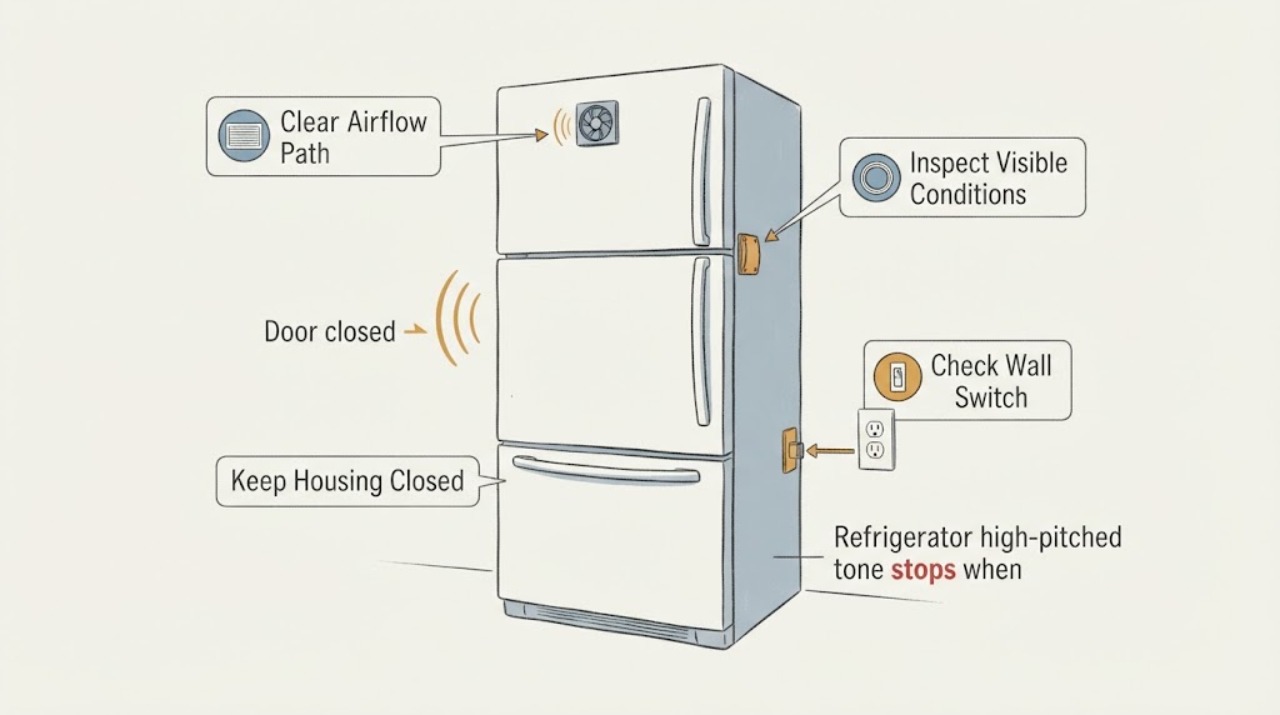
Work through in order
Diagnostic checks
Use only checks that match the exact appliance or system and its official guide.
-
Check 1
From a normal standing position, note whether the tone is present with the refrigerator door fully closed, whether opening the refrigerator door stops it immediately, whether opening only the freezer door changes it, and whether the sound is a steady high pitch, a fan-like whine, a scrape, or an intermittent beep. Do not hold a switch open, remove a door panel, or reach near a moving fan.
Expected result: The tone stops instantly when the refrigerator door opens, the freezer door has no effect, or neither door changes the sound; the sound is steady, fan-like, scraping, or a patterned beep.
Next step: Record a short description or safe recording for the service visit and continue with the visible display, cooling, and external-obstruction checks. Stop if the sound is accompanied by rubbing, smoke, burning odor, heat, or electrical damage.
Stop if: Do not press or defeat a door switch, remove an internal cover, or place hands or tools near a fan.
Why this matters
Why: A door-state and timing response is different from a generic door-closure obstruction. Instant silencing by one door makes a fan/airflow or door-switch/control interaction worth assessing, while a patterned beep or an unchanged sound needs the exact model manual rather than a guessed component diagnosis.
-
Check 2
With the appliance operating normally and the doors closed between observations, look at the display and controls. Check whether an ALARM OFF indicator, a door-open message, a freezer-high-temperature warning, or another model-specific message appears. Compare the result only with the exact Thermador owner manual; do not enter a hidden diagnostic mode or use a reset sequence from another model.
Expected result: A door alarm or temperature alarm is displayed, the display is normal with no alarm, or the message cannot be matched to the exact model manual.
Next step: For a documented alarm, follow the exact manual's external response and watch whether it clears when the documented condition ends. For a closed-door tone with no matching alarm, preserve the observations and use Thermador's model-specific support or qualified service.
Stop if: Do not repeatedly cycle power, change settings at random, or remove the control panel to clear a tone.
Why this matters
Why: The T36FT manual documents separate door and freezer-temperature alarms, while a closed-door high pitch without an alarm display is not established as that documented door alarm. An unmatched display is a model-identity problem, not proof of a failed board or sensor.
-
Check 3
Inspect only accessible storage and airflow points: confirm that containers are not touching or projecting into the door path, shelves and bins are seated, visible interior and exterior ventilation openings are clear, and there is no visible frost blocking an opening. Do not remove a rear wall, fan shroud, evaporator cover, or fixed grille.
Expected result: A container or fitting is touching, an accessible vent is blocked, frost is visible, or the accessible interior and exterior are clear.
Next step: Correct only a clearly accessible loading or vent obstruction and monitor one normal cooling cycle. If frost returns, the tone persists, or the obstruction is behind a fixed panel, arrange qualified service instead of forcing a defrost or installing a heater.
Stop if: Do not chip ice, use a heat gun or hair dryer, insert tools into vents, or add an aftermarket heater.
Why this matters
Why: The Thermador manual says to keep interior and exterior ventilation openings clear, leave space between food and the back panel, and keep removable fittings from wobbling or sticking. A clear external inspection does not rule in or rule out internal fan ice or another service condition.
-
Check 4
Check the cooling and safety condition without dismantling the refrigerator: note whether both compartments are maintaining their usual cold condition, whether food may have warmed, and whether there is water near electrics, a hot or damaged plug, burning odor, smoke, exposed wiring, or a repeated breaker trip. Keep the doors closed as much as practical.
Expected result: Cooling is normal and no hazard is visible, cooling is worsening or a temperature alarm is active, or any electrical, water, smoke, heat, or repeated-breaker symptom is present.
Next step: If cooling is impaired or food safety is uncertain, protect or move perishable food according to local food-safety guidance and arrange prompt refrigeration service. For smoke, burning odor, water near electrical parts, a hot or damaged cord or plug, exposed wiring, or repeated breaker operation, stop using the appliance and isolate power only from a safe dry location before qualified service.
Stop if: Do not restore power to wet or scorched equipment, bypass a breaker, or continue reproducing the sound when a hazard is present.
Why this matters
Why: A sound does not establish that food remains safe or that the refrigeration system is healthy. The Thermador manual treats a freezer temperature alarm as a separate condition and warns against operating a damaged appliance or using electrical devices inside it.
-
Check 5
Photograph the rating-plate model and the display, and record the market, which door changes the sound, the exact timing, cooling observations, visible frost, and any alarm text. Use Thermador's official refrigeration support route to locate the matching manual or service path.
Expected result: The full model is available and the tone can be reproduced safely, or the model, market, or symptom pattern remains uncertain.
Next step: Arrange qualified Thermador service for a persistent or recurring tone, especially if it is a high-pitched whine or scrape, returns after clearing an accessible obstruction, or is paired with cooling changes. Give the provider the model, recording, alarm state, and safety observations.
Stop if: Do not order a fan, sensor, control board, heater, or gasket solely from the sound or from a different Thermador model.
Why this matters
Why: Thermador's support material is organized around model-specific manuals and troubleshooting. A service provider can use the timing and door-state evidence to assess fan/airflow, door-switch or control behavior without assuming a part from a different family.
Use your observations
Decision map
Find the observation that best matches what you see, then follow the next safe action.
-
PATH 01Next step
What you see
The tone occurs only while the refrigerator door is closed, stops immediately when that door opens, the freezer door does not change it, and there is no ALARM OFF or temperature warning.
Do this next
If the tone persists after the accessible vent and loading check, arrange qualified Thermador service and provide the exact model plus the door-state recording. Do not remove the fan cover or attempt a heater or forced-defrost repair.
Why this path and its safety boundary
Why it matters: This does not match the opened T36FT manual's door-open alarm pattern. A fan/airflow or door-switch/control interaction is possible, but the Reddit report and timing are only clues, not a confirmed diagnosis.
-
PATH 02Next step
What you see
The sound is a patterned warning, appears after a door has been left open, and the display shows ALARM OFF or a matching door-alarm indication.
Do this next
Close the door fully and use ALARM OFF only as the exact manual describes. If the warning returns with the door closed or the display does not match the model manual, preserve the evidence and arrange service.
Why this path and its safety boundary
Why it matters: For the opened T36FT family, this is consistent with the documented door alarm rather than the closed-door high-pitched symptom.
-
PATH 03Next step
What you see
The tone is accompanied by visible frost at an airflow opening, reduced cooling, a freezer-high-temperature warning, or food that may have warmed.
Do this next
Keep the doors closed, protect or move perishable food according to local food-safety guidance, and arrange prompt qualified refrigeration service. Do not chip ice, force a defrost, or open fixed panels.
Why this path and its safety boundary
Why it matters: The sound is now combined with an airflow, cooling, and food-safety concern. The alarm or frost does not identify a particular fan, heater, sensor, or control board.
-
PATH 04Next step
What you see
The model, market, appliance family, or display behavior cannot be matched, or the tone continues regardless of door state.
Do this next
Use the exact Thermador manual or official support route and arrange qualified service if the tone persists. Do not transfer a reset, component location, or part recommendation from another model.
Why this path and its safety boundary
Why it matters: The cited manual behavior cannot be safely generalized, and the symptom may be a different alarm, an ordinary operating noise, or a service fault that requires model-specific diagnosis.
-
PATH 05Next step
What you see
The tone is accompanied by smoke, burning odor, a hot or damaged cord or plug, water near electrical parts, exposed wiring, or repeated breaker operation.
Do this next
Stop using the refrigerator, isolate power only if it is safe to do so from a dry location, keep clear, and obtain qualified appliance or electrical service; use emergency help for an active fire. Do not reproduce the sound or remove covers.
Why this path and its safety boundary
Why it matters: This is an electrical, fire, shock, or water-damage stop boundary in addition to the refrigerator symptom.
Helpful context
Understand the symptom
Why the closed-door timing matters
The exact timing is the first useful separator. In the opened Thermador T36FT manual, the door alarm starts after the door is open for a while, shows ALARM OFF, and stops when the door is closed or ALARM OFF is pressed. A tone that is already present with the door closed and disappears as soon as the refrigerator door opens does not match that documented pattern. It may be related to a running fan, airflow or ice condition, or a door-switch/control response, but the sound alone cannot confirm any of those causes.
Keep the model boundary explicit
Thermador sells multiple refrigerator families and the official support site routes owners to the exact manual and model-number path. Use the T36FT alarm description as a comparison, not as a universal rule for every Thermador refrigerator. Do not transfer a diagnostic-menu sequence, fan location, defrost duration, or part number from another model.
When checks do not resolve it
Need a professional?
Arrange qualified Thermador service when the high-pitched tone persists after accessible loading and vent checks, returns repeatedly, becomes a whine or scrape, cannot be matched to the exact manual, or occurs with frost, reduced cooling, or a temperature warning. Use qualified electrical help for visible power damage or repeated breaker activity.
Safety scope: Do not remove interior or rear panels, defeat a door switch, chip or heat ice, install a heater, bridge or disconnect wiring, perform live voltage tests, open sealed refrigeration components, or choose a part solely from a sound. Stop immediately for smoke, burning odor, a hot or damaged cord or plug, water near electrical parts, exposed wiring, repeated breaker operation, or unsafe cooling and food conditions.
Have this ready
- Provide the full model or product code, market, display photo, exact sound description or safe recording, which door silences it, whether the freezer door changes it, timing, ALARM OFF or temperature-warning state, cooling and frost observations, and any water, odor, heat, smoke, or breaker observations.
Common questions
FAQ
Why does my Thermador refrigerator make a high-pitched tone that stops when I open the door?
That timing does not match the documented T36FT door alarm, which sounds after the door has been open for a while. A fan, airflow or ice condition, or a door-switch/control interaction is possible, but the symptom does not identify a failed part. Record which door silences it, check only accessible vents and loading, and arrange model-specific service if it persists.
Is a tone from a Thermador refrigerator always a door alarm?
No. The opened Thermador manual describes a door alarm with a door-open condition and ALARM OFF indication, while it separately lists motor, fan, refrigerant, valve, defrost, and ice-maker sounds. Because Thermador models differ, match the exact model manual before labeling a sound.
Can I remove the rear panel or install a heater to stop this noise?
No. A community suggestion about fan ice is not a model-specific repair instruction. Do not remove fixed panels, chip ice, use improvised heat, or install a heater. If visible frost, poor cooling, or a temperature alarm accompanies the tone, protect food and arrange qualified refrigeration service.
Read the exact guide
Official sources
- Refrigerator Troubleshooting | Problems & Solutions | ThermadorThermador · Supports using the exact model's troubleshooting and manual path and qualified service routing; it does not define the closed-door high-pitched symptom or a universal part cause.
- Use and Care Manual T36FT.. | ThermadorThermador / BSH Home Appliances · Directly supports the T36FT family's documented door-alarm timing, separate temperature alarm, listed normal operating sounds, ventilation guidance, and professional-repair safety boundary. It is not a universal manual for every Thermador refrigerator.
- High pitched tone from Thermador refrigerator, stops when door opensReddit r/Appliances · Supports only the reported symptom pattern and a community hypothesis; it is not authoritative model documentation or a repair instruction.
Community feedback
Share a repair observation
Share a plain-text repair observation. Accepted observations are published automatically; this page may take a moment to update.