
On this page
Start here
Quick answer
For a noisy Thermador refrigerator, record when the sound occurs and whether cooling, fans, ice, or water use coincide. Check only for stable placement and visible obstructions; do not access fans or sealed components. A new, harsh, or persistent noise needs service.
Work through in order
Diagnostic checks
Use only checks that match the exact appliance or system and its official guide.
-
Check 1
Record the sound, location, duration, and whether it coincides with compressor, fan, ice, or water operation.
Expected result: The sound is brief and function-linked, or it is new, harsh, continuous, or unrelated to a normal cycle.
Next step: Monitor only a normal brief sound. Arrange service for persistent or worsening noise.
Why this matters
Why: A function-linked sound may be an operating event; a new or harsh sound needs diagnosis rather than a guessed part.
-
Check 2
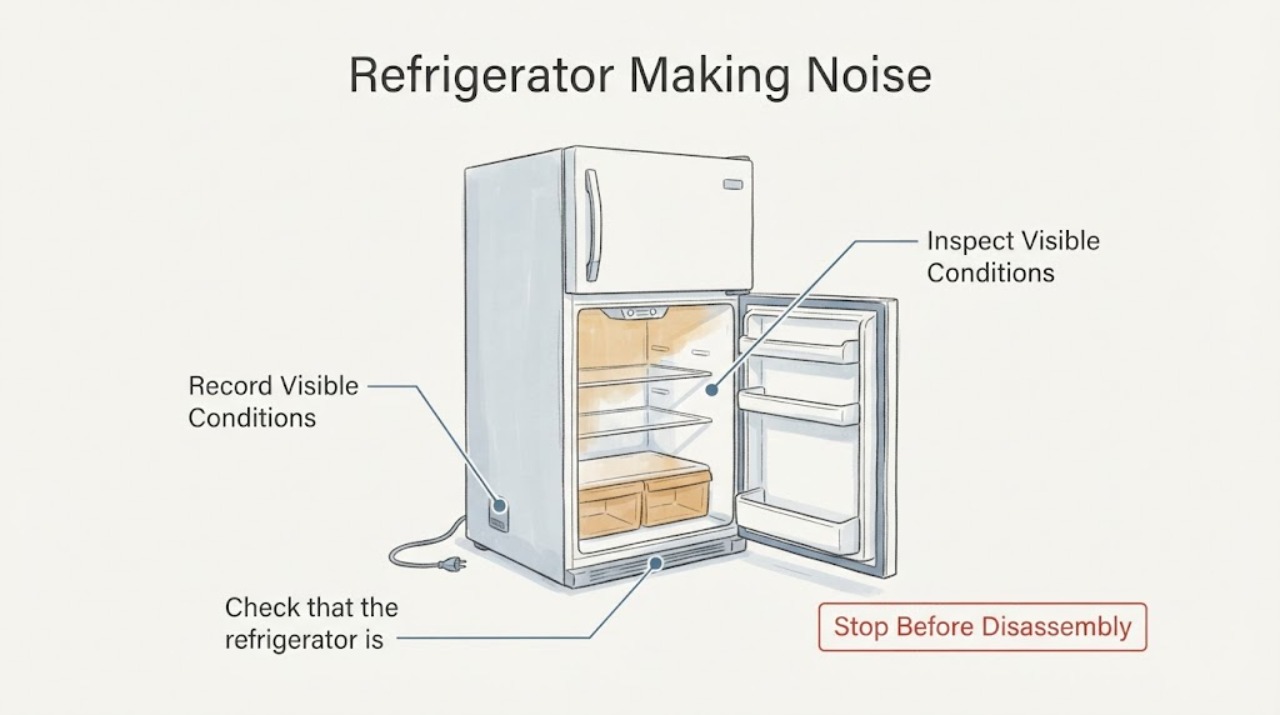
Check that the refrigerator is stable and that accessible bottles, bins, or nearby objects are not vibrating against it.
Expected result: An object or unstable contact is found, or the source is internal or unclear.
Next step: Move only the loose object or correct safe placement. Do not move the appliance or access fans.
Why this matters
Why: External vibration can create noise without a component failure.
-
Check 3
Observe whether cooling, ice making, dispensing, and door operation remain normal.
Expected result: All functions remain normal, or a function also fails.
Next step: Record the combination for the technician and stop if heat, odor, or electrical symptoms appear.
Why this matters
Why: A noise plus a failed function raises the need for service.
-
Check 4
Check the display for warnings without repeatedly power-cycling the unit.
Expected result: A warning is present, or the display is normal.
Next step: Use the exact manual or arrange service for an unexplained persistent sound.
Why this matters
Why: A warning can provide model-specific diagnostic context; a normal display does not rule out a mechanical fault.
Use your observations
Decision map
Find the observation that best matches what you see, then follow the next safe action.
-
PATH 01Next step
What you see
Making noise is linked to an accessible obstruction, setting, or supply issue
Do this next
Correct only the documented condition and monitor once.
Why this path and its safety boundary
Why it matters: The symptom may have an external explanation that can be corrected under the exact manual.
-
PATH 02Next step
What you see
The refrigerator remains making noise after safe external checks
Do this next
Arrange qualified Thermador service.
Why this path and its safety boundary
Why it matters: The assigned symptom is not resolved by an accessible condition and needs model-specific diagnosis.
-
PATH 03Next step
What you see
The symptom includes heat, smoke, burning odor, water damage, exposed wiring, or a repeat breaker trip
Do this next
Leave the appliance isolated when safe and obtain qualified service.
Why this path and its safety boundary
Why it matters: The condition is unsafe to continue testing.
Helpful context
Understand the symptom
The useful decision for a refrigerator that is making noise is to separate an accessible loading, setting, or supply condition from a symptom that needs model-specific service. Observe the result of each check before taking the next step.
When checks do not resolve it
Need a professional?
Stop troubleshooting and arrange qualified Thermador service if the Thermador refrigerator remains making noise after the safe external checks, if a control is damaged, or if a breaker trips again. Do not remove covers or work on energized, gas, sealed, or refrigerant components.
Common questions
FAQ
Can I keep using the Thermador refrigerator while it is making noise?
Stop troubleshooting and arrange qualified Thermador service if the Thermador refrigerator remains making noise after the safe external checks, if a control is damaged, or if a breaker trips again. Do not remove covers or work on energized, gas, sealed, or refrigerant components.
Read the exact guide
Official sources
- Refrigerator Troubleshooting | Problems & Solutions | ThermadorThermador · Thermador refrigerator and refrigeration troubleshooting, water and ice maker checks, odor, power, temperature, and service guidance
Community feedback
Share a repair observation
Share a plain-text repair observation. Accepted observations are published automatically; this page may take a moment to update.