
On this page
Start here
Quick answer
A Crosley refrigerator can make normal hum or pulsating compressor sounds, fan airflow, gurgling as refrigerant moves, whooshing as door pressure equalizes, clicks during a restart or defrost, and sizzling or dripping during automatic defrost. First note where and when the sound occurs and whether the refrigerator is cooling normally. Then check only from outside that the cabinet is level, not touching a wall or cabinet, and that no loose item or accessible water line is vibrating against it; on ice-maker models, a fill-valve buzz or loud chatter with no connected water supply has a model-specific explanation. A new grinding, scraping, arcing, burning smell, repeated hard-start clicking with poor cooling, or noise from an inaccessible component is not a safe DIY diagnosis. Unplug only from a safe position and leave fans, compressor/start parts, wiring, sealed refrigeration work, and internal repairs to qualified service.
Before you begin
Safety first
- The user may listen from outside, note the cycle, check safe cabinet contact and leveling, and use an exact model's external ice-maker control. Compressor, fan, motor mount, start device, control, defrost heater, wiring, ice-maker mechanism, and sealed-system diagnosis or repair are for qualified service personnel.
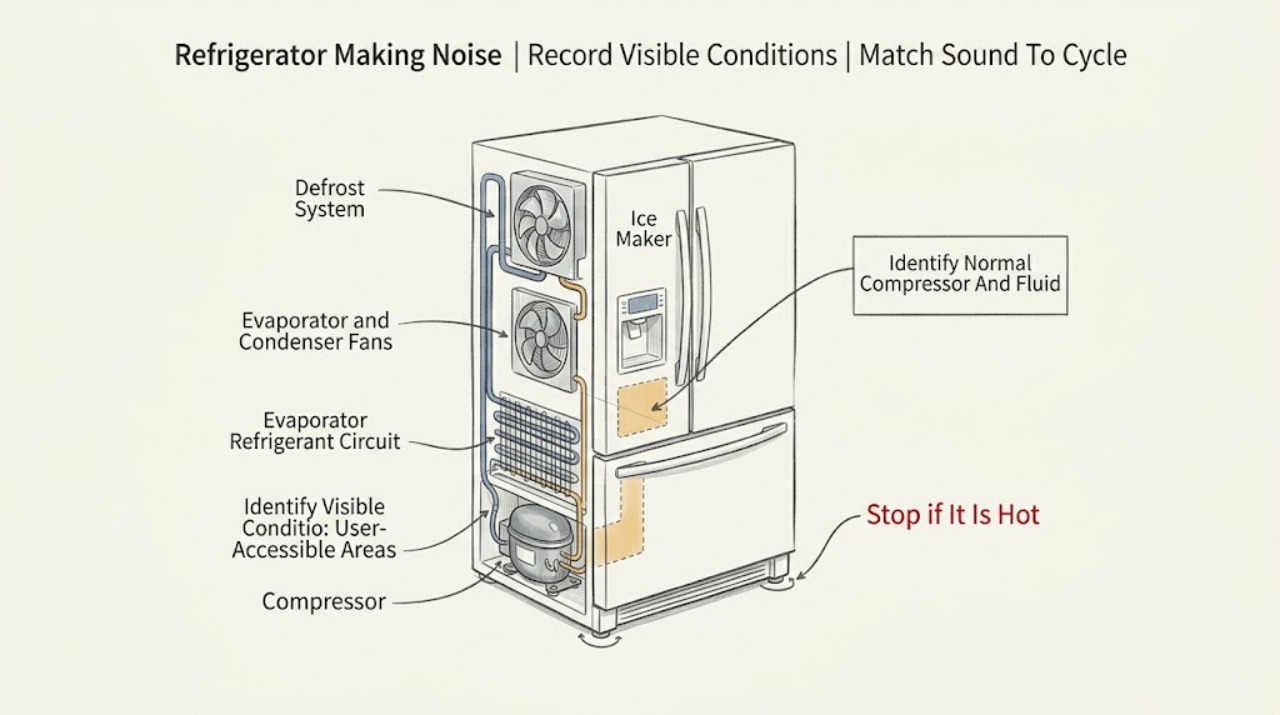
Work through in order
Diagnostic checks
Use only checks that match the exact appliance or system and its official guide.
-
Check 1
Stand clear of moving and cold parts and listen from outside. Stop using the refrigerator for smoke, a burning or electrical smell, arcing, a hot or damaged cord or plug, repeated breaker trips, liquid near electrics, or a casing that is abnormally hot. If no hazard is present, record whether the sound is a hum, pulsation, whoosh, gurgle, fan rush, click, pop, hiss, buzz, rattle, scrape, or grind, and whether cooling remains normal.
Expected result: An immediate electrical or fire hazard is present, the sound is one of the documented operating sounds, the sound is a new mechanical noise, or cooling is also failing.
Next step: For a hazard, isolate power only from a safe position and arrange service. If safe, continue with the timing, location, leveling, and ice-maker checks without opening the cabinet.
Stop if: Do not run repeated tests after smoke, arcing, a burning odor, damaged electrical parts, or repeated breaker operation.
Why this matters
Why: A hazard or sound combined with poor cooling is more urgent than an isolated normal operating sound. A documented sound with normal cooling can be expected, while a new or worsening mechanical sound needs an external source check and possibly service.
-
Check 2
From outside the cabinet, note when the noise starts and stops: during a compressor run, immediately after a door closes, after power-on or a large load, during defrost, while an ice maker fills or harvests, or only when a door or drawer moves. Do not press internal switches or reach into the freezer to force a cycle.
Expected result: The sound follows a compressor cycle, door closure, fan demand, defrost period, ice-maker cycle, or a movable part, or it has no repeatable timing.
Next step: If the timing matches a documented sound and cooling is normal, monitor it. If it is unrelated to a cycle, persists when idle, or is accompanied by poor cooling or electrical symptoms, continue only with external checks and prepare for service.
Stop if: Do not remove covers or create a test cycle by touching the fan, compressor, ice maker, or defrost components.
Why this matters
Why: Timing can identify a documented operating sound without identifying a failed component. A sound with no cycle relationship, a sudden change in pitch, or a noise that persists while the appliance is idle is less consistent with normal cycling.
-
Check 3
Compare an isolated hum, higher-pitched hum, pulsation, whoosh, or gurgle with the model manual. Crosley describes high-efficiency compressor hum or pulsation, refrigerant flow that can sound like boiling or gurgling, and a whoosh from pressure equalization after a door closes as normal on the cited model families. Check only whether the refrigerator is maintaining normal cooling and whether the sound has changed materially.
Expected result: The sound is a steady or pulsating hum during cooling, a brief whoosh after door closure, a gurgle during or just after a cycle, or a new loud sound with poor cooling, repeated hard starts, or no cooling.
Next step: Monitor a documented sound if cooling is normal and there is no hazard. For repeated clicking with no cooling, abnormal cycling, or a materially worsening sound, leave the refrigerator running only if safe and arrange qualified service; do not open the sealed system.
Stop if: Do not tap, shake, puncture, or work on compressor tubing or the cooling circuit.
Why this matters
Why: The first three patterns are documented normal sounds when the appliance otherwise operates normally. A repeated hard-start click or a new loud sound with poor cooling can indicate a compressor/start/control problem, but the sound alone cannot identify which part.
-
Check 4
With doors closed and from outside, check whether the cabinet rocks, touches a wall or cabinet, or transfers vibration through a visible rear water line, floor, or nearby object. If the exact manual permits it and the refrigerator can be moved safely, pull it straight out and use its leveling legs or rollers to restore stable placement. Do not move a loaded refrigerator alone or remove a rear cover.
Expected result: The cabinet is uneven, a wall/cabinet/object or accessible line is vibrating against it, the sound changes when contact is relieved, or the refrigerator is stable and clear of contact.
Next step: Correct only an obvious, safe leveling or contact issue and observe one normal cycle. If the noise persists, becomes scraping or grinding, or the appliance cannot be leveled without disassembly, arrange service.
Stop if: Do not wedge tools into the cabinet, bend tubing, roll over the power cord or water line, or work behind the refrigerator while it is energized.
Why this matters
Why: An uneven cabinet or external contact can amplify normal compressor or fan vibration and produce rattling. If the sound remains with a stable, isolated cabinet, an internal fan, motor, mount, control, or other component becomes more likely.
-
Check 5
If the noise is airflow, buzzing, hissing, sizzling, dripping, popping, or clicking, check whether it coincides with fan demand, automatic defrost, or an ice-maker cycle. On an ice-maker model without a connected water supply, use the exact manual's external On/Off control to disable the ice maker until the line is connected; do not touch the ejector, heater, fan, or water valve while plugged in.
Expected result: The fan becomes audible after startup or frequent door openings, water drips or sizzles during defrost, ice drops or the fill valve buzzes, the ice maker chatters without a water line, or the sound is a persistent scrape/grind.
Next step: Monitor a documented cycle sound if cooling and safety are normal. Disable an unconnected ice maker only as the exact manual directs. For a persistent abnormal fan, defrost, or ice-maker noise, stop manipulating the component and arrange service.
Stop if: Do not put fingers or tools into the ice maker or freezer fan area and do not access a defrost heater or water valve while powered.
Why this matters
Why: Crosley manuals describe fan airflow, defrost water and heater sounds, ice dropping, and model-specific water-valve buzz as normal. Loud chatter without a connected water supply can be an ice-maker state; persistent scraping, grinding, or a sound not tied to one of these cycles is not explained by the normal-sound list.
-
Check 6
If the sound remains after safe external leveling and contact checks, document whether cooling is normal, whether the sound occurs while idle, and whether the compressor or fan appears to start and stop abnormally from outside. Record the exact model and serial information and do not remove panels or attempt a live electrical, motor, pressure, or temperature test.
Expected result: The sound is persistent, increasingly loud, scraping or grinding, accompanied by poor cooling or repeated clicking, or accompanied by smoke, odor, heat, arcing, or a breaker trip.
Next step: Leave the refrigerator out of service when unsafe or when the manual's normal checks do not explain the sound, protect perishable food if cooling is affected, and arrange Crosley or qualified appliance service. Provide the sound recording and timing notes.
Stop if: Do not open the cabinet, probe live wiring, bypass a safety device, or work on the compressor, fan, defrost circuit, or sealed cooling system.
Why this matters
Why: A persistent noise with a cooling or electrical symptom can involve an internal fan or motor, compressor/start assembly, control, mount, defrost component, wiring, or sealed refrigeration system. The external sound pattern cannot safely identify a replacement part.
Use your observations
Decision map
Find the observation that best matches what you see, then follow the next safe action.
-
PATH 01Safety boundary
What you see
The sound is a hum/pulsation, fan rush, brief whoosh, refrigerant gurgle, defrost hiss/sizzle/drip, or a normal ice-maker sound, and cooling and electrical behavior remain normal.
Do this next
Monitor it and keep the refrigerator level, clear of contact, and used according to the model manual. Arrange service if the sound changes, persists while idle, or cooling begins to fail.
Why this path and its safety boundary
Why it matters: The pattern matches Crosley's documented normal operating sounds more closely than a failed part.
Safety stop: Do not dismantle a component merely because a normal operating sound is unfamiliar.
-
PATH 02Safety boundary
What you see
Rattling or vibrating changes when an uneven cabinet is leveled or a wall, cabinet, visible line, or nearby object is no longer touching it.
Do this next
Keep the refrigerator stable and clear of contact, using only the model's safe leveling and moving procedure. If the noise returns with a stable cabinet, arrange service.
Why this path and its safety boundary
Why it matters: External vibration transmission is more likely than a compressor or fan failure.
Safety stop: Do not move a heavy loaded refrigerator alone or work behind it while plugged in.
-
PATH 03Safety boundary
What you see
Buzzing, clicking, ice-drop noise, or loud chatter occurs only around an ice-maker cycle, especially when the water line is not connected.
Do this next
Use the exact model's external ice-maker On/Off control until a water line is connected, or monitor a normal cycle when connected. Persistent noise with cooling or water-supply problems needs service.
Why this path and its safety boundary
Why it matters: An ice-maker fill, harvest, or water-valve sound is more likely. Crosley treats an unconnected ice maker's loud chatter as a model-specific condition.
Safety stop: Do not reach into the ice maker or touch its ejector, heater, fan, or valve while powered.
-
PATH 04Safety boundary
What you see
A new scrape, grind, repeated hard-start click, or increasingly loud noise occurs with poor cooling, abnormal cycling, or a component that never starts.
Do this next
Stop repeated testing and arrange qualified Crosley appliance service. Provide the exact model, sound timing, cooling status, and any recording.
Why this path and its safety boundary
Why it matters: An internal fan/motor, compressor/start, control, defrost, mount, or sealed cooling problem is more likely than a documented normal sound.
Safety stop: Do not open panels, test energized parts, bypass protection, or replace an internal component from sound alone.
-
PATH 05Safety boundary
What you see
Smoke, arcing, burning odor, a hot/damaged cord or plug, liquid near electrics, repeated breaker trips, or an abnormally hot casing accompanies the noise.
Do this next
Isolate power only from a safe position, keep the refrigerator out of use, protect perishable food, and request qualified service or electrical inspection.
Why this path and its safety boundary
Why it matters: The immediate fire or shock risk overrides sound classification, even if the refrigerator still cools.
Safety stop: Do not re-energize the refrigerator to reproduce the noise or touch exposed electrical parts.
Helpful context
Understand the symptom
Classify the sound before calling it a fault
The same refrigerator may hum during a compressor run, whoosh just after a door closes, gurgle as the cooling fluid moves, click while a control starts or stops the system, and hiss or drip during defrost. A fan can become louder after startup, frequent door openings, or a large load. Record the sound's location, timing, duration, and whether cooling, lights, and doors behave normally; a change in cooling performance makes a sound more significant.
Vibration is often a cabinet or contact problem
Crosley documentation says an uneven cabinet can cause rattling or vibrating noise and can be corrected with the wheels or levelers. A refrigerator pushed against a wall, cabinet, water line, or another object can transmit normal motor vibration and make it seem abnormal. Check only accessible contact points and use the exact model's leveling or moving instructions; do not remove rear panels.
Keep moving and energized parts closed
Unplug before cleaning or any repair, keep hands out of ice-maker ejectors and heating areas, and do not use an extension cord or operate with a damaged power cord. Do not drill the cabinet, puncture cooling tubing, remove covers, or test the compressor, fan, start device, wiring, or defrost circuit. Crosley manuals state that repairs must be performed by a qualified service professional.
Safety boundary
Stop conditions
- Stop for smoke, arcing, a burning or electrical odor, a hot or damaged cord/plug, liquid near electrical parts, repeated breaker trips, or an abnormally hot casing; isolate power only from a safe position.
- Do not use a damaged refrigerator, bypass a safety device, or continue cycling power to reproduce a loud or abnormal sound.
- Do not put fingers or tools into an ice maker, fan, defrost heater, compressor area, or other moving or energized component.
- Do not remove the cabinet, puncture cooling tubing, perform live electrical or pressure tests, or work on the sealed refrigeration system.
- Do not order a compressor, fan, relay, control, defrost part, or ice-maker valve from the sound alone; Crosley model assemblies vary.
Only after diagnosis
Potential parts
Rattling changes with cabinet leveling or external contact correction but returns with an unstable cabinet.
Airflow noise is persistent, scraping, or abnormal and is not explained by startup, frequent door openings, defrost, or surrounding contact.
Repeated hard-start clicking, abnormal pulsation, or a new compressor-area sound occurs with poor cooling or no cooling.
Buzzing, chatter, clicking, or harvest noise is isolated to an ice-maker model and persists after the exact model's water-supply and On/Off checks.
When checks do not resolve it
Need a professional?
Arrange Crosley or qualified appliance service when a new scraping, grinding, or repeated hard-start noise persists; a noise accompanies poor cooling or abnormal cycling; the sound comes from an inaccessible component; the ice maker or fan remains abnormal after the exact model's external control check; or any electrical, fire, or cord hazard appears.
Safety scope: The user may listen from outside, note the cycle, check safe cabinet contact and leveling, and use an exact model's external ice-maker control. Compressor, fan, motor mount, start device, control, defrost heater, wiring, ice-maker mechanism, and sealed-system diagnosis or repair are for qualified service personnel.
Common questions
FAQ
Is a humming or pulsating sound normal on a Crosley refrigerator?
Crosley manuals describe a high-efficiency compressor hum or pulsation as a normal operating sound. It is more reassuring when cooling is normal and the sound follows a cooling cycle. A new loud sound, repeated hard-start clicking, poor cooling, or overheating needs service rather than a compressor diagnosis by sound alone.
Why does my Crosley refrigerator make a gurgling or whooshing sound?
Crosley documentation attributes gurgling to refrigerant flow and a brief whoosh after door closure to pressure equalization. These can be normal when the refrigerator cools properly. A persistent new noise with poor cooling or a mechanical scrape is a different pattern and should be serviced.
Why does my Crosley refrigerator rattle or vibrate?
Check from outside whether the cabinet is uneven or touching a wall, cabinet, visible line, or nearby object. Crosley identifies cabinet leveling and surrounding surfaces as reasons normal operating sounds can seem louder or become rattling. Correct only safe external leveling/contact issues; persistent rattling needs service.
Is clicking, popping, sizzling, or dripping from a Crosley refrigerator normal?
It can be, depending on timing. Crosley lists restart clicks, coil expansion pops, defrost sizzling, and water dripping into the drain pan as normal sounds. The sound should be assessed with its cycle and cooling status; a persistent scrape, grind, electrical odor, or cooling failure is not explained by that list.
Why is my Crosley ice maker making a loud buzzing or chattering noise?
On models with an ice maker, a water-valve buzz or ice-drop sound can occur during a cycle. Crosley also warns that an unconnected ice maker can chatter loudly; use the exact model's external On/Off control until the water supply is connected. Do not reach into the ice maker while plugged in.
Read the exact guide
Official sources
- Crosley Top-Freezer Refrigerators Owner's Manual and Installation Instructions (XTS21)Crosley Home Products · Specific XTS21 top-freezer model; its sound and troubleshooting information illustrates the symptom but does not establish behavior for other Crosley models.
- Crosley Top-Freezer Refrigerators Owner's Manual and Installation Instructions (XRS/XRE)Crosley Home Products · Specific XRS/XRE top-freezer model family; normal sound, control, ice-maker, clearance, and safety details are not universal to every Crosley refrigerator.
- Crosley Refrigerator Use and Care Guide (CTRE182 family)Crosley Home Products · Specific Crosley refrigerator family; component labels, door alarm, ice-maker, and sound details are model-specific.
Community feedback
Share a repair observation
Share a plain-text repair observation. Accepted observations are published automatically; this page may take a moment to update.