
On this page
Start here
Quick answer
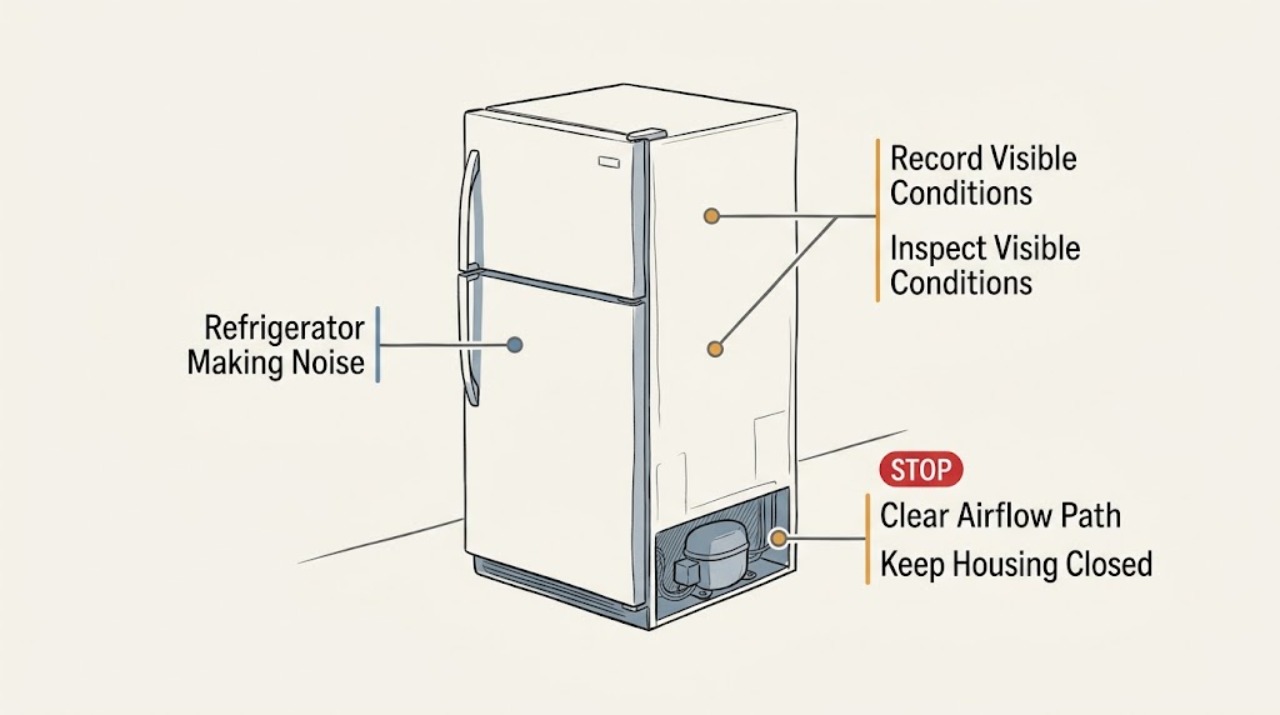
A Bosch refrigerator can normally hum while the compressor or a fan runs, gurgle or bubble as refrigerant moves through the tubes, click as a motor or switch changes state, or pop during automatic defrost. First note whether the sound is smooth and cyclical or a new scrape, grind, knock, or loud vibration. Then check from the outside that the refrigerator is level and not touching cabinets, that shelves and bottles are not vibrating, and that visible air outlets are clear. Bosch says a freezer evaporator fan that does not move freely or a compressor suspected after the fan check needs professional diagnosis. Do not remove panels, touch a fan or compressor, pierce refrigerant tubing, or test live wiring; stop using the appliance and arrange qualified service for a harsh persistent noise, cooling loss, burning smell, damaged cord, or repeated breaker trip.
Before you begin
Safety first
- The user may classify the sound, check accessible cabinet contact and removable fittings, observe cooling and alarms, and inspect visible airflow paths without reaching into panels. Qualified service must handle fan access, motor or bearing diagnosis, compressor and start components, refrigerant tubing, sealed-system work, live wiring, and heavy or built-in appliance movement.
Work through in order
Diagnostic checks
Use only checks that match the exact appliance or system and its official guide.
-
Check 1
From a safe position, record the sound and its timing: does it occur only while the refrigerator is cooling, when a door is opened, during automatic defrost, immediately before or after startup, or even when the appliance is idle? Note whether it is a hum, whir, gurgle, click, pop, rattle, scrape, or knock, and whether cooling and lights still work.
Expected result: The sound is a steady hum/whir, bubbling or gurgling, an occasional click or pop, a rattle tied to vibration, or a new rough sound that continues through several cycles.
Next step: Use the pattern to choose the external fitting, airflow, and fan/compressor boundary checks below. Stop operating the refrigerator if there is a burning odor, smoke, arcing, damaged cord, or a harsh sound accompanied by loss of cooling.
Why this matters
Why: Bosch lists compressor, fan, refrigerant, defrost, and switching sounds as normal in appropriate operating conditions. A new rough, continuous, or rapidly worsening sound is less consistent with those normal noises, but sound alone cannot identify a failed compressor, fan, or bearing.
-
Check 2
Check the refrigerator's external position without moving a heavy unit: look for a cabinet or wall touching the sides or back, a visibly uneven stance, and loose removable shelves, drawers, or bins. Move bottles or containers slightly apart only when they are accessible and the doors can remain closed.
Expected result: The cabinet touches adjacent furniture, the appliance is visibly uneven, a shelf or bin wobbles, or bottles are touching; alternatively, the unit and removable fittings are stable and clear.
Next step: Clear only the accessible contact or reposition a loose container. Do not pull out, tip, or re-level a built-in or heavy refrigerator yourself; have installation corrected if the appliance is unstable or the noise persists.
Why this matters
Why: Bosch manuals associate an uneven or non-free-standing refrigerator and loose or contacting removable items with preventable vibration noise. If the sound remains with the cabinet and fittings isolated, the noise is less likely to be a simple external resonance.
-
Check 3
Inspect only the visible interior air outlets and freezer area for heavy frost, packaging, or food blocking an air path. Keep fingers and tools out of any fan opening. If frost appears to cover a fan or outlet, follow the exact model manual's defrost procedure rather than scraping or heating the panel.
Expected result: A visible outlet is blocked, heavy frost is present near an air path, the refrigerator is a NoFrost model with no visible obstruction, or the noise seems to come from behind a freezer panel.
Next step: Clear only accessible food or packaging and use the model-approved defrost process if applicable. If the sound persists behind a panel, the fan blade cannot move freely, or frost rapidly returns, arrange qualified service.
Why this matters
Why: Restricted airflow or frost can make fan noise more noticeable, but a hidden evaporator fan cannot be safely assessed by reaching through a panel. Bosch's direct fan guidance says a blade that does not move freely may need replacement; this is a service diagnosis, not permission to dismantle the freezer.
-
Check 4
Observe the cooling cycle without touching the compressor: note whether the sound starts with the compressor, changes briefly at startup, continues while the cabinet reaches temperature, or occurs with a simultaneous loss of cooling. Check the display for an alarm and compare the actual cabinet temperature with normal operation, without changing several controls at once.
Expected result: The refrigerator cools normally with a brief startup hum or click, runs loudly without reaching temperature, repeatedly starts and stops, or is warm while the sound has changed.
Next step: Keep doors closed and protect perishable food in a known-cold appliance if cooling is unreliable. Do not adjust or replace a compressor, start device, thermostat, or refrigerant component based on noise alone; arrange service for persistent abnormal operation.
Why this matters
Why: A brief compressor-start increase, a normal hum, and cooling recovery can be normal. A compressor that is unusually loud, runs without cooling, repeatedly fails to start, or is accompanied by warming needs professional diagnosis; the sound does not prove a compressor or sealed-system failure.
-
Check 5
Check for escalation signs without opening the appliance: a breaker trip, hot or burnt smell, smoke, arcing, damaged cord, water near electrical parts, or refrigerant tubing damage. If none is present but a scrape, grind, or rhythmic knock remains after the external checks, record the model/E-Nr and sound pattern for service.
Expected result: An electrical, refrigerant, or heat warning is present, or the rough noise remains with a stable cabinet, clear fittings, and no accessible airflow obstruction.
Next step: Switch the refrigerator off and isolate power only if it is safe to do so; keep clear of wet or damaged electrical parts and arrange qualified Bosch service. Do not remove panels, probe wiring, handle refrigerant, or keep running the appliance to reproduce the sound.
Why this matters
Why: These conditions are outside a safe user-level noise check. A persistent rough sound may involve an internal fan, motor shaft, bearing, compressor, or another sealed-system component, but only qualified testing can distinguish them.
Use your observations
Decision map
Find the observation that best matches what you see, then follow the next safe action.
-
PATH 01Next step
What you see
The refrigerator makes a smooth hum or fan whir during cooling, a brief click at startup, or occasional bubbling/gurgling, and it reaches temperature normally without vibration or warning signs.
Do this next
Monitor for a change in character, duration, cooling, or safety symptoms. Use the exact owner manual if the normal sound becomes noticeably louder or persists abnormally.
Why this path and its safety boundary
Why it matters: Compressor operation, fan air movement, refrigerant flow, or switching is more likely than a mechanical fault.
-
PATH 02Next step
What you see
The sound is a rattle or vibration, and the refrigerator touches furniture, is uneven, or has a loose shelf, drawer, bin, bottle, or container.
Do this next
Clear the accessible contact or reposition the removable item. Have a heavy or built-in refrigerator safely aligned if it is not level; do not tilt or pull it out as a home test.
Why this path and its safety boundary
Why it matters: External resonance or a loose removable fitting is more likely than an internal compressor or fan defect.
-
PATH 03Next step
What you see
The sound is a whir, scrape, or cyclic noise from the freezer area, and visible frost or an obstructed air outlet is present, or the noise stops when the cooling/fan cycle ends.
Do this next
Clear only accessible obstructions and follow the exact manual's defrost procedure if applicable. Arrange service if the fan does not move freely, the noise returns, or frost blocks a panel.
Why this path and its safety boundary
Why it matters: Airflow restriction or an evaporator-fan area issue is plausible, but the hidden fan and panel are not safe user-service points.
-
PATH 04Next step
What you see
A loud hum or knock continues while the refrigerator is warm, fails to start normally, or follows the compressor cycle after the cabinet, fittings, and visible airflow checks are normal.
Do this next
Move perishable food to a known-cold appliance and arrange professional diagnosis. Do not open the compressor compartment, replace a start device, or handle refrigerant tubing yourself.
Why this path and its safety boundary
Why it matters: A compressor, start/control, fan, or sealed-system fault is more likely than normal operating noise, but the sound does not identify the failed part.
-
PATH 05Next step
What you see
There is a burning odor, smoke, arcing, a damaged cord, water near electrical parts, refrigerant tubing damage, a breaker trip, or a harsh noise that worsens rapidly.
Do this next
Keep clear, isolate power only if it can be done without touching a hazard, ventilate and avoid ignition sources if tubing is damaged, and contact qualified service or emergency responders as appropriate. Do not operate the refrigerator again until assessed.
Why this path and its safety boundary
Why it matters: This is an electrical, fire, or refrigerant safety condition rather than a routine noise adjustment.
Helpful context
Understand the symptom
Classify the sound before blaming a component
The sound's character and timing are more useful than loudness alone. A steady hum or soft whir that starts with cooling is consistent with a compressor or fan. Bubbling or gurgling can come from refrigerant flow, while a click can occur as a motor, switch, or valve changes state. A rattle that changes when a bottle, shelf, or cabinet contact is moved points toward vibration. A rough scrape or repeated knock that follows the fan or compressor after those external checks is a service symptom, not proof of a particular motor, bearing, or compressor failure.
Do not open the refrigeration or electrical system
Keep hands and tools away from fans, compressor terminals, wiring, and refrigerant tubing. Do not chip ice, pierce a tube, remove a rear cover, or attempt to lubricate or replace an internal fan or compressor. If a cord is damaged or refrigerant tubing is damaged, keep ignition sources away, ventilate, switch the appliance off, and contact qualified service. Disconnect power before any permitted cleaning or external inspection, but do not reach toward a wet or damaged electrical connection.
Only after diagnosis
Potential parts
- refrigerator evaporator fan assembly
Consider this category only if qualified service confirms that the model's evaporator fan does not move freely or has failed after external airflow and frost checks; a freezer-area noise alone does not identify the fan.
Confirm the complete Bosch model/E-Nr and manufacturer fit information before ordering; fan access and replacement are internal service work. - refrigerator compressor or start component
Consider this category only after a technician confirms a compressor or start/control fault associated with abnormal noise and cooling behavior; a normal hum or click is not evidence that a compressor needs replacement.
Confirm the exact Bosch model, electrical specification, and manufacturer fit information before ordering; compressor and sealed-system work belongs to qualified service.
When checks do not resolve it
Need a professional?
A technician should assess persistent rough noise, suspected evaporator-fan or compressor problems, repeated start failures, cooling loss with abnormal sound, inaccessible frost or airflow faults, and all electrical or refrigerant safety warnings.
Safety scope: The user may classify the sound, check accessible cabinet contact and removable fittings, observe cooling and alarms, and inspect visible airflow paths without reaching into panels. Qualified service must handle fan access, motor or bearing diagnosis, compressor and start components, refrigerant tubing, sealed-system work, live wiring, and heavy or built-in appliance movement.
Common questions
FAQ
What refrigerator noises are normal on a Bosch model?
Bosch lists compressor running, fan air movement, refrigerant bubbling or gurgling, popping during automatic defrost, and a click before the compressor starts as normal in the appropriate cycle. A new scrape, grind, or harsh knock is not explained by that list and needs further checks.
Why is my Bosch refrigerator rattling or vibrating?
Check whether the cabinet touches furniture, the appliance is uneven, a shelf or drawer is loose, or bottles are touching. Bosch identifies those conditions as preventable sources of noise. Do not pull out or tip a heavy or built-in refrigerator to level it yourself.
How do I know if the Bosch refrigerator fan is causing the noise?
A sound from the freezer area that follows the cooling cycle and accompanies visible frost or restricted airflow can make a fan issue more plausible. Bosch says a freezer evaporator-fan blade that does not move freely may need replacement, but fan access and testing belong to qualified service.
When should I call service for a noisy Bosch refrigerator?
Call when a rough noise persists after the cabinet, fittings, and visible airflow checks; when cooling is poor or the compressor does not start normally; or immediately for smoke, burning odor, arcing, a damaged cord, water near electrical parts, refrigerant-tube damage, or a breaker trip. Do not open panels or handle refrigerant.
Read the exact guide
Official sources
- 40815356.fmBosch · Official Bosch refrigerator operating instructions covering a refrigerator/freezer with an ice maker and the listed normal-noise guidance; exact model documentation controls procedures.
- Refrigerator Making Loud Noises | Troubleshooting | Bosch Home AppliancesBosch · Official Bosch refrigerator noise troubleshooting page for general owner guidance; exact model manuals control model-specific procedures.
- Installation instructions and instructions for use Fridge-freezerBosch · Official Bosch fridge-freezer installation and use instructions for a model family with compressor, fan, refrigerant, and automatic-defrost operating sounds; exact model instructions control other appliances.
Community feedback
Share a repair observation
Share a plain-text repair observation. Accepted observations are published automatically; this page may take a moment to update.