
On this page
Start here
Quick answer
Some Blomberg refrigerator noise is part of normal operation: the official Blomberg FAQ describes a compressor or fan hum, light clicking, refrigerant gurgling, and defrost-related hissing as common sounds, while a pop can come from temperature-related expansion. Start by identifying when the noise occurs and whether cooling remains normal. For rattling or vibration, check that the appliance is level and that bottles, items on top, or nearby surfaces are not touching it. With the refrigerator safely switched off, inspect only visible, model-authorized areas for an obstruction; do not remove covers or reach a fan. A new, loud, persistent high-pitched, grinding, or repeating click that continues after these checks, especially with poor cooling, water, a damaged cord, smoke, or a burning smell, needs qualified Blomberg service.
Before you begin
Safety first
- This article covers sound classification, normal-access level and contact checks, visible obstructions, model-manual lookup, and symptom recording. A qualified technician must handle live electrical work, covers, fans, compressors, sealed refrigeration systems, internal controls, wiring, and moving fixed appliances.
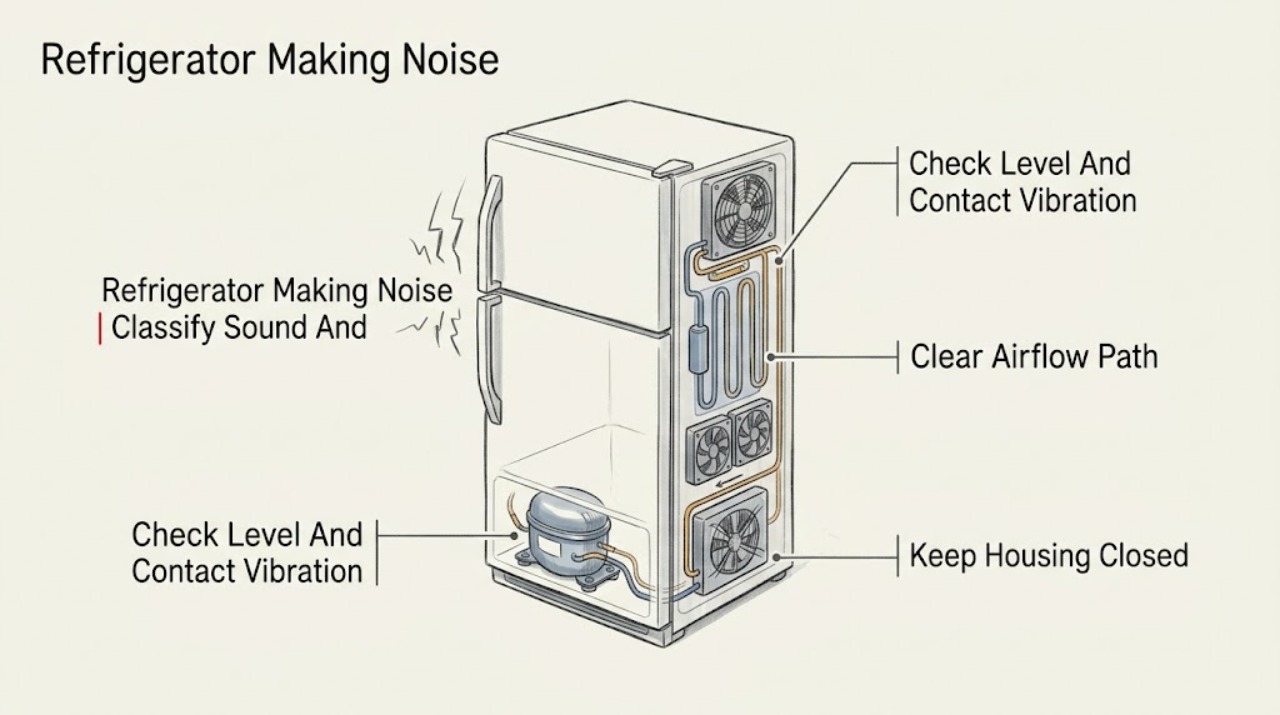
Work through in order
Diagnostic checks
Use only checks that match the exact appliance or system and its official guide.
-
Check 1
Listen from a safe standing position and note whether the sound is a low hum or buzz, a brief click, rattle or vibration, pop, gurgle, hiss, whine, scrape, or another sound. Record whether it occurs during cooling, after a door closes, during defrost, or continuously, and whether both compartments are cooling normally.
Expected result: The sound is a short or soft operating noise with normal cooling, a vibration changes when the cabinet or nearby item is touched, or the noise is new, loud, high-pitched, grinding, or paired with poor cooling.
Next step: For normal cycle sounds, continue only with the level and contact checks. For abnormal or cooling-related noise, make one safe external inspection and prepare the model information for service rather than guessing at a part.
Stop if: Stop using the refrigerator and isolate it safely for smoke, burning smell, sparking, a damaged or hot cord, refrigerant or water leakage, or a sudden severe mechanical noise.
Why this matters
Why: A sound that matches a normal refrigeration or defrost cycle and leaves cooling intact is less likely to be a fault. A vibration that changes with contact points toward the cabinet or surroundings. A persistent abnormal sound or a sound paired with a cooling change moves the problem toward professional diagnosis.
-
Check 2
Without pulling out a fixed appliance, check that the refrigerator stands steadily and that bottles, shelves, food containers, items on top, the wall, or adjacent cabinets are not touching or resonating against it. Remove only loose external items and use the model instructions for any accessible foot adjustment.
Expected result: The cabinet rocks, the floor is uneven, an item touches the cabinet, or the refrigerator is stable with clear surrounding space.
Next step: Remove the loose contact and make only the model-approved accessible leveling adjustment, then listen through one normal cooling cycle. If the vibration persists, becomes louder, or requires moving a built-in unit, arrange qualified service.
Stop if: Do not tip, drag, dismantle, or force a built-in or water-connected refrigerator, and do not place hands near moving or energized parts.
Why this matters
Why: An unstable cabinet or contact point can amplify a normal compressor or fan vibration into a rattle. If the cabinet is stable and clear but the vibration remains loud or is accompanied by cooling trouble, the source may be inside the appliance.
-
Check 3
If the noise is a whine, scraping sound, or airflow-like noise, switch the refrigerator off using its normal control and follow the model manual's shutdown guidance. Inspect only visible, user-accessible ventilation openings and the interior for an obvious item blocking airflow; do not remove a cover or reach through a grille toward a fan.
Expected result: The noise changes or stops when the normal cooling cycle ends, a visible obstruction is present, the sound is a normal soft airflow, or the noise remains with no visible obstruction.
Next step: Remove only a loose, accessible obstruction when the appliance is off, restore normal operation once, and monitor. If the sound remains, or the fan is inaccessible, damaged, or noisy with cooling symptoms, leave internal diagnosis to qualified service.
Stop if: Do not insert tools into vents, remove fan or rear covers, touch a moving fan, or perform an energized inspection.
Why this matters
Why: A cycle-linked airflow sound can be normal on fan-equipped models. A reachable obstruction may explain a changed airflow sound, but a persistent whine or scrape with no visible cause keeps a fan or motor fault in consideration without proving it.
-
Check 4
For a gurgle, hiss, pop, or light click, note whether it is brief and linked to temperature changes, refrigerant movement, compressor switching, or defrost. Compare the timing with normal cooling and check that the doors close and the refrigerator is maintaining its expected temperature; do not open the sealed cooling system.
Expected result: The sound is brief and cycle-linked with normal temperature, or it is continuous, unusually loud, or accompanied by poor cooling, frost, moisture, or another new symptom.
Next step: Monitor a normal cycle when cooling is stable. If the sound is persistent or the refrigerator is not cooling normally, stop repeated tests and arrange qualified service.
Stop if: Do not pierce tubing, remove panels, attempt refrigerant work, or continue operating when there is a leak, burning odor, smoke, or electrical hazard.
Why this matters
Why: Brief cycle-linked fluid, expansion, or switching sounds are described by Blomberg as common operating sounds. A continuous or unusually loud sound with another symptom is less consistent with a harmless cycle noise and needs model-specific diagnosis.
-
Check 5
Read the model and serial information from the refrigerator's rating label without removing panels. Use that model's Blomberg manual to confirm the normal sound and any user-level checks, then record the sound type, timing, cooling status, and whether leveling or removing contact changed it.
Expected result: The exact manual describes the observed sound as normal and cooling remains stable, or the noise persists after the visible checks or is paired with another fault.
Next step: Monitor only when the model guidance supports a normal sound and the appliance is functioning normally. Otherwise keep the refrigerator off when safe and arrange qualified Blomberg service with the model and serial information.
Stop if: Do not remove electrical or refrigeration covers, test live components, bypass a safety device, or replace a part based on sound alone.
Why this matters
Why: A model-specific manual can explain differences between fan-equipped and non-fan designs. Persistence after external checks, or a noise with cooling or safety symptoms, indicates that further diagnosis is needed rather than that a specific compressor, fan, or control should be ordered.
Use your observations
Decision map
Find the observation that best matches what you see, then follow the next safe action.
-
PATH 01Safety boundary
What you see
The refrigerator makes a soft hum, brief click, gurgle, hiss, or pop during a normal cooling or defrost pattern, and temperatures remain stable.
Do this next
Use the model manual for confirmation and monitor without opening the cabinet. Arrange service only if the sound becomes new, loud, persistent, or is joined by another symptom.
Why this path and its safety boundary
Why it matters: The pattern is more consistent with compressor, fan, refrigerant, switching, defrost, or temperature-expansion operation than with a confirmed failure.
Safety stop: Stop for smoke, burning smell, sparking, a damaged cord, leakage, or a sudden severe change in sound.
-
PATH 02Safety boundary
What you see
Rattling or vibration changes when a loose item is removed, a surface is no longer touching the cabinet, or the refrigerator is balanced.
Do this next
Leave the refrigerator stable with surrounding items clear and observe one normal cycle; call service if the vibration remains loud or the appliance cannot be safely leveled.
Why this path and its safety boundary
Why it matters: Cabinet leveling or contact with a bottle, wall, top item, or adjacent surface is more likely than a proven internal component failure.
Safety stop: Do not drag, tip, or dismantle a fixed or water-connected refrigerator to reach the rear.
-
PATH 03Safety boundary
What you see
A high-pitched whine, scrape, or unusually loud fan-like sound persists with no visible obstruction, or is present whenever cooling runs.
Do this next
Switch off normally when safe, keep covers closed, and arrange qualified Blomberg service with the model, sound timing, and cooling observations.
Why this path and its safety boundary
Why it matters: A fan, motor, compressor, or control issue is more likely, but the sound does not identify a replaceable part and the internal area is outside the safe user-check boundary.
Safety stop: Stop immediately for a grinding escalation, burning smell, smoke, sparking, unusual heat, or a tripped supply.
-
PATH 04Safety boundary
What you see
The noise is accompanied by warm food, loss of cooling, repeated compressor attempts, water or frost where it should not be, a damaged cord, smoke, or a burning odor.
Do this next
Protect food as practical, stop the appliance and isolate power only if it can be done safely, then arrange qualified appliance service; do not open the sealed system or electrical covers.
Why this path and its safety boundary
Why it matters: The combined pattern is not safely explained by an ordinary operating sound and may involve a refrigeration, electrical, or mechanical fault requiring professional assessment.
Safety stop: Do not continue cycling the refrigerator, handle a wet or hot connection, or attempt refrigerant, compressor, fan, or wiring repair.
Helpful context
Understand the symptom
Name the sound before treating it as a fault
A steady hum, a brief click, liquid movement, a soft hiss, or a pop can occur as the compressor, fan, refrigerant circuit, or defrost system operates. The useful distinction is whether the sound is new or excessive, whether it follows a cooling or defrost cycle, and whether the refrigerator still holds its normal temperature. Record the sound and its timing before moving the appliance.
Vibration usually starts at the cabinet or its surroundings
Blomberg's guidance links rattling and vibration with an unlevel or unstable floor and with objects touching the sides, back, or top of the refrigerator. A door shelf, bottle, decorative item, or wall can amplify a normal compressor vibration. Make only external, accessible adjustments and avoid moving a heavy built-in or water-connected appliance to reach its rear.
Persistent mechanical noise has a clear stop boundary
A high-pitched whine, grinding sound, or frequent clicking that remains after level and contact checks can involve a fan, motor, compressor, or control system, but the sound alone cannot identify which part has failed. Switch the appliance off from the normal control and use qualified service when the noise is accompanied by poor cooling, a leak, smoke, burning smell, electrical damage, or a repeated trip.
Safety boundary
Stop conditions
- Stop using the refrigerator for smoke, burning smell, sparking, a damaged or hot cord, water near electrical parts, refrigerant or other leakage, or a sudden severe grinding noise.
- Switch off or unplug only from a safe, dry access position before any permitted external inspection; do not pull out a built-in or water-connected unit.
- Do not remove electrical, fan, rear, or refrigeration covers; do not reach toward moving parts, pierce tubing, or perform live tests.
- Do not order or replace a compressor, fan, control, or other internal part from the sound alone; obtain model-specific diagnosis first.
When checks do not resolve it
Need a professional?
Safety scope: This article covers sound classification, normal-access level and contact checks, visible obstructions, model-manual lookup, and symptom recording. A qualified technician must handle live electrical work, covers, fans, compressors, sealed refrigeration systems, internal controls, wiring, and moving fixed appliances.
Common questions
FAQ
Is a humming Blomberg refrigerator normal?
A steady hum or buzz can be the compressor or fan operating, especially while the refrigerator is cooling. It becomes a service concern when it is unusually loud or persistent, or when cooling changes; first check level and nearby contact points without opening the appliance.
Why is my Blomberg refrigerator rattling or vibrating?
Blomberg links rattling with an unlevel appliance or items touching its sides, back, or top. Remove only loose contact items and use the model instructions for accessible leveling; do not drag or dismantle a fixed refrigerator.
Are gurgling and hissing sounds a fault?
Gurgling from refrigerant flow and some hissing during defrost can be normal. A continuous or unusually loud sound, especially with poor cooling, water, frost, odor, or another new symptom, needs qualified diagnosis.
What should I do about a high-pitched whine?
Switch the refrigerator off normally and inspect only visible, model-authorized areas for an obstruction; do not remove fan covers or reach inside. If the whine persists or cooling is affected, arrange Blomberg service.
What information should I give Blomberg service for a noisy refrigerator?
Provide the complete model and serial information, the type and timing of the sound, whether it changes with cooling or defrost, whether the appliance is level, and whether cooling, frost, water, odor, or electrical symptoms are present. Blomberg says model and serial information is needed for manual and repair services.
Read the exact guide
Official sources
- Product ManualsBlomberg · Official Blomberg manual-support page; select the refrigerator's own model number before applying control or maintenance instructions.
- Find Your Model & Serial NumberBlomberg · Official Blomberg support page; use the refrigerator's own model and serial information for exact documentation and service.
- Contact UsBlomberg · Official Blomberg support contact page; provide model and serial information when requesting technical assistance.
- Should my fridge be making a noise?Blomberg · Official Blomberg refrigerator FAQ; use the exact model manual for model-specific controls and access.
- RefrigeratorBlomberg · Official Blomberg refrigerator manual for the KFD4952XD model family; it is an example, so the owner's exact manual controls where models differ.
Community feedback
Share a repair observation
Share a plain-text repair observation. Accepted observations are published automatically; this page may take a moment to update.