
On this page
Start here
Quick answer
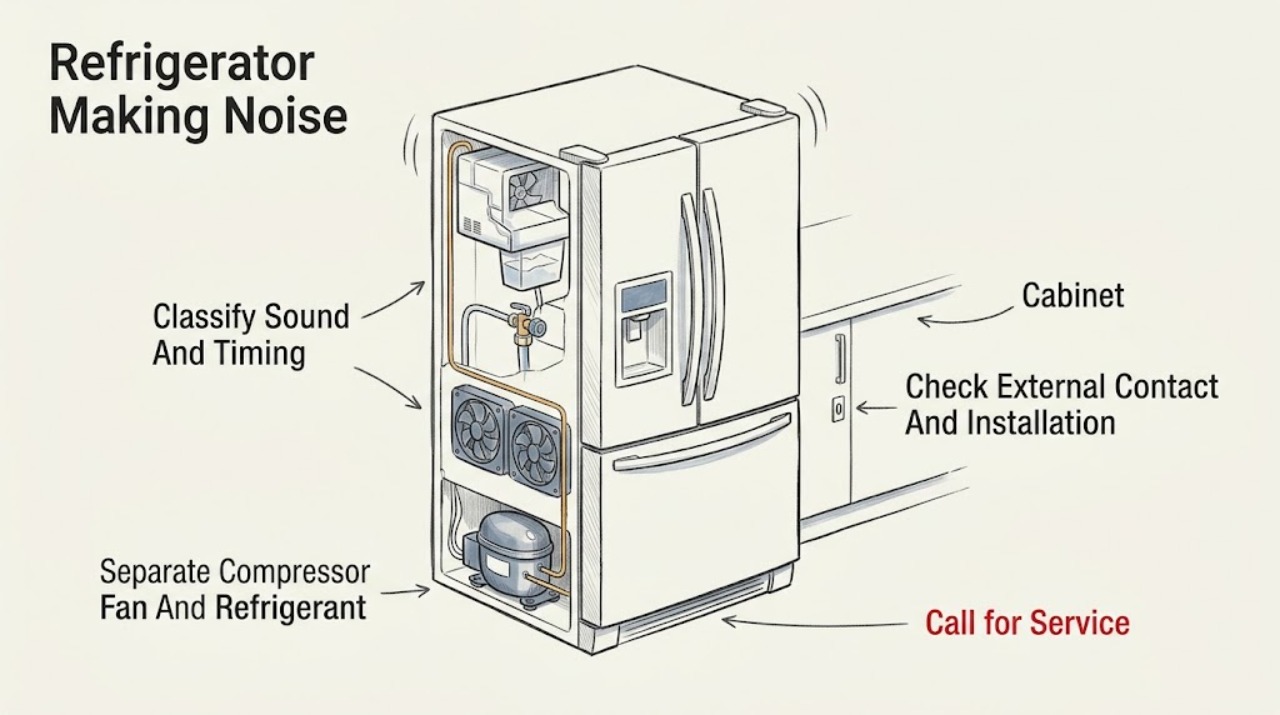
A Dacor refrigerator is not expected to be silent. A soft compressor hum or changing motor tone, fan airflow, refrigerant gurgle or hiss, brief defrost sizzling, and ice-maker fill or ice-drop sounds can be normal when cooling is stable and the sound follows the related cycle. First record when and where the sound occurs, then check only accessible external causes: a cabinet or panel touching surrounding surfaces, an unstable installation, loose items, or an ice-maker water supply/control issue on models equipped with those features. Dacor sells multiple refrigerator architectures, including built-in French-door and column models, and feature sets differ by model, so use the exact owner's manual. A new loud scrape or grind, repeated hard-start clicking, a fan-like noise that returns with frost, or noise together with poor cooling needs qualified service; smoke, burning odor, arcing, unusual heat, a damaged cord, or a tripped protective device is a stop-use condition. Do not remove panels, reach into a fan or ice maker, open the cooling circuit, or perform live electrical testing.
Before you begin
Safety first
- The user may listen from outside, document timing, check accessible external contact or loose items, and use an exact model's normal ice-maker control. Fan, compressor, start device, control, defrost circuit, wiring, water valve, ice-maker mechanism, and sealed-system diagnosis or repair are for qualified service personnel.
Work through in order
Diagnostic checks
Use only checks that match the exact appliance or system and its official guide.
-
Check 1
From a safe position, note the sound's character, location, duration, and timing without touching the appliance: hum or buzz, whir or airflow, hiss or gurgle, click, pop, rattle, bang, scrape, or grind. Note whether cooling and the display appear normal, and whether the sound starts with a door close, a cooling cycle, defrost, or ice/water activity.
Expected result: The sound is brief and tied to cooling, fan demand, defrost, or an ice-maker cycle; it is a quiet steady hum; or it is new, loud, persistent, scraping, grinding, or paired with a cooling change.
Next step: For a cycle-linked sound with normal cooling and no safety warning, continue with the external checks below and monitor one normal cycle. For a loud scrape, grind, repeated hard-start pattern, or cooling change, stop repeated testing and arrange qualified Dacor service.
Stop if: Do not keep cycling power or controls to reproduce a loud or unsafe sound.
Why this matters
Why: Cycle-linked hum, airflow, refrigerant, defrost, and ice sounds fit documented operating mechanisms more closely. A new persistent mechanical sound, repeated hard-start click, or noise with poor cooling is not explained by the normal-sound list.
-
Check 2
Listen from outside the cabinet during a normal cooling period. Compare the sound with door-open and door-closed timing only through normal use; do not hold a door switch, remove a cover, or reach toward a fan. Note whether the sound is a low motor hum, a fan rush that changes with cooling demand, a brief hiss or gurgle, or a rhythmic scrape that follows fan operation.
Expected result: A low motor tone changes speed or stops after the refrigerator reaches temperature; airflow rises during cooling; a hiss or gurgle is brief; or a scrape/grind persists or repeatedly returns with fan demand.
Next step: Monitor the first three patterns when cooling is normal. For a persistent scrape, fan-like grinding, or abnormal cycling, leave the component closed and arrange service; do not try to access the fan or defrost area.
Stop if: Do not remove an interior or rear panel, spin a fan by hand, or make a live electrical check.
Why this matters
Why: Digital compressor speed changes, circulation-fan airflow, and refrigerant movement can produce normal sound variation. A persistent scrape or grind, especially if it changes with a door-related fan cycle or is accompanied by frost, poor cooling, or vibration, makes fan interference or an internal mechanical fault more likely.
-
Check 3
Inspect only from the front and sides for an accessible loose item, kick plate, decorative panel, cabinet edge, wall, or visible water line touching or resonating against the refrigerator. Confirm that doors, shelves, and bins close normally and that the unit is not visibly rocking. Do not pull a built-in or column refrigerator out of its enclosure.
Expected result: The sound changes when a loose external item is removed or when contact is relieved, the cabinet appears unstable, or the exterior is clear and stable.
Next step: Secure or remove only a loose external item that can be reached without moving the appliance. For an integrated unit that appears misaligned or unstable, contact the installer or qualified service rather than pulling it forward. If the sound persists, arrange service.
Stop if: Do not wedge tools into the cabinet, adjust hidden mounts, bend tubing, or move a loaded built-in refrigerator.
Why this matters
Why: External contact and an unstable installation can amplify normal compressor or fan vibration. If the sound remains with no accessible contact and a stable cabinet, an internal fan, mount, compressor/start component, control, or sealed-system issue becomes more likely.
-
Check 4
If the refrigerator has an ice maker or internal water dispenser, note whether the buzz, click, fill noise, or bang occurs only during ice or water operation. From outside, verify that an installed water line is visibly connected and that the normal control does not show ice production disabled. If the model has no connected water line, use only the exact manual's external ice-maker Off control; do not operate a valve or reach into the ice maker.
Expected result: The sound occurs during water filling or ice harvest, the ice maker is enabled without a connected line, or the sound occurs while no ice or water function is active.
Next step: Use the exact model manual to disable an ice maker that lacks a water connection, or monitor a connected model's normal cycle. If the sound is loud, occurs outside the cycle, or the water connection is damaged or leaking, stop the ice/water function and arrange service.
Stop if: Do not reach into the ice maker, touch an ejector or water valve, or disconnect plumbing behind an integrated refrigerator.
Why this matters
Why: A water-valve buzz, fill sound, and ice dropping can be expected during an ice cycle on equipped models. An enabled ice maker without water can create repeated valve noise, while grinding or loud noise outside an ice cycle is not explained by normal filling or harvest.
-
Check 5
Without opening the cabinet, compare the noise with cooling performance and visible frost or moisture around accessible door seals. Note whether an airflow or scraping sound stops when a door is opened normally, returns after closing, or is accompanied by warmer food, alarm, frost, or reduced airflow. Do not use a heat source or sharp tool to clear ice.
Expected result: A fan-like scrape changes with door operation and returns, frost is visible, cooling is impaired, or there is no frost and the sound is a normal brief airflow or cycle sound.
Next step: Leave a recurring fan-on-ice pattern for qualified service because a temporary defrost does not correct the underlying cause. Protect perishable food if temperatures are rising. Monitor a brief normal airflow sound only when cooling and safety are normal.
Stop if: Do not use a hair dryer, heat gun, knife, or other tool near ice, vents, liners, wiring, or fans.
Why this matters
Why: A fan striking ice or an airflow path affected by frost is more likely when the sound follows a door-related fan cycle and returns; poor cooling raises the priority. A brief airflow sound without frost or cooling loss is more consistent with normal circulation.
-
Check 6
If the noise remains unexplained, record the exact Dacor model, the sound location and timing, whether cooling is normal, and a short recording made from a safe distance. Check only visible external signs for smoke, burning odor, arcing, unusual heat, liquid near electrical areas, a damaged cord, or a protective-device trip.
Expected result: The sound is persistent or increasingly loud; cooling is poor; repeated clicking prevents normal operation; or smoke, odor, arcing, heat, liquid, cord damage, or a breaker/RCD trip is present.
Next step: For a persistent mechanical or cooling-related sound, leave internal diagnosis to qualified Dacor appliance service and provide the model and recording. For smoke, burning odor, arcing, heat, liquid near electrics, or cord damage, keep clear, isolate power only from a dry safe position if possible, do not restart, and arrange urgent qualified help.
Stop if: Do not open panels, test energized parts, bypass a safety device, or work on the compressor, fan, defrost circuit, wiring, or sealed cooling system.
Why this matters
Why: Persistent noise with a cooling symptom can involve an internal fan or mount, compressor/start assembly, control, defrost component, or sealed cooling system. Electrical or fire signs override diagnosis and make the appliance unsafe to operate.
Use your observations
Decision map
Find the observation that best matches what you see, then follow the next safe action.
-
PATH 01Safety boundary
What you see
The refrigerator makes a quiet hum or speed-changing motor tone, fan rush, brief refrigerant gurgle, defrost hiss/sizzle, or ice-drop sound, and cooling and electrical behavior remain normal.
Do this next
Monitor it during normal cycles and keep all model-specific controls and installation conditions documented. Arrange service if it becomes loud, persistent while idle, or changes with cooling loss.
Why this path and its safety boundary
Why it matters: The timing and sound pattern match documented refrigeration, fan, defrost, or ice-maker operation more closely than a failed component.
Safety stop: Do not replace a compressor or motor solely because a normal operating sound is unfamiliar.
-
PATH 02Safety boundary
What you see
Rattling or vibrating changes when an accessible panel, line, wall, cabinet edge, or loose item is no longer touching the unit, or the cabinet is visibly unstable.
Do this next
Remove or secure only the accessible loose item. Do not pull an integrated Dacor refrigerator; have installation alignment or hidden leveling checked by a qualified person if needed.
Why this path and its safety boundary
Why it matters: External contact or installation resonance is more likely than an internal compressor or fan fault.
Safety stop: Stop if moving the appliance would require pulling a built-in unit, handling plumbing, or working behind energized equipment.
-
PATH 03Safety boundary
What you see
Buzzing, filling, clicking, or a bang occurs only while the model's ice maker fills, harvests, or drops ice, especially when its water connection or ice setting is not as expected.
Do this next
Use the exact Dacor manual's external ice-maker control and water-connection guidance. If the noise is loud, occurs outside the cycle, or water is leaking, stop using that function and arrange service.
Why this path and its safety boundary
Why it matters: The sound is more consistent with a water valve, ice harvest, or ice-drop cycle; the feature is model-specific and may not exist on every Dacor refrigerator.
Safety stop: Do not reach into the ice maker or access its valve, heater, or mechanism while connected to power or water.
-
PATH 04Safety boundary
What you see
A scrape or grind changes with fan demand or door operation, returns after the door closes, is accompanied by frost or poor cooling, or persists without an identifiable normal cycle.
Do this next
Do not dismantle the refrigerator or force a defrost with heat. Keep the appliance closed and arrange qualified service; protect food if cooling has deteriorated.
Why this path and its safety boundary
Why it matters: Fan interference, an internal mount or motor issue, or another cooling-system fault is more likely than normal airflow. The pattern cannot safely identify the failed part.
Safety stop: Do not touch the fan, remove covers, or probe wiring to confirm the diagnosis.
-
PATH 05Safety boundary
What you see
Smoke, burning odor, arcing, unusual heat, liquid near electrical parts, damaged cord or plug, or a repeated protective-device trip accompanies the sound.
Do this next
Keep people away and isolate power only from a dry, safe position if it can be reached without approaching the hazard. Do not restart the refrigerator; arrange urgent qualified appliance or electrical service.
Why this path and its safety boundary
Why it matters: The immediate shock or fire risk overrides sound classification, even if the refrigerator still appears to cool.
Safety stop: Do not touch a wet appliance or plug, cross water to reach a control, or use the appliance to reproduce the sound.
Helpful context
Understand the symptom
Classify the sound before naming a part
A short hum, whir, airflow rush, refrigerant gurgle, defrost sizzle, or ice drop can be a normal operating sound. The useful distinction is timing and change: does it occur during cooling, after a door closes, during defrost, or only while ice or water is being made? A new persistent scrape, grind, loud knock, or repeated start-click is a different pattern. Sound alone cannot identify a compressor, motor, fan, valve, or control replacement.
Dacor model and installation type matter
Dacor refrigeration is not one mechanical layout. Its official product pages identify built-in French-door and flush-installed column families with different ice, water, panel, and installation features. Do not apply a freestanding refrigerator clearance or control sequence to an integrated Dacor column, and do not assume that every Dacor model has an ice maker or dispenser. Locate the rating label and match every control or service instruction to that model.
Keep the internal service boundary clear
Listen from outside and make only safe external observations. Do not remove a rear cover, reach into a fan or ice maker, bypass a door switch, probe energized wiring, or open the sealed cooling system. Dacor's own guidance says to stop when a safety issue is present and to disconnect power before repair work; smoke, a burning smell, or visible damage warrants leaving the refrigerator out of service and arranging qualified help.
Safety boundary
Stop conditions
- Stop use for smoke, arcing, burning odor, unusual heat, liquid near electrical parts, a damaged cord or plug, or repeated breaker/RCD operation; isolate power only from a dry, safe position.
- Do not restart repeatedly to reproduce a loud noise or continue using a refrigerator with worsening cooling, a persistent scrape or grind, or an unexplained hard-start click.
- Do not remove panels, bypass a door or safety switch, reach into a fan or ice maker, or perform a live electrical test.
- Do not use a hair dryer, heat gun, knife, or sharp object to clear ice, and do not open the sealed cooling system or bend refrigeration tubing.
- Do not order a fan, compressor, start device, control, valve, or ice-maker assembly from the sound alone; Dacor families and fitment vary by exact model.
Only after diagnosis
Potential parts
- leveling or vibration-isolation component
Consider this category only if an accessible external contact or documented installation check changes the vibration and the exact model procedure identifies an adjustable or replaceable component.
Dacor built-in, column, and French-door assemblies differ; verify the exact model and service documentation before ordering or moving the appliance. - evaporator or condenser fan motor and mount
Consider this category only when a qualified diagnosis finds persistent scraping, grinding, or abnormal airflow that is not explained by normal cycles or external contact.
The sound cannot distinguish motor, blade, mount, ice interference, or control failure; confirm exact model fitment through Dacor documentation. - compressor start assembly or compressor mount
Consider this category only after repeated hard-start clicking or compressor-area noise is professionally linked to a start or mounting fault, especially with cooling symptoms.
Dacor digital compressor systems and service parts are model-specific; do not infer a replacement from sound alone. - ice-maker or water-valve assembly
Consider this category only when the refrigerator is equipped with the feature and a qualified diagnosis finds persistent noise during or outside the ice/water cycle after the external control and supply checks.
Ice-maker and dispenser configurations vary by Dacor family; verify the model, water configuration, and approved part information.
When checks do not resolve it
Need a professional?
Arrange qualified Dacor appliance service when a new scrape, grind, persistent loud knock, repeated hard-start click, or abnormal fan sound remains after safe external checks; when noise accompanies poor cooling, frost, or an alarm; when the ice or water function is noisy outside its normal cycle; or whenever smoke, burning odor, arcing, heat, liquid near electrics, cord damage, or a protective-device trip appears.
Safety scope: The user may listen from outside, document timing, check accessible external contact or loose items, and use an exact model's normal ice-maker control. Fan, compressor, start device, control, defrost circuit, wiring, water valve, ice-maker mechanism, and sealed-system diagnosis or repair are for qualified service personnel.
Common questions
FAQ
Is a humming or buzzing Dacor refrigerator normal?
Often, yes, when it is a quiet motor-like sound that changes with cooling and the refrigerator maintains temperature. Official refrigerator guidance attributes humming or buzzing to compressor operation and, on equipped models, ice-maker water filling. A new very loud hum, repeated hard-start click, heat, or cooling loss needs service rather than a compressor replacement based on sound alone.
Why does my Dacor refrigerator make a hissing or gurgling sound?
Refrigerant moving through the cooling system can gurgle or bubble, and defrost water can hiss or sizzle on a heater. These sounds can be normal when brief and cycle-linked. A very loud new hiss, poor cooling, a scrape, or a burning or electrical odor is a different pattern and should be serviced.
Why is my Dacor refrigerator rattling or vibrating?
Check from outside for a loose panel, kick plate, visible line, wall, cabinet edge, or unstable installation. Official guidance identifies external contact and leveling as common ways vibration is amplified. Dacor column and built-in units should not be pulled from their enclosure; if an accessible check does not change the sound, arrange service.
Why does my Dacor ice maker make a loud buzz, grind, or bang?
On a model equipped with an ice maker, a fill-valve buzz, ice harvest sound, or ice dropping into the bin can occur during a cycle. If the water line is not connected, use the exact manual's external ice-maker Off control. Noise that is very loud, occurs when ice is not being made or dispensed, or is accompanied by a leak needs service; do not reach into the mechanism.
What should I do if the noise stops when the Dacor refrigerator door opens?
A door-related change can indicate that an interior fan cycle is changing, but it does not prove which part is at fault. If the sound is a recurring scrape or grind, especially with frost or poor cooling, leave the fan and panels closed and arrange qualified service. Do not hold a door switch, insert a tool, or use heat to clear ice.
Read the exact guide
Official sources
- DRF485300APSamsung Canada · Specific Dacor DRF485300AP/DA support page; used to reinforce model-driven manuals and support, not to generalize that model's components to all Dacor refrigerators.
- 36-Inch Built-In French Door with SteelCoolDacor · Specific Dacor built-in French-door family; feature and installation details are not universal to every Dacor refrigerator.
- Understand the noises coming from your Samsung refrigeratorSamsung Canada · General refrigerator noise guidance, not a substitute for the exact Dacor model manual; the Dacor product pages link separate model-specific manuals.
- 24-Inch Column RefrigeratorDacor · Specific integrated Dacor column family; flush installation, controls, and feature details should not be generalized to freestanding or French-door models.
- Self-RepairDacor · Safety and repair-boundary guidance; it does not identify the failed part in an unspecified refrigerator model.
- What can you do when you hear unusual noises from the back of your Samsung refrigeratorSamsung Canada · General water-line and valve guidance; use Dacor's exact model instructions for an integrated refrigerator's plumbing and ice-maker controls.
- Troubleshooting a rattling noise in your Samsung refrigeratorSamsung Canada · General external-rattle guidance; Dacor integrated units should not be pulled from an enclosure without model-specific installation or service instructions.
Community feedback
Share a repair observation
Share a plain-text repair observation. Accepted observations are published automatically; this page may take a moment to update.