
On this page
Start here
Quick answer
Humid weather can make condensation and temperature recovery more noticeable, but it does not by itself prove a failed cooling part. Thermador says refrigerator features vary by model, and its official guidance points owners to the exact manual for temperature controls and feature behavior. First confirm the complete model and measure the refrigerator with a thermometer, then check door closure, the seal, loading, airflow and any documented cooling mode from the outside. Keep perishable food safe and arrange service if the measured temperature stays out of range, the door does not seal, frost blocks airflow, the unit runs without recovering, or there is water, electrical damage or another hazard.
Before you begin
Safety first
- Do not open the cabinet or sealed refrigeration system, probe live wiring, use sharp tools on frost, remove the gasket, repeatedly reset a tripping breaker or keep perishable food in a refrigerator whose measured temperature is not safe.
Work through in order
Diagnostic checks
Use only checks that match the exact appliance or system and its official guide.
-
Check 1
Read the complete rating-label model and revision, record the region, and compare it with the assigned KBULT3671A02 identity. Open only the matching Thermador manual before changing a temperature mode or humidity control.
Expected result: The full label and matching manual are confirmed, or the label/manual remains unavailable or shows a different model family.
Next step: Use the confirmed model manual for the next checks. If the identity cannot be confirmed, keep the appliance to external observation and give the label and symptoms to Thermador service rather than copying a nearby model's settings.
Why this matters
Why: Thermador says controls and features vary by model; a generic refrigerator page cannot establish the exact temperature setpoints, humidity controls or cooling modes for an unresolved model identity.
-
Check 2
Place a refrigerator thermometer in the main food compartment according to the exact manual, note the display setting and room conditions, and record readings before and after the door has remained closed. Do not use a hand test as the temperature measurement.
Expected result: The measured temperature returns to the manual's target after the door stays closed, or remains elevated and the refrigerator continues to struggle.
Next step: If readings recover, monitor the pattern and reduce unnecessary door openings or warm-food loading. If they remain elevated or an alert appears, keep food safe and arrange model-specific service without testing sealed-system or electrical components.
Why this matters
Why: Recovery after a documented door opening or loading event is different from a persistent temperature problem. Thermador does not publish a universal KBULT3671A02 recovery time, so a fixed number of minutes cannot identify a failed part.
-
Check 3
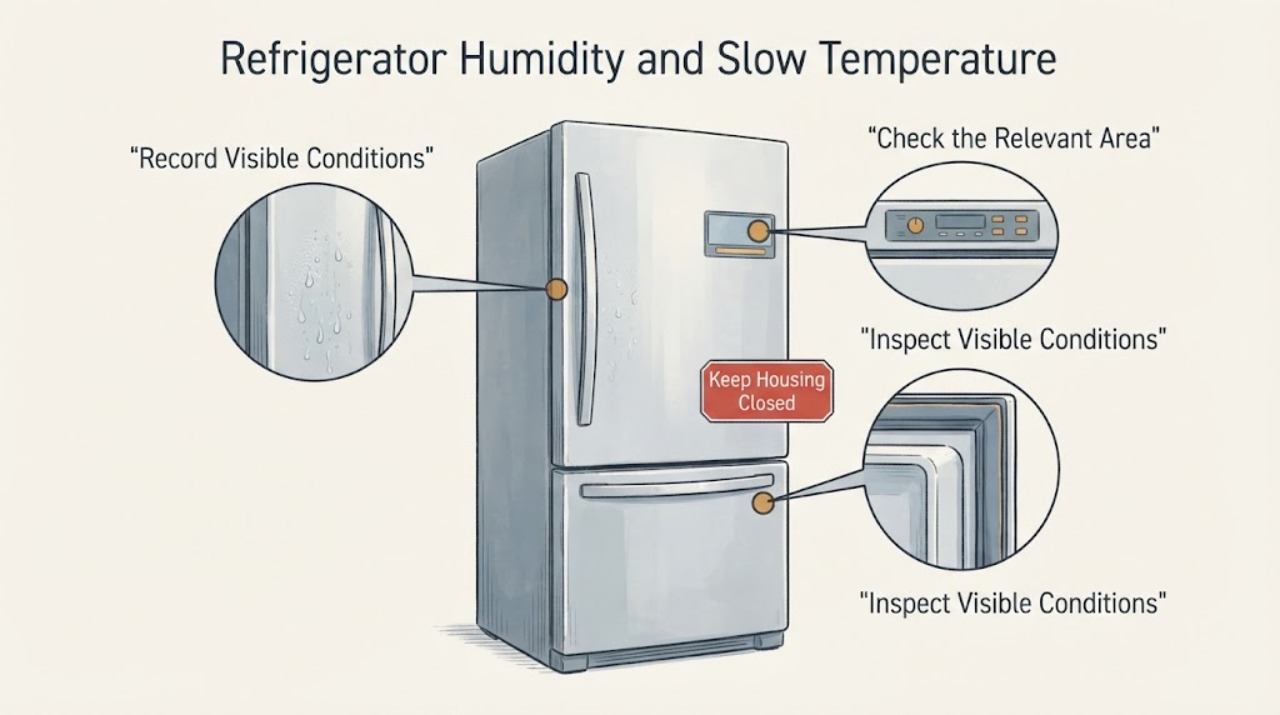
From the outside, look for condensation location, a wet drawer, moisture around the door, a door that rebounds, or a gasket that is visibly dirty, folded or not contacting the cabinet. Wipe the seal with clear water and dry it as Thermador directs; do not use soap on the seal or remove it.
Expected result: Moisture is limited to a produce drawer, or moisture is on shelves/food packaging/door edges and the seal or door closure is abnormal.
Next step: Adjust the documented drawer humidity setting or correct only an obvious external obstruction. If the door still fails to seal, protect food and arrange service; do not disassemble the built-in door or cabinet.
Why this matters
Why: Thermador identifies drawer condensation as dependent on produce and humidity settings, while a broader moisture pattern with a poor seal can allow humid room air into the cabinet. Neither observation proves a compressor, fan or refrigerant fault.
-
Check 4
With power and doors left undisturbed, look for food packages covering visible interior air outlets, an overloaded compartment, heavy frost blocking an opening, or a cabinet pushed against an installation clearance. Make only the external adjustments described by the exact manual.
Expected result: An outlet is blocked, the compartment is overfilled, heavy frost is visible, or no external obstruction is found.
Next step: Rearrange only movable food and follow the manual for any documented defrost or cooling mode. If frost returns, the temperature remains high or no external cause is found, stop escalating DIY checks and contact Thermador service.
Why this matters
Why: A blocked air path or overload can make temperature distribution and recovery uneven, but heavy frost or persistent warm readings require the model-specific service path rather than a guessed defrost part.
Use your observations
Decision map
Find the observation that best matches what you see, then follow the next safe action.
-
PATH 01Next step
What you see
Moisture is limited to a produce drawer and the refrigerator thermometer remains at the manual's target after the door stays closed.
Do this next
Wipe the drawer dry, use the documented fruit or vegetable humidity setting, and monitor the measured temperature. Escalate if moisture spreads beyond the drawer or cooling does not recover.
Why this path and its safety boundary
Why it matters: Thermador says condensation in a humidity-controlled drawer can depend on the type and quantity of produce and can be managed with the drawer humidity control.
-
PATH 02Next step
What you see
Moisture appears around the door or on packaging, the gasket does not contact evenly, the door is obstructed, or the complaint worsens after frequent openings in humid weather.
Do this next
Remove only an obvious obstruction, clean and dry the gasket with clear water, and keep the door closed while taking thermometer readings. Arrange service if the door or gasket still cannot seal.
Why this path and its safety boundary
Why it matters: Humid room air entering through a door that is not sealing or through repeated openings can explain condensation and additional cooling load, but it does not prove a failed seal until the external condition is corrected and observed.
-
PATH 03Next step
What you see
A thermometer remains above the exact manual's target after the door has stayed closed, or a temperature alarm appears despite no obvious loading, seal or airflow issue.
Do this next
Protect perishable food, record the readings and display settings, and contact Thermador or a qualified appliance technician. Do not open the sealed system, probe wiring or order a part from the symptom alone.
Why this path and its safety boundary
Why it matters: The refrigerator has a persistent cooling symptom, but the official general guidance does not select a compressor, evaporator fan, damper, sensor or refrigerant diagnosis for KBULT3671A02.
-
PATH 04Next step
What you see
There is water near electrical parts, a damaged cord, smoke, burning odor, arcing, a repeated breaker trip or a severe leak.
Do this next
Stop using the refrigerator, isolate power and water only when it is safe, keep clear of smoke or electrical hazards, and arrange qualified service. Do not remove built-in panels or repeatedly reset protection.
Why this path and its safety boundary
Why it matters: The issue has moved beyond a humidity or temperature observation and may involve electrical or property-safety risk.
Helpful context
Understand the symptom
Separate humid-air condensation from a cooling complaint
Thermador's refrigerator guidance says condensation can form in a humidity-controlled produce drawer depending on the type and quantity of food. Wipe visible drawer condensation dry and use the drawer's humidity control only as the owner's manual describes. Moisture on shelves, walls, food packaging or the floor of the cabinet is a different observation: record where it appears, whether the door closes fully and whether the measured temperature is actually rising.
Use the exact model controls and a thermometer
Thermador states that controls and features differ by model and directs owners to the matching manual. Record the full rating-label model, the displayed refrigerator and freezer settings, the time and temperature from a refrigerator thermometer, and whether the door alarm or a high-temperature alert appears. Do not infer a sensor, fan, compressor or refrigerant problem from a single warm reading or from the amount of moisture alone.
Check the outside of the cabinet and door seal
With the appliance in place and powered normally, confirm that the door closes without obstruction, the gasket contacts the cabinet around the full perimeter and food or containers are not blocking the door or visible air passages. Thermador's cleaning guidance says to wipe the door seal with clear water and dry it thoroughly; it also warns against letting cleaning water enter lights or the drainage opening. Do not remove panels or reach behind the built-in cabinet.
Treat recovery failure as a service decision, not a part diagnosis
If the measured temperature does not recover after the documented external checks, the official pages do not identify a particular fan, damper, compressor, sensor or refrigerant fault for this model. Save the temperature readings, door and room conditions, frost or water observations and any display warning for Thermador service. Food that has not stayed at a safe temperature should be handled according to local food-safety guidance.
When checks do not resolve it
Need a professional?
Contact Thermador or a qualified appliance technician if the measured temperature remains high after the exact manual's external checks, the door or gasket will not seal, frost repeatedly blocks airflow, an alarm persists, or there is water near electrics, smoke, burning odor, arcing or a repeated breaker trip.
Safety scope: Do not open the cabinet or sealed refrigeration system, probe live wiring, use sharp tools on frost, remove the gasket, repeatedly reset a tripping breaker or keep perishable food in a refrigerator whose measured temperature is not safe.
Have this ready
- Provide the complete rating-label model and revision, region, thermometer readings with times, display setpoints or alerts, door-opening and loading conditions, room humidity or weather context, location of condensation, seal observations, frost pattern and whether the cabinet is built in.
Common questions
FAQ
Is condensation during humid months automatically a failed refrigerator part?
No. Thermador says condensation in a humidity-controlled produce drawer can depend on the produce and humidity setting. Check where the moisture is, verify the door seal and measure the refrigerator before inferring a cooling fault.
How long should a Thermador KBULT3671A02 take to recover temperature?
The opened official pages do not publish a universal recovery time for this assigned model. Use the exact manual, a refrigerator thermometer and the door-closed pattern; persistent elevated readings need service rather than a guessed time threshold.
Can I remove the gasket or access the cooling parts to find the cause?
No. Thermador's cleaning guidance supports wiping the seal with clear water and drying it, but does not support removing a built-in door seal or opening refrigeration or electrical parts as a user check. Arrange model-specific service for a persistent seal or cooling problem.
Read the exact guide
Official sources
- How to Clean Your Refrigerator or FreezerThermador · Opened Thermador's official cleaning page. It supports switching off before interior cleaning, drying the interior and wiping the door seal with clear water, while warning against water entering lights or the drainage opening.
- Refrigerator FeaturesThermador · Opened Thermador's official refrigerator features page. It says features vary by model, describes drawer humidity control and condensation, and describes model-dependent Super Cooling. It is used for family-level external guidance, not an exact KBULT3671A02 diagnosis.
- Refrigeration - Troubleshooting GuideThermador · Opened Thermador's official refrigerator troubleshooting page. It covers power, model-manual lookup, food/odor care and temperature-related refrigerator support without identifying an internal cooling part for the assigned model.
- How to Use the Controls & SettingsThermador · Opened Thermador's official controls page. It says built-in refrigeration settings differ by model and directs owners to the matching manual; it is used to avoid inventing a universal recovery time or button sequence.
- Refrigeration - Usage & Appliance FeaturesThermador · Opened Thermador's official appliance-features overview. It states that controls and refrigerator features vary by model and lists humidity control and other features without asserting that every model has them.
Community feedback
Share a repair observation
Share a plain-text repair observation. Accepted observations are published automatically; this page may take a moment to update.